Thursday, 11 September 2014

The Spa Tour of Bath: an advert for privatisation

The Spa tour of Bath is in competition Bath's The City Trail for being the most neglected tour of the city. It is an audio tour that can be found tucked away in a corner of the petite and distinctly sleepy Spa Visitor Centre. 


It is available in English, French, German, Japanese, Spanish & Dutch and considerable effort has clearly been put into producing it. This effort has not translated into visitor numbers. When I asked the assistant at the desk when was the last time someone took the tour, she thought about it then replied, "last Summer." She did qualify this by saying she doesn't work every day and it's possible someone took it on one of her days off, but she seemed to suggest that even this was unlikely. That's one person taking this tour per year. I find that an impressive statistic! I was that person for 2014. 


The way it works is simple enough: you take one of the crisp and clean (i.e. unused) maps, select the language on the handset, punch in the number on the map and it tells you about the location you are standing in.


The audio commentary was a jovial and camped up affair, much like a BBC radio adaptation of Dickens. Popping out of this were short interviews with people who had memories of working in the spa. As I was listening to this I also browsed the walls and came across some rather interesting things.  


Obediently following the audio guide and map, I dragged myself from point to point in the streets around the visitor centre. This was a history focussed commentary that was about how and when the baths were first constructed and then used. The two mental pictures that it left with me are of people bathing in canvas costumes with weights attached to protect their modesty, and the Bath rugby club celebrating in there after matches. The second mental image is derived from a LP I have in my collection with this delightful cover.


Volume 1 is not much better, but that's another story.


With the rugby songs nagging away in my head, I made the circuit which took me around the back of the new Thermae Bath Spa. The commentary seemed to be designed to tell the story of how much better the new spa is and how obsolete the old one was. Seeing as the tour was, I'm guessing, commissioned by or at very least, made in collaboration with the new spa owners, it is not surprising that it was talking up the swanky new spa. The audio tour ended with a nicely cheesy plug that went along the lines of, "you've immersed yourself in the history, now why not immerse yourself in the water?"


Back in the visitor centre I looked more closely and read that the spa used to offer treatment on the NHS. The closure of the public swimming pool on this site was also mentioned and I started to wonder if the subtext of this tour was the privatisation of public utilities. It certainly read that way to me. Given that this somewhat preceded the Thatcher government's public services closing-down-sale and that there's a 20-year time lapse between the closure of the public spa and its reopening as a private spa, it is unlikely to be a cynical privatisation in which those managing the premises orchestrated its sale for personal profit, yet, the effect is the same: it is now private. The true story of how and why it happened is probably rather complicated and I only stumbled upon a few shreds of PR dressed up as a tour. When I come to talk about this on my Tour of All Tours in October this puts me in a position of knowing little and that is something that can have its uses. I think I should like to ask the people taking the tour to share their various takes on this old story of why the city has moved from having public spa and bathing facilities in the historic buildings, to these being privately owned and managed.  
  

And here are the prices for using it now. Not cheap!


That said, it does look rather special. There is even an open air swimming pool on the top of the building, as the audio tour was keen to stress, which has views over the whole city and surrounding hills. This, I suppose, is the closest I will get to seeing it.
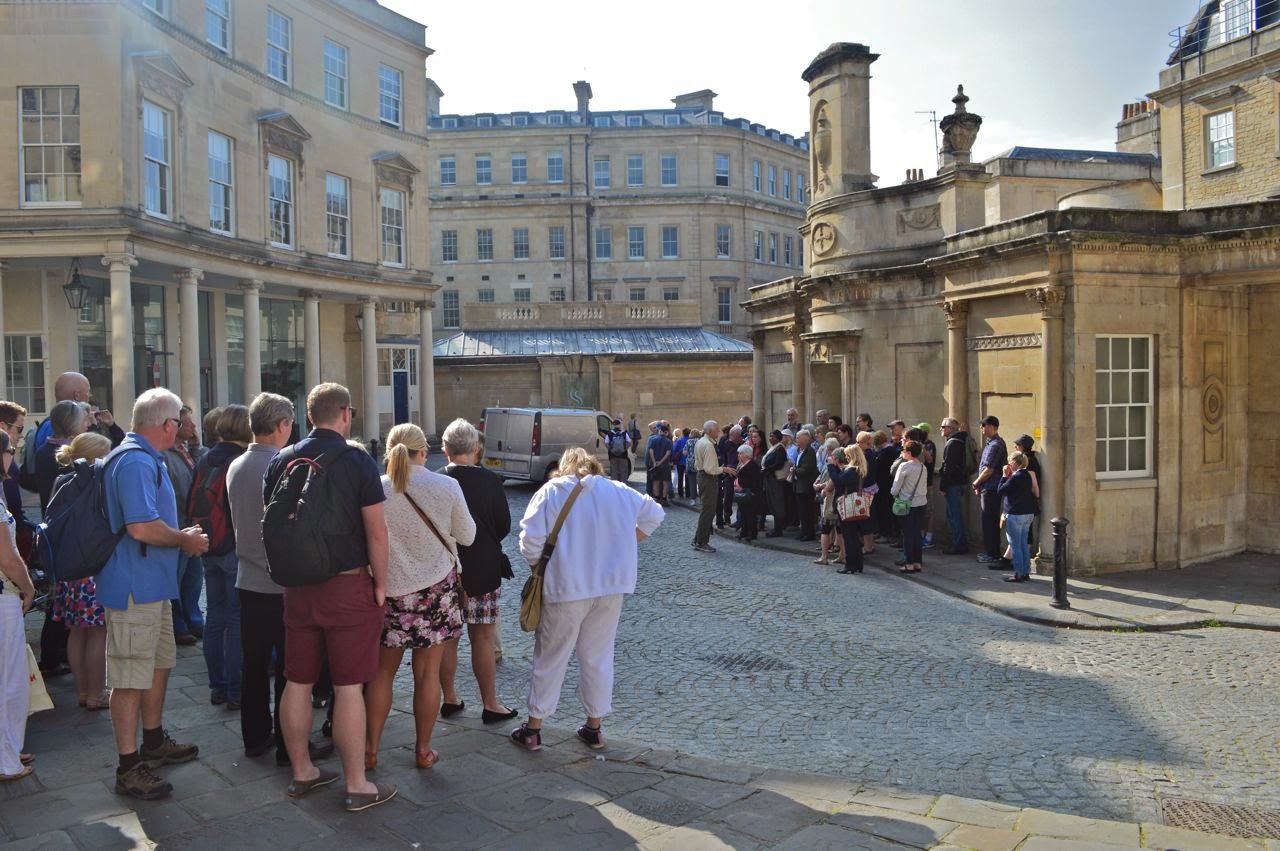

When I was about to go, tour groups descended en masse. I must have hit prime time for the guided tours as no less than three groups all clustered around the baths within the space of five minutes. It is rare to see quite such a gathering here, the city's sites are diverse enough to usually spread the groups, but 11.30 AM is hot. 


I noticed this group who looked unfamiliar and, from the name badges I was able to determine they are with APT Touring and their trip is most likely the 21-day UK and Ireland tour that costs £5615. That's pretty expensive and they offer a more pricey 35-day trip with a European cruise added on for £9650. No wonder they were mostly older with time and money to burn. The guide had a little microphone, the type I sometimes use, and after having given a test Tour of Tours on Tuesday, I see I will need it. Some of the streets in Bath are really loud.


Chance would have it that, on my way back to my accommodation, I passed the new public swimming pool and sports facility housed in the 1970s civic leisure centre. It's not quite the same thing as the historic baths. I look forward to the conversations that come out of this part of tour.

Monday, 8 September 2014

The Jurassic Electric Tour

Jurassic Electric is not a Steven Spielberg 3D holographic experience, it's a down to earth little company running guided tours on electric bikes around West Dorset. They are one of the very few with guides who take people to Littlebredy, the geographic focus of my upcoming Tour of All Tours for Inside Out Dorset Festival, so they were of obvious interest. The rest of the group was there for the birthday ride of this chap in blue leisure wear, the sun was shining and they were in good spirits.


The tour began with us assembling on a green and Martin our guide in the day-glo green T-shirt getting everyone sorted out with a bike adjusted to their size. We had a short explanation of the bikes and a test ride to get used to them. Although this looked like a formality I heard that it had happened that a woman turned up who was incapable of riding a bike (despite saying she could in advance) and had to end her day at this point as she would have been a serious liability. Harsh though that must have felt at the time, it was correct and I felt there was an eye for safety on the tour that was reassuring without being overbearing.


This is what makes the difference: the battery and motor tucked below the seat. We were told that there would be no problem of the battery running out over the distance of our tour, they are strong and, apparently, if used sparingly can be strung out over a full day's ride very effectively. I was making no such economising and wanted to see just what this baby could do. The hills out of Portesham gave ample opportunity to do this. 


Here is the group making a short stop to hear about a historical building. Usually on a bike I tend to resent making stops like this as the momentum, particularly in hills, pulls me ever forward. On these bikes however, starting and stopping on slopes was a doddle so they work very well for the rhythm of guiding a group of people which inevitably entails making occasional stops to regroup and to explain things.


We made a proper stop at a local vineyard where we were shown around and when the proprietor brought out a bottle of his red and white for us to sample we didn't need any convincing. I haven't tried a great deal of British wine and that which I have had has usually been homemade gut rot rather than the produce of commercial vineyards. My expectations were therefore pretty low. The wine was however, really a great deal better than I expected, I would have happily drunk another glass rather than looking for a plant pot to discretely pour it into. There was even the idea being put around the group of buying a bottle to drink immediately as a birthday toast. Wiser heads prevailed. Stopping at an interesting local business was a nice addition to the tour, it made it about more than just the cycling, we got to meet people, see a new place and hear about making wine in this part of the world. I'm quite sure this will lead to future customers for the vineyard so it really worked well on both sides. 


There were some great views from the spots by the side of the road we stopped at. Maiden Castle, the series of brown horizontal lines in the mid-distance, was pointed out to us with a brief explanation of its role as a iron age hill fort. The sceptics amongst us asked how can you have a fort with no real walls, just banks of earth and ditches. Maybe it's no great surprise the Romans managed to take it... It is a beautiful place nonetheless and worth a visit in its own right. With this tour however there was no time for that, or for further historical speculation, we were back on the saddle again with a hill to climb. 


On our way up that hill we passed a person lying flat on the grass beside the road with a bike lying on the grass behind her. Asking if he or she was OK (it wasn't easy to tell from when flat out), there was some stirring and eventually this older lady propped herself up and said she had just cycled up Hardy's Monument and the last time she'd been up on a bike  she was 17. She was recovering from the ordeal which was a lot tougher than she'd imagined. She had just bought a new road bike and was trying it out, she explained to us. When we suggested she might like to try an electric bike she scoffed at the very thought of it but looking at how wasted she was from the ascent I seriously think she would have benefitted from one. Actually, she was probably the best advert for the bikes that I could have imagined.


Now it was our turn to fight our way up the hill. It is not like riding an electric scooter that does all the work for you, we really do have to pedal. Having come up this same slop before on a section of the Tour de Manche with a bike loaded with kit I know precisely how much effort it requires and this was about half that. Some call it cheating but I daresay some people call cycling cheating and prefer to walk instead.


Excited to have made it up to the top, we pulled the bikes around the fence and, unlike the lady crashed out at the side of the road, we were all standing, smiling and even able to speak.


The view from Hardy's monument is terrific. It's a place that I could spend hours gazing out from on a good day like this. The last time I was up here was during a storm in February to do a geology tour when it was almost impossible to stand upright so powerful was the wind. It's difficult to reconcile the place in two such different states.


Descending from on high was easy, we rolled down Portesham Hill in no time at all, returned the bikes and headed over to the pub for a well earned pint. It was a friendly group who were most accommodating of a stranger like me. I left them deliberating over the steak or seafood linguine as I had to return to my hotel before sunset when by bike turned into a pumpkin. That, unfortunately, meant cycling back up the same hill I had not an hour previously flown down with such ease. It may be that the electric bikes create their own sense of necessity for I was expecting it to be a steely ordeal but, it finally turned out to be  basically OK. I am a regular cyclist and have a decent bike so am probably not the target public for Jurassic Electric as I am able to make my way up and down these steep Dorset Hills under my own steam. That said, the stops en route and the possibility of being in a mixed group with people like me and people less accustomed to such efforts does bring something of value. The proprietor of the hotel I was staying at told me about two couples who visited for a cycling holiday last year; the two guys were keen cyclists their girlfriends enthusiastic but less seasoned. After two days on the hills the bikes were ditched and it became a walking holiday instead...


I also rather liked the general atmosphere of the bike tour too; Martin and his partner who accompanied us, were clearly enjoying showing people around a part of the world they loved. When you have a guide who is in their element you usually see them at their best and, what they decide to show you also has greater weight as well. What's more, I can now see the point in electric bikes in a way I never did before. While I am unlikely to rush out and buy one for a good while yet, I have made a mental note to add one to my 70th birthday wish list. If, God forbid, I am still around and haven't been put away by then, I rather like the idea of wizzing about like a teenage-pensioner over hill and dale.

Sunday, 7 September 2014

The Bath City Trail

I realised today that I have been walking over a tourist route these last few days that I hadn't even noticed. I'm probably in company with pretty most of the people in the city centre as The City Trail is anything but noticeable.


Upon emerging from the Tourist Information with some leaflets on further tours, such as The Tour of Britain coming to Bath very soon, I looked down and by chance spotted this plaque below.


Each of these brass plaques, sunk into the pavement, has a quote about Bath from a British writer or notable figure of the past. What they have to say is rarely interesting or important, all that matters is that Dr Samuel Johnson said something about Bath.


Unexpectedly then, I was off once more on a tour, excited to see where it would lead me. I somehow managed to miss plaque 2 and passed directly to 3. The arrow seemed to be pointing in the right direction. When I thought about it further, the work involved in laying out this trail is not simple at all and there is scope for error both in the design of the plaques and in their installation too.


The arrow gives you the direction of the next plaque but not the location. It could be 10 metres away it could be 10 kilometres, there is no way of telling. This made the game more interesting as it introduced an element of uncertainty that kept the eye busy. In practice the distances were never that great but they were certainly not uniform either.


The route was also designed to make it easy, as far as possible, by avoiding obstacles in the path from one point to another. It would have been possible to have made two points on either side of a building, so that you would either have to walk through the building or else walk around it, thus going off the line of the arrow in order to return to it. I would have rather liked it more if they would have done this as that would have brought the intervening structures and spaces more fully into the frame of the trail. 


Thinking about that further, such a trail cutting straight lines through space is somewhat reminiscent of the colonial divisions of newly acquired territories. When conquering powers had a duty of administering land over which they had little familiarity, the line was the abstract and arbitrary method of delineating one area from another. It is precisely this possibility of making a line that passes through someone's house and then turning that line into a meaningful border that displays both power and insensitivity. The line can be a potent thing. These lines, however, were not.


As I fell into a rhythm moving from plaque to plaque, I started to think of the work of the Boyle Family too. Some of their works present pavements as wall mounted artworks and I remember how these had the wonderful effect of reawakening the senses to the complex compositions under the feet. The least loved of the directions of looking, down is where these abstract social sculptures abound.  


As I was fully expecting, there were locations where the trail met unforeseen obstacles. The arrow pointed in the direction of this construction site and at the far end of it no plaque was to be found. With the pavement claimed and closed off, I had to assume the plaque was there but I could not be sure, which made it far more interesting.   


I found my way back on the trail again easily enough as it passed through the tourist attractions. I only had to pause and think, what is the most obvious place to walk to next, go there, search for the plaque and there it was.


The trail made me think of the trail of plaques put up by The Museum of London along the length of London Wall. I really should write that up as a tour sometime since I have taken it and it was a really worthwhile stroll. It was enjoyable partly because of its limitations and neglect: the Roman wall has been largely destroyed and exists only in fragments. The contemporary plaques have also fallen into neglect making it a trail of double neglect. Following such a tenuous route became a challenge.


This plaque struck me as a sad one. The designer must have run out of quotes to add so it remained blank with just a number and an arrow in its centre.


After a while the distances between the plaques enlarged and it became increasingly difficult to find them. What also happened is that my eye became more attuned to looking for them. I spotted, for instance, the plaque on the far side of this crossing.


I here realised that there was another quoteless plaque and that the previous ones had attempted to make the quotes relevant for the locations they were sited in. That must mean that there was nothing much to say about Queen Square, which was sad in itself too. Surely, even staying within the frame of the work, it would have been possible to find enough specific quotes for the locations that had them and keep enough generic Bath quotes to spread around the rest. But no, the trail became a simple game of directing the walker from point to point. To be honest I didn't miss the quotes that much as they added little and were written in a circle that makes you have to stand above them, twist your head, turn around and even stoop down to read more closely when there is an interior line of text with a smaller font size.   


Thank God for number 14, then. and a return of words! My impressively practical though less than beautiful shoes, by the way, are for a skyline walk tomorrow which I was instructed to come suitably attired for.


I found this plaque a curious one as it was quite different to the others. It was on the right direction, more or less, but it seemed to not belong to the series. It had no number in the middle and was embedded in a newer concrete slab which was itself framed by tarmac. I suspect that this may have been a later addition but I could not say for sure. If it were a newer addition it makes me ask, is the trail still maintained or was there a year when it ceased to be?


The trail seemed to fall apart all together at this point so I took a picture of a water cover instead, as it was in the area the plaque should have been. That's when it struck me just how invisible these plaques are. With a little bit of weathering they fade into invisibility and become a variant of the utilities cover.


By the time I got to 18 my will to pursue this City Trail was failing. I started to wonder if anyone had really bothered to come this far before, except for the people specifically invited when the trail was first set in place. I suspect there may be a handful, but this really is one of those public art projects that must have seemed like a good idea at the time but which is now near forgotten.


At the circus I felt sorry for the designer of this trail as he or she had an obvious problem to contend with: how to point with a straight line around a circular space? Their solution, pointing towards where this woman is coming from, was not a good one but then again this was always going to be a challenge. Following the arrow on its word would have led me into the building behind her so I instead interpreted it to mean, follow the circular path of the pavement.


This I did and I failed to find another trail plaque so settled for this gas cover. With that I concluded the City Trail.


Stepping back to Tourist Central I noticed this woman posing for the camera. Following up on an observation I made on the Pingyao Tour about there being a very interesting range of culturally specific poses that tourists pull when getting their picture taken, this was a new one for me. I cannot locate this body gesture at all. It looks very deliberate, like it might be part of a traditional dance or a pose common to statues, yet there is always the possibility that it's a more personal mannerism.  


The tables were soon turned and she was in the camera crew taking pictures of the monks. There's something funny about monks doing typical tourist things, you somehow imagine they would be above that. 


On a similar note, I saw this picture of Obama in Stonehenge this morning, he visited it after the NATO summit in Newport, which itself is also slightly mismatched. This opens up the question of appropriate and inappropriate costume for tourists which narrows down to casual and smart casual in the UK. Going round the Roman Baths dressed as a soldier, a nurse, a cleaner or a homeless person would not look at all right. A businessmen in a suit mixing work with leisure is somewhat acceptable but even that looks like it belongs more to the 1970s than to today. Practical solution: remove the tie and jacket.

Saturday, 6 September 2014

The Carriage Tour of Bath: 30 minutes of horse drawn escapism

Always on the lookout for new types of tour, and sometimes finding them, here is another first for The Tour of All Tours: a horse drawn carriage tour. The hook to this one is that it helps you imagine Georgian Bath from the point of view of a noble, since this was a place where persons of quality were transported in precisely this way. Seeing as quite a number of the city's attractions and tours are about helping you imagine you are in the city's 18th Century hey day, how does this one fair?


This picture is about as dumb as the picture of me sitting behind the wheel of a Porsche in Stuttgart. I love these readymade tourist shots taken by other tourists! With just me inside, the carriage set off at a genteel pace, only a little quicker than a fast walk. It picked up every tiny imperfection and pot hole in the road so, creeping slowly along at this modest speed felt like the wisest thing to do. In any case, I was not going anywhere in particular, this was a promenade: it was as much about being seen as it was about seeing the city.


One of the first things that struck me when I was being led around was the smell of the horses. I found this incredibly evocative, most probably because I am so rarely in contact with these animals. To be pulled by another living creature, or creatures, is an entirely different feeling to driving a car or being driven. The horses have their moods and rhythms quite different to ours.


Of all the tours I have taken, I would compare this one most to the River Avon Cruise. Not only is it is also based in Bath, indeed their paths cross at Pulteney Bridge, but it is also a tour where the main attraction is the mode of transport. Where they differ is the cruise offered some commentary on the return leg whereas this carriage tour had no commentary at all. You could call it a one trick pony... but it was a good trick. A guide would have interfered in the experience. 


Although the carriage is a sophisticated form of transport, and they do their best to keep you in the historical tourist bubble, you are still in a real city: we passed the fish and chip shop. This makes me immediately imagine inappropriate vehicle tours: a tour of Glasgow's council housing estates in a Rolls Royce, a tour of a monastery's grounds in a beer laden pedibus or a tour of flower gardens in a tank. 


The rain started really lashing it down and it was at this moment I felt glad to be the only passenger. Sitting by the sides it would have been easy to get soaked in a shower like this, and that would be most unfitting...


The carriage gets a great deal of attention; even more than an expensive car it turns heads. Lounging in the back all by myself it was easy to start feeling like a VIP. I was surprised at just how effectively this works: cars or boats don't do this nearly as well, but a horse drawn carriage plays to the inner aristocrat that lurks inside of us supremely well. Yes, it helped a great deal to be the only passenger due to the awful weather; I should imagine the benefit that the carriage confers could be divided by the number of passengers.


There comes the crashing realisation after a short while, however, that the people in the street are not turning to look at you, they are looking at the carriage. And not only do they look, some of the dedicated tourists take pictures too. If I am destined to appear in the holiday snaps and videos of those taking The Chinese Bus Tour, then that is only justice, I suppose, seeing as I have featured some of them on this blog previously.


The duration was just about perfect: it was a thirty five minute circular tour. Any longer and it would have become ever so slightly ordinary. Whilst I can't see myself investing in a horse drawn carriage of my own any time soon, or more to the point, ever, this is the next best thing. I can imagine taking a carriage tour in another city on the strength of this tour of Bath, though I suppose it is not everywhere that such a ride exists. I suppose, following this line of tours, next I'll have to take a camel ride in the desert and a husky sled through the snow. Those are both attractive for their novelty value but I think I'd still take the horse carriage, it's just that bit more sophisticated.