Showing posts with label audio. Show all posts

Saturday, 16 April 2016

The BBC's REAL Shanghai Tour: the dwindling currency of authenticity


The REAL Shanghai is an audio-tour that can be downloaded for free from the BBC. When I was in Taipei recently, I had an interesting conversation about the theme of authenticity and the tourist's experience. I was thinking back to those words as I walked from the metro station to the start point of the audio tour and passed all manner of 'REAL' sites such as these improvised panel walls. I was wondering if the idea of the real city, that the BBC were about to present to me, was going to be any more real than what I was already looking at. 


After an upbeat jazz intro, the tour began uncertainly. According to the map, the cream coloured building on the right was the start point. I listened to the narrator talk about the history and architecture of Broadway Mansions and he said it was an impressive art deco building with commanding view. Yes... a view of a minor road bridge. While it is OK, I couldn't see why he thought it was so very special.   


It turned out that it was marked incorrectly on the map, really quite far off at that. Not only was number 1 quite some distance off, as a result of mistaking waterways, but numbers 4 and 6 were also a little imprecise. It is surprising that this managed to happen and never got corrected. BBC what is going on?


All this would not have been such an issue if it were not for the fact I was walking at a snail's pace. I had woken up in the morning with an intense pain at the top of my right leg. It was as if I had been attacked in my dream and had badly pulled a muscle defending myself. I tried to soldier through the pain but increasingly wondered whether I should I seek medical attention, massage, acupuncture, or something altogether more esoteric. I was getting slower and slower: just lifting this dead lump of a leg and placing it in front of me became a great effort and climbing up or down steps was positively painful. 


I was struck by how inappropriate this dolphin topiary was seeing as how The Yangtze River, which Shanghai sits at the delta of, was until ten years ago the unique habitat of a now extinct species of dolphin. These leafy creatures jumping out of the bushes are not some sort of memorial to the Baiji, these are stereotypical cute dolphins. Memorials tend to be created to benefit someone or something in the present and driving the Baiji to extinction is probably something that there is more desire to forget than remember. By a complete coincidence, when I got home and looked at this picture, I realised that standing in the background is the missing wayward point 1 of the tour, the REAL Broadway Mansions! Completing a tour is, in a way, a similar pleasure to finishing a jigsaw so I was happy to see I had in fact, inadvertently, covered the 9 points of this tour.


Moving onto The Bund, I then ducked into this park, the site of the former British Consulate.  Stepping into this park I got the same immediate sense of discomfort I get when I am in  places like Whitehall. The British ruling class and their bureaucratic representatives have generally felt more like adversaries than friends to me. I took a picture, turned around and immediately walked away. I wanted nothing to do with them, not even with their memory.


Hobbling down the road as quickly as I could, I spotted this interesting poster. The meaning of it, if I understand correctly, is that you should only trust officially registered guides working for reputable companies and should avoid the unregistered people who offer you tours on the spot. Having been on a number of rather typical Chinese tours given by registered guides, I have the feeling the official ones are not necessarily any better than the private ones. They almost inevitably drag you into 'consumption traps' as part of the tour.


Next stop was the promenade with a view of the iconic architecture. Maybe this is the REAL Shanghai in the sense that it is the image of the city that has come to represent it. The problem with it, however, is that these towers are unrepresentative. There are still a majority of poorer and middling neighbourhoods. This is very much the image the city wants to project rather than what the city generally is. Another thing worth mentioning is that this sort of picture is usually 'fixed' today using photoshop to adjust the keystone, as it has been below. While the first is what the camera actually saw, the second is probably closer to how we picture it. The more closely I search for reality, the more I start to realise it can be constituted in very different ways. 


Next came a proper dark tourism site, the scene of the New Year's Eve 2014 stampede in which 36 people died. As far as I could see there was no memorial left behind. These deaths were, like the Baiji, embarrassing to those who control the space and thus not selected for remembering. There is indeed little official embrace of dark tourism in China, the only real exception being the Nanjing Massacre Memorial. The country has a disturbing history of stampedes including the world's most deadly ever (Chongqing 1941) and a string of recent ones too. It is no surprise that city officials are sensitive about this issue and from what I could see, crowd control has been stepped up and has become a far greater concern. Of course, none of this was on the BBC audio track which simply told us how the building in the background was a masterpiece which Charlie Chaplin once stayed in.
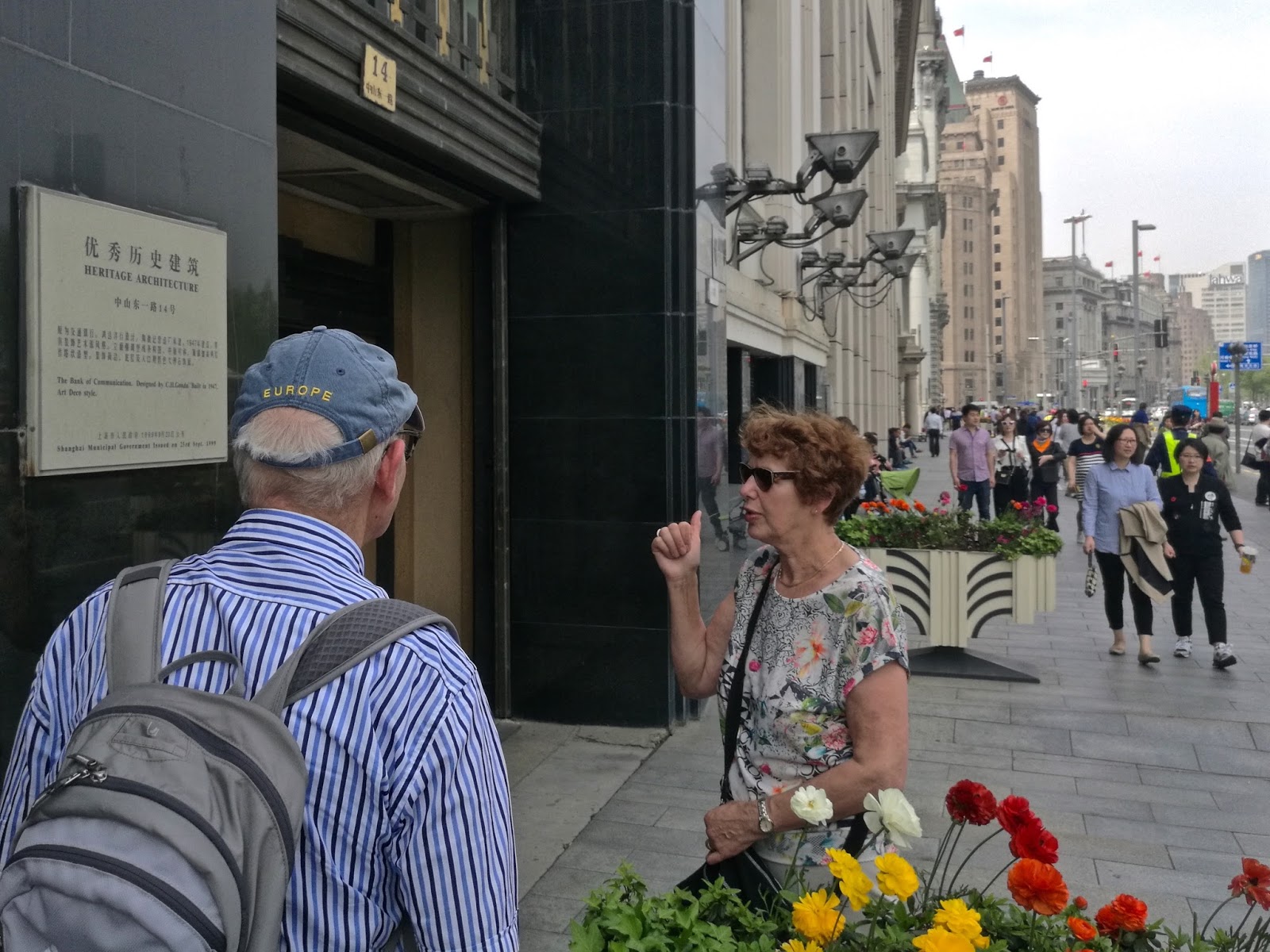

Moving down The Bund the narration settled into describing the banks that line this former colonial drag. The narrator was rather lazy in how he arranged it; he only had two or three sentences to say about each building so he strung these together and told me to look out for these various banks as I made my way to next point.


This tour was essentially one of the Western-styled architecture that can be found on The Bund, which struck me as a rather self-congratulatory sort of tour for the BBC to offer. One way in which authenticity can be understood is that something is original and not a copy of something else. Viewed in those terms, these buildings can be seen as being about as fake as Shanghai Disneyland, which recently opened to feed kitsch to a new generation of China's youth. It is possible that The Bund gains some aura of authenticity with age, namely, the period these buildings were put up in was a unique time in the city's life. But, what I think he was really cracking away at was an idea of this being REAL because it falls into a narrative of Shanghai being a city that always looks to the future. If that is the case then the older neighbourhoods don't have much hope of making it to 2050 and the city is nothing but an oversized sponge for whatever is trendy. I think there is more going on here than just that. The BBC has a big reputation but a tour is only as good as the guide who designs it and this one was so flimsy that one cough would blow it away. Reality is a fragile thing indeed.

Monday, 9 February 2015

The And While London Burns I Shivered Tour

Last week I attended a talk by Graeme Miller who was speaking about Linked, his audio walk in East London, and much thought was given to how the work had aged and how it might best be preserved, or indeed whether it ought to be allowed to quietly grow obsolete. I will cover Linked another time, but that discussion made me aware there that there was another audio tour, And While London Burns, which had also been around for a while gathering dust and which I had not got round to taking yet. So, one grimly cold afternoon in early February, I downloaded it onto my phone and, following the instructions, looked for a Starbucks next to Bank tube station.


I quickly realised that the Starbucks I was looking for had moved on to pastures greener and more lucrative in city workers in search of over-priced coffee and wifi, and the gloomy underground mini-mall I found myself in had now been colonising by a Weatherspoons pub and a decidedly mediocre looking noodle bar. The ironically named Green Man is most probably a reference to a historical pub that stood on this blighted spot 500 years ago and leant its name to this contemporary outfit offering it a fig leaf of respectability. I pressed play, the tour got going, and the main protagonist talked confessionally about being over-worked and infertile while a narrator gave facts and figures about ecology and banking. So far so good.


My first impression was that this audio tour had very high production values; this was not the work of one man and his dictaphone, this was like the BBC on a good day. The other thing that became quickly clear was I needed to keep up. This was an immersive audio tour which demanded I walk with it: when the narrator said "walk forwards" I had to walk forwards for the tour to make sense. My movements were being choreographed and I only had as long to look at a scene as had been allotted me in the recording. The pace was upbeat and did not allow for dawdling or reflection. I also quickly noticed that the directions that were  being given were neither obvious nor clear. For example, I was told to go up an escalator opposite an opticians. I headed for an escalator opposite a Boots, which turned out to be a Boots chemist with an opticians inside. Anyone trying to speak plainly and give directions in the UK would say take the escalator opposite the Boots (a popular store in the Britain) but this tour avoided saying their name and offering their brand 'the oxygen of publicity'. This set the tour off an a conspicuously anti-capitalist footing. All the while I was thinking about this and following the instructions, I was peering at the dirty hand marks on the pillar and wondering how and why they had come about.


I then got settled into the tour which combined the story of a city worker whose girlfriend had left him to live off-grid, with an explanation of the relationship of finance to ecology in The City of London with operatic voices, instructions of where to walk, a music score and sound effects thrown in for good measure. It was a dense sonic package. With so many elements it could have easily descended into a chaotic soup but, for the most part, it was scored sparingly and logically so it was easy enough to follow. The main actor's delivery was a little over-wrought for my liking, which is a way of saying I didn't quite see why he was talking so candidly to me. What's more, I came over time to view him as being there mainly in order to serve the purposes of the audio tour, that's to say in order to give it a human point of entry and avoid it becoming too much facts, figures and politics.


Most of the directions were given by a cooler-headed female narrator who told me to cross the road. Probably because the traffic island that I was meant to cross at no longer existed, I was too focussed on where I was meant to walk and didn't notice the approaching cars until the last moment and had to scramble to the other side of the road to avoid being flattened. I then went in search of the Roman excavation The Temple of Mithras but found instead a Bloomberg construction site where this ancient temple once sat. 


The City of London can have an elemental beauty to it and this came out when being led around Bank underground station. A driving musical crescendo accompanied by intonations on global warming and the rising sea level transformed the glum corridors into something far more than themselves and concluded with a scene that could have been choreographed: a businessman raised up on a platform in front of me, standing in profile, talking animatedly into his phone, flanked on either side by a silver dragon. A captain of industry if ever there was one. 


As I was listening to the voices telling me to walk, turn, stop and push the button on the traffic lights, it struck me that in the eight years since And While London Burns was produced, there has been a more thorough penetration of navigational software into cars. Robotic Jill was already around back then telling you to turn right in 100 meters, but these Tom Tom style devices have since become the norm in the car when travelling unfamiliar routes. They are not infallible and I've seen some people treat them more as suggestions than instructions but, one way or another, they have worked their way into the car and by extension, the imagination. As something of a non-driver and someone who enjoys getting pleasantly lost now and then, I realised my first instinct on hearing these directions wasn't to simply follow then but rather, it was to think about them, to visualise them and decide whether I should go along with them or not.


The Nat West Tower swung into view and the story moved onto natural resources. I remember there was quite a lot of information about oil and banking which amounted to 'they're in it together'. It was the stuff of George Monbiot articles and as such, not unfamiliar. The result was I became a little too over-aware of the intentions of the piece. I felt it had been conceived to educate me and change my behaviour. It desperately wanted me to see the light, go green and save the planet. When this unambiguous message was combined with voices telling me to turn left, walk forwards, stop at the traffic lights and look up at the sky, I felt an opposite push from inside of me reasserting the integrity of my own experience and reflections. I guess I just cannot bear propaganda, even when it is for a cause I am sympathetic towards.


I was led down the exact same obscure passageway that I myself use in my London Tour of All Tours. This got me wondering whether there was an aesthetic dimension to this use of space, namely that artists are attracted to this passageway as it is disorienting and offers a fresh eye on The City. Knowing that this tour passes this way I shall, I suppose, have to weave it into my Tour of All Tours and find a space for it in my narrative immediately after the Occupy Tour and Critical Mass tour. I have a dilemma however, as most the tours I mention in this area are already of an anti-capitalist variety and I could really do with a pro-business tour in order to balance my treatment of The City, instead of ladling out more of this stuff.    


I was then led directly below the old Nat West Tower or, as it is prosaically known today, Tower 42. One of the voices said, 'it is windy' and it certainly was. By this time I was starting to feel the cold biting; a chill wind was sweeping around the tall buildings making this lonely walkway seem all the more desolate. The tour's theme of global warming could not have felt more distant at this moment; I was more concerned about how much longer this walk would take and where I would go to warm up afterwards. This was not climate change denial, it was the simple tendency to concentrate on what's immediate: while London was burning I was shivering.


While I had already had my doubts that I was walking in the right direction, there came a point a little later when it became patently clear things were not going according to plan. I was meant to be circling a building that I could not locate and, choosing this block instead, I came  to an impasse. I had been warned that this would happen by a friend and lecturer Theron Schmidt, who had produced an up to date annotated map indicating the correct route which detailed some of the changes in the buildings' usage. I didn't come armed with it, however, as I felt the way The City might have other plans for me is just as much a part of the tour as following the instructions to the letter. I therefore wandered back and forth looking for the restaurant that the anguished protagonist was talking about and listened to him and his girlfriend talking about getting out of The City. 


There was a moment when I was asked to stand next to a tree and to look up at its branches towards the sky. It was far too cold to relax into a hippie moment like that: I looked, I saw, I waited a moment, I moved on.


Spinning away from The Gherkin I must have got the directions confused and took a wrong route down to The Thames. Whether that was my fault for not listening closely enough, the recording's fault for not being clear or nobody's fault and simply the result of the architecture and street layout having changed, I couldn't say. However it happened, I was now walking down one street and listening to the description of another. The tour didn't really suffer as a result of this, if anything it gave it an added layer of interest as I imagined myself walking a few hundred metres along a parallel lane. This gave me the opportunity to observe that whilst the street directions were specific such as cross over the road at the Costa, the content was far less wedded to it and for the most part could work anywhere in The City.


I was instructed to enter The Monument, which I spied in the distance, so I trotted over to it in haste to make up for lost time. I was then told I'd have to pay the two pound entry ticket. In the eight years since And While London Burns was made the entry price of The Monument has doubled to four pounds. Now call me stingy if you will, but I was already having decidedly mixed feelings about the audio tour and to then support this London tourist attraction's hyper-inflation by paying four pounds to walk up the insides of this tower was more than I really cared to do. OK so I missed out on the panoramic view but I was quite able to imagine it and besides, I was curious about life on street level.


I instead stood at the foot of The Monument to the fire of London and here the reasoning behind the name And While London Burns became very clear. The Monument was a confident mark of rebuilding the city after the devastation of the fire and we, faced with our contemporary crisis of climate change, could take bold action, tackle the problem and shape a new future too. As I imagined myself ascending the steps to the top of The Monument the narration stopped and gave way to a Philip Glass style musical crescendo. This was where the work was really meant to pack its punch and finish leaving the listener exhilarated on high. I instead watched the construction workers from the building site next door taking a break, one of their number feeding the pigeons. This simple act, unexpected from a man in a bright orange suit, had a beauty of its own. I enjoyed watching it because it was intimate, caring and ever so slightly ridiculous. In contrast to the voices from the tour, who seemed like puppets for the cause, this was a completely unscripted, unnecessary action, the sort of thing real people do. The two layers of the experience, the audio recording and the city, need not necessarily stand in opposition but in my experience they were often at tangents as, And While London Burns felt like it had an ideal experience in mind, deviations from which were just that: deviations. Whilst I feel I should have liked this audio-tour more because it was well intentioned and well made, it felt more than a little claustrophobic and, returning to my starting point of The Green Man to warm up over a pint, I was relieved to back amongst chaotic, pluralistic life once again.

Monday, 29 September 2014

The Loop Beijing Tour: sonic journeys on Beijing's buses

LOOP Beijing is a sound system made for the Beijing public bus network that is currently being showcased in the 2014 Beijing Design Week. The idea is, you can get on a public bus and listen to a recording that has been made for the specific bus line you are travelling on. What's more, it is designed to allow people to submit their own recordings making it a platform for the sharing of sounds, whether they be music, speech or otherwise.


Beijing buses are numerous and the timetables next to impossible to make head or tail of if you don't read Chinese. They are, however, extremely convenient, if you know how to use them, and remarkably inexpensive too. The bus I took was the 731, I was on it for about half an hour and it cost £0.04. There are still one of two leftovers from communism in today's market economy. 


I plugged in my headphones and using the application Wechat (it's also possible to listen from the website) tapped in 731. At first the streaming was poor and the sound came in fits and bursts but, with 3G, it began to flow much better. The sound turned out to be a five minute piece of electronic music, not the most obvious sort of dance music but nothing that particularly stretched the ear either. I read that it was composed by a musician in London, whether or not he made it with this specific route in mind or not was not clear. When I came to think about the mechanics of it, it is quite difficult to make something very specifically for a route as the starting and ending point of the listener's journey is impossible for the composer to know, as is the time of day the listener will take the bus and the direction they will take it in. With all these variables, the possibility of predetermined relations between the outside the bus and the sound file are next to impossible so this is never going to be like an audio tour on a tourist bus that tells you, "on your right is..." 


The interior of the bus was, in any case, more present than the exterior. The bus rattled along and managed to make a racket of its own with windows vibrating in their frames, doors shaking together, the engine complaining like an asthmatic doing a marathon, and the occasional mobile phone soloing over the bus's tense rhythm section. When the bus pulled over to stop something special happened. On one of the seats on the side of the bus facing the exit door, a man cleared his throat and, with the door wide open and nobody standing between him and the exit, managed to spit clean out of the bus! I am not particularly impressed by spitting but I had to recognise this as quite a feat in precision, distance spitting. The Beijing Loop soundtrack that was playing as this happened definitely elevated this moment into something memorable, or else the spitting gave the music a special appeal.


At the risk of mixing my tours up, listening to this audio recording reminded me of A Folded Path, a concert / performance I saw a few weeks ago in Bristol. This basically worked by having three groups of audience members led through the city streets carrying speaker boxes which emitted different sounds. These were tailored to the routes that we followed and the guides, in the yellow high visibility jackets, kept the group on time so that the sound and space related as intended. This side of it worked well with some dynamic changes in the rhythm of the tour deliberately choreographed onto the streets of Bristol. What was less exciting for me was the choice of sounds which were used to achieve this: it was the sort of sound I might expect on a compilation CD called Ambient Chill Out Groove, or something of that ilk. As well as it not being my musical taste, it felt, more importantly, arbitrary and without any deep relation to the social spaces we were passing through. The same thing could have been done with a Bhangra, heavy metal or yodelling soundtrack, and it would not have been much more or less related to the space. It may be that I was expecting too much and already using the space as a trigger for the composer's imagination is sufficient. I do however hold this desire for something more so that the work succeeds or fails not only based upon you liking the music and admiring its novel form of presentation. 


To jump back to Loop Beijing then, I felt that the particular track I listened to had a similar arbitrary quality to it. I have, however, listened to a number of other tracks since then and they are quite varied with musicians considering this problem and people using the upload facility to play with the possibilities of this system in quite different ways. LOOP  Beijing has just been launched and right now only a small proportion of the city's vast bus network has been linked to recordings. I rather think this is likely to grow and people will find ways to use this platform that are difficult to predetermine. Who knows, maybe people will use it to tell stories, give directions, jam with the buses own soundtrack or even advertise their services or find dates with fellow passengers. I already had one idea of a soundtrack grounded in the social space of the bus: a periodic clearing of the throat and spitting. It's a pity I didn't get the guy on the bus with the projectile spit to make a recording for me, he was something special. But on second thoughts, maybe it's for the best I didn't, this is probably not not what you want to hear creaking through rush hour traffic in Guomao. I will in any case be following how this develops as it's a very nice concept, the infrastructure really works and the content is accumulating.

Saturday, 20 September 2014

Inside Out Dorset Festival: The Alternative Tour

Yesterday I was putting the finishing touches on The Alternative Tour for Inside Out Festival. The day began with some last minute editing to get the timings precise for the audio tour element. This is modestly ambitious in that I have tried to avoid some of the things that I have often been annoyed by when taking audio tours. 


The principal one of these annoyances is the structure of most audio tours whereby you look at the map, walk to number 1, press play and listen. When that's finished you look at the map, go to number 2, press play and so on. I instead made this tour continuous so that you it walks with the listener throughout, both giving the guiding directions and the commentary. This way makes for a shorter, more intensive sort of audio tour. It does however take quite some work to get there.


This is the slightly glazed look I had when done with the recording and editing. The village  was empty then and has since been transformed by the festival infrastructure; there is some serious event management going on. One part of me would prefer to see the place in a quieter way but I know that if you have 2000 people coming, you need to be able to deal with them, and their cars, which now swell fields designated as temporary parking spaces.


I am on a three performance a day schedule, which is pretty heavy, particularly as the tour is a little longer than anticipated, even though it only uses nine locations. It covers Nelson, 1983, The Tour de Manche, lost Danish students, an alcoholic cricket team, an electric bike tour, stones circles, the Parish book, genealogy and magic mushrooms! Not bad for 40 minutes.


I did manage to see some of the other work in the festival such this giant hare. It is very nice to see it transform as you approach it from the side. At first it is an abstract shape but as the position shifts it comes into focus and reveals itself fully. Nice. There's plenty more going on too, so if you are in Dorset do pop down this weekend.

Thursday, 11 September 2014

The Spa Tour of Bath: an advert for privatisation

The Spa tour of Bath is in competition Bath's The City Trail for being the most neglected tour of the city. It is an audio tour that can be found tucked away in a corner of the petite and distinctly sleepy Spa Visitor Centre


It is available in English, French, German, Japanese, Spanish & Dutch and considerable effort has clearly been put into producing it. This effort has not translated into visitor numbers. When I asked the assistant at the desk when was the last time someone took the tour, she thought about it then replied, "last Summer." She did qualify this by saying she doesn't work every day and it's possible someone took it on one of her days off, but she seemed to suggest that even this was unlikely. That's one person taking this tour per year. I find that an impressive statistic! I was that person for 2014. 


The way it works is simple enough: you take one of the crisp and clean (i.e. unused) maps, select the language on the handset, punch in the number on the map and it tells you about the location you are standing in.


The audio commentary was a jovial and camped up affair, much like a BBC radio adaptation of Dickens. Popping out of this were short interviews with people who had memories of working in the spa. As I was listening to this I also browsed the walls and came across some rather interesting things.  


Obediently following the audio guide and map, I dragged myself from point to point in the streets around the visitor centre. This was a history focussed commentary that was about how and when the baths were first constructed and then used. The two mental pictures that it left with me are of people bathing in canvas costumes with weights attached to protect their modesty, and the Bath rugby club celebrating in there after matches. The second mental image is derived from a LP I have in my collection with this delightful cover.


Volume 1 is not much better, but that's another story.


With the rugby songs nagging away in my head, I made the circuit which took me around the back of the new Thermae Bath Spa. The commentary seemed to be designed to tell the story of how much better the new spa is and how obsolete the old one was. Seeing as the tour was, I'm guessing, commissioned by or at very least, made in collaboration with the new spa owners, it is not surprising that it was talking up the swanky new spa. The audio tour ended with a nicely cheesy plug that went along the lines of, "you've immersed yourself in the history, now why not immerse yourself in the water?"


Back in the visitor centre I looked more closely and read that the spa used to offer treatment on the NHS. The closure of the public swimming pool on this site was also mentioned and I started to wonder if the subtext of this tour was the privatisation of public utilities. It certainly read that way to me. Given that this somewhat preceded the Thatcher government's public services closing-down-sale and that there's a 20-year time lapse between the closure of the public spa and its reopening as a private spa, it is unlikely to be a cynical privatisation in which those managing the premises orchestrated its sale for personal profit, yet, the effect is the same: it is now private. The true story of how and why it happened is probably rather complicated and I only stumbled upon a few shreds of PR dressed up as a tour. When I come to talk about this on my Tour of All Tours in October this puts me in a position of knowing little and that is something that can have its uses. I think I should like to ask the people taking the tour to share their various takes on this old story of why the city has moved from having public spa and bathing facilities in the historic buildings, to these being privately owned and managed.  
  

And here are the prices for using it now. Not cheap!


That said, it does look rather special. There is even an open air swimming pool on the top of the building, as the audio tour was keen to stress, which has views over the whole city and surrounding hills. This, I suppose, is the closest I will get to seeing it.


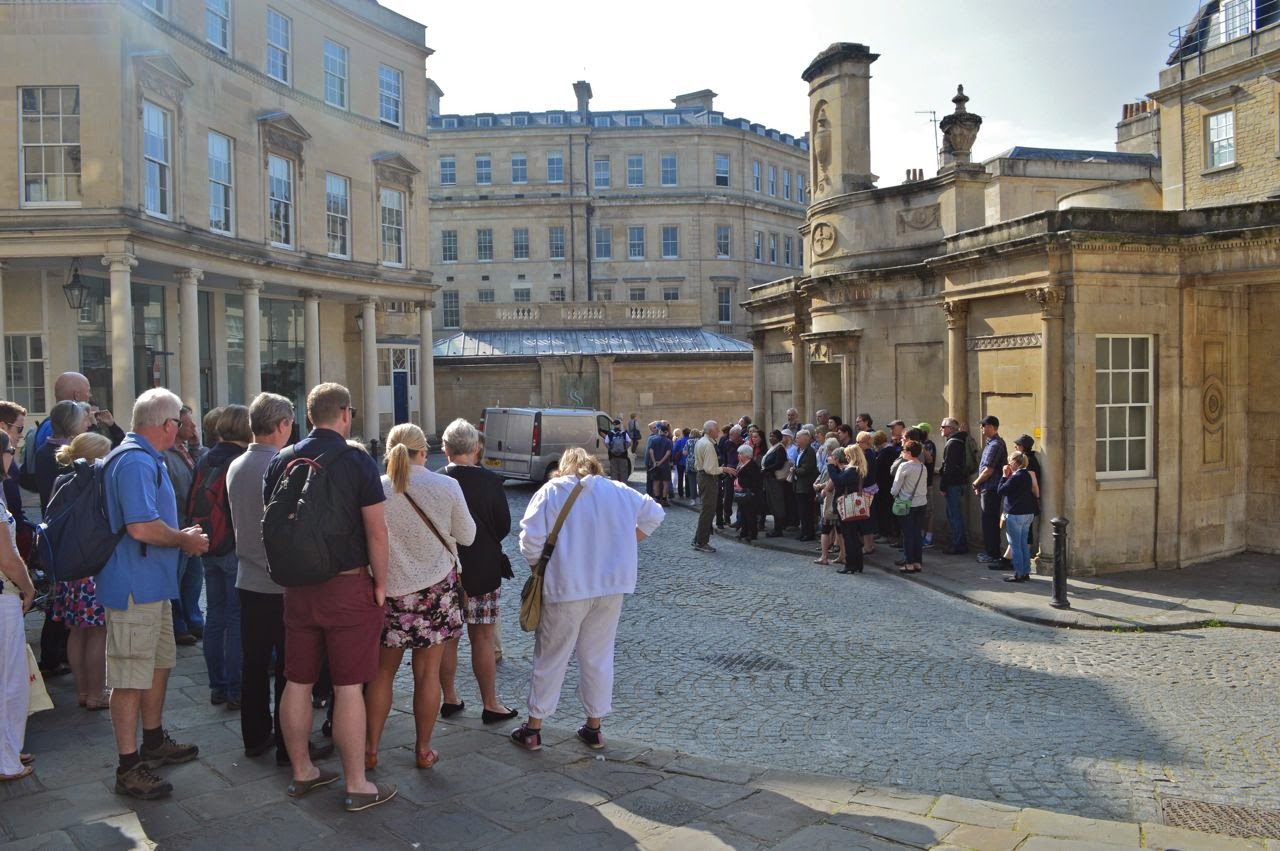
When I was about to go, tour groups descended en masse. I must have hit prime time for the guided tours as no less than three groups all clustered around the baths within the space of five minutes. It is rare to see quite such a gathering here, the city's sites are diverse enough to usually spread the groups, but 11.30 AM is hot. 


I noticed this group who looked unfamiliar and, from the name badges I was able to determine they are with APT Touring and their trip is most likely the 21-day UK and Ireland tour that costs £5615. That's pretty expensive and they offer a more pricey 35-day trip with a European cruise added on for £9650. No wonder they were mostly older with time and money to burn. The guide had a little microphone, the type I sometimes use, and after having given a test Tour of Tours on Tuesday, I see I will need it. Some of the streets in Bath are really loud.


Chance would have it that, on my way back to my accommodation, I passed the new public swimming pool and sports facility housed in the 1970s civic leisure centre. It's not quite the same thing as the historic baths. I look forward to the conversations that come out of this part of tour.

Monday, 18 August 2014

The Roman Baths of Bath Tour: one cup is enough

There is a hierarchy of attractions in Bath and at the top sits the Roman Baths. The heritage tours had already primed me with some information on the baths as they are central to the city's history and even name; it was now time to see how they are presented.


I joined the queue that snaked around the side of the building and listened to this busker who is something of a mainstay of Bath city centre right now. He's not bad at all and he kicked off a retro set with Norwegian Wood. The skeleton on the pushbike is Bizarre Bath advertising and to the left and out of the picture was a Falun Gong lady doing her stuff protesting at the Chinese government. We crept forwards to The Who, past the anti-Trident Missile protest beside the Abbey and finally into the Roman Baths' reception hall. 


The ticket is not cheap but it did come with a free audio guide available in several languages. The way it works is at points around the building there are signs which indicate which audio track to listen to. Here, for example, when I entered 85 into the handset it gave me the standard description of what was in front of me. If I had a German, French or Japanese handset it would have done the same in those languages. Additionally, I could then press 12 and listen to a Bill Bryson commentary, available in English only, and if that was not enough there was a further additional description for the English and French handsets that could be summoned up by tapping in 113. That meant that I could listen to three different tracks about the same location and being conscientious I started off doing just that. 


Because there was A) no live guide to lead us around and B) the audio tracks were specific to each spot and not inscribed within a tour that placed them in a clear narrative, they were isolated nodes of information. There were these great big arrows that went some way to directing us but we were more or less left to it.


This brought me round to the top level, which seemed to be the best place to get a selfie in front of the water. It's a pretty location and is far enough set back from the main bath that you can get it all in the frame. I'd be interested to know what percentage of photos taken in different locations around the world are selfies, that would make for a quite unusual map of narcissism. These Roman Baths would not be anywhere near top: it is not iconic enough and it is also relatively sober in tone. The most popular selfie site worldwide by volume is, according to CNN, the Eiffel Tower with Disney World and Disney Land also in the top ten. This answer was based on Instagram research but I bet if they used a Chinese or Indian photo sharing platform they'd come up with a different answer.


Over on the other side of the wall there was an excellent view back into square where I noticed that the Falun Gong lady had by now been joined by a man in a shiny yellow suit. The music had moved onto Imagine by John Lennon which was a stark soundtrack to the posters on organ harvesting and a tangential one to Bill Bryson rabbiting on about the layers of history in the baths. I am probably extra sensitive to this issue of sound but in an open air space it really does make a difference what is playing in the background: while listening to Bryson I was taken away to The Dakota for a moment and reimagine Lennon being gunned down outside the building in 1980. I felt that the Bryson recording was rather disappointing in general as I had thought there would be more of the gentle irony that characterises his travel writing. It sounded to me as if he had been invited to record his commentary in order to add a celebrity name to the audio guides but he wasn't given enough time to develop anything of substance, he was more or less busking it and giving on the spot feedback. Speaking for myself, the levels of ironies and webs of ideas that I can get from visiting a place only become separated and more distinct with a bit of time to reflect upon what it is that I have seen.


The next stage of the trip around the baths took us down into the modern museum. This was a big contrast to the top level as it was very new and ever so precisely lit. They had good quality models like this one which showed what the Roman baths would have looked like. I would have also liked to have had a model of the contemporary site to see how the two compare. That way I could admire little model tourists queuing to get in, model buskers and model protesters, model groups taking selfies in front of the baths and then crowding around a model of the contemporary site looking down onto their tiny model selves. 


This looks like a cinema but the tourists are actually looking at a number of stone carvings that have been hung on the wall in front of them and which are being described in detail on their audio guides. It was a rather neat way to borrow the architecture of the cinema so as to encourage people to sit and take their time to listen to the commentary. If this were simply a standing exhibit, there might only be five or six people here.


There were also a number of videos dotted around the museum and the audio guide provided the dialogue for them. The problem here of course is how to make it OK that the audio guide's dialogue does not synchronise with the image, because you drop into the film sequence randomly. You wouldn't do this with a Tarkovsky movie but here they kept the videos short and focussed around a single issue so it more or less worked.  


The remains of the Roman baths are in much better condition here than is typical for Roman sites in the UK and the fact that they has been overlaid with other layers of English history only adds to them. What is also true is that the museum has been very good at making the most of the fragments that they've found. This altar is a case in point. They have very little of it but have given the impression of a large significant altar by adding the missing sections without trying to trick you with fake antiques. The overall effect is to make the fragments appear much more valuable by conveying the scale of the original object, which is usually lost. It's a smart piece of display and is quite typical for this museum which has a uniformly high level of museology.


Just as I was getting tired of juggling between the assorted audio descriptions and was about to give up on them, I saw a live guide showing people around the baths. My interest picked up again and I followed him as he showed the bathing rooms and explained how they were constructed and used. While the general content of what he was saying was no different from the audio guide, the effect was world's apart. When, for example, he saw you looking at the green coloured water, he told you why it is that colour and advised you not to touch it, though around the sides of the bath many people were doing precisely that, dipping their fingers in to see just how warm this natural spring was. When he talked about the hills that the water comes from, a gesture accompanied his words and it all made fell into place. He showed us an oil scraper, passed it around, sand for a moment I wondered if he would take his clothes off, rub himself in olive oil and demonstrate it, but alas that would be going too far. This did get me imagining tours where the demonstrations went way too far: baths where the guides undress, a medieval torture chamber where the visitors are stretched on the rack and prison where you are locked up for a week.


I love these sort of pictures so much more than selfies. This one reminds me of the pictures taken of the African students in China on The Pingyao Tour. This one records not only a cross-cultural meeting but it is also a pleasingly ahistorical shot. I've so far resisted the dressing up in a historical costume and standing in front of a historical site type of shot but it might be time to jump in. I did get a nice one of me standing beside the Jane Austin waxwork the other day, my equivalent to this gentleman's Roman shot. I think these photos are extremely important as they shape the way people look at, encounter and remember these sites.


Towards the end of the tour there is a fountain where you can help yourself to the supposedly curative water. It is not exactly a pleasant brew but I was preparing myself for something truly vile so was ever so slightly relieved that it didn't make me naueous. And lo and behold, as I write this now, I can  vouch for it: my leprosy has cleared up completely! That at least was the story that created such a buzz around Bath in the 18th Century and shot the city into the limelight. Apparently, you can also sample this water in the pump room upstairs, a smart Georgian cafe popular with tourists.  


If the busker upstairs were to have sung Across The Universe while I was looking at this pool that glitters like the Milky Way it would have been a fitting end to the tour but we were buried inside the complex and he was out of earshot. The water is supposedly rich in minerals, particularly  iron, and this bath is rich in metal all right, the glittering is the from coins visitors toss into the pool. And it is no surprise they do so as the baths are rather special and I can understand why they pull in over a million punters a years. There is not so much to say from a tour point of view, the audio and live tour simply do an efficient job at introducing and leading you round the site. With such a bulk of visitors it is hard to imagine it being done in any other way and. The visitors themselves are not infrequently on tours of their own, such as an English language school's day trip. They will experience the baths as a tour within a tour and that's probably where the more far out tour stories are to be found.