Showing posts with label monument. Show all posts

Monday, 9 February 2015

The And While London Burns I Shivered Tour

Last week I attended a talk by Graeme Miller who was speaking about Linked, his audio walk in East London, and much thought was given to how the work had aged and how it might best be preserved, or indeed whether it ought to be allowed to quietly grow obsolete. I will cover Linked another time, but that discussion made me aware there that there was another audio tour, And While London Burns, which had also been around for a while gathering dust and which I had not got round to taking yet. So, one grimly cold afternoon in early February, I downloaded it onto my phone and, following the instructions, looked for a Starbucks next to Bank tube station.


I quickly realised that the Starbucks I was looking for had moved on to pastures greener and more lucrative in city workers in search of over-priced coffee and wifi, and the gloomy underground mini-mall I found myself in had now been colonising by a Weatherspoons pub and a decidedly mediocre looking noodle bar. The ironically named Green Man is most probably a reference to a historical pub that stood on this blighted spot 500 years ago and leant its name to this contemporary outfit offering it a fig leaf of respectability. I pressed play, the tour got going, and the main protagonist talked confessionally about being over-worked and infertile while a narrator gave facts and figures about ecology and banking. So far so good.


My first impression was that this audio tour had very high production values; this was not the work of one man and his dictaphone, this was like the BBC on a good day. The other thing that became quickly clear was I needed to keep up. This was an immersive audio tour which demanded I walk with it: when the narrator said "walk forwards" I had to walk forwards for the tour to make sense. My movements were being choreographed and I only had as long to look at a scene as had been allotted me in the recording. The pace was upbeat and did not allow for dawdling or reflection. I also quickly noticed that the directions that were  being given were neither obvious nor clear. For example, I was told to go up an escalator opposite an opticians. I headed for an escalator opposite a Boots, which turned out to be a Boots chemist with an opticians inside. Anyone trying to speak plainly and give directions in the UK would say take the escalator opposite the Boots (a popular store in the Britain) but this tour avoided saying their name and offering their brand 'the oxygen of publicity'. This set the tour off an a conspicuously anti-capitalist footing. All the while I was thinking about this and following the instructions, I was peering at the dirty hand marks on the pillar and wondering how and why they had come about.


I then got settled into the tour which combined the story of a city worker whose girlfriend had left him to live off-grid, with an explanation of the relationship of finance to ecology in The City of London with operatic voices, instructions of where to walk, a music score and sound effects thrown in for good measure. It was a dense sonic package. With so many elements it could have easily descended into a chaotic soup but, for the most part, it was scored sparingly and logically so it was easy enough to follow. The main actor's delivery was a little over-wrought for my liking, which is a way of saying I didn't quite see why he was talking so candidly to me. What's more, I came over time to view him as being there mainly in order to serve the purposes of the audio tour, that's to say in order to give it a human point of entry and avoid it becoming too much facts, figures and politics.


Most of the directions were given by a cooler-headed female narrator who told me to cross the road. Probably because the traffic island that I was meant to cross at no longer existed, I was too focussed on where I was meant to walk and didn't notice the approaching cars until the last moment and had to scramble to the other side of the road to avoid being flattened. I then went in search of the Roman excavation The Temple of Mithras but found instead a Bloomberg construction site where this ancient temple once sat. 


The City of London can have an elemental beauty to it and this came out when being led around Bank underground station. A driving musical crescendo accompanied by intonations on global warming and the rising sea level transformed the glum corridors into something far more than themselves and concluded with a scene that could have been choreographed: a businessman raised up on a platform in front of me, standing in profile, talking animatedly into his phone, flanked on either side by a silver dragon. A captain of industry if ever there was one. 


As I was listening to the voices telling me to walk, turn, stop and push the button on the traffic lights, it struck me that in the eight years since And While London Burns was produced, there has been a more thorough penetration of navigational software into cars. Robotic Jill was already around back then telling you to turn right in 100 meters, but these Tom Tom style devices have since become the norm in the car when travelling unfamiliar routes. They are not infallible and I've seen some people treat them more as suggestions than instructions but, one way or another, they have worked their way into the car and by extension, the imagination. As something of a non-driver and someone who enjoys getting pleasantly lost now and then, I realised my first instinct on hearing these directions wasn't to simply follow then but rather, it was to think about them, to visualise them and decide whether I should go along with them or not.


The Nat West Tower swung into view and the story moved onto natural resources. I remember there was quite a lot of information about oil and banking which amounted to 'they're in it together'. It was the stuff of George Monbiot articles and as such, not unfamiliar. The result was I became a little too over-aware of the intentions of the piece. I felt it had been conceived to educate me and change my behaviour. It desperately wanted me to see the light, go green and save the planet. When this unambiguous message was combined with voices telling me to turn left, walk forwards, stop at the traffic lights and look up at the sky, I felt an opposite push from inside of me reasserting the integrity of my own experience and reflections. I guess I just cannot bear propaganda, even when it is for a cause I am sympathetic towards.


I was led down the exact same obscure passageway that I myself use in my London Tour of All Tours. This got me wondering whether there was an aesthetic dimension to this use of space, namely that artists are attracted to this passageway as it is disorienting and offers a fresh eye on The City. Knowing that this tour passes this way I shall, I suppose, have to weave it into my Tour of All Tours and find a space for it in my narrative immediately after the Occupy Tour and Critical Mass tour. I have a dilemma however, as most the tours I mention in this area are already of an anti-capitalist variety and I could really do with a pro-business tour in order to balance my treatment of The City, instead of ladling out more of this stuff.    


I was then led directly below the old Nat West Tower or, as it is prosaically known today, Tower 42. One of the voices said, 'it is windy' and it certainly was. By this time I was starting to feel the cold biting; a chill wind was sweeping around the tall buildings making this lonely walkway seem all the more desolate. The tour's theme of global warming could not have felt more distant at this moment; I was more concerned about how much longer this walk would take and where I would go to warm up afterwards. This was not climate change denial, it was the simple tendency to concentrate on what's immediate: while London was burning I was shivering.


While I had already had my doubts that I was walking in the right direction, there came a point a little later when it became patently clear things were not going according to plan. I was meant to be circling a building that I could not locate and, choosing this block instead, I came  to an impasse. I had been warned that this would happen by a friend and lecturer Theron Schmidt, who had produced an up to date annotated map indicating the correct route which detailed some of the changes in the buildings' usage. I didn't come armed with it, however, as I felt the way The City might have other plans for me is just as much a part of the tour as following the instructions to the letter. I therefore wandered back and forth looking for the restaurant that the anguished protagonist was talking about and listened to him and his girlfriend talking about getting out of The City. 


There was a moment when I was asked to stand next to a tree and to look up at its branches towards the sky. It was far too cold to relax into a hippie moment like that: I looked, I saw, I waited a moment, I moved on.


Spinning away from The Gherkin I must have got the directions confused and took a wrong route down to The Thames. Whether that was my fault for not listening closely enough, the recording's fault for not being clear or nobody's fault and simply the result of the architecture and street layout having changed, I couldn't say. However it happened, I was now walking down one street and listening to the description of another. The tour didn't really suffer as a result of this, if anything it gave it an added layer of interest as I imagined myself walking a few hundred metres along a parallel lane. This gave me the opportunity to observe that whilst the street directions were specific such as cross over the road at the Costa, the content was far less wedded to it and for the most part could work anywhere in The City.


I was instructed to enter The Monument, which I spied in the distance, so I trotted over to it in haste to make up for lost time. I was then told I'd have to pay the two pound entry ticket. In the eight years since And While London Burns was made the entry price of The Monument has doubled to four pounds. Now call me stingy if you will, but I was already having decidedly mixed feelings about the audio tour and to then support this London tourist attraction's hyper-inflation by paying four pounds to walk up the insides of this tower was more than I really cared to do. OK so I missed out on the panoramic view but I was quite able to imagine it and besides, I was curious about life on street level.


I instead stood at the foot of The Monument to the fire of London and here the reasoning behind the name And While London Burns became very clear. The Monument was a confident mark of rebuilding the city after the devastation of the fire and we, faced with our contemporary crisis of climate change, could take bold action, tackle the problem and shape a new future too. As I imagined myself ascending the steps to the top of The Monument the narration stopped and gave way to a Philip Glass style musical crescendo. This was where the work was really meant to pack its punch and finish leaving the listener exhilarated on high. I instead watched the construction workers from the building site next door taking a break, one of their number feeding the pigeons. This simple act, unexpected from a man in a bright orange suit, had a beauty of its own. I enjoyed watching it because it was intimate, caring and ever so slightly ridiculous. In contrast to the voices from the tour, who seemed like puppets for the cause, this was a completely unscripted, unnecessary action, the sort of thing real people do. The two layers of the experience, the audio recording and the city, need not necessarily stand in opposition but in my experience they were often at tangents as, And While London Burns felt like it had an ideal experience in mind, deviations from which were just that: deviations. Whilst I feel I should have liked this audio-tour more because it was well intentioned and well made, it felt more than a little claustrophobic and, returning to my starting point of The Green Man to warm up over a pint, I was relieved to back amongst chaotic, pluralistic life once again.

Monday, 8 September 2014

The Jurassic Electric Tour

Jurassic Electric is not a Steven Spielberg 3D holographic experience, it's a down to earth little company running guided tours on electric bikes around West Dorset. They are one of the very few with guides who take people to Littlebredy, the geographic focus of my upcoming Tour of All Tours for Inside Out Dorset Festival, so they were of obvious interest. The rest of the group was there for the birthday ride of this chap in blue leisure wear, the sun was shining and they were in good spirits.


The tour began with us assembling on a green and Martin our guide in the day-glo green T-shirt getting everyone sorted out with a bike adjusted to their size. We had a short explanation of the bikes and a test ride to get used to them. Although this looked like a formality I heard that it had happened that a woman turned up who was incapable of riding a bike (despite saying she could in advance) and had to end her day at this point as she would have been a serious liability. Harsh though that must have felt at the time, it was correct and I felt there was an eye for safety on the tour that was reassuring without being overbearing.


This is what makes the difference: the battery and motor tucked below the seat. We were told that there would be no problem of the battery running out over the distance of our tour, they are strong and, apparently, if used sparingly can be strung out over a full day's ride very effectively. I was making no such economising and wanted to see just what this baby could do. The hills out of Portesham gave ample opportunity to do this. 


Here is the group making a short stop to hear about a historical building. Usually on a bike I tend to resent making stops like this as the momentum, particularly in hills, pulls me ever forward. On these bikes however, starting and stopping on slopes was a doddle so they work very well for the rhythm of guiding a group of people which inevitably entails making occasional stops to regroup and to explain things.


We made a proper stop at a local vineyard where we were shown around and when the proprietor brought out a bottle of his red and white for us to sample we didn't need any convincing. I haven't tried a great deal of British wine and that which I have had has usually been homemade gut rot rather than the produce of commercial vineyards. My expectations were therefore pretty low. The wine was however, really a great deal better than I expected, I would have happily drunk another glass rather than looking for a plant pot to discretely pour it into. There was even the idea being put around the group of buying a bottle to drink immediately as a birthday toast. Wiser heads prevailed. Stopping at an interesting local business was a nice addition to the tour, it made it about more than just the cycling, we got to meet people, see a new place and hear about making wine in this part of the world. I'm quite sure this will lead to future customers for the vineyard so it really worked well on both sides. 


There were some great views from the spots by the side of the road we stopped at. Maiden Castle, the series of brown horizontal lines in the mid-distance, was pointed out to us with a brief explanation of its role as a iron age hill fort. The sceptics amongst us asked how can you have a fort with no real walls, just banks of earth and ditches. Maybe it's no great surprise the Romans managed to take it... It is a beautiful place nonetheless and worth a visit in its own right. With this tour however there was no time for that, or for further historical speculation, we were back on the saddle again with a hill to climb. 


On our way up that hill we passed a person lying flat on the grass beside the road with a bike lying on the grass behind her. Asking if he or she was OK (it wasn't easy to tell from when flat out), there was some stirring and eventually this older lady propped herself up and said she had just cycled up Hardy's Monument and the last time she'd been up on a bike  she was 17. She was recovering from the ordeal which was a lot tougher than she'd imagined. She had just bought a new road bike and was trying it out, she explained to us. When we suggested she might like to try an electric bike she scoffed at the very thought of it but looking at how wasted she was from the ascent I seriously think she would have benefitted from one. Actually, she was probably the best advert for the bikes that I could have imagined.


Now it was our turn to fight our way up the hill. It is not like riding an electric scooter that does all the work for you, we really do have to pedal. Having come up this same slop before on a section of the Tour de Manche with a bike loaded with kit I know precisely how much effort it requires and this was about half that. Some call it cheating but I daresay some people call cycling cheating and prefer to walk instead.


Excited to have made it up to the top, we pulled the bikes around the fence and, unlike the lady crashed out at the side of the road, we were all standing, smiling and even able to speak.


The view from Hardy's monument is terrific. It's a place that I could spend hours gazing out from on a good day like this. The last time I was up here was during a storm in February to do a geology tour when it was almost impossible to stand upright so powerful was the wind. It's difficult to reconcile the place in two such different states.


Descending from on high was easy, we rolled down Portesham Hill in no time at all, returned the bikes and headed over to the pub for a well earned pint. It was a friendly group who were most accommodating of a stranger like me. I left them deliberating over the steak or seafood linguine as I had to return to my hotel before sunset when by bike turned into a pumpkin. That, unfortunately, meant cycling back up the same hill I had not an hour previously flown down with such ease. It may be that the electric bikes create their own sense of necessity for I was expecting it to be a steely ordeal but, it finally turned out to be  basically OK. I am a regular cyclist and have a decent bike so am probably not the target public for Jurassic Electric as I am able to make my way up and down these steep Dorset Hills under my own steam. That said, the stops en route and the possibility of being in a mixed group with people like me and people less accustomed to such efforts does bring something of value. The proprietor of the hotel I was staying at told me about two couples who visited for a cycling holiday last year; the two guys were keen cyclists their girlfriends enthusiastic but less seasoned. After two days on the hills the bikes were ditched and it became a walking holiday instead...


I also rather liked the general atmosphere of the bike tour too; Martin and his partner who accompanied us, were clearly enjoying showing people around a part of the world they loved. When you have a guide who is in their element you usually see them at their best and, what they decide to show you also has greater weight as well. What's more, I can now see the point in electric bikes in a way I never did before. While I am unlikely to rush out and buy one for a good while yet, I have made a mental note to add one to my 70th birthday wish list. If, God forbid, I am still around and haven't been put away by then, I rather like the idea of wizzing about like a teenage-pensioner over hill and dale.

Thursday, 27 March 2014

The Beijing Hub of Tour Dispatch Tour aka The Great Wall (with shopping)


Yes it is a bit of mouthful, more than a little Chinglish, and otherwise known as the Ming Temple Tombs and Great Wall Tour, the C Tour or The Great Wall (Badaling) with Shopping. The tour begins just off Tiananmen Square where the coach company, a state owned business and the official tour company of the city, runs its coaches from. According to the online discussion the tours are guided and can be given in English. Upon arrival, however, I learnt that it would be in Chinese only and that it would cost more than advertised. 


As I am currently studying Mandarin at a Chinese University I have an official student card  valid here in China. I have heard that it can be difficult to get student prices for things if you merely have a foreign student card, indeed probably best to replace difficult with impossible. However, I confidently thrust my Chinese student ID at her, handed over a note, the saleswoman took one look at my face and charged me for a full-price ticket as I was a foreigner. This tour begins with racial discrimination.


Next thing is we had to sign a disclaimer form making the company not responsible for accidents or injuries and we also had to provide a phone number. With this done we got aboard the bus and a took a seat while it slowly filled up. The TV was showing one of the anti-Japanese TV dramas, which are popular right now. These TV shows are generally set during the Sino-Japanese War of 1937-45 and tell the history from a firmly Chinese point of view. In a way their rise reminds me of the torrent of WW2 movies that filled British TV when I was growing up in the 70s and 80s in which the Germans took the role of the Japanese. Maybe one legacy of victory is to have the war replayed endlessly on the nation's TV screens for years to come, and with this, to gradually fall victim to your own rhetoric. I watched for a while until finally the guide, a rather tough lady, handed round identity passes we were to wear and made some announcements about sticking together and getting back to the coach on time. We pulled away and slid through wide avenues lined with large buildings.


The guide, microphone in hand, started telling us about tours she had given and celebrities who had taken her tours. This led her onto some bad things that had happened before and which she didn’t want replicated like the eating of tea eggs on the bus or the wearing of too much perfume. She asked us if we were here to sleep or here to travel and got us all shouting back in chorus that we were here to travel and see things. Well, all of us except the one or two who really were sleeping. She then moved onto Feng Shui and how the corporate headquarters that we saw along the sides of the road were designed according to these principles. She then settled into talking about traditional Chinese culture and in particular about pixiu.


I have noticed that you can often find pairs of creatures outside the entrance of buildings in China such as these two lions that were waiting for us at our first stop. Out guide told us that with the pixiu their mouth is held open in order to collect money and good fortune and that because they have no anus, the money and fortune accumulates rather than dissipates out the rear end. She even told as about a time she was playing mahjong for money and she took two miniature pixiu with her and placed then in front of her facing her opponents. Apparently she won a considerable amount of money in this game thanks, she told us, to the pixiu.


She strung out stories such as this a little longer until finally we arrived at our first destination the Ming Tombs. Nestled under mountains to the North of the city, the smog had cleared enough for it to be a pleasure to be outside rather than a cause of concern. We assembled outside the bus and were encouraged to use the four star toilets in the car park which were built to communist party official’s standards. They turned out to be reasonable but not particularly glamorous and certainly not up to the standard of those in up-market commercial centres. Refreshed and with identity badges displayed prominently we made our way into the tomb complex and passed through security who inspected many of our group’s identity papers.


The tomb was set in an attractive park with historical stone staircases, sculptures, tress and a conspicuous absence of vendors. Smoking was forbidden and when stepping away from the group there was a sense of calm about the place. That quickly ended when descending to the underworld which consisted of a series of stone chambers though which we shuffled in line. On display were funerary objects upon which lay layer upon layer of bank notes. It was a custom amongst visitors to throw small quantities of money over the exhibits as this would presumably also bring good fortune. We were told that when in the tombs we should not take pictures that included any living people, I don’t know exactly why that should be  so but I, in any case, respected those rules when taking these snaps.


The bus was scheduled to depart quite soon so there was no time to absorb things further, just a brief spin inside the exhibit hall, which looked lost somewhere in the 1980s, before jumping back aboard. Our guide launched back into more pixiu theories and told us we’d now be arriving at a museum above which lunch was waiting for us. The museum tour was included in our ticket, she happily told us, and we filed inside where a distracted middle aged man showed us the highlights of the collection. This was a slightly odd museum tour as the space was run-down: pictures were hung crooked, there were empty display cabinets and a general air of neglect. What’s more, he told us there was little time so we only gathered around two items to hear about them before emerging into a large, modern, brightly lit jade shop. He told us that this was an excellent place to buy pixiu and bracelets and he reassured us that, as a government business, it was reputable and the jade authentic. This switching from heritage tour to shopping seemed fluid and unsurprising to the tour group; many even seemed to welcome the chance to have a bit of the action for themselves. It also made me reconsider the things that the guide had been telling us earlier about the pixiu and see this heritage commentary in a new light as a part of the sales pitch, a warming up act to wet the buyers’ appetite.


I had read the publicity of a number of tours to the great wall which describe their trip as Great Wall (Badaling) with no shopping. Badaling is the point on the wall where we were heading and those trips were free from commercial stops. To be honest, I was quite interested to see this sort of tour instead, one that as it unfolded could almost be described as Shopping with Great Wall (Badaling). This little pixiu in the museum seemed to capture the spirit perfectly.


Lunch upstairs was functional to say the best. We sat as a group of strangers around a round table and silently put away the decidedly bland dishes that were served up. In a little over 10 minutes the table cleared and we took a look at the stalls outside selling a bit of everything including broken plastic toys.


This is my group and our next destination was The Sacred Way, another part of the Ming Tombs area. We had a new guide here who she came with the destination. Wearing sports gear and with a relaxed approach to guiding, she explained the history and importance of the location underlying this by showing us some of the famous visitors who had visited, like Kissinger and the presidents of Poland and The Netherlands. She rather exaggerated the location’s claim to significance by saying that if you visit The Great Wall you’ve been to China and if you visit The Scared Way you’ve been to Beijing.


Without constant translation I would have been well and truly lost and while I may know enough to know when to get on and off the bus this tour would have been a very different experience if it were not for the assistance of Miyi for whom I am extremely grateful. The sculptures were rather beautiful and in spite of the piped music the place did have a presence of its own. Just as it was almost becoming serene we were led us into a gift shop located in the centre of the Sacred Way and the guide tried to sell us some amulets. There were no takers.


Back on the beat she led us past more animal sculptures and explained how they symbolised the different parts of the emperor’s kingdom, hence the camels and elephants marking out the lands to the South and West. One young woman was climbing on the elephant and had to be asked to climb down upon which she shouted to the guide, ‘are you crazy?’ to which the guide replied, ‘are you crazy!!’


Returning to the bus we were given a talk on how best to be a tourist. The basic idea was, “when you are on holiday you are there for pleasure so you shouldn’t be too careful with money, you should spend and enjoy your time. You don’t do it often so make the most of it.” The bus then arrived at the Great Wall but stopped short of the entrance. We were asked to get out as this was the cable car terminal and we were told that we should take the cable car, which would cost an extra 100 rmb. When we asked if it was really necessary, as we wanted to walk, we were told it was necessary as there would not be time otherwise. There was, after all, a Great Wall 3D film which we could watch at a discounted price once we had done the cable car. This all seemed like a bad idea and finally we decided to walk instead, while the rest of the group bowed to peer pressure and took the cable car. The coach did not take us to the entrance of the wall, we had to walk there ourselves which was a bit mean spirited as the bus was heading that way anyway, but we were quite quickly there and then up on the wall.


The wall is to me an ambiguous symbol which is at once impressive but also a testament to fear of the outside and a monument that relied upon forced labour whose construction was the cause of a great many deaths. For it to have become quite such a tourist attraction is odd but Badaling certainly is that. It is the most developed of the wall’s official visitor locations, it has rails to help you up and stalls selling everything under the sun. Visitors come in great numbers wearing all sorts of costumes: there was a lady in thick pink pyjamas and heels for instance. It is a place of many photographs as the scenery really is quite something with peaks stretching out into the haze that replaces the horizon.


I visited the Great Wall back in 1997 and it seemed to me that the industry around it has increased a great deal since then. There are complaints that the site is a reconstruction of the wall and not authentic and I can understand that point of view but I can also see how there is a different relationship to history here and an alternative way of experiencing monuments and nature. This historical question is complicated as there is both a neglect even active destruction of many of the physical sites yet this is accompanied by a fetishisation of the historical culture, which remains very present in the language and sense of pride in the age of the civilisation. The side that I feel I can see more clearly is how tourist sites are more typically enjoyed collectively rather than as an individual. If the site is important, so the logic goes, then it will be popular and the presence of many people a testament to this and validation of your own personal decision to come. For instance, the vast majority of the Great Wall is unvisited by tourists and often and in a state of some disrepair. As such, to the group visitor, it does not constitute an important site as it does not show the wall at its best. I have heard of alternative tours, popular with Westerners, which take small groups of 3 or 4 people to unofficial sites where the hiking is far more strenuous and views unmediated by the Chinese mass-tourism industry.


The journey back into the city was for the most part quiet, the selling having being done, though a sting in the tail still awaited. We were told that there was an optional visit to the Bird’s Nest Stadium and Olympic Park if we wanted it. As this would also take us to the subway station and the coach was getting progressively snagged up in Beijing traffic it seemed like a good idea to get out here. The bus pulled over on a busy highway, some of us spilled out, far from the Olympic park with no directions given. This led to a trek through darkening streets before finally coming to what has become a kind of pilgrimage site amongst Chinese citizens, The Bird’s Nest Stadium. I visited it back in 2009 so did not feel the need to repeat that tour so the Great Wall (Badaling) with Shopping Tour came to an end on the efficient and economical Beijing subway.

Sunday, 9 February 2014

The South Dorset Ridgeway Tour

This was the first full day of work in the area and it began with a hearty breakfast over which I learnt from my landlady that she is a qualified blue badge tour guide. Outside the weather was doing its worst with a heavy hail storm so I had a good root around the bookshelves which were well stocked with guidebooks, maps and books on local history.


While the weather forecast was poor, it did clear a little and since I was here I thought I may as well just head out and see what happens. It is all experience and can contribute to the work, after all. My journey again began with Portesham Hill which is a proper test of the legs and willpower. I battled my way up and the weather was actually to my advantage as it was blowing a gale from behind me, effectively pushing me up the hill.


At the top by the completely exposed Hardy Monument it was not so easy to stand upright such was the strength of the wind. I rested my bike on the most sheltered side of it, further cycling not being wise, even kind of dangerous. With storm clouds massing I looked for shelter, the doorway to the monument being the closest thing to cover that I could find.


It was here I noticed the graffiti carved into the stone, Alf R Bates making a record of his visit to Hardy Monument a record destined to outlive him.


With the immediate threat of rain receding I looked for the South Dorset Ridgeway Path which passes this way. It helps to actually be on the path to see the path and once I found my first sign post I was up and away.


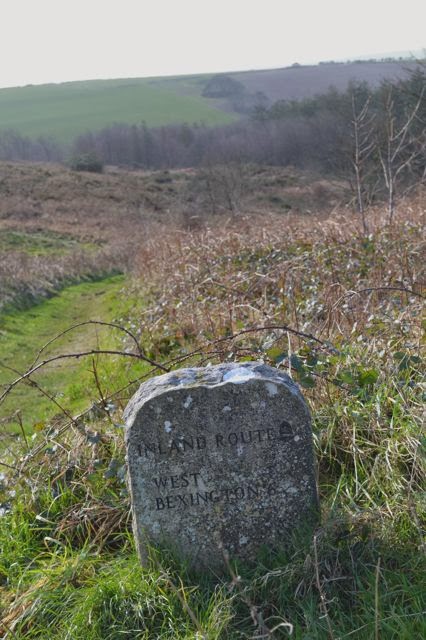
Not all the signs describe it as the South Dorset Ridgeway, some still describe it as the Inland Route of the Coastal Path, if that makes sense at all. There seems to be some debate amongst walkers on their forum whether this route is preferable to the purist's longer route by the sea that goes around Portland with opinion sharply divided.


I came to a three-way junction and became interested in the sign post that describes your options. It had mixed information. In one direction was the Bridleway and in the other two the SDR path, or so it seemed.


Yet the same post from the other side showed the SDR path taking the direction of the bridleway. The system of the circular markers and the wooden signs seemed to be at odds. I took my chances and followed my instincts setting off in the rough direction I could see on the map I had.


This led me around a bend until finally I could see in the distance The Hardy Monument ahead of me once again! I must have taken the wrong turn on that South Dorset Ridgeway junction with the bridleway I guessed.


I followed the path back towards the monument and was once again buffeted by the strong winds. When I got home later I read they were up to 70 mph in strength! This tree was up-ended by wind and so I had the idea to make some sound recordings of the wind since I will be making an audio tour and some sort of portrait of the location in sound might come in useful.


After this long diversion I returned to the original junction and studied at it once again. This bridleway really took me in the wrong direction it seemed to me so I again followed the path ahead between the trees hoping there might be some other clues that would set me on the right way.


Here I found a subtle junction with the main path (bridleway) taking the left and a small path heading off to the right. What exactly the orange circle is is quite beyond me, I didn't notice any UFO activity at the time and this just seemed to appear in the photos later so I'm going for optical effect in the camera. Anyway, I looked for signs but saw none and so explored the right hand path.


Following the path through a gate, around a small pond and then round a corner I discovered I was on the right path when I saw the next sign post. This is a rather laboured explanation, I know, but this is precisely the sort of thing that happens when you try following these paths: you stray from the route, you find your way back, you try again and then finally find your way. The reason I got lost was not the ambiguous three way sign back up towards Hardy Monument but because the UFO junction had not been marked and the main path was not the the actual path I was meant to follow.


Back on the SDR things were looking up again and I allowed myself to indulge in a little thought experiment. I had seen this route featured in the Channel 4 TV programme 'TIME TEAM' when they made a special feature on the South Dorset Ridgeway. One part of this had presenter Alex Langlands joined by an archeology professor from UCL who encouraged him to try an phenomenological approach to walking the landscape. That is to say, he was to follow the South Dorset Ridgeway for a couple of days and try to put himself into the head of an iron age man plodding the same track. He claimed that in spite of the Goretex and cameras he had some success in better understanding the 'ceremonial landscape' in this way. If it worked for him surely it could work for me! Well, I tried but kept on finding things such as this double style to interest myself in: the path continues on both sides of the fence, you are to pick the cow-free side.


There was then another hailstorm that I took shelter from, followed by a rainbow, and at the point where the SDR arrives at the road the cows were back in force and thick deep slurry too. The prospect of wading through that stuff again and to do with a herd of cows surrounding me, was not one I relished. Call me too modern, I retraced my steps and the stone age spell was well and truly broken. What did happen however is that I noticed the signage system of the route made more sense coming in this direction. There was not the same deeply ambiguous junction problem and this made me wonder if those making the route worked from West to East when putting the signs up. When a route has to function in both directions the person responsible for signage needs to be able to walk a route they have already signposted in the opposite direction as if they know nothing of the route. Either that or they get a colleague to walk it in the opposite direction and check it works equally well. It is actually not such an easy thing to do, particularly over a long distance when the work of laying out the signage is handled by different people who all have slightly different ways of indicating junctions. I remember following the number 1 cycle route though Kent some years ago and it was a complete mess with some sections crystal clear and some so opaque that they were more of a distraction than a help. SDR is not so bad but, like I showed, far from perfect.


This is the public art in the form of stones that can be sat upon and which invite the sitter to close their eyes and listen. I did so and heard a lot of wind. This reminded me of something I heard earlier about the South Dorset Ridgeway, that essentially 'they are trying to make it something that it isn't'. By which I took it to mean it is a pleasant walk through some interesting places if you know the history but it is not the new stonehenge just as The Jurassic Coast is not the Grand Canyon, even though they both hold UNESCO world heritage status. I see the hand of tourist development officers behind these efforts to rebrand the location and make it into a destination. The problem with this walking route is it is still going through too many working farms so it gets seriously gross underfoot in places and the signs aren't clear. Add to that the place is nice but it isn't exactly The Lake District or Scottish Highland and I see the point about trying to make it something that it isn't.


I cycled back down the hill in the face of the winds and ventured out again later to Abbotsbury to catch the sunset before heading to the local pub and doing some online research on further tours. Plenty more to investigate and another day of challenging weather.