Showing posts with label art. Show all posts

Sunday, 11 November 2018

The Roaming Through 40 Years of Shanghai Tour


Today's tour had all the potential to be something rather special. It was a walking tour of the older part of the city centre with artist interventions. A collaboration between an art festival and a walking tour company. We gathered waiting for it to begin.


The tour was given in Chinese with no translation so I was a bit on the outside of it all. I got bits and pieces of it and actually that was enough to realise the sort of tour it was: an anecdotal historical building tour of the neighborhood. Even though there was enough space to gather everyone on the pavement, we still spilled out into the road, the guide included.


The ostensive theme of the tour was the last forty years of history - that is to say the period of opening up and reform of the Chinese economy - and how that is manifested in the local area. Normally forty years would not be enough to make something historical in the typical frame of the guided tour but given the pace of change in China and Shanghai in particular this could have been interesting, even if it is working to a government agenda. The reality was more loose and we stopped beside older buildings and talked about their histories quickly letting go of the economic reform theme. This turned into a tour of old buildings with stories connected to them, the standard fare of local history tours. 


The public taking this tour was a mix of artists and a general public who were looking for a local history tour. It seemed as if the art interventions were not so welcome, finally. One of the group, July Yang, made a commentary performance while we were walking between stops and I later joined in, repeating the Chinese commentary imperfectly. When we arrived at the next stop we were asked to be quiet.


The guides used a microphone and portable speaker even though the road was not so loud and the group not so large. I felt this was more about establishing authority, though one of the ladies (there was a rotating cast of guides) probably did have a quiet voice. The stories were not particularly interesting and didn't connect to build into anything more than a series of curiosities. 


This got me thinking that, rather than choosing 40 years as a theme (and then breaking it) how about a much shorter time period? What if you were to give a tour of what has changed in a neighborhood over the last week? Immerse yourself in the contemporary and use that as the way to get to the story of what is happening.


There were some things I noticed along the way such as this sign recruiting female staff of between 160-170 cm and 20-35 years of age. This seemed much more interesting to me than these disconnected stories, which, to make matters worse, did not even deal with the appearance and material qualities of the buildings very much. If a tour can make you see something afresh and then understand something from it then it has done something useful. This tour did nothing to alter our perception, the guide simply stood in front of the building and told a story about it.


The weather was, however, very pleasant. It was great just to be outside on a mild autumn afternoon like this.


We entered a building and I was fascinated by this little room, which looks as if it is rouge construction added at a later date. This got me looking for quick-fixes, of which there were plenty, and then exploring the environment of the tour using different themes again. Rather than suffering the mediocre, it seemed much more fun to make something else out of the day. I didn't share this with the wider crowd, just one or two of the artists, as I could see that to do so would disrupt the plan in a way the local history guides were completely unprepared for. A tour with two guides could be good, but the two should agree some basic house rules in advance so that the tension can be a respectful and healthy one rather than an acrimonious one. This was not the occasion, but I should try to find the time to do just this. What would make it all the better would be to propose a route and let different people make their tours of it, then jam them together. That would be fun!

Thursday, 2 February 2017

The Wood Green Revisited Tour


Today's tour was of the stalwart North London neighbourhood Wood Green in the affable company of Hugh Chapman. I say stalwart because Wood Green is one of those areas that has the character of always being there but never being too obtrusive, like the waiters in the excellent Kervan Sofrasi Turkish Restaurant on the High Road. This is in complete contrast to attention seeking Dalston, for example. This can mean that the place gets taken for granted, which is a pity because changes, such as the imminent demolition of the gas holder, can just happen like weather: it lurches from grey to grey.


Our tour of Wood Green was not a rehearsed walk with a set script, but Hugh did have several locations in mind to take me to. That is what brought us to the Chocolate Factory, a former industrial building now housing creative businesses. It still bore traces of its history of sweetening the tooth of the British Empire but today it housed such things as overspill from Mountview Theatre Academy. As we were walking around this oversized shoebox and later waking beside some of the other refashioned industrial units in the area, I had a sense of familiarity that I now realise came from the old Middlesex University Fine Art School being based here on Western Road back in the 90s. I first visited it as an undergraduate student and then later as a judgemental life model; a cash-strapped 22-year-old performance artist who looked down on life drawing but had to keep his opinions to himself and humbly take the money. The school has long since moved elsewhere, the building changed its appearance and my attitudes to drawing softened.


Back out into the cool grey we ascended the multi-story car park in search of a view and this is the best we got. Whilst Wood Green's centre has some density, it is surrounded by rows of two-storey houses with cars parked out the front and little back gardens filled with patches of grass, bikes and children's plastic toys.


For an area whose name evokes a Robin Hood-like image of a clearing deep in the forest, the reality is resolutely urban with no wood to see and scarce little green either. The slither of greenery that we did come to was the New River, reached by walking under the train tracks, which neatly slice the urban fabric in two. To the south we arrived at Turnpike Lane Station where the slender Ducketts Common stretched before us but which marked the limit of our walk: we turned around and headed back up High Road. That park is another old haunt of mine: many moons ago I directed A Goat to Grind a performance for six cyclists that briefly interrupted the assembled Special Brew drinkers. Whilst I have been away too long, they looked as if they were still there, still putting the world to rights and peeing in the bushes. It is reassuring that some things don't change.


One of the purposes of the tour was to test out an idea of mine to explore an urban environment via the reproductions of art that can be found in it. This picture on the left, sitting in a charity shop, is an example. I wanted to first identify its origin and with this see if there was a way to connect this Rembrandt (right) to its contemporary environment. The first thing that I noticed doing this was how unevenly art is distributed: there are vast swathes of the city that art barely touches. What you do see everywhere, however, are the byproducts of art, namely design. Looking for both art and the traces of it through the etymology of images, proved to be a quite fascinating exercise that offered an original method of viewing the city. How the art reflects back upon the city remains to be seen but it can be so rich in content - Balthazar's Feast, Rembrandt's life and the painting's history - that these will, without the shadow of a doubt, include stories that could be reactivated in Wood Green.


Hugh is working for the social enterprise Green Rooms, a hotel catering for the arts sector which has its own arts programme. Naturally, they have an affinity with independent local businesses such as the Big Green Bookshop, a sympathetic place tucked away off the main street. Here we met the people running the place who were happy to chat and willing to be involved in some sort of artistic tour too. This is quite a contrast to another one of our stops, the frozen food store Iceland, where a security guard asked us to stop taking photographs, afraid we might be stealing their stellar design concepts. This division between local stores and national chains was predictable but is worth bearing in mind when making a tour. The temptation is to make tours on a personable and local level, bypassing the brightly lit mall, but that would give a very false impression of the neighbourhood. Somehow, it seems to me the resistance or impersonality that you can encounter in the larger places is interesting in itself and a tone not to be avoided altogether. 


All the time that we were looking around the neighbourhood as a form of artistic research, there was also a secondary very practical task of looking for a suitcase going on. This took us up and down High Road in and out of large and small stores alike. I did finally find a decent case in a sale in one of the smaller places and it was put to use immediately as I checked out of Green Rooms. I expect to see more of the area and, in the words of Arnold Schwarzenegger, I will be back. Touch wood (Green). 

Friday, 17 June 2016

The Banned in Shanghai Tour: a tour of censorship


This performance has been made and remade in nine locations now and I was starting to wonder if it was becoming safe and, within the context of China, over-accommodating of the authorities. It was a surprise to learn after the eleventh of the thirteen scheduled performances that the last two shows were cancelled on the order of the city's cultural censor. The reason I was given was that I presented Shanghai in a negative light. Being cancelled by the authorities did not, however, stop the show, it only made it in into an unofficial, underground performance!


The organs of censorship were slow and acted in two stages. First, on the day before the show opened I gave a try-out show to which this man and an official from the local district government turned up. I had not invited them, they arrived unannounced with the festival team. I was also informed that my plan to use flags would not be possible and that I should change it. The next day I was told to make an adjustment to the show: do not mention the boy urinating on the tour bus. Several days then passed before this charmer turned up again with a phone in hand recording the show start to finish. This was presumably played to his boss with a translator assisting the two of them and the decision then made to pull the show. I can only imagine it took them this long to come to a decision because their English was not so good and they had plenty of other shows to consider cancelling too.


This is the first time I have had a work of mine censored by authorities since the age of nineteen when a picture I had in my Foundation Fine Art end of year show was mysteriously taken down and thrown in the skip. I found it, cleaned it off and put it back up. That, too, was my approach to the tour. I gave the final two shows to invited audiences, bypassing the festival ticketing system, playing it low-key and changing the nature of the show. This new tour was the uncut performance that included not only the peeing boy but also the things I had not included in the first place in order to get the show to initially pass the censor. This site was a case in point. On the normal tour I neither stopped at nor said anything about the most important tourist attraction in Xintiandi: the location of the first congress of the communist part of China. On this uncut tour I stopped and explained why it was impossible to say anything here without it potentially causing problems as the party's narrative is not there for everyone to use and repeat as they see fit. Even though the show was not negative about the party, any reference to it here could well lead to the show being stopped out of fear it might be misinterpreted. Officials don't like to take chances, as their job is on the line, so the higher up the food chain one goes, the more likely it is that caution will prevail.


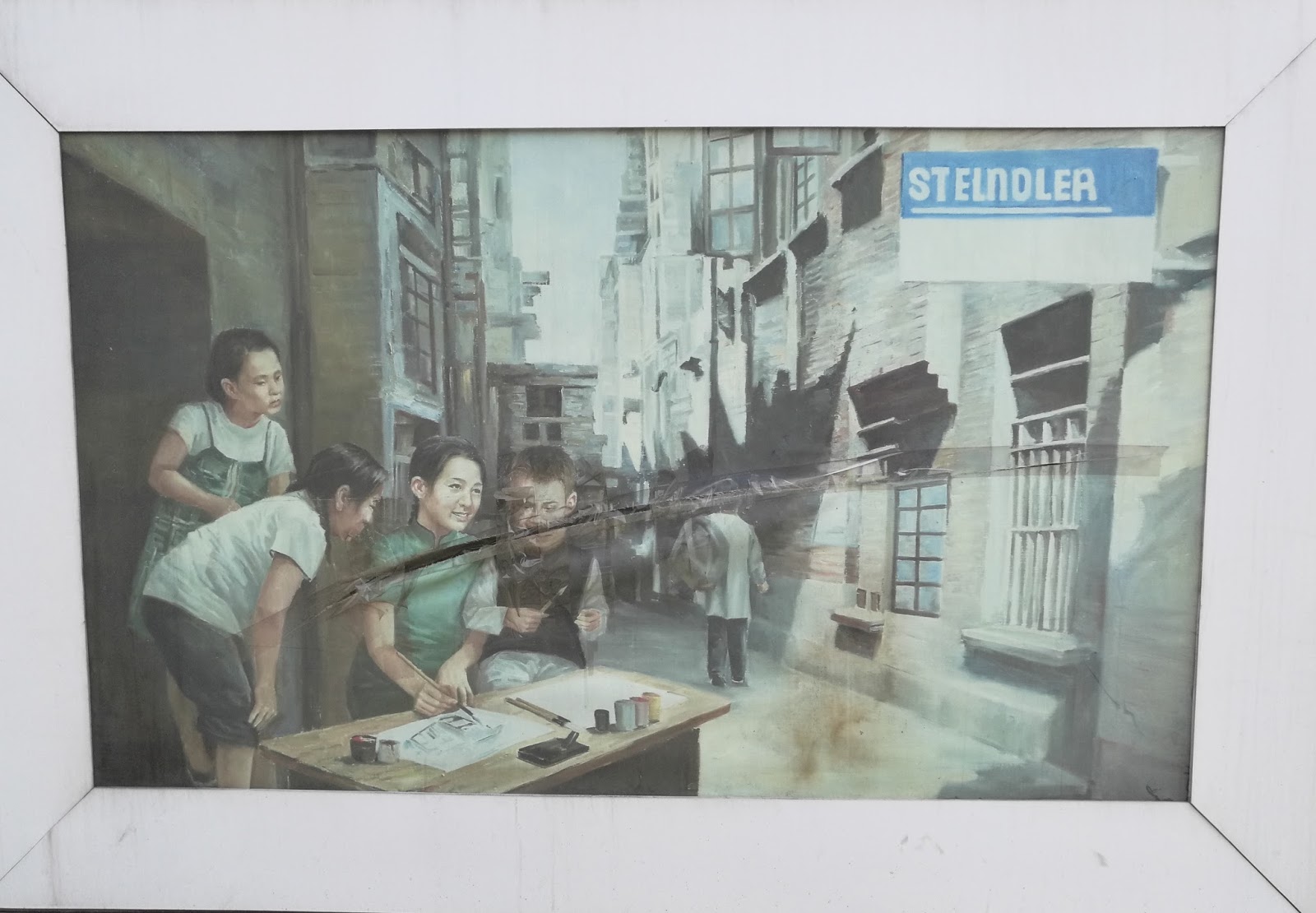
Another example of a thing I was unable to talk about on the normal tour was this ripped picture that I saw in Hangkou. It was part of the Jewish refugee heritage trail put up around the neighbourhood. I did not know the reason why it and several other related pictures, had been slashed. Here it was possible to ask the question and see if my audience knew if this was due to anti-semitic vandalism, if it was related to the redevelopment plans in the area which will see many thousands forcibly moved from their homes or something else entirely. It prompted a real discussion. 


It was shocking that by far the greater degree of censorship I talked about was self-censorship. I'd say that accounted for around 95% of the things that I talked about on the tour. It is not that I would ordinarily (i.e. outside China) include all of this material, but it would all be in circulation and quite possibly find a way into the show in one form or another.


When one of the people on the uncut tour told me that it was very different to the orthodox tour, which she had also seen, it led me to question the wisdom of self-censorship. If I had not been pushed into this situation by unusually conservative city censors, I would not have gone about making this unofficial tour. That said, the standard performance that I made was one that did get people thinking and seeing the area differently. I know this because several told me so. I think it right that art stretches the boundaries of what people think and say in both private and public and that to reach a significant number of people is valuable. I also see that there are some lines it is not possible to cross: if the authorities only want positive tourist marketing, this show will never provide that, it is far too objective. I therefore feel it best to operate on both sides of the line: official and unofficial.


It is ironic that I was able, by performing this piece guerrilla style on the sidelines of the rest of the festival, to actually provide a quite genuine Fringe festival experience here in China. It is also ironic that by censoring the show in order to preserve the neat image of world-class Shanghai, the authorities' efforts were counter-productive. Not only did I do the show anyway and focus on all the negative things I had previously left out, they also revealed themselves to be artistically out of touch conservatives doing their small part in holding the city back from truly becoming China's artistic hub.

Friday, 3 June 2016

The K11 Art Tour: a contemporary art shopping mall in Shanghai


K11 Shanghai is a seriously upmarket property development in the Xintiandi district of the city; an unholy alliance of offices towering above, a mall sandwiched in the middle and a contemporary art space stuffed below, into the basement. If you're idea of sophistication is shopping for luxury brands followed by art and international dining, this might just be your sort of heaven. As an artist, however, I found it a not so very seductive, soft cell version of hell. 


First stop on the tour were the videos. This Warholian homage by a Korean artist was introduced to us by our guide, a youngish lady with an acne problem bubbling away under a thick layer of foundation. Her commentary was brief and she kept to the script. I started to have the sinking feeling that neither the art nor the tour were going to be quite as good as the shopping opportunities.


We wandered past a few China flagship stores then came to these two works: an oversized bronze pillow on the floor and a series of wall mounted ceramic drips by the same artist. She explained how it was the artist's idea that his art could also be practical thus the pillow functioned not only as a sculpture but also as a public seat, not that many people were using it. When I asked why, then, was there a rope in front of the other piece, she was unable to answer. I wasn't particularly trying to be a nuisance, I simply wanted to see if she could come up with an answer that was not part of her script.


We left that one hanging and went up to the centrepiece of their collection, the Hirst. The main thing that she had to say about it was how expensive it was and how, in spite of the price, they insisted on not having it under glass as it is important to be able to really see the work and feel close to it. The last time I saw his work live was a few years ago at the opening of his diamond skull folly at White Cube in London. That occasion struck me as being primarily about the aura of money and the free bar. This statue was a throwaway budget version of the scull, of which many, many thousands now litter private collections and museums around the world, the sub-prime of the art world.


We stopped at a bed of conspicuously planted herbs where Louis Vuitton handbags should rightfully have been on display. I am all in favour of organic farming and re-connecting with nature instead of growing foodstuffs in toxic slurry, as can happen. What is a pity is that this should be a luxury taste one acquires in a high-end mall and not a more general strengthening of food safety across the board. While practices have to start somewhere, when they start so very high, how long will it be before they make their way down to the everyday lives of common people? Touring the art of K11, I felt I was in a bubble far removed from normal life: what happens here stays here. I felt distant, even, from K11's own backstage, which is very carefully concealed. The nearest I got to seeing the backstage workings of the place was in the Family Mart supermarket round the back of the building, where some of the staff eat their lunch while playing on their phones. 


Onwards and upwards we went till we came to an interactive video installation. It showed a young woman out shopping, her hands full of bags bearing brand names. The video invited me to call her and, when I did, the number rang and the woman in the video looked for her phone. I then received a message on my phone, "What is it, darling?" The best thing I can say about this piece is that it was well matched to K11.


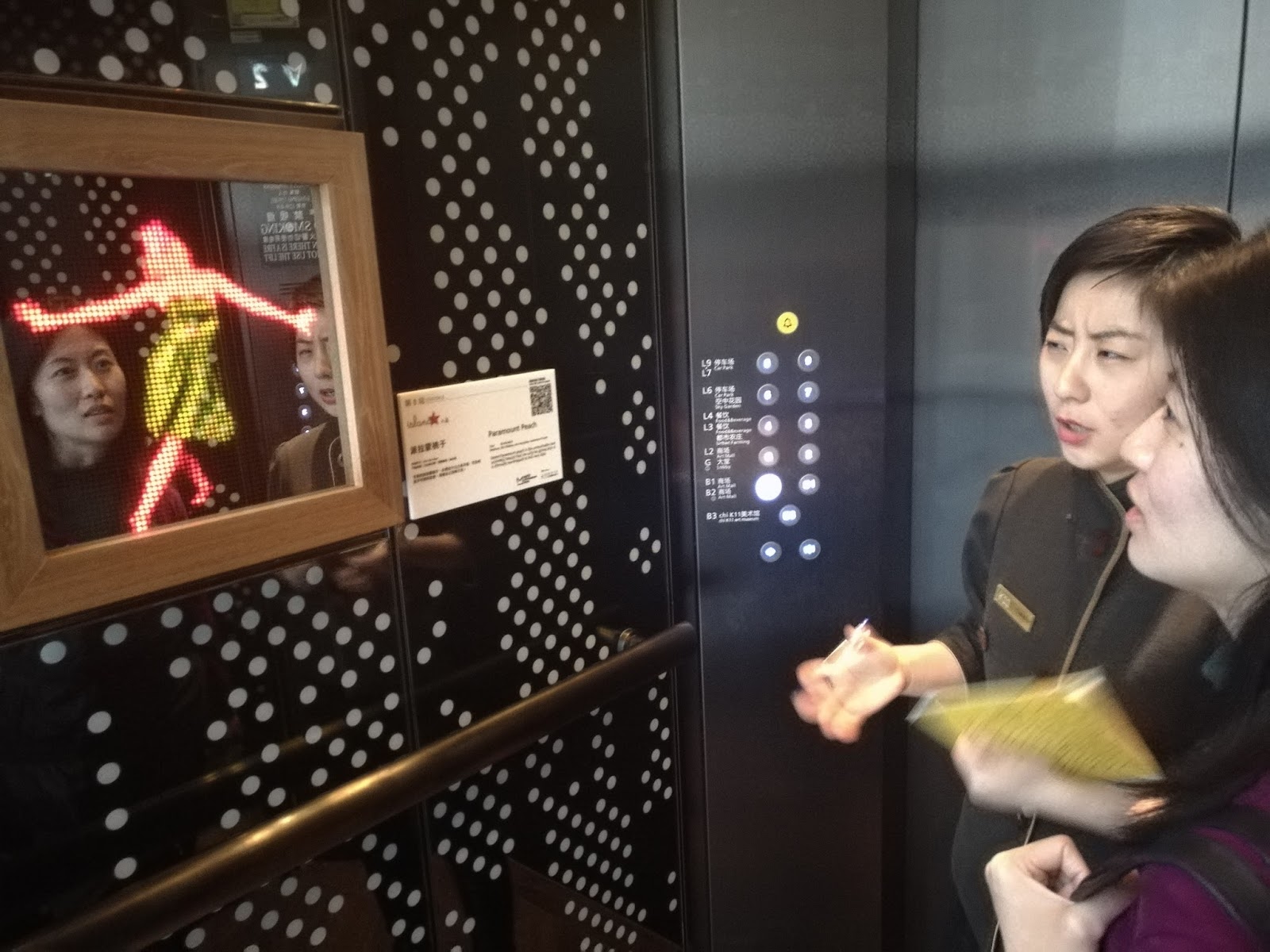
A final decorative video piece waited for us in the lift. This seemed to be how K11 liked its art: a catalyst to consumption and status symbol of a luxury lifestyle. This tour, it slowly dawned on me, was about grooming the next generation of art loving consumers. The guide told me that the tour is frequently given to children, hence, I realised, the simplistic content matter of her explanations. I'm guessing the commercial logic underpinning it is, once the kids become accustomed to the mall they will return with mum and dad (and wallet and purse) in tow. No doubt, there is some genuine love of art behind this collection and public display; if it were purely commercially motivated then every mall would feature art. The infuriating thing is the financial hubris that drips off the artworks and second-rate nature of the collection. That would not matter if K11 were just a rich person's plaything but they are significant players in promoting Chinese contemporary art nationally and internationally. Last year, for example, they were behind Zhang Ding's appearance at the ICA in London for Frieze. 


Stepping out of the lift and saying goodbye to our guide, I looked back at the directory on the wall from which it was not hard to see that this place has some serious money flowing through it. The next day we received a phone call from K11 asking about the tour. Naturally they asked about the quality of the guide, the comfort of the tour and such things and fortunately for them it was my wife who took the call and not me so the answers remained civil. At the end came the most important question, "Did you spend more time shopping around K11 afterwards?" They were smart enough not to directly ask, "How much money did you part with during your visit?" but the meaning was clear. They got the polite but vague answer they deserved but the real answer, which they didn't receive, was this, "Not a single RMB. I couldn't get to the exit too quickly!"

Thursday, 16 July 2015

The Stockholm Metro Art Tour

Stockholm is busy right now branding itself as The Capital of Scandinavia, a title I can only guess they have seized upon without bothering to consult their neighbours. So, what does the Scandinavian 'capital' have to offer beyond painful prices and Abba nostalgia tours?


For starters, it has free guided tours of its subway's art programme organised by SL, the company who run the trains. The tour began with an introduction to the city's transport network: facts and figures stuff.


We then descended down into the metro, our spritely granny guide leading the way.


She seemed to enjoy guiding us; she told us she had been giving tours of the metro's art for 16 years. Just as it is difficult to maintain a stage show for such a length of time, it is is also very hard to give a tour for such a duration and for it to not become sleepy. Bizarre Bath is one of the rare examples of an old walking tour/show that still feels fresh despite its age, but this tour did not have such vigour: spontaneous it wasn't. Still, we slowly made our way through the station listening to the same story that had been spun out time and time before.


We were to be shown a number of the cave-like subway stations such as this one. The tour only ran to one hour in length and we visited just four stations, however, we learnt that the majority of the 100+ stations in the city feature artworks of one kind or another. In this way the tour was an eye opener as now, after the tour, I continue to look out for the art at each stop.


At the same time as getting a basic art appreciation tour, we also got some background history. The basic story was that the country was more powerful in the past and that not participating in the major world wars of the 20th Century has made the country rich again. 


Since the tour was spread over a number of stations, was interspersed with short metro rides, and the artworks were very different to one another, it was always going to be a difficult tour to hold together and frame through any coherent narrative. The solution of not bothering to develop anything across the tour was of course predictable, but I would have liked to have seen something to elevate it beyond a succession of moments. In situations like this I try to find something of my own to explore but even that largely eluded me till some time later when I got focussed on her hands.


Some of the locations were elaborate and more than a little kitsch. I can imagine this arrangement sinking into the background if I lived in Stockholm, but as a visitor I found it quite amusing.


Others were rather more predictable showing themes like sport or folklore. This is a 3D picture which we were encouraged to explore from both sides. In terms of art appreciation this was quite unlike the tour I took of the Kunstmuseum in Stuttgart, which aimed to get the public talking about the art themselves. This tour was more of a one way affair in which the guide pointed out the art and made some short comments such as, the footballers in this picture are the Swedish national team from the mid-seventies.


Whilst her face was not particularly expressive and the descriptions of the artworks anodyne, I came to notice that she used here hands a great deal to explain her ideas. I remember once coming across a theory of there being different cultural uses of hand gestures based on some studies in New York City back in the 70s: Italian Americans used their hands for emphasis, Jewish Americans used theirs to indicate the causality of ideas, etc. This got me focussed on her hands trying to figure out how she was using them. For a while, this completely revived my flagging interest in the tour. If I were to describe her hands I'd say she mostly used them to draw maps and demonstrate physical processes such as how layers of concrete and paint are put together, though now and again she was doing other things with them too. In fact, once I started noticing her hands and the two chunky blue rings she wore, I got far more interested in looking at them than at her face or even at the art itself. In this respect she reminded me of Jeff Goldblum who, in my opinion, has the most interesting hands in Hollywood and who can make a Spielberg movie watchable simply on account of his gesticulation.


One of the more impressive works was a large-scale piece that took up a major intersection of the subway. We were told that the figures were all based on real people.


She made a point of how even many Stockholm residents were not aware of some of the art works, such as this black trumpet on black tiles. I like subtlety and believe there should be more space for it in public art, but this struck me as something else. It looked to me like a not so interesting decorative art work that was largely invisible to the casual viewer. Maybe there are levels that escape me here but I had to think back to a conversation I had earlier in the day with a choreographer living in Stockholm about the generous level of public financial support for the arts in Sweden. We were having this conversation as we both came from places with much less public financial support and we were caught in the dilemma of both admiring it, and in his case benefitting from it, yet also doubting its effectiveness in producing great, or even half-reasonable, art. The old theory goes that if you want the great art you need to also have the depressingly mediocre and the downright terrible art too: any head requires a body.


These doubts didn't seem reflected in our guide's commentary, however, it was upbeat about the art right down to this final scratching on concrete with which the tour came to end. My overall feeling was that the tour could have been a great deal more dynamic and it was popular mostly because it was a rare free tourist activity in an otherwise over-expensive and under-exciting city. That said, there is always something to enjoy if you look hard enough and her hands really made the tour for me. There are more tours to come, however, so maybe the city has some unexpected delights waiting around the other side of the proverbial corner. 

Thursday, 25 June 2015

The Free Alternative Tour of Berlin


To the East of the city, by the banks of River Spree, runs a daily 'Alternative Tour' of the city. A reasonably sized group of us gathered at noon for a three-hour walk through the sites of Berlin's counter-culture. This tour is another so-called free tour, which is to say, it is one that is done for tips. Unlike the Amsterdam 'free' tour I recently took, this one was not pushy and did not try to pump us to give money, it was much more low-key. Our guide, a young Australian woman, introduced herself to us and it turned out she was relatively new to Berlin having lived in the city just one year. Her main qualifications for the job were her command of the language, an outgoing personality and her enthusiasm for street art.  


After having a chat with another one of the company's guides, who runs their ever popular pub crawl in the evenings, we stopped to admire our first piece of street art. We learnt a bit about the artist, an Italian woman, how the work was made and what it might mean. We then took photos and filed off to the next artwork.


We were given an interpretation of this work that both started and stopped at the blatantly obvious: it is a political piece of street art about the euro crisis. I'm not so used to this blunt form of art criticism and if I try to imagine it in a museum tour it can be almost funny. Here, however, it more or less worked as it was in keeping with the directness of the art itself. Indeed, I had the feeling that the majority of the street art we came across was raw expression, though there were some refined works too, and this got me wondering, what is the attraction in looking at miserable art? When I thought about it further I came to see that these sorts of pictures are to art what teenage grunge bands are to music. They rarely have the skill or subtlety of expression of gallery artists and they are working to a much more immediate, easy to grasp, aesthetic. They are still expressive, some maybe even more so than the professional art, and some people (mostly younger) will feel more connected to this sort of art than to what they'd find in museums. There are exceptions too; crossover street artists who branch into advertising, gallery shows and coffee table books, which we'll come to later. 


She talked a lot about the different techniques employed by street artists, such as, attaching wheat paste posters to the wall. I found it surprising she did not acknowledge the man standing to the side of her sticking an advertisement, piece by A3 piece, onto the wall. The technique is very similar and I was struck that the advert was not printed on a large sheet of paper but was rather home-made and assembled from many smaller pieces. She said that street art being used for advertising was frowned upon yet I also see that it's rife. The NSDM wharf in Amsterdam, where I will open another tour in a little over a week, is full of street art advertisements for trainers. It is also, not co-incidentally, where MTV have their offices and studio.


The pivotal moment of the tour for me came when we were walking in Kreuzberg. We came upon a large and very direct piece of street art: a hand giving the finger with the words 'FUCK YOU' above it, just in case you didn't get the message. On the side is another piece of text reading "TRAVELLERS WELCOME FUCK GHETTO TOURISTS". I guess that would mean us. She said it was a new piece that was 'brutal' and she couldn't find a neat way to incorporate the message back into the tour, as it was a direct challenge to our tour's legitimacy. 


We instead talked about a large squat that once occupied the land in front of the wall that was so spectacularly showing us the finger. The place had been cleared by the city authorities fairly recently amid speculation that a fire which precipitated its clearance, on public health grounds, was not accidental. My impression was that the whole area was cleaning up and while it still had the self-identity of being grungy and alternative, the reality was something else. The cafes we passed were actually not so cheap and the punks were outnumbered by the hipsters and Turks going about their business. The conditions that had created Berlin's counter culture were no longer in place and, block by block, the city seems to be returning to the mainstream German fold.


While we were talking about a street artist who was fined a hefty sum by the city authorities, decorators on the other side of the road were painting the front of a building an elegant shade of cream. It must be an unrewarding job painting a building like that in the full knowledge that within 48 hours it would be tagged but, on the other hand, that does also mean that as a painter you have a steady stream of work. Indeed, even the street artists have this problem of their pictures getting plastered in tags and we learnt that some return to touch up their art.


We came to the work of some successful street artists, a pair of twins who make large-scale paintings such as this one on the side of the building. There must be a system for the promotion of artists like these and it might be interesting to learn how the street and money collide and interact with one another. The Banksy film Exit Through The Gift Shop covers some of this terrain quite entertainingly but does so from a self-serving position. A cooler more analytic documentary would make for myth-busting viewing.


The last stop on the tour was a park with some street art. Some alcoholics were drinking beside the art we were looking for so we did not interrupt their reverie and instead concluded next to this statue. There was nothing said about the statue, however, it was to all effects invisible. I found this a pity as it too is art that is found on the street. By focussing so exclusively on contemporary street art a great deal of art that is also found alongside it was missed and I would have found the comparisons very interesting. Perhaps that is just me reimagining the tour with a broader visual field that would bring into focus some interesting questions around who makes art, for whom, and how. Those sorts of questions which open up a discussion of society, politics and aesthetics were outside the scope of this tour, however, which stuck to simply showing some examples of one type of art. Finally, it is a tourist walking tour after all.