Showing posts with label centre. Show all posts

Thursday, 11 September 2014

The Spa Tour of Bath: an advert for privatisation

The Spa tour of Bath is in competition Bath's The City Trail for being the most neglected tour of the city. It is an audio tour that can be found tucked away in a corner of the petite and distinctly sleepy Spa Visitor Centre. 


It is available in English, French, German, Japanese, Spanish & Dutch and considerable effort has clearly been put into producing it. This effort has not translated into visitor numbers. When I asked the assistant at the desk when was the last time someone took the tour, she thought about it then replied, "last Summer." She did qualify this by saying she doesn't work every day and it's possible someone took it on one of her days off, but she seemed to suggest that even this was unlikely. That's one person taking this tour per year. I find that an impressive statistic! I was that person for 2014. 


The way it works is simple enough: you take one of the crisp and clean (i.e. unused) maps, select the language on the handset, punch in the number on the map and it tells you about the location you are standing in.


The audio commentary was a jovial and camped up affair, much like a BBC radio adaptation of Dickens. Popping out of this were short interviews with people who had memories of working in the spa. As I was listening to this I also browsed the walls and came across some rather interesting things.  


Obediently following the audio guide and map, I dragged myself from point to point in the streets around the visitor centre. This was a history focussed commentary that was about how and when the baths were first constructed and then used. The two mental pictures that it left with me are of people bathing in canvas costumes with weights attached to protect their modesty, and the Bath rugby club celebrating in there after matches. The second mental image is derived from a LP I have in my collection with this delightful cover.


Volume 1 is not much better, but that's another story.


With the rugby songs nagging away in my head, I made the circuit which took me around the back of the new Thermae Bath Spa. The commentary seemed to be designed to tell the story of how much better the new spa is and how obsolete the old one was. Seeing as the tour was, I'm guessing, commissioned by or at very least, made in collaboration with the new spa owners, it is not surprising that it was talking up the swanky new spa. The audio tour ended with a nicely cheesy plug that went along the lines of, "you've immersed yourself in the history, now why not immerse yourself in the water?"


Back in the visitor centre I looked more closely and read that the spa used to offer treatment on the NHS. The closure of the public swimming pool on this site was also mentioned and I started to wonder if the subtext of this tour was the privatisation of public utilities. It certainly read that way to me. Given that this somewhat preceded the Thatcher government's public services closing-down-sale and that there's a 20-year time lapse between the closure of the public spa and its reopening as a private spa, it is unlikely to be a cynical privatisation in which those managing the premises orchestrated its sale for personal profit, yet, the effect is the same: it is now private. The true story of how and why it happened is probably rather complicated and I only stumbled upon a few shreds of PR dressed up as a tour. When I come to talk about this on my Tour of All Tours in October this puts me in a position of knowing little and that is something that can have its uses. I think I should like to ask the people taking the tour to share their various takes on this old story of why the city has moved from having public spa and bathing facilities in the historic buildings, to these being privately owned and managed.  
  

And here are the prices for using it now. Not cheap!


That said, it does look rather special. There is even an open air swimming pool on the top of the building, as the audio tour was keen to stress, which has views over the whole city and surrounding hills. This, I suppose, is the closest I will get to seeing it.


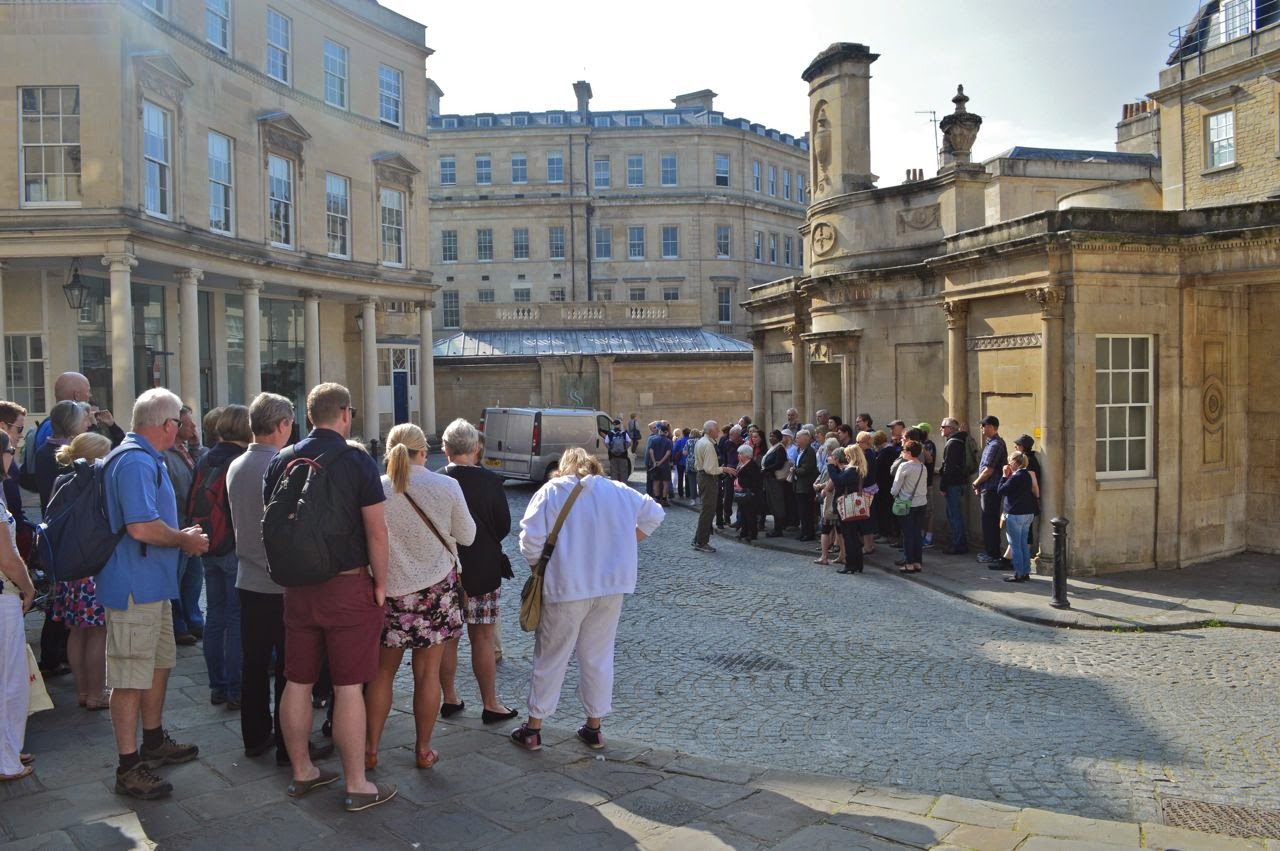
When I was about to go, tour groups descended en masse. I must have hit prime time for the guided tours as no less than three groups all clustered around the baths within the space of five minutes. It is rare to see quite such a gathering here, the city's sites are diverse enough to usually spread the groups, but 11.30 AM is hot. 


I noticed this group who looked unfamiliar and, from the name badges I was able to determine they are with APT Touring and their trip is most likely the 21-day UK and Ireland tour that costs £5615. That's pretty expensive and they offer a more pricey 35-day trip with a European cruise added on for £9650. No wonder they were mostly older with time and money to burn. The guide had a little microphone, the type I sometimes use, and after having given a test Tour of Tours on Tuesday, I see I will need it. Some of the streets in Bath are really loud.


Chance would have it that, on my way back to my accommodation, I passed the new public swimming pool and sports facility housed in the 1970s civic leisure centre. It's not quite the same thing as the historic baths. I look forward to the conversations that come out of this part of tour.

Wednesday, 20 August 2014

The Jane Austen Centre Tour: literature as lifestyle

The Jane Austen Centre, Bath, is squeezed into a Georgian house and spread over two floors with the third floor, up top, given over to a tea room. At the front door a middle-aged man in period costume, sideburns bristling, hovered around, occasionally waving at the passing tourist buses trying to drum up business. I could see how his job could easily become a soul destroying one if he invested too much of himself in it. I slipped past, got my ticket from a lady, also in period costume, who ushered me up onto the 1st floor.


There I waited for fifteen minutes until the next introduction to the centre was due to start. At first alone and then with a small but growing group, I watched a promotional video for the Jane Austen Festival, which takes place annually in Bath and features literary events, dances, walks, concerts and dinners. Much of it appeared to have next to nothing to do with literature except for the fact that Austen wrote about these things. There is, I realised, a big market for fans to enter into the world of the novels that they hold dear: they've already bought the books, the next step is workshops in the dances that Austen may have enjoyed.


A young woman entered and then ushered us into the next room where she gave us an introduction to the life and work of Jane Austen. I have to confess to not having read cover to cover any of her novels; I received a truly awful education in English literature that pretty much poisoned the entire English cannon for me. So, In order to get better acquainted with Austin's oeuvre, I have just watched an adaptation of Northanger Abbey. It looked like a good quality Mills & Boon story. Indeed, taking a look at the Mills & Boon website, like you do, I noticed that they have a 24-book Regency Society series of brassiere busters. I know that TV adaptations are almost always going to have a dumbing down effect on literature and I also see it was a vastly different thing for Austen to write novels back then than it is for the M&B stable of authors to pump out their slim tomes destined to fill charity shops. Still, it is ultimately girl meets boy stuff. That said, even though I was through with it by about 20 minutes and was then watching it mainly for the Bath angle, I did hang on till the bitter, or should I say saccharine sweet end, when they got married, had a baby and lived happily ever after. You can't leave things like that dangling in the air.
  

We were shown a picture of Austin's family home in Chawton, Hampshire which is today the Jane Austen's House Museum. I got the distinct impression that it was by far the larger and more prestigious establishment and that this smaller Bath centre, existed because the city is a major tourist destination and the setting of two of her novels. The Bath connection is, then, not wholly tenuous, even if it takes the form of a museum primarily because of tourist money. I noticed some much more opportunistic literary acquisition still in the shape of Birmingham's claim to some of the Sir Arthur Conan Doyle glory on the basis of a few months' work there spread over 3 years. Portsmouth has their angle on his time there, Edinburgh can claim his birthplace, London has 221b Baker street and Crowborough, his home in Sussex, is in with a punt too. There's no reason why there should only be one museum to these figures, but in the case of Jane Austen and Bath, I felt it superfluous in that they didn't really have anything very original to show, the original objects are held elsewhere. The relationship between the author and city was, here, not that of the city showing off its finest sons and daughters but rather the city using its relations with famous figures to show off itself. Bath is in the enviable position of having been a society resort to which practically all of the 18th Century canonical English authors would have paid a visit. This opens up the possibility of many more museums where this one came from.


The introductory talk lasted no more than 20 minutes and we were then led downstairs into the exhibition space and left to it. There were displays like the one which work the Austen in Bath angle; both Austin the writer and the lives of her literary creations.


Following this was a video that explained it a whole lot more. There were some nice shots of the architecture and a spectral Georgian lady making her way along the streets. It looked a bit like a ghost walk but I suppose the idea is that the presence of Austen remains tangible in the city today. It was striking that the Bath of this video looked almost exactly like the Bath of the walking tours. No Primark and absolutely no Poundland.


An actor who had starred in one of the adaptations of her novels a few years back gave the authoritative narrative that strung the video together. It featured many clips from film adaptations and the whole package was politely short so that it didn't try the visitors' patience. If there are multiple levels and nuances to her work, as I'm guessing their must be, they were not evinced here. The centre, when taken as a whole, seemed to celebrate Jane Austin and the Bath lifestyle that she led and wrote about, while leaving her actual literary works more or less untouched.


Moving on, I came to a wardrobe of clothes and here I am playing at being the Georgian gentleman. Dressing up in period costume was more popular with the ladies: I was the only man attired this and the choice of men's clothes was far more limited. Looking at the picture now, I think I look a bit stranded in the 21st century, not quite able to make that leap back. I do have some pictures from my dim past working on TV period dramas, however, and in these I am a little more fully makeover for the 18th and 19th centuries. Thinking back to those costume drama experiences, I seem to remember the programmes almost always found themselves caught in the dilemma that the audience and actors didn't actually want to go too far down the line of historical accuracy. If it's done too thoroughly, the actors get stuck with weird haircuts and facial hair that interferes with their other work and they have to learn accents and mannerisms that today's audience struggle to understand. So that is how it was in the centre too: we all remained stranded in our presents, the costumed staff in the centre and tourists dressing up for Georgian dinners and dances.


This is a picture that was taken a few weeks ago when I visited the centre for the unveiling of their latest exhibit. I only had the time that day to see the final exhibit, this 'lifelike' waxwork model of Jane Austen based upon a single sketch and written descriptions of her. There are now 'no photography' signs up around it. I'm trying to understand the impulse to stop photography since taking pictures has become so much a part of what tourists do. No 1 Royal Crescent also has a picture ban as does Denis Severs House in London, which I reviewed a few months ago. There is an article in The Telegraph supporting a photo ban, but reading through the comments it is interesting to see how normal people are more inclined to allow photography, as indeed am I. While I think there is a problem of some people paying too much attention to artworks through the lens of their camera and not looking closely enough when lacking a screen, I believe educating people to look rather than banning this principal form of image distribution is the answer. The Jane Austen Centre banning just this single exhibit seems odd and it could have been done for two reasons, as far as I can see. The first was to protect the sculpture from flash photography. I don't know how it was made and if it is sensitive to flash, so maybe there's something there. The second reason is simply to protect postcard sales. This Jane Austen lookalike sculpture and the dressing up option in the previous room are practically the only two photo worthy moments in a visit to the centre. Having many pictures like the above double portrait in circulation brings more attention to the centre and Jane Austen more generally. A similar debate takes place in the performance field and I am of the opinion that it is better to embrace the camera as this then leaves records that provoke memories and spark conversations.


And then, spat back onto the street, I saw this: blokish humour co-existing with Georgian make believe. Faced with such a contrast I see how there is a space for a Jane Austen Centre. Bath is a divided city and the lines are only starting to become a bit more visible. If it is possible to find tours that can make these evident is a challenge, but I'm out every day with a new tour, so lets see.

Saturday, 16 August 2014

The Waylosing Tour

The meeting location for the Waylosing Tour was Birmingham New Street Signal Box which, handily enough, is not located on New Street at all, but is instead round the corner on Navigation Street. What's more, the sign marking this brutalist classic is located in a position facing the train line and is only visible from the street when seen above a wall in a few locations, none of which are actually on Navigation Street itself. This made it a familiar yet mysterious building in the very heart of the city and a prefect place to begin.


It had been raining all morning and the afternoon tour looked like it would be a wet and lonely one. Come 1PM, however, most of the people who had reserved showed up, ready for 5 hours of getting lost on the Birmingham streets in the rain. This was a hardy bunch. We began by establishing which areas of the city we knew best. The general consensus was that the South, West, and centre were the most familiar parts of the city, though there were some hardened urban explorers amongst us who had made it their business to see all points of the compass. While it would be easy enough for me to get lost in Birmingham as I don't know the city, showing this group something none had seen before was going to be a challenge.


With the East as our direction of choice, we set off into the drizzle which obligingly cleared in minutes to leave a mostly bright afternoon. A rhythm established itself whereby we'd walk a few hundred metres, sometimes a few hundred more, stop, look at our new location and consider the choices we had ahead of us.


When we stopped at intersections to discuss the respective waylosing merits of the different paths ahead, we also looked for things that could act as signs. This one for a solicitor is quite literally a sign, albeit one that was placed upside down. As often as not, a building, colour or object could do equally well as our waylosing sign. I like this business plate very much because it is a sign that poses more questions than it answers. Another early find was the sign 'Ask Italian' which was simply the name of a restaurant which sat beside one of the forks ahead of us. These simple observations were allowed to be what they were, i.e. they didn't have to be immediately smart or significant, but every now and then I'd bring previous ones back by mentioning them in case they could help us develop a narrative around the tour as it unfolded. 


These cones looked for the world like clues too. What they were pointing to or what underwater geography they marked was unclear but that did not stop them being signs all the same. A walk unfolds in time as well as space so there is always a going to be some element of narrative, but when we deliberately lay our mental traces as we go, this capacity to see it as a journey with a theme and logic of its own is greatly enhanced. When I made my trial waylosing tour in the city some 3 or 4 weeks ago, the walk came to its conclusion at the Ulysses Kebab Shop. Even though I don't eat meat, I was happy with the reference to both The Odyssey and Joyce as that rounded the walk off very nicely. I was hoping today's walk would start to make sense a bit earlier and not only come together at the end but I also wanted to genuinely work with what we saw and not impose a pre-determined meaning upon it. This meant we had to be patient and trust it would become clearer the more lost we got. It sort of did. 


At the same time as thinking about a story or theme to the tour there remained the very practical task of losing our way. One technique that was helpful was to switch levels from street to canal and back to street again. The canal is great as it has a different navigational logic to the street, what's more, you don't always see the surrounding roads when you are on this lower level so you can cut through otherwise easy to understand routes. You can only have so much of a good thing, however, as canals can also become predictable after a while as they are usually quite straight. 


We walked some real distance and the group was fine with this with no moaners. When trying to get lost distance matters. Thoreau's notion of a 10 mile radius from your home being a suitable distance for an afternoon's walk and at the same time corresponding to the area you can survey in a lifetime and still always find something unfamiliar, came to mind. That requires a conscious search for the fuzzy areas of the mental map and while we began with this idea which propelled us East, we then went through a number of other techniques to help us stumble upon the unknown. If I can imagine two different approaches to way losing I can see one as the search for the North West Passage whereby you have a known start and end point and try to connect them through unfamiliar territory, whereas a second model is to head off into the uncharted periphery with no defined destination. We were more the latter sort of explorers today, though we did have an end point of sorts: I had said we'd aim to be back in the city centre by 6. 


The ambient foods on this sign is what caught my attention. Not being in the catering business I immediately imagined it as food to munch on or suck discretely through a straw whilst listening to Brian Eno albums. We simply had to take a look inside. 


Instead of the large warehouse I was expecting, the doors opened into a single, modestly sized room with a man and a woman sitting behind a glass counter at the far end. Two freezers displayed some non-ambient weekly offers such as this 10-kilo pack of frozen squid tubes. Good value though they were, I regarded them more as an art installation than as serious foodstuffs. 


They had a remarkably good and inexpensive coffee machine so, with espressos in hand, we used the space as if it were a cafe rather than the order room of a warehouse. The staff were bemused but tolerant about us getting lost and finding them.


This alarming sign popped out though thankfully none of us were pulled over and strip searched for concealed squid tubes.


Refreshed and back on the road again we had managed to more or less lose sight of the landmark BT Tower that tethered us to the city-centre but, having made great efforts to remove that landmark, another replaced it in the form of these gas storage tanks.


We came to a large Chinese supermarket and restaurant which we entered as it was time for some refreshment. As we were no longer in the city centre and they had ample space they were fine with us just drinking tea in a way that would not be the case in Chinatown where a meal would have been required. I remember talking about the significance of the compass to Chinese cities and people's sense of orientation. It seems to me that in the UK we are less aware of this as the cities rarely follow grids but instead twist and snake according to the contours of the land with little unified order.


We walked some more and just as we arrived at Spaghetti Junction and looked all set to explore the nation's most iconic car structure as pedestrians, we changed track and dived into a bus. While the junction was no doubt impressive, it was also familiar to several of the group and exploring it would really be the work of a different sort of tour. I also thought about the sign we had seen earlier and made sense of at least one of them: 'Ask Italian' = Spaghetti Junction. On the bus we settled at the top and I asked the group to close their eyes.


Closing the eyes was strangely addictive. I had thought I'd keep mine open so I could oversee the situation and maybe take a picture of this decidedly odd looking group. Once I had closed them however, I found that it became quite compelling and instead started talking about what we could sense and where we might be passing through. In spy movies you see scenes of blindfolded men in the backs of cars being driven round cities to secret destinations; this was a budget version in which we made do with a West Midlands Bus day ticket. We came to a halt after some minutes and I was not sure if we were at the terminus or were taking a long stop. We waited till finally it was clear we were not moving and reluctantly opened our eyes and descended. The bus driver could not work us out at all.  


From there we crossed a park and entered a housing estate and finally were getting properly lost with no clear sense of where we were or how it connected to where we had come from. A large guard dog jumped at me from behind a fence, its bark and bite both scary but thankfully separated from me by metal mesh. While this would not have had such impact elsewhere, having the dog jump out at me once we had entered the lost zone made it more of a shock. I didn't know what sort of place we were in, how exactly to get out of there or indeed what precisely to expect. I won't exaggerate and say I was in a state of fear, but my emotional reaction was stronger as I certainly was that little bit less in control. We then stumbled upon this graffiti 'Hi bill'. I posed for the picture but as you can see, I was uncomfortable, expecting another vicious dog to launch itself at me from behind the black door on the right that bears a 'beware of the dog' sign.  


From the dog estate I then saw what looked like an informal entrance to a green space. We entered and found this semi-desolate location, the site of former construction that had been raised to the ground. I do not deliberately seek such places in the way some urban explorers do, but I do value them all the same as their official neglect permits all manner of unofficial activities to coexist making them paradoxically rich and diverse spaces. 


We saw a steady trickle of people passing through here, mostly young men on their way somewhere else. We, however, were occupying this space: this was our destination. As it was now 5.15PM and I sensed this would be the point in the day when we would be the most lost, it made sense to savour its character. I understand that Birmingham is quite rich in such spaces and this makes me wonder if this experiment were repeated would it be to a similar sort of location that we would be led or would the dynamics of the group lead us somewhere very different?


And here is a group photo of the merry waylosers from Birmingham basking in the warm sunlight. I was lucky to be accompanied by such a great group on this experiment as everybody was very easy to talk to and curious about the urban environment. I think we had pretty much all got talking to one another at some point in the 4 or 5 hours and those conversations make up an essential part of the experience transforming something that was a curious proposition into a genuinely fun afternoon out. It all had to come to an end however, and from here we switched mode from waylosing to wayfinding. We quickly found a bus back into the city centre, a ride which retraced our steps uncannily well. From an elevated position on the top deck of the bus it gave us an overview of the route we had taken and allowed us to review the day's adventure in 10 minutes flat.


We were swiftly delivered to The Woodsman where we drank some well deserved beer. We stayed for a long time (several hours) unpacking the experience and more generally unwinding. Thank you Still Walking and thank you Birmingham for entertaining this notion. It gives me an appetite to go further into waylosing and perhaps even expand the frame of it so that it could take in a whole weekend and take place in a foreign city, which would of course greatly aid getting lost. These are all ideas to turn over and develop at a later date but one thing I am quite sure of is that there will more tours like this in the future, though they will of course be quite different too, as they are all steps into the unknown.  

Wednesday, 23 July 2014

The Bath Bus Tour: City Sightseeing automaton guides

The City Sightseeing bus tour of Bath runs along two routes: the first circles around the city-centre and the second climbs up the hills so that you can get a view over the city. This is exactly the same as the Stuttgart bus tour which I have written about previously. Having two routes instead of a single longer ride means they each of the routes has a clearer basic theme and neither of them takes too long: they last about 45 minutes each.    


There was live commentary in English but no possibility of listening to it using any of the other languages indicated. I don't know if these were not playing because there was a live guide but it did mean that some of the people on the bus looked confused and then ignored the commentary, taking the bus simply as an open top bus ride, which can be a pleasant thing in itself. Unlike Stuttgart, whose tourist attractions are scattered over a large area, Bath's attractions are clustered in the city centre with relatively few points of interest that far out. The stop button was used on just one occasion. There is indeed less point in having a tourist bus in Bath as the city is highly suitable for walking tours. The bus therefore does not so much act as a transport service getting tourists to and from the attractions, it functions as a guide imparting knowledge to those who don't like walking.


Like in Stuttgart, art had a low position in the commentary. The art gallery was described not by what it currently does but by the fact it is free and what the building used to be. I get the impression that unless this sort of bus tour takes place in a dedicated 'city of culture', it is assumed that tourists don't have a great deal of interest in art. Added to that is the not insignificant fact that the bus moves much more quickly than a walking tour which means descriptions tend to be brief and to the point. There is simply no time for art.


Because it was mid-summer and the trees were full of leaves, it was hard to see through them and admire any of the stunning views that the guide was talking about.


As has been the case with all of the other Bath tours I've taken, the guides were somewhat older in age as indeed were most of the passengers, except for a Thai family who were taking a lot of photos. 


The suburban hill bus came to a rest and I changed onto the city-centre bus. It pulled away, the guide began to intone and settled into a rhythm. His commentary mixed significant and interesting details about the city with some pretty tedious information that seemed of little relevance. Granted, what is considered interesting and what is not, is highly subjective and I'd expect there to be some things of greater and some of lesser interest to me. That understood, I felt that there were points where the commentary continued not because there was anything interesting left to say but merely to cover the silence. For example we'd go from a story about Queen Victoria feeling snubbed by Bath to the opening of a new Primark. This has in fact rather inspired me with my imagination taking this to its natural conclusion: the deadpan delivery of a radically flattened order of knowledge in which everything is of precisely equal value. If nothing else, there is some good comedy potential here.


The historical background was more than a little messy. I learnt that under Henry VIII, England moved away from the Catholics and back to the Church of England, even though I rather remember it was he who founded that church in the first place. Meanwhile, a seagull did its business. We got a lot into celebrities, like Dickens who is connected to this pub, and celebrity chefs, who I very much doubt are connected to it. It seems pretty easy to get into historical figures here as not only did many live here but a great many more visited. When you enlarge the pool to include famous people paid a visit to Bath you practically all people of significance from the 18th century as this was the society holiday and gambling spot.


The weather was great, maybe even a bit too hot so I was sheltering under the covered area at the front of the top deck, as was the guide. This basic arrangement of the seats and space is awkward as it leaves the guide facing in the same direction as the passengers. As a result of this it was difficult for him to make any real connection with the public so, on my tour, he simply talked off into space. That must be a difficult thing to do for hours and hours on end and I could tell he was struggling to stay focussed. Finally he seemed to drift into autopilot, repeating the same information time and again to nobody in particular.


Some final things I spotted today: Fun For Less Tours. If I see them again I'll have to follow them and see whether they take people into the Weatherspoons for a drink, and then visit the Pondland and Primark for shopping.


And second, I noticed this pub map of Bath that proposes several routes for a pub crawl. Actually, the routes are not precisely that as they mostly contain too many pubs to make a drink in each feasible. Such a map which did offer distinct pub crawl routes with options for additional elements might be a nice but complicated work. A definite labour of love. This  map makes me think of the London Underground map and of the Bath's relationship with the capital. I sense a degree of complicity with London as opposed to the hostility that is often manifest in my home city of Portsmouth. I learnt, for example, that the 2004 film Vanity Fair was filmed in Bath, not London where the novel is set. In the city centre there is a shop called London Camera Exchange. Such a shop would rapidly go out of business in Portsmouth if it didn't change its name.


Bringing these thoughts together, I am also reminded of a Victoria Line pub crawl I heard about. The Victoria Line is the only proper line (i.e. not Waterloo and City line) on which it is possible to hold a terminus to terminus pub crawl. the idea is you start at Walthamstow Central, have a drink in a nearby pub, duck down into the tube, take it one stop, emerge for a drink and then repeat this process till you make your sozzled way to Brixton. That's another tour for another day, and most probably, another person.