Today's tour was a self-guided tour in the sense that my guide was not a living breathing tour guide but instead 4 sheets of A4 that I printed at home from a free download I found on the Internet. I have written about this idea of the self-guided tour on an earlier blog so I won't repeat what I wrote there, but, this tour has given me the opportunity to expand upon those ideas somewhat. Suffice to say, when making my way around Spitalfields on this tour, I tried to follow the map and usually succeeded.
A Walk Through Spitalfields Stories has been designed to be read as an A5 booklet but working out the paging and folding it accurately on Commercial Street is a little optimistic. Best do that before you set out. As you'll see, mine is messy and distressed from being stuffed into my back pocket.
I set out in search for Number 1, the starting point of this circular walk. Without too much effort I found it: SOUP KITCHEN.
It was possible to stand more or less on the same spot as the photographer who took the picture in the booklet did, and to then recreate it. The difference here is the picture has been cropped at both top and bottom. The accompanying text from 1892 gives a snippet of information that can then be placed alongside the building today.
En route to number 2, I rounded the corner and came to the spot that the Spanish Jack the Ripper tours always seemed to be occupying. It was a little earlier in the day so it was empty this time and I had a good look at what was purportedly London's most lawless street 125 years ago. Nowadays it is a car park protected by dogs.

My circular tour took me next to this lamppost where a Charles Dickens quotation was my framing text, a quote about people leaning on lampposts that suggests though neither confirms nor denies that this was the precise lamppost Dickens had in mind. I have never had much time for Dickens personally even though I know he is much feted in the UK. It may in fact be because he is so celebrated and contemporary adaptations of his novels invariably grace abject poverty with nostalgia that I have such a hard time with his work. In any case, this passageway, I was told on a Ripper tour, was used for a scene in one of the Harry Potter films and this has put it firmly on the contemporary tourist map. There are indeed dedicated film location tours; I ought to cover one sometime soon. What's more, the film industry is seen as a way in which a city may be marketed. The recent Day of the Doctor being an example of this, the Olympic marathon another. However, I find that the media generated images of the city do not correspond to the actual experience of living or working in it as they tend to favour the tourist sites. When walking though these streets then, the visitor is simultaneously walking through a mental film set and comparing the streets to scenes from film and TV. This does not happen in the same way in an undistinguished small city that does not feature in the media. In Leighton Buzzard you really are, I'm guessing, in Leighton Buzzard.

The game then with this tour was essentially twofold. First it was locating the image on the paper in the actual street you are walking down, such as the door to the synagogue here. Second, it was reading the place through the frame of the historical quotation beside it. That at least was the ostensive game. Add to this the task of following the map which sometimes had stretches without designated stopping points. It is quite a simple proposition and it is one that leaves you with enough space to bring your own thoughts to bear. There is not so much room for ambiguity and getting involved in situations, it functions as a reliable guide rather than an unreliable guide such as Alley's Travels in China would do today.

And so to another familiar spot, the starting point of The Alternative Tour. Something that I did not mention when writing about that tour but which has struck me many times since is how it was a tour of street art which ignored a certain type of street art completely. It was very much focussed upon the art in public space that has grown out of the graffiti tradition and made no mention at all of public art, like this sculpture or corporate art that litters the squares and lobbies of offices all over the City of London. I would be interested in how these different forms of art and their economies could be compared to one another within a single tour.
Number 8 was a historical photograph not one from today and so it was impossible to tell for sure which building Dan Cruickshank, yes he of The Bridges of London Tour was referring to. I therefore had to take my bearings from the map.
And this is the 'charnel house' as far as I could tell: COSTA. Little do they realise in the bottom floor on the left, just behind Santa Claus, that they are sipping Lattes where human remains were once collected. This COSTA must also be the one where my anti-capitalist guide on The Alternative Tour got his coffee from. Suddenly this tour I was on was starting to become a vortex sucking in all the previous tours I had taken. The quietness of this tour allowed the references from all the previous tours to find their way in and invade the rather minimal narrative that it was constructing.

A feature of this part of London is roads and passageways that bear no name. This I guess is the result of it being a very old part of the city that has been redeveloped in a very modern way. Whilst I was never remotely lost it was not always clear where I was on the map. I would have to look at an historic map to see if this passage had an old name which was simply no longer indicated or whether this was a new space. Somehow I find it hard to image new public space being created but I remain uncertain what the exact status of this space between the two buildings is.
I came to 18 Folgate Street which is described as a time capsule.
There is nothing very much to see and so I dutifully took a picture and continued on my path. It was only later when looking up the weblink to Denis Severs House that I see that behind this door there really is something to see. What's more, if you look on their website they propose a tour. And so a new door opens in my research of tours in and around Shoreditch and Spitalfields.
Next came Spitalfields market. I remember the place from the mid-1990s as a shabby artistic haunt; nowadays the The City of London has eaten it up and this is what you see on the outside.
On the inside there are still market stalls and food available but these days it is chains like Gourmet Burger and the stalls sell middle class kids rather than vegan slops and second hand tape recorders. What is odd however is that it still trades on the idea of creativity even though the artists are long gone. I guess that is the genius of creative industries.
This is the map that I was following; the route looks a little like a dog with a long tail that stretches East as far as Brick Lane. It is indeed a 'circular' route however there is a gap between number 16 Christ Church and number 1 the Soup Kitchen. This then makes me wonder if it might not be interesting to make a fully circular tour that not only returns to the starting point but which also revisits the entire route a second time using a different framing text.
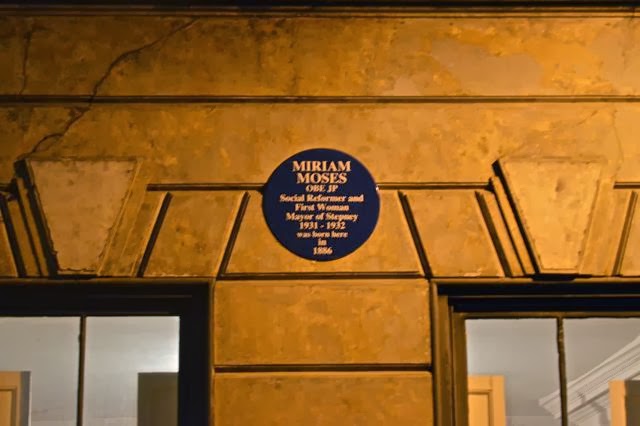
Something I learned recently was that many of these blue plaques are not official in the sense that they have not been approved by English Heritage the body that has historically granted sites this status. This is just such an unofficial plaque. This one does not even indicate upon whose authority it has been put in place.
By the time I made it around to 19 Princelet Street it was really rather dark and I got to see how my new camera really did a better job than my old little pocket camera. Expect better night shots from now on.
I had tried on the Alternative Tour to take a picture of this metal sculpture that sits on the top of a post beside Christ Church. It had simply been a blur and so here is it is. The way these different tours were interweaving was, I realised, a consequence of them taking place within a concentrated geographical space. When I made the Stuttgart Tour of Tours I was taking the entire city as my frame and as such had to construct connections whereas here they were happening very naturally.
Here for example was my first Jack the Ripper tour group of the evening. I was finishing around 5.15 PM and the Ripper industry had already started for the evening.

Which led me to Jack the Clipper on my way between point 16 to point 1 the start of the circular tour. I had heard that the Ten Bells pub had tried to change its name to a Jack the Ripper Theme pub but backed down after protests from women's groups. This barber shop was not so inconvenienced. This then completed my tour and my abiding feeling was that this tour was constructed simply to get people walking it being framed as a healthy and interesting activity. The booklet was part-funded by the National Heath Service and there was a section extolling the benefits of walking. The quotes were a bit random so they never constructed a very precise narrative or theme beyond 'this is all historical stuff that people once wrote about this place'. This meant that I was rarely that deeply involved in the tour on offer but was able to use it as a way to consider the space and how it is to follow a written guide rather than a live guide.