Showing posts with label tourist. Show all posts

Sunday, 7 September 2014

The Bath City Trail

I realised today that I have been walking over a tourist route these last few days that I hadn't even noticed. I'm probably in company with pretty most of the people in the city centre as The City Trail is anything but noticeable.


Upon emerging from the Tourist Information with some leaflets on further tours, such as The Tour of Britain coming to Bath very soon, I looked down and by chance spotted this plaque below.


Each of these brass plaques, sunk into the pavement, has a quote about Bath from a British writer or notable figure of the past. What they have to say is rarely interesting or important, all that matters is that Dr Samuel Johnson said something about Bath.


Unexpectedly then, I was off once more on a tour, excited to see where it would lead me. I somehow managed to miss plaque 2 and passed directly to 3. The arrow seemed to be pointing in the right direction. When I thought about it further, the work involved in laying out this trail is not simple at all and there is scope for error both in the design of the plaques and in their installation too.


The arrow gives you the direction of the next plaque but not the location. It could be 10 metres away it could be 10 kilometres, there is no way of telling. This made the game more interesting as it introduced an element of uncertainty that kept the eye busy. In practice the distances were never that great but they were certainly not uniform either.


The route was also designed to make it easy, as far as possible, by avoiding obstacles in the path from one point to another. It would have been possible to have made two points on either side of a building, so that you would either have to walk through the building or else walk around it, thus going off the line of the arrow in order to return to it. I would have rather liked it more if they would have done this as that would have brought the intervening structures and spaces more fully into the frame of the trail. 


Thinking about that further, such a trail cutting straight lines through space is somewhat reminiscent of the colonial divisions of newly acquired territories. When conquering powers had a duty of administering land over which they had little familiarity, the line was the abstract and arbitrary method of delineating one area from another. It is precisely this possibility of making a line that passes through someone's house and then turning that line into a meaningful border that displays both power and insensitivity. The line can be a potent thing. These lines, however, were not.


As I fell into a rhythm moving from plaque to plaque, I started to think of the work of the Boyle Family too. Some of their works present pavements as wall mounted artworks and I remember how these had the wonderful effect of reawakening the senses to the complex compositions under the feet. The least loved of the directions of looking, down is where these abstract social sculptures abound.  


As I was fully expecting, there were locations where the trail met unforeseen obstacles. The arrow pointed in the direction of this construction site and at the far end of it no plaque was to be found. With the pavement claimed and closed off, I had to assume the plaque was there but I could not be sure, which made it far more interesting.   


I found my way back on the trail again easily enough as it passed through the tourist attractions. I only had to pause and think, what is the most obvious place to walk to next, go there, search for the plaque and there it was.


The trail made me think of the trail of plaques put up by The Museum of London along the length of London Wall. I really should write that up as a tour sometime since I have taken it and it was a really worthwhile stroll. It was enjoyable partly because of its limitations and neglect: the Roman wall has been largely destroyed and exists only in fragments. The contemporary plaques have also fallen into neglect making it a trail of double neglect. Following such a tenuous route became a challenge.


This plaque struck me as a sad one. The designer must have run out of quotes to add so it remained blank with just a number and an arrow in its centre.


After a while the distances between the plaques enlarged and it became increasingly difficult to find them. What also happened is that my eye became more attuned to looking for them. I spotted, for instance, the plaque on the far side of this crossing.


I here realised that there was another quoteless plaque and that the previous ones had attempted to make the quotes relevant for the locations they were sited in. That must mean that there was nothing much to say about Queen Square, which was sad in itself too. Surely, even staying within the frame of the work, it would have been possible to find enough specific quotes for the locations that had them and keep enough generic Bath quotes to spread around the rest. But no, the trail became a simple game of directing the walker from point to point. To be honest I didn't miss the quotes that much as they added little and were written in a circle that makes you have to stand above them, twist your head, turn around and even stoop down to read more closely when there is an interior line of text with a smaller font size.   


Thank God for number 14, then. and a return of words! My impressively practical though less than beautiful shoes, by the way, are for a skyline walk tomorrow which I was instructed to come suitably attired for.


I found this plaque a curious one as it was quite different to the others. It was on the right direction, more or less, but it seemed to not belong to the series. It had no number in the middle and was embedded in a newer concrete slab which was itself framed by tarmac. I suspect that this may have been a later addition but I could not say for sure. If it were a newer addition it makes me ask, is the trail still maintained or was there a year when it ceased to be?


The trail seemed to fall apart all together at this point so I took a picture of a water cover instead, as it was in the area the plaque should have been. That's when it struck me just how invisible these plaques are. With a little bit of weathering they fade into invisibility and become a variant of the utilities cover.


By the time I got to 18 my will to pursue this City Trail was failing. I started to wonder if anyone had really bothered to come this far before, except for the people specifically invited when the trail was first set in place. I suspect there may be a handful, but this really is one of those public art projects that must have seemed like a good idea at the time but which is now near forgotten.


At the circus I felt sorry for the designer of this trail as he or she had an obvious problem to contend with: how to point with a straight line around a circular space? Their solution, pointing towards where this woman is coming from, was not a good one but then again this was always going to be a challenge. Following the arrow on its word would have led me into the building behind her so I instead interpreted it to mean, follow the circular path of the pavement.


This I did and I failed to find another trail plaque so settled for this gas cover. With that I concluded the City Trail.


Stepping back to Tourist Central I noticed this woman posing for the camera. Following up on an observation I made on the Pingyao Tour about there being a very interesting range of culturally specific poses that tourists pull when getting their picture taken, this was a new one for me. I cannot locate this body gesture at all. It looks very deliberate, like it might be part of a traditional dance or a pose common to statues, yet there is always the possibility that it's a more personal mannerism.  


The tables were soon turned and she was in the camera crew taking pictures of the monks. There's something funny about monks doing typical tourist things, you somehow imagine they would be above that. 


On a similar note, I saw this picture of Obama in Stonehenge this morning, he visited it after the NATO summit in Newport, which itself is also slightly mismatched. This opens up the question of appropriate and inappropriate costume for tourists which narrows down to casual and smart casual in the UK. Going round the Roman Baths dressed as a soldier, a nurse, a cleaner or a homeless person would not look at all right. A businessmen in a suit mixing work with leisure is somewhat acceptable but even that looks like it belongs more to the 1970s than to today. Practical solution: remove the tie and jacket.

Tuesday, 5 August 2014

Book Review: The Dark Tourist by Dom Joly

So far on this blog reviews been confined to reviews of tours I have actually taken. There's plenty of writing about tours too, however, and I thought it might be worthwhile to introduce some book reviews here and there to liven things up. So first up is The Dark Tourist by Dom Joly which I have just finished reading. It is a 2010 publication that would probably be best described as off-beat travel writing with author Joly relating trips of his to Iran, North Korea, USA, Lebanon, Cambodia and Ukraine. Some of these trips were to 'dark tourism' destinations such as the Killing Fields of Cambodia, Dealey Plaza in Dallas the site of JFK's assassination or Chernobyl the location of the world's worst nuclear reactor disaster. As well as these he also visits a number of untypical tourist destinations like the ski slopes of Iran and the propagandistic museums of North Korea. As such the book does not hold together through a clearly defined idea of dark tourism but rather through the quality of his observation and style of writing. There are some great episodes and unlikely encounters but there is also quite a lot of more conventional travel writing that is simply suggesting to the reader that there is much to be seen in untypical tourist destinations. 

I was vaguely aware of Joly through his TV appearances and I found his writing to be considerably more reflective than the comedy output I associate with him. It occupies a hip intelligent space as interested in foreign affairs as in the unwitting comedy of his North Korean guides and odd-ball tour group. Where the book took a very different turn was in the final chapter on Lebanon, the birthplace and childhood home of Joly. In this chapter his writing takes a more overtly personal turn and appears to be an attempt to understand his past and in doing so give a broader sense of why dark tourism might hold the appeal it does to him. I felt that this chapter belonged to a different book as it did not so much extend and deepen the rest of the book as take it in a new direction. It is as if he does not try so hard to be entertaining here and instead has a quite different relationship to the country and his experiences. As such it felt somewhat unfinished and I shouldn't be surprised if he develops some of the themes touched upon there further, at a later date. Overall the book is a mostly entertaining read that neither insults nor greatly stretches the intelligence and which has significant appeal to those who already have a bit of the dark tourist inside of them.

Thursday, 2 January 2014

The Undiscovered East End Tour

I managed to squeeze in one last tour for 2013 and once again it was a tour of London's East End. I should admit I was even tempted to turn New Year's Eve into a tour using one of the self-guided architecture tours as a starting point but the weather had other ideas.


And indeed it also had other plans for this tour; it was, quite simply not a guided tour sort of day. Unphased, Luke our guide waited at the statue opposite McDonalds sporting an orange umbrella, exactly as I was told to recognise him. Since Easyjet don't bother with East London (an oversight I feel) there was no confusion of corporate colours. Having found him I ducked back under cover, the station's ultrasonic 'Mosquitos' were preferable to the rain. 


We were a small but hardy group made up of South Londoners, friends from Cologne who had reassembled for a London visit, two Australians and I. The tour was from a company called Undiscovered London and yes, while the name is a bit of an oxymoron for a company giving guided tours, the East End is off the main tourist piste so it can be thought of more as meaning undiscovered by you. This is a daily tour that starts at 11AM so it is probably fair to say that it is one that is geared principally at visitors to the capital.


This tour was in a certain respect refreshingly traditional in that it did not try to tell a single story or focus upon one theme exclusively, but rather, made its way through the East End stopping at one point of interest after another. In this sense it was in the best way generalist: one moment the evacuation of jewish children, the next 16th Century hospitals then a bit of street art. In the crowded market place of London tours there is a tendency for tours to carve out a niche for themselves by having a unique angle to mark them out and while this can result in excellent tours there remains a need to simply show people around an area and talk about the various things that can be interesting to different sorts of visitor. When done well this sort of generalist tour becomes a collage of places and stories that can give a taste of how complicated and open-ended the place itself is. Here for instance we were told about the medieval psychiatric hospital that stood on what became Liverpool Street Station. What's more, we heard how Bedlam, as it became known, offered visitors self-guided tours of the wards where visitors could witness inmates in distress and so on. The health service has been looking for additional profit making activities for a while then. 


For the first time I was taken to the Charnel House on a tour. The story here was of the hospital fields (Spitalfields) and how the dead were temporarily buried then exhumed and the bones placed here to save space. This is probably the more interesting story from the visitor's perspective yet from the point of view of someone who knows East London the more present narrative is that of The City's aggressive expansion eastwards in the form of Norman Foster's 1 Bishops Square. Incredibly, this won London Planning Award's best new public space. It is important to take stock of just how conflicted various interest groups (stakeholders in today's corporate parlance) can be: local residents, city investors, tourists, hospital authorities, the dead. 


We passed the public toilets in Spitalfields Market which were recommended for being both clean, publicly accessible and free to use, a rare thing today following the wholesale closure of public toilets by local authorities. There is an unusual London tour that caught my eye which comprises of a tour of toilets led by Lootours. Unfortunately they don't stray this far East, they focus on the West End's commodes so I won't have occasion to be reviewing that tour anytime soon.


Where a fortnight ago there stood Santas quaffing mulled wine following their city running tour we now sat and listened to a summary of the Jack the Ripper story. I suspect we stopped here not because it was on the ripper route but because it offered us a moment of reprieve from the elements. With the essentials of the murdering spree covered we were told that we had saved ourselves the three hours of going on a ripper tour. This was a nice little gag that got me thinking about how much time going on a tour of tours would save you. "Take this tour and save yourself two and a half days" might make a good tag line. This reference to the ripper tours also made me realise that I was getting a bit of a tour of tours having already heard about the Bedlam tour and now getting a potted ripper tour. I now see that many tours are developed from recycling existing tours, adding some new details or combining some previously separate information and putting a new spin on them. Completely original tour research is more unusual and almost inevitably gets sucked into other tours, unless it is too geeky. This leaves a tour of tours in the paradoxical space of being both a properly original focus and at the same time an ultimately parasitic form of tour.


We were then treated to a colourful explanation of the etymology of the phrases "shit-faced" and "saved by the bell". These were new to me and the first in particular was based on something that could be seen in the street still: the ghost of a sewer running down the centre of the passage. We had earlier been introduced to cockney rhyming slang too and this interest in local language was very welcome as it really made the invisible visible. It even got me imaging that this topic was rich enough to deserve a specialist language tour of its own.


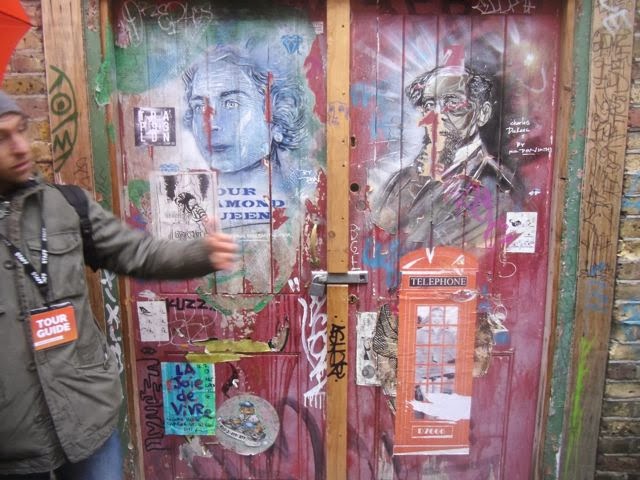
Moving on however we were next onto street art. I had the feeling that compared to The Alternative Tour which is a specialist street art tour, we were given a simpler snapshot of a number of works that covered who the artists were and was followed by some observations on the different styes.   


I noticed that this piece carried the signature not only of the artist but also a link to Global Street Art (top left) the company promoting and facilitating much of this work locally. Having run into Lee Bofkin from this company whilst on The Walk the Line Tour I start to see their hand more widely in the area.   


True to form we stopped, like practically every other tour, outside the the mosque and heard about its multi-faith history. I think the only tour I have taken than did not bother with the mosque was the Whitechapel Gallery First Thursday bus.


I enjoyed the way that many of the points we stopped at were quite unspectacular such as this wall. It was the small metal plaque up on the wall that was the point of interest here and which prompted a history of London's fire services following the Great Fire of 1666. Rather than this being a tour that showed us 'wow' sites, it typically used details such as these to tell stories. The balance of interest was then upon interpretation over spectacle.


We stopped at something I have passed before but never previously paid attention to: patriotic street art. I had sort of assumed that this type of art would be iconoclastic but was proved wrong here, unless of course there is a deeper irony that I am missing.


We came to the yard behind Truman's Brewery and were shown quite a number of larger pieces of street art. There was the inevitable Bansky, some other large sculptures and a piece by Space Invader. An interesting thing that our guide said about this last artist's work is that the placement of these mosaics around the city of Paris when viewed on a map creates a picture of a space invader in its own right.


This map details the pieces Space Invader left in the 4th arrondissement of Paris. I don't quite see a space invader here but I do like how the city map has been thoroughly reconfigured to suit its new purpose yet enough vestiges of conventional maps remain to remind you of official ones. In late 90s Paris I did somewhat similar but less refined work using stickers, texts, photos and maps, so this work evokes both nostalgia and respect seeing these concepts fully developed and given a consistent graphic style. What I also like is that this map proposes a tour of the various works, some of which will and some of which won't still remain in place. While guided tours of street art can be interesting and rewarding, when the artist his or herself creates tours of their own work, effectively curating their own solo show in the city/gallery space, a rather different sort of tour is offered.


Our guide stopped to tell us about The Krays and how the area we were walking through was formerly their territory, they being the senior London gangsters of the 60s. He said that the streets were in some ways safer back then, suggesting that they did a good job at keeping competing criminals off the street. It was striking that once again it was crime that made the neighbourhood famous, from Jack the Ripper to The Krays, the East End has been popularised as a, maybe even the, place of violent crime in the UK. Historically there may be something to this but how many parts of Central London haven't had a few grizzly events take place in them? Still, the idea has somehow stuck that these are dark and dangerous streets and visitors will often still come with this expectation when in fact the worst thing likely to happen is that they are harassed by over zealous waiters offering 25% discounts on meals, and even they seem to have calmed down somewhat. The Krays have only more recently been given the film treatment and maybe we'll see their status rise with time and distance from their actions. I will in fact be taking a Kray Twins tour to see what sort of story is spun, a tour that boasts a celebrity guide no less, too. Hooks a plenty. Meat hooks. 


We rounded off the tour at the bottom of Brick Lane. We were directed the various ways we were all heading, some back to Liverpool Street Station others back up Brick Lane in search of curry. Chillies was recommended and it looked like there would be a small post tour gathering of our guide and the young men from Cologne around a table for lunch. Finally we got onto the subject of Trip Advisor. We were all encouraged to rate the tour 5 stars if we enjoyed it. I'm fortunate writing here that I don't deal in stars. I find them superficial when it comes to arts reviews in the papers and don't want to reproduce a system I distrust. What I can say however is that this tour was engaging and varied, that Luke our guide was both personable and enjoyed his job and despite the lousy weather this was a fun way of introducing the area to visitors who knew nothing of it.

Saturday, 10 August 2013

The Father Courage Tour

I am currently helping prepare the performance Father Courage for Dubrovnik Summer Festival, which will premiere next Tuesday. Directed by Boris Bakal, it is a performance that takes place in a number of locations around the old city and so requires some walking as there are no cars inside the city walls. I won't disclose too much about the show in advance, as there are some very nice surprises, but it is enough to say that the work brings together guiding, multi-media theatre, tells many stories in personal, political and poetic ways, and it remains an open-ended and at times beautiful experience. 


While the work deals less directly with tourism than most of the tours I have been writing about here, since it is happening here in Dubrovnik, tourism remains a definite presence. It is the city's main industry and it has transformed the character of the old town out of all recognition and besides, we keep crossing the paths of tourists as they mill around Stradun (pictured above) in the centre. Last night we made a run through of the show and a tourist from Italy happened to join us out of curiosity. She seemed very happy to have had this experience which led her through many parts of the city and into situations that a tourist might not otherwise encounter. While this sort of work is probably not for every tourist's tastes I genuinely believe that for a significant number of 'reluctant tourists' like the Italian woman from last night, it can be far more engaging than standardised guided tours. In a sense, with most touristic tours the format is completely familiar, it is just the content that varies from place to place. With this however it is an artistic performance which, in many ways, gives a much fuller and more vivid, subjective impression of the city, culture and people.

Monday, 5 August 2013

Tourists on Tour

Today I noticed an amusing phenomenon: tourists who wear tourist souvenirs from their previous destinations. This was the young man who brought this to my attention as he has followed a similar journey to mine: I covered Portsmouth Dockyard in a previous blog post


He is wearing a cap bought from HMS Victory in Portsmouth while here on holiday in Dubrovnik. Seeing this I see something of his tourism history; I see him on tour coming from a northerly historical maritime location to a southerly historical maritime location. A tourist on tour. I almost don't see him stopping off at home but instead imagine him making the journey direct from the UK to Croatia.


This is something very different from this tourist group. No prizes for guessing where they are from. They are recognisable for where they have come from whereas the man above, Italian I believe, is recognisable more for where he has been to. And this is something of a standard tourist conversation: exchanging lists and short comments about places you have visited. "I have been to Greece" says one,  "Oh we've been there too, back in 1983 when it was so beautiful and quiet." comes the reply.    

Sunday, 26 May 2013

Artists as Tourists

I write this entry in an inbetween state: I am home and have unpacked my bags from last weekend's symposium at NIDA and am getting ready to pack for the next journey. I will indeed most probably meet some of the same faces next week: when we went our separate ways there were many of us who said Venice Biennale would be the next stop on the merry go round. Can we then talk about artists as tourists, and if so where can this lead us?

At the symposium "Critical tourism, site-specificity and post-romantic condition" there was a low-level but pervading negative tone about tourists. They were often equated with the most superficial form of travel, a form of thrill seeking that has little use for serious art. Art seemed to be considered a more fitting place for considering relationships to site, for constructing a critical discourse that went beyond beaches, bars and barbecues. There were exceptions such as Error Collective who were designing immersive art installations cum artist lifestyle breaks and there were also those who, perhaps wisely, steered away from the subject of tourists all together. 


I have the feeling that this malaise over travel and tourism is something of a luxury problem. The majority of people taking holidays do not have the opportunity to travel internationally so often and for them they might not experience the mechanics of travel in so negative a way. I also have the feeling that the hunger for authenticity is not a constant. An artist or researcher might well make the elaboration of meaning an objective of theirs when in a place. I believe, however, meaning comes in many forms and is something of a speciality taste of its own. We as artists might do a residency and succeed in understanding the light in a place or appreciate layers of history or language or whatever is the focus of our work but that does not necessarily stop us from acting like tourists in many other regards. Regular tourists are also liable to have 'real' experiences by which I mean ones which have not been designed for the exclusive benefit of visitors. They may choose to avoid these or embrace them, enjoy them or be wary of them, but they will surely happen in any environment except perhaps a totalising tourist location like a Disney theme park, though even here reality has a nasty habit of reasserting itself.   


For me then, I think that it is good to view artists as being more similar than different to tourists and to use this as a starting point for offering something that constructively and artistically engages with tourism. I understand that this position brings with it some very particular artistic challenges and these will not suit every form of work or even every project of mine. What does excite me however is the realisation that tourists are in a rather special inbetween state of their own. They are often actively seeking distraction and an out of the ordinary experience. The tourist can be encouraged to find this in a bewildering range of possibilities; we heard about Thanotourism, tourists attracted to death and disaster, to graves and battlefields; we also heard of communist nostalgia tourism and slum tourism. The tourist really is malleable. Why not then view the artist as the 'expert tourist', as someone who can construct situations and experiences that connect people from different places? This is not quite the same idea as cultural tourism, though I suspect they crossover in certain regards, but is instead an artistic response to the condition of tourism. Something that might be a goal worth pursuing is to not only see artists as tourists but to also see tourists as artists. This is somewhat ambitious and may work more as an idea than a reality but if it is an idea that leads us somewhere interesting, if it provokes another form of travel, it is one I am willing to ride with.

Saturday, 11 May 2013

How to Commission a Tour / How to Be a Tourist.

I've had some enquiries about how a tour is made and what it consists of so, having already made a pitch for a tour in Cambridge, it was easy enough to produce a brochure that covers the essential details. It's now online: 


I'm writing this in Zagreb and looking at the city through a dual lens. On the one side I am very much engaged in the performance workshop I am assisting, which deals with, among other things, urban and communal space, connecting the many layers of personal, political, contemporary and historical views of the city. On the other side, I am also looking at it with the memory of The Tour of All Tours fresh in my mind and from the point of view of a visitor to the city. It is really valuable to not forget what it is like to be a visitor and to be excited by things that inhabitants of the city take for granted.


Although this is far from my first time in the city I am struck afresh by the different colour palette that I see around me. Buildings are painted such colours as cream and brown. 


And the staircase inside the building is also painted in unfamiliar colours. While they may not be spectacular in themselves they make me aware of the relative absence of these colours in my own environment in the UK. There are cities which are a riot of colours and this is not one yet it does frequently have these creams, browns, ochre shades and greens in various states of freshness. Many buildings were once pained in this manner but have acquired layers of dirt, graffiti and neglect which produce a quite specific result too.  


The final thing that has surprised me afresh and endeared me to the city is the prevalence of brown paper bags. They remind me of when I was growing up; they were much more used in the UK in the 70s and 80s and are relatively rare now. Here is one that contained a lisnato mak, a roll you find in the bakeries that contains a sweet poppy seed filling. You can see some of the crumbs on my trousers. What's more, it is no problem to bring your snack into the cafe, order coffee and eat it in peace. That has been a regular breakfast fixture in fact. And that is another thing that is no longer generally possible in the UK where signs usually advise you "Customers may not consume food that has not been purchased on the premises."

These are the sorts of observations a tourist might make and which should be allowed to find their way into The Tour of All Tours, which is another way of saying, I should not be too professional a tourist as to be above such matters.