Showing posts with label artist. Show all posts

Saturday, 5 November 2016

The Dazu Rock Carving Tour: an international artists' group brings fresh eyes to a Chinese package tour


I consider myself a veteran having taken quite a number of Chinese bus tours. Almost every time I've been on it has turned out to be so bad it has been paradoxically great; there is a perverse pleasure in being shunted around as one of the masses within the world's largest domestic tourist industry. Today was going to be another tourist bus experience, a day trip to the Dazu Rock Carvings. There was to be a curious twist, however. The group was made up of artists and curators from around the world brought together for an exhibition in the Chongqing and now enjoying a day off. Many of the foreigners were new to China and most had never been on a package tour like this before. Little did they know what was awaiting them.


We got off in style with the bus waiting for us in a different place to where we had been told to assemble and when we finally connected, we were then driven through the mounting morning rush hour traffic to a point in the city centre where we disembarked and waited for a new coach to take us onwards. This quickly came and we were carried off again into the thick of the now slowly creeping traffic, our guide urging us, in Chinese, to relax. Mystified but excited to be rolling out of the city, we finally reached a B-List stop-over attraction after an hour or two. This turned out to be a newly reconstructed historical site that housed a few souvenir stalls. It seems its primary purpose was as a toilet stop.


We broke out into groups and seemed to quickly exhaust the site's potential, our visit lacking any context or, beyond the restrooms, purpose. The thirty minutes we had to look around were more than enough.


Our next stop, the China Dazu Best Kitchen Culture Museum was another story completely! This was a place that stretched the definition of museum to well beyond breaking point: it was very plainly a shop and restaurant with an attitude. The Dazu in the title is the giveaway: this meant we had arrived in the vicinity of our destination, the Dazu rock carvings. The 'museum' was a coach party's lunch and shopping stop par excellence. What's more, looking around it in the company of a group of artists new to China, allowed me to relive my first encounters with Chinese bus tours. Some were downright incredulous.


The best that can be said about the lunch was that it was adequate in quantity, though half my table of nuisance weirdo non meat-eating foreigners (myself included) wouldn't touch most of it.  


We went back through the 'museum' which merged seamlessly into a showroom and shop. Outside, three old ladies were selling pomelos which turned out to be both good value and fresh. I think I must have spent more time with them than I did with the exhibits.


We finally arrived at the Dazu rock carvings where we were separated into a Chinese speaking group and an English speaking group. We weren't briefed on the site beforehand so didn't really know what to expect, but by this time it was clear that the best attitude to take was just to relax into the experience and let it be whatever it was going to be. We were joined by an American doctor and his Chinese student, who, for a while seemed to become our guide.


On the site proper, a new guide took over. She introduced herself as Angela and she told us she was a native of Dazu who had been giving tours for several years. She spoke through a microphone which relayed her voice into our headphones. In this way the there was not the usual earsplitting chaos of competing amplified guides that often come in places like this. What's more, her English was quite clear and she seemed to actually like and respect the place. 


She did have this habit, however, of sometimes sounding too rehearsed. For example, at one point she said the women of Dazu are known for their beauty, and as she said this she put on a falsely modest smile and tilted her head to one side. This might have been a spontaneous comment and gesture she once made, many years ago, but by now it seemed to me to have hardened into a moment she performed every time she stopped at this point. I understand that it is perhaps too much to expect that she gives the tour for five years in a foreign language and still sounds fresh. I was happy enough with what we got, which was already significantly better than average. Still, this makes me think that tour guides and actors performing long runs face a similar problem of appearing stilted. Their solutions are often different though not unrelated. From what I've seen, the most successful tour guides get over this difficulty by making their tours more interactive, primarily opening up to the group they are leading but also sometimes responding, in the moment, to the living site they are visiting. It might be a stretch, but you could say this is the tour guide equivalent of the Meisner method.


I have to admit I was more interested in the carvings depicting hell than those showing heaven. I never imagined the Buddhists would be so thorough in their administration of suffering. It seems to me that hell lends itself more to art than heaven: there is greater drama in suffering than in comfort. I immediately though of the Chapman brothers' Hell sculpture which exaggerates and locates torment to such a degree it reaches a level of black humour.  


The most famous carving, the 31-metre long sleeping Buddha, was under wraps and was barely mentioned. As the tour went on I started to realise that our guide was not just contextualising a historical and artistic site, she was also using it to deliver the messages of the sculptures. The site, I learned, was educational and devotional and, contained within the carvings, were many stories and morals drawn from different sources (Buddhist, Taoist and Confucian) instructing the viewer how to live. We were therefore treated to some of these ideas, and when she finished telling us to be nice to one another she tilted her head to the side again, and give a little smile. 


The Buddha was not the only one sleeping. Once out of the gate it was not so much a case of exit through the gift shop as exit along the gift shop road. There was a relentless duplication of stalls at each of which sat, or slumbered, mostly middle-aged women. They sold a fantastic array of Buddhist souvenirs riffing off a rock and stone theme, factory produced antiques, plastic replica swords and tray-loads of shiny plastic children's toys. Business was decidedly slow and I counted at least three stall owners who had slipping into their afternoon nap. 


We were urged, no implored, to take a ride back to the coach in one of these cars but a group of us walked anyway. There was a bit of a cultural difference here. Most Chinese tours I have taken try to reduce walking and physical exertion to a bare minimum. I can only speculate that this is because using the body is associated with physical labour, poverty and the past whereas tourism is modern, effortless and connotes wealth. Still, walk we did and, as well as saving ourselves 5 RMB each, it brought us once again to the monumental pastiche structures that clustered around the entrance. These behemoths testament to a fetishised history that announces YOU HAVE ARRIVED at a national level tourist attraction.

Saturday, 18 October 2014

The Time To Get Lost Audio Tour: drifting round Wangfujing

The Time to Get Lost audio tour is an artist's project by Jennie Savage. It is described as "an invitation to people all over the world to get lost simultaneously" and the designated moment for this to happen was 6.30PM on the 3rd October 2014. A list of suggested starting locations was published so people could chose to start their walk in a common location in their city, if they wished, and possibly get lost in company. The other twist is that there were not one but three, presumably different, recordings that could be followed, one titled 'wanderers' and the other two, 'idlers' and 'drifters'. I tried downloading one of these onto my phone but was thrown off by some technical issues which meant I did not manage to get this done on time. Trying again a few days later it worked fine so, even if a little late for the collective event, I  headed off to the suggested meeting point: outside the Beijing Dept Store 北京百货大楼 located on Wangfujing.


I figured that even if I had been here at the appointed hour, the chances of meeting someone else doing this audio walk in Beijing were slim to non-existent and, added to that, I was not sure if the proposed start time was 6.30PM local time or 6.30BST, which would have required me to have started at 1.30AM on October 4th, not a likely prospect, even with the best of will. So a week late, but round about on time, I went to Wangfujing. There was still a relentless flow of people and standing still for a moment I was approached by a not unattractive Chinese woman in a leather jacket who spoke to me in English and came on a bit over-friendly. Having witnessed this routine before, one which typically finishes in a tea scam as China Uncensored amusingly describe, I made an exit, pressed play and pretty much immediately heard a softly spoken woman telling me to turn left.


This quickly brought me into the night market. I've been here once before so knew what to expect: bright and shiny tourist tat China style. The voice on the recording was at times hard to make out as the crowds around me were loud, the C-pop and electronic toys louder still and the vendors the true volume kings. What's more, the recording itself also had background sounds that seemed to shift in and out of focus. At one moment I found myself in a silk store and the next jammed by the crowd beside a stinky tofu stall, and yes the name is well deserved. The woman described some things she could see: workmen eating their lunch and looking around I could see some half parallels in the tourists eating the weird and wonderful snacks from the market, which not only include stinky tofu but go as far as the infamous scorpions on a stick. Passing a small but aggressively amplified Beijing opera stage, I finally squeezed out of the market and could hear the voice clearly.


I was led back onto Wangfujing and where previously I had been noticing the correspondences between the place she was describing and where I was, I now started noticing differences. For example, I cannot imagine seeing large portraits of politicians proudly displayed in the window of a photography shop in, say, Bristol. A picture of Thatcher of Blair in the window there would almost certainly dampen sales and quite probably attract unwanted late-night fast food or even a brick.


Following the instructions proved to be more an art than a science; there was plenty of scope for interpretation. For example, the way the roads and paths were laid out around me did not permit such rapid twists of direction as those being taken in the recording. Faced with impossible instructions or old ones that were superseded by fresh suggestions, choices had to be made. Without ignoring the tour's suggestions I interpreted them in a way that allowed me to be spat out of the shopping area and onto roads behind the shops as a change of atmosphere felt due. Here, removed from the neon and bustle of commerce, other layers of the city presented themselves. Was this a map of the city and its six current ring roads or was somebody making I Ching doodles while on the phone? 


The basic premise of the walk is that you follow the directions given by the woman on the recording as she is walking elsewhere and describing her environment. This elsewhere turns out to be a composite location for whilst I was delving further into one location, the recording seemed to be continually expanding its scope. This basic premise of taking a walk parallel with someone else in another location is familiar. Last year I wrote about A Walk With Amy by Amy Sharrocks which I took in Stuttgart whilst she was on the other end of a phone walking, presumably, in London. In both that work and this the two walkers are paired and the differences and similarities of their observations make up a considerable part of the work's appeal. Where they differ is that Sharroks spoke live, one to one, from a single location whereas Savage's walk is pre-recorded, for multiple users and is not contained within any one real space.   


The audio tour often seemed to be referring to market type places and global business being what it is, it was almost inevitable I would encounter a shopping parallel. This came in the form of H & M. If not them then it would have been an Apple Store, Gap or Starbucks or some other global brand. Ten or twenty years ago that would not have been the case here in Beijing but the city is slowly becoming predictably normal in the sense of having designated shopping areas with global brands. I wonder if the potential walker in Baghdad, one of the other locations proposed, would be more able to escape the reach of McDonalds and KFC? 


I came across a man taking a picture of the city map and for a moment liked to imagine he was on a similar mission to mine, but his lack of headphones precluded him from being on the Time To Get Lost tour. Taking a picture of a map might indeed look like the opposite of trying to get lost but this map, one showing the city's ring roads and sprawling suburbs is all but useless for finding your way locally, such is the scale needed to contain the entire city on a single panel. Added to that, there is no 'you are here', so it really is more an emblem of the city demonstrating its size and showing all the recently conquered lands that make up the new far-lying neighbourhoods.


There were a section of the recording that featured many cars and this had the effect of inducing some nervousness that they might in fact be in my space. That is a real danger in Beijing as the lines between pavement and road can at times be very fluid with pedestrians often having to walk on the roads and cars driving and parking on the pavements. On at least one occasion I had to check behind me in case a car was rushing upon me. This blurring of the sonic spaces was quite pleasing, particularly as it was done by introducing something new into the area rather than doubling up the existing sounds, which is more commonly done on audio tours that appropriate the existing sonic space for the recording.


The recording then seemed to shift to a developing country and talk about shacks and stalls that had solidified into buildings. The closest equivalent I could see were these soft drink stalls doing bubble tea and what not. This shift in the recording from a British environment to a very different one made some sense given the global ambition of the project.


Although Wangfujing is one of the most developed shopping streets in Central Beijing, I almost never come here so it is relatively unfamiliar to me. It was, then, a surprise to stumble in front of the Foreign Languages Bookstore which I remember looking around the first time I came to Beijing in 1997. Back then I came out of it with absurdly cheap propaganda posters of Mao, Marx and Stalin as well as some translated Chinese literature. Not having seen the place in 17 years it seemed at first glance peculiarly similar, a Communist era time capsule surrounded by malls and tourist markets. This interruption of the tour with a strong personal memory span me off on another tangent while I was being urged to turn left by the insistent voice.


I was brought finally into one of the malls and went up an escalator. In my own Waylosing in Beijing Tour, which I took earlier this year, I found myself similarly putting aside my visceral dislike of malls and trying to get lost in one. The problem with using them for this purpose is that they are usually designed with these central atriums that help you find your bearings and the best that can generally be hoped for is to exit the mall into an unfamiliar space. 


I consciously avoided making any selfie pictures on this audio tour but when I arrived at a mirror it was clearly the moment to place myself in the frame. Looking at this picture of myself now, I am prompted to ask, 'what was I really doing there? What was I looking for?' Without getting too introspective about it, I think I was looking for a disorienting experience which might lead me to some unexpected locations and possibly new realisations. As such, I was bringing my own ideas about the value of getting lost and I rather think this audio tour was doing something else. With it only being 30 minutes in length and taking a circuitous path, it did not cover much ground and was never going to seriously disorient me. When leading a Waylosing tour in Birmingham this year, it took us four and a half hours of dedicated action to reach a location entirely unfamiliar to us all and to sense we were more or less lost. The Time to Get Lost Tour was instead for me an experiment in parallel indeterminate spaces that might result in a little disorientation. Taken that way the experiment worked.


The places I was moving through seemed in general a good deal richer and busier than the locations of the recording. This did not entirely surprise me given the neighbourhood.


The recording did not have a strong narrative line to it, it simply seemed to be about movement through different spaces which, at a certain point and without any climax, came to an end. My final location was this street. I don't know how the other two audio tours would have been different, maybe they would have brought me into more contact with people or to other places, I will never know. Knowing there was potential for the experience to have followed other lines is pleasing in a way, but I have to think back to Auto-theatre an experimental audio tour I made with a three way multiple choice of routes back in 2008. Knowing that this work already contained a healthy does of inherent indeterminacy in terms of which way the listener should walk, I now ask myself whether compounding that with two alternative tours was really necessary. With regards this Time To Get Lost Tour, I will of course never know the scope of the full work. If you are interested to know more about the walk there is an interview with Jenny Savage on Talking Walking in which she goes into the process of creating the walk and some of its intentions. It makes for interesting listening, whether sitting or walking. It is definitely a worthwhile experiment and fun to take, even if the name is a little misleading. I should not be surprised to find myself getting lost again with Savage in the future.

Friday, 21 March 2014

The Sanlitun Tour: a conceptual tour of Beijing's tours

This blocking of the blog from within China is why there have been fewer postings of late and that is a pity as there has been plenty to write about. The tour to The Great Wall was very silly and they managed to make something that could have been quite beautiful and impressive a great deal less than what it is. On the other hand, the way the day unfolded and the differences between Chinese coach tours and those I am more familiar with was so vast that it was worthy of a study unto itself. 

Last weekend I gave the first Tour of Tours here in China for the Bookworm's Literary Festival and it went really well. The smog did not interfere, the weather was finally warm and it was a pleasure to be outside, something that has not been the case for a while. That helped enormously. The tour was a particularly conceptual one as there are no real tours that I took of the area and which I could report on. Everything was referring to something else or was a projection of another location onto Sanlitun. As such it made for an unusual sort of tour with the weight falling on talking about tours. We passed through Yashow Market a place bristling with fake branded products and lost a few people there, such is the danger of passing through a shopping place. In all however, it was a good start to Beijing tours and one that will be built upon in the coming months.

Advance notice now about workshops that will be given on performing in public space using guiding principles. There will be workshops in Beijing in May and in London in July, others to be announced.    

Friday, 17 January 2014

The Denis Severs House Tour: a candlelit tour of an artist's installation

Having stumbled across Denis Severs House on Folgate Street on the Spitalfield Stories Tour back in December, I had the occasion to take a tour of the property. I was however slightly early so I had a pint in The Golden Heart, round the corner on Commercial Street, as advised on The Sound Map Tour. It was suitably eccentric with a scatty, opinionated and welcoming landlady, random music, a man reading 'The History of History' and that increasingly rare thing in this part of London: the presence of artists.


Refreshed and diligently ten minutes early for the tour's start time of six, I knocked on the front door, it half opened and I was told to wait and not go anywhere. As I stood on the pavement a group of three arrived, also looking for the tour, I reassured them they were at the right address and then, at the stroke of six, the door swung open. A rather serious man took our names, checked them against a list on his ipad and explained the rules of the tour. We were not to touch anything, we should not talk, phones must be turned off, we should follow the route from the basement to the top of the building and we were not allowed to take any pictures. This picture above is of a subsequent group being given the same briefing at the entrance to the house, all of the pictures below are from the website of Denis Severs House.


My group descended into the basement and our eyes slowly adjusted to the candlelight. Looking around a house lit by genuine candlelight is a rare experience now in this age of health and safety and while the texts were a strain on the eyes the flames illuminated the space with a soft, warm, shimmering dance. Shadows were so much darker than they typically are this made the paintings that featured contrasts that Rembrant would be proud of, look far more understandable. That is not to say all paintings were like this, far from it, there were also more conventional portraits also adorning the walls.


The house is presented as the work of artist/curator Denis Severs who lived  in the property and designed rooms in order that they should capture the feeling of different periods. The objects and arrangements are therefore not strictly authentic but rather convey an atmosphere of the past which in practice means that the decoration can in places look somewhat camp, even flamboyant. A central conceit to the tour is that the occupants of the various rooms have just left as you stepped in so you should be able to sense their presence through the various clues left behind. The fire is still burning, there are smells of food in the space, a broken saucer lies in pieces on the floor as if the occupants had fled in haste. Sounds of footsteps around the house and the exterior sound of church bells chime to give the space an added sense of life. 


Scattered around the building are small slips of paper with advice for the visitor written upon them such as, "you either see it, or you don't" and warnings that the property is protected by hidden security cameras.  I had a sense that the space had been very deliberately arranged over a long period of time by first Severs and subsequently, the curators. As such, a detailed rationale for the building and the lives of its imaginary occupants must have been built up layer by layer. This interior story remained somewhat invisible for me and what I saw was an accumulation of details and an interplay between the paintings, texts, objects and rooms. It was like Poirot with the crime removed. It may even be that they slips of texts instructing me to look more carefully and absorb the situation had the dual effect of both drawing me in and, at the same time, keeping me out. It was as if they had been written with the presumption that the visitor would not understand which left me wondering, what was there precisely to understand? Placing it within artforms it is most close to an immersive installation yet it sits somewhat outside of the contemporary art discourse and neither does it look like it was made to be of historical or heritage appeal only. It is a product of its own unique circumstances.


The house is being run as a serious business and due to its proximity to The City, must have a relationship with the financial sector. Some of the other people on the tour were clearly city workers, though this was not uniformly the case. From Trip Advisor I see it is also popular with tourists as well as with a broader cross-section of Londoners. When I was walking around I could see that more visitors could have been squeezed inside, but the house was run with the idea of preserving the integrity of the experience. With timing and numbers strictly managed, there was no excess of visitors in the building at any single point in time so it was possible to take the tour at my own pace and have quiet moments alone in the rooms. This was quite in contrast to standing in queue after queue and feeling like you are on a tourist conveyor belt, as some similarly structured tours can be, such as the tour of HMS Destroyer that I took last year. 

Monday, 9 December 2013

The First Thursday Tour: Whitechapel Gallery's free bus tour of exhibition openings

The First Thursday Bus is a free bus tour that you can take on, unsurprisingly enough, the first Thursday of the month. It has been running a while now and it is part of the much broader First Thursday initiative by which East London galleries stay open late and often hold not so very private views the same evening. The bus tour departs from Whitechapel Gallery and takes you to a selection of participating galleries.  


I was instructed to arrive at 6.45 in order to pick up my ticket. Upon arrival I found the front desk besieged with hipsters as there was another event taking place in the gallery that evening and people were picking up tickets. The staff were ticking off names, answering the phone, handing out different coloured stickers for the various events and answering the inevitable random questions. There was also a 'meet-up group' trying to form amongst those standing around but nobody seemed to know who was and was not part of that group so it  was slow to happen and more than a little self-conscious. Next to this there were book stalls and some people selling raffle tickets for a youth project. It was proper London art bustle.


The tickets for the tour were not all collected so someone from the gallery went around checking to see who was on the waiting list, handing out yellow stickers accordingly. Because it is free to enter into the ticket lottery to go on the tour (you apply a few days in advance) there must routinely be quite a number of people who do not collect their tickets. If you really want to do this tour then, it is probably quite possible to get on it simply by arriving in advance at around 6.30 and adding your name to the waiting list. Nothing beats actually being there.


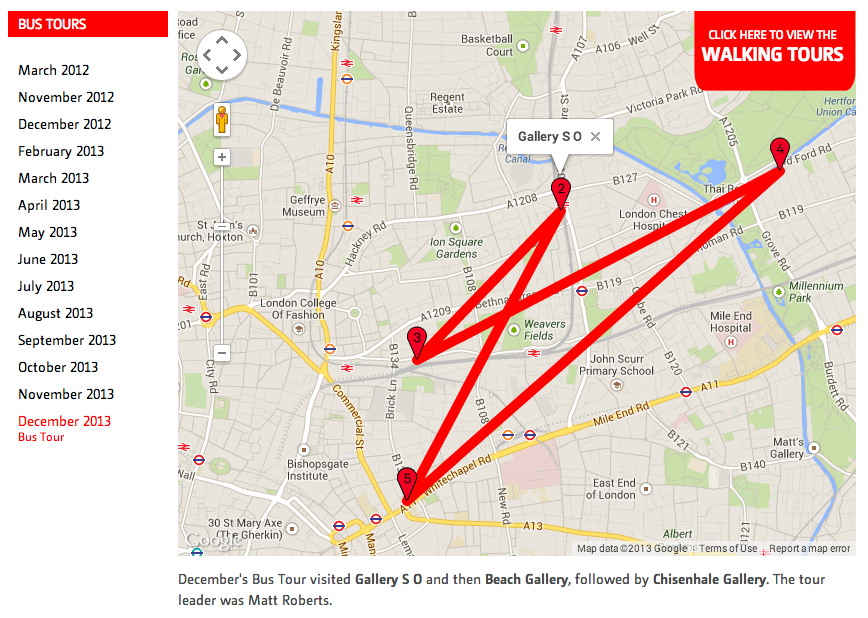
I don't how it happened but the map of the tour on the official website is wrong. As well as having no number 1, Gallery SO is actually located on Brick Lane and not north of Bethnal Green as shown above. The rules dictating the shape of the tour, as far as I understand them, are 1) it starts at 7PM 2) visits 3 galleries in the East End and 3) returns to Aldgate East at around 9PM or shortly after. This time frame is set so that it works with the timing of the private views most of which are winding down by 9. It is interesting to note that there is another First Thursday tour also available from the gallery and that one is a walking tour which obviously covers a shorter distance. Common to both are these bold red lines which connect one gallery to the next like a teleporter zapping you from opening to opening. For those pounding the pavements they must therefore decide for themselves how to make their way from one point to the next as the precise walking route is not specified. Some roads might present themselves as the obvious path but there is an element of active choice here as it is not always obvious. While at first I thought this an oversight I now see potential in deliberate ambiguity and will have to file this thought away in order to retrieve it at a later point when I need to direct people somewhere but not direct them too precisely.  


The bus was waiting for us outside the gallery. It was a nice comfortable Mercedes.


The 20-odd seat bus filled slowly and there were quite a number of empty seats. It was perhaps a little over half full and I had the whole back row to myself. We left Whitechapel 10 minutes behind schedule, probably the result of the ticketing being so complicated and hoping a few latecomers would arrive to bolster numbers.


First stop was SO Gallery which I was excited to enter because it had already featured in the Sound Map Tour I had taken barely a week before. This overlapping of spaces is what happens when working with several tours that cross a more restricted geographical space. It invited me to speculate whether there was a connection between the Jewish heritage referenced in the previous tour and the art of the current one. 


After the gallery's curator said a few words we then got an introduction to the exhibition from Leo Fitzmaurice, the artist whose work filled the space for his solo show Post Match. He talked about his inspiration and process but generally avoided trying to define the meaning of the work too firmly. The exhibition comprised of the tops of cigarette packets that had been unfolded and modified in order to look like footballer's tops. It was a simple idea that was well realised and which allowed for many connections to be made between the worlds of smoking and football. To me at least, it invited a semiotic reading of these two fields that had been unified in the artwork, and the subsequent rubbing of tangential orders of symbols (eg. the Bundesliga vrs cigarette brand design) against one another to produce new meanings. Thinking about this further the CH N KATZ. sign above the window is not so different, or at the very least, has the potential to create a similar crossover of symbols.


When I stepped out of the gallery I saw someone I know, Hydar Dewachi, being dragged into a disagreement with a man on the street. It seemed to be about the right to take photographs and the man on the left appeared to be angry and looking for someone to shout at. I was about to jump in and come to Hydar's defence but the tour bus was waiting for me (I was last person to leave the gallery) and my intervention would probably have only escalated the tension. I later heard that thankfully things resolved themselves OK. It was for me a moment that popped me out of the First Thursday Tour and into a very different situation. I guess most conventional tours function like worlds unto themselves and such events do not happen though I did notice that on the Winterthur Tour people taking it bumped into friends of theirs who happened to be passing in the street, so this is not unprecedented. 

Developing this idea, it amuses me to imagine tours that encourage this fluidity more, either by deliberately going to places connected to the individuals on the tour or going to public meeting spots where such things happen as a matter of course. This First Thursday Tour did already have something of that quality as First Thursdays is, for people connected to the London art world, a significant monthly socialising event. I did in fact bump into another person I knew while waiting at Whitechapel Gallery and met him again later in the evening on the street outside. This happened because I  was in a context I have a place within. As for general public meeting spaces, those are few in number in London as the city is large and anonymous. In smaller cities these function better, such as the pedestrianised cafe zone in the centre of Zagreb. Even there though, it is not a hub for everyone but it does function far more effectively as a random meeting zone to the extent that if you are in a hurry it is a place best avoided. 


Dave Roberts, of Dave Roberts Foundation was our tour guide. He gave a brief introduction at the start of the trip and said a few words about each space, like he is doing here, before we arrived at them and the coach emptied. The coach was in fact very well equipped for guided tours, there was even a microphone just to his right that he could have used in order to look and sound like a proper tour guide. He was never going to go there however.


Beach, the next gallery we stopped at, was smaller and much more crowded. They were showing the work of an artist usually associated with street art who had recently moved into making ceramic 3D works. There was also another event taking place simultaneously in the gallery and a woman was handing out bottle after bottle at the entrance. I was less excited about the work, indeed there was less of it on display, this place was more about meeting people and taking advantage of the drinks. On leaving I took one for the bus ride.


By the time we were back on the bus and moving agin we were running late and our last stop was still a little bit of a drive away and the traffic was inching along Brick Lane. By this time a few people had dropped out of the tour and a new couple had joined us as there was plenty of space. There was in general a more informal atmosphere on the bus with the drinks flowing and people chatting to one another who an hour and a half ago had been strangers. Drawing close to our destination Chisenhale Gallery, we were given another short introduction as to the sort of gallery it is, namely a publicly funded space that typically offers rising artists their first major solo show in London. 


We entered and were immediately asked to take our shoes off before proceeding any further. I have heard of performances at which the audience is required to be fully nude, fortunately this was a more modest request but one which changed our relationship to the space nonetheless.


We entered the gallery proper and sat on the carpeted floor in front of the screen and watched the video. Unlike the other galleries there were no drinks and there was no scene, in fact we were the only people in the gallery. We watched a video work of Jordan Wolfson that was a mix of animation and exterior shots mostly taken around SoHo in the artist's native NYC. The work was OK and reminded me of when I briefly worked for a SoHo gallery in the 90s but I found myself drifting off and asking myself how this piece of work ended up in front of me. I came to the conclusion that this is a two part question the first part of which is how I ended up on the First Thursday Tour: how the tour came into existence and how Chisenhale Gallery ended up on this tour. The other side of the question is how did this video end up being shown in this gallery and that is also a rather complicated issue, particularly as this was not the work's first showing and Chisenhale usually commissions. Both these questions are basically questions about the mechanics of the London (and global) art world where private and public money mix and different interests are served. A woman from the gallery talked a little about the work and why it was here when we were back outside but I felt there was a lot more to this encounter that was left unsaid. To really get inside of a seemingly simple question such as "how did I end up looking at this?" could easily be a PhD study in itself so I will not go any further here as I've probably already said enough.  


The evening ended when the bus dropped us off at Aldgate East a three-minute walk from Whitechapel Gallery. My over-riding impression of it is this is the sort of tour that does not feed you that much information but instead is rather open-ended and you can make of it what you like, depending on what you bring to it in the first place. Someone who hates art and thinks it pretentious will most likely come away thinking it was evening spent amongst tossers while someone interested in contemporary art and the edgy fashion of the London art scene will be right in their element and return bringing their friends next time round.

Saturday, 9 November 2013

The Littlebredy Tour

Little Bredy or Littlebredy, the village gets spelt both ways, is indeed little. It's a village in South Dorset that I was shown around in preparation for the arts festival Inside Out that will be held there next September. I shall be constructing a tour for the festival which takes the South Dorset Ridgeway as its frame and Littlebredy as its focus. 


The day began in the village hall with talks about the area and an opportunity to meet the other artists. We assembled outside later in the afternoon to take a walking tour.


This tour led us past a number of points that the artists had selected to site their work in. Here for example is one of the artists with a plan of the landscape artwork she will create showing it to us and describing how it will sit upon the side of the hill. 


There was no precise tour guide leading this walk so there was no group commentary but instead a straggle of artists following a route that had been more or less decided in advance. The leader at the front of the group changed from time to time but was always one of the festival team who knew the route. As there was no ongoing commentary it was far more a chance to walk around the village and ridgeway and talk with the other artists. The going underfoot became increasingly muddy as it had been raining recently. There was much sidestepping of puddles.


We encountered our first real obstacle with a series of gates, this being one of them. We had to clamber over them but when it came to the dog in our group this variously meant coaxing it to squat under the gate or lifting it up and passing it over the gate. Undignified.


We then met the livestock. They took us for intruders and a showdown ensued. After a few nervous advances they scattered and let us pass. This was one of those moments that divided the group into those of us familiar with animals and farms and those of us more familiar with the Coffee Republic and city life.


We then came to an impasse by a farm at the bottom of a hill. There ensued much consultation of maps and smart phones, which started failing as we drove deeper into the folds of the South Dorset Ridgeway. Finally we had to ask the farmer.


Our path was an unlikely overgrown one that passed beside the cow shed. They eyed us keenly, they don't get many walkers coming this way.


And where you have cows you have cow slurry. Our path passed directly through several ankle deep, hold-your-nose stretches of manure and mud. There was no alternative but stoically soldiering on and hopping that it did not get any deeper.  


We reached an abandoned chapel in the woods some distance from Littlebedy as the light was failing. Later than expected with the night closing in we took it in and made an exit for the road which seemed to be some distance still.


By the time we reached the road it was a dark and not long after a taxi arrived to whisk us through the winding roads back to the village. This ended the first day and first part of the village tour but there was more to follow the next day.


As I had expressed an interest in tours I was offered a tour around the village's visitor attraction, The Walled Garden. I was joined by some of the artists and our guide was both responsible for maintaining the garden and showing people around so she knew the place very well.


She told us that various people visited the garden such as ramblers and horticultural societies from as far away as Somerset. I asked her if she could offer her standard visitor tour so I could get a sense of it and she agreed however as we started looking around I realised that what I was experiencing was something quite different. The artists were asking about the buildings and looking inside in order to see if they might be useful locations to site artworks and events in. Our guide was obliging and shared what she knew about the places and I realised that I was not on a normal visitor's tour but was instead getting a different sort of tour: the artist's site visit tour. Once I realised this was what was happening I relaxed more into it and took it for what it was rather than wishing it to be a different sort of tour.


With a storm forecast for the next day there were preparations afoot to limit possible damage to the garden by taking down temporary structures such as this gazebo. The approaching storm was a bit of a conversation topic in general over the weekend as it was being talked up as if it was going to be a devastating hurricane when in fact it turned out to be far less.  


Perhaps as a nod to our curiosity and the nature of the group we were treated to the ghost story. While our guide acknowledged she was not a believer in the ghost she did not disappoint us by omitting the fact that a ghost was said to haunt the garden. Coming on the back of the Haunted Holborn Tour I'm starting to see a strange connection between ghosts and tourism. This will have to be investigated a whole lot more. 

Overall then, this was a very relaxed and informative introduction to the village for what will be a new commission for The Tour of All Tours. I'll be returning here next year to develop the project and have many ideas of tours to reference. As it is not a saturated site I will have to be creative and this may in fact mean the work refers out into the society more than it might do in a place where there is an overwhelming amount of tours already in place. The festival will take place in September next year, details and updates will stream in before then.