Showing posts with label Australia. Show all posts

Wednesday, 25 November 2015

The Melbourne Tour of All Tours: where are the indigenous Australians?


I was invited to Melbourne to make a tour performance as part of the exhibition Performing Mobilities at RMIT Gallery. It was an ambitious exhibition and performance programme that, among other things, looked at people's mobility in a local and global context and then how artworks and performances incorporate mobility within their formal structures. Given how the Syrian refugee crisis has unfolded recently, this was topical, even if the way this has played out in Australia is quite different to how it has impacted Europe. That was just one of the wider frames; locally, many other issues and practices seemed to also inform the work I saw, the conversations I had and my creative responses.  It was a quite ideal frame for The Tour of All Tour which was made in response to the tours I found and the wider life I encountered in the city of Melbourne. 


We started at RMIT gallery and headed out into the city-centre. I find my tours of tours are always more lively when we get to see some other tour groups in action rather than just hear about them through an abstract commentary. We were in luck today: we bumped into Technopia Tours. The previous day, when we were a small group, we even stealthily joined another tour for 5 minutes in a practice I call 'tour surfing'. No chance of that on this tour, we were too much of a group with our own gravitational force.


The State Library of Victoria has a number of galleries displaying artworks that are in some way part of the story of the state and its people. Particularly interesting for me were the paintings showing the genesis of Melbourne at the end of the 1830s. These paintings showed hills and trees punctuated by the log cabins and tents of the early settlers. The landscape was somewhat familiar; I had already seen it when I was taken out into the forest with the Walking Club of Victoria. One of the things that struck me was the depiction of indigenous Australians: two or three men huddled around a fire on the edge of the settlement. In this version of events they were marginal but present. These pictures were historical recreations of the scene painted 40 years after the city's founding, that is to say, when Melbourne had already established itself and was looking to develop its own mythology.


When we came to Chinatown I had to stop outside some of the Chinese tour agencies and point out their packages. One of their 'hot tips' was a trip to Sovereign Hill, a gold rush theme park where some enterprising Australians recreate the mid-nineteenth century by dressing up in period costume and taking visitors down mines before making a high-tech sound and light show in the evening. It is amusing to imagine a kitschy Australian theme park from a Chinese tourist's point of view but, when I stopped to do this, I realised there was something disconcerting. Seeing it through this frame, I imagined I was looking at the 'Australian people' as an ethnic group dressed in their traditional costumes. Completely absent within this frame were indigenous Australians; this was a history which they had been written out of entirely. Not having been to Sovereign Hill myself I cannot say if that is the experience of seeing it up close but I did read that it most surely is how it is in a similar historical recreation park in Australia. The paper, Colonialism's Past and Present, makes the point that discrimination is perpetuated and enshrined in popular memory through inaccurate historical recreations. One of the conclusions is that while tourist sites are primarily run as businesses, sites such as these do also have a historical and educational responsibility that is not always being fully met.


Since we were walking through Chinatown, we made a stop outside the Chinese tax free shop where it was possible to go a bit further into some of the patterns of Chinese tourists. Part of this was the way students act as the driver for parental holidays and then we got onto the gift culture and some of the more exotic items that this shop specialised in: skin cream made from sheep placenta.


I gave this tour a number of times and it was interesting to note that when we were a small group it was possible to have much slower and more interactive tours where each stop was, in a sense, a prepared conversation starter on different topics broadly within the politics, culture and experience of tourism in Melbourne. When we were a larger group, however, it became a show where timing was essential and the conversation took place much more within the audience as we walked from stop to stop.


We had our moment with the selfie stick and shortly after our tour experience was on social media. 


We came across two works of Invader on our tour making a neat link to East London where these space invader mosaics are also to be found and feature in a tour of mine. One of the things I am attuned to, having made tours in different cities and countries, is not only the portability of tour formats, but also the duplication of sites. This is something that I typically associate with corporate structures like Regus: they produce similar rented workspaces around the world, one of which I took a tour of and reviewed here. In street art this is less typical; I am aware that there are some taggers who operate on a European-wide scale but very few spread themselves quite as far and wide as Space Invader who operates on multiple continents.


Naturally, we stopped off in the street art zone. Because many of the people on my tour were just visiting the city for the symposium and not from Melbourne, the cameras came out and the performance became near identical to the tours I was talking about. Street art, no matter if it is good or bad, seems to have this effect.


At the age of 16 I had dreamt of moving to Australia and getting away from all the things that upset me in the UK, which were a great many. This stay in Melbourne was my first visit to Australia and so my week of taking tours around the city was an opportunity to consider how my life would have been different had I moved all those years ago. My conclusion was that I did not know at the time what I would have been stepping into and making that move now would be an uneasy one since, as a British citizen, I feel a weight attached to the colonial history of settlement. 


At the Performing Mobilities symposium, I gave a talk in which I floated the idea that the tourist gaze has spread far and wide, well beyond the realms of the tourist industry alone. City branding, wedding photography and outdoor sports are all areas where the tourist eye has started to extend and establish itself. It also, I believe, can be seen in mobile art projects, though here it is often an unconscious and unacknowledged presence, seeing as it is viewed as a negative thing. These are, in fact, ideas I will be developing and presenting at the end of March in Taipei in a talk I am preparing called The Emancipated Tourist. The symposium proved to be rich, varied and offered some welcome optimism. I had been troubled by the near invisible status of indigenous Australians in the tourist sector as I had experienced in the days before, but here in the symposium, that was far from the case. Aboriginal elders were treated as guests of honour, their ideas and culture valued, and a serious effort made to move forward together. I was very grateful to end my visit on this more constructive tone; it genuinely transformed my stay by addressing the thing that I had been sensing all week, giving form to my feelings and offering a model of how to integrate communities that history has previously set apart.

Monday, 9 November 2015

The Walking Club of Victoria Tour


The Walking Club of Victoria is a Melbourne-based walker's club that organises weekly walks in, around and outside of the city. I was kindly invited to join one of their Sunday walks for which we gathered at 8:30AM around the back of Southern Cross Station and then car pooled. With four of us comfortably seated and our destination Steiglitz entered on the map, we headed west out onto the highway. The city thinned and eventually gave way to dry farmland. As we drove I talked to my fellow passengers who told me about some of their more adventurous hikes in the thin Himalayan air of Nepal. Those days were behind them now and the Australian outback was where they now did most of their walking. 


Once we'd all arrived at our destination, an hour of so later, we stood in a circle and began with a formal introduction to the walk and the day. Our guide was a relatively new member of the club and she was being mentored by a more experienced walker. In a sense, she was the beginner and was leader in name only, but her responsibilities were, nonetheless, real. This was a learning experience for her and a way in which the club brought in new people and gave them the skills to lead walks. She explained what the walk would be like (she had already scouted it with another club member) gave us some advice on how to stay safe in the hot weather and welcomed today's new member, which would be me.


We walked out of Steiglitz and saw the remains of this gold-rush mining town. At one time it was home to over 1500 people. Streets such as Barry Street, pictured here, would have been lined with more or less temporary structures, all of which have now vanished. When the gold dried up there was little else to keep people here: today the population is in single figures. As I am currently developing a project for another 19th Century mining village, Allenheads in Northumberland, I was set wondering why one village was able to adapt and another has all but disappeared. 


As we walked we talked. The way conversations flow on longer walks, like this, is quite specific. The duration, the rhythm of the footsteps and the changing scenery allow for pauses and silences, for interruptions and observations whilst still maintaining enough direction for the conversation to continue. You invest time and effort into the walk and this rubs off in the connection with the other walkers. I find people are usually more open when walking in nature, more focussed on what and who is around them than on their phones, as is often the case. As we headed up a largely dry stream bed, the path became more broken and the walking became harder. I heard some nice stories about the club which was founded in 1947, and which had seen pretty much everything, it seemed. At one point, apparently, there was a spate of its members getting married to one another, and on another walk some years ago, a senior member had passed away. Whilst that must have been distressing for the rest of the people on the walk, it sounded like a pretty good way to go. They agreed; if it's your time, sitting down on a quiet rock in a beautiful place and letting go is just about ideal.


The plants and landscape were pleasingly unfamiliar to me. There were no two-headed turtles or carnivorous bushes, but when I examined the flora closely I could not say precisely what any of it was. Along the way we came across a lot of tall grasses, the most aggressive of which was this variety that reaches a metre in height and carries a nasty spike on the end. The hikers came equipped: some wore gaiters and many used walking poles to cut a path through the bush and work the arms at the same time. I understood why: this was not a gentle stroll in Surrey, there were plants here that could rip you up, there were (thankfully rarely) poisonous snakes too, to say nothing of the threat of bushfires that can race faster than a man can run. I checked my phone: there was no signal down here in the valley. This was not a good place to come alone or to act dumb in, this was a place to come prepared and in company.


I wanted to see if there were different ways the group's members walked through and experienced the landscape because, although this was one tour, I suspected there were numerous parallel tours taking place. I floated around spending a bit time with different people, dropping into their conversations and then, sometimes, I just walked on my own and let the landscape make its own impression. As expected, there was quite a contrast in how we walked. One lady was keen on interpreting the rocks and trees and seeing things into them. For example, we sat in front of these rocks, which she called 'the temple' because they reminded her of a Greek temple, and once she had said it I also started to see it too. It was fun, not to say enlightening, to walk and talk with her and see the trail through her imagination. I then spent some time with a serious bush whacker who had a very specific and efficient way of forging a path through rough terrain. As he and a friend of his walked, they looked around and compared this trail to other trails they knew in other parts of Victoria. They were serious walkers. This variety of perspectives made me think that I should like to better understand how indigenous Australians view, cross and imagine this landscape. Theirs, however, must be a very different way of walking, one most probably quite antithetical to this.


At lunchtime the gatorade came out. I was offered some and while I'm sure it serves its purpose of rehydrating admirably, it is not a pleasant brew. I have a tribal loyalty for Irn Bru (Scottish family) which I admit is not consensual stuff either, but I was surprised to learn that there are Gatorade cocktails; an Angry Granny = gatorade and whisky; an H-Bomb = gatorade and malibu. Hmm, I think I'll stick to the gin and tonic.


At some point the trail levelled off and it became easier to stroll, look around and take everything in. That is when the otherness of this place really hit me.


The early afternoon sun was pretty hot and on the home stretch back into Steiglitz we fell into a more languid rhythm. A conversation question I overhead was, "Have you ever had skin cancer?" This struck me as a question you wouldn't often hear asked in a British walking club. In the UK you'd be more inclined to hear people ask where they went to find some sun. Towards the end of the walk, one of the group (not the lady above) had to take a stop for a breather in the forest, the heat getting the better of him. The club sprung into care mode and I discovered a number of the walkers came from medical backgrounds, and those who didn't were also active immediately planning a way to get him out, carrying him if need be. Finally, all he needed was a break and he was back on his feet and tramping back into Steiglitz in no time. It was reassuring, all the same, to see how the club takes safety seriously and everyone was really looking out for one another. 


When we were done we jumped back into the cars and headed over to a nearby cafe. Over custard tarts and refreshments I asked some of them why they were a part of the club. Their answers were varied but overlapping, the most common ones being that it was good exercise, a pleasant social activity and the club enabled them to go to beautiful places they probably wouldn't otherwise visit. The bonds of friendship seemed deep; even if the club's marrying days were over, at least for the time being, they seemed to connect well as people. I also learnt that there are a number of walking clubs in and around Melbourne, and that there is really quite some variety in them. I started to see that there was an understated competition for members between the clubs as they all need to ensure a consistent stream of new blood into their clubs. I felt that this club was doing things right; it could never be all things to everybody, what matters most is that it is meaningful for the people who do it and that it remains sustainable. In this respect, not being too large was actually quite a good thing: over the duration of the walk I had time to talk to just about everyone.


In a similar way to how we began, the computers and GPS stepped back in. It doesn't look too tough a walk, according to the stats, but fighting our way up the dry river bed, weaving from side to side was not smooth going. If I lived in Melbourne I would definitely give them a go again, they not only organise walks every week but also talks on subjects relevant to their outings. I suppose the most similar tour to this one that I have made recently was the trip up El Teide in Tenerife this Summer. That was a good deal more arduous and uncertain than this one, as our guide had never made the trip himself. This was an altogether more relaxed and comfortable walk, as I would expect of a club that had been doing this for over 60 years. What they had in common was they were about walking in nature and letting that be the strongest element, rather than listening to a guide telling a story. To put it another way, on these tours, the walk itself is the story and the guide is simply there to help us better hear it.

Monday, 2 November 2015

The Technopia Tour of The Press Club Kitchen, Melbourne


I came to Melbourne to participate in the gallery programme and symposium Performing Mobilities and also a part of the same programme was Technopia Tours offering daily tours of Melbourne at work. Today's tour was a visit to the Press Club kitchen, other tours during the week took groups to a recycling plant, the State Library and a public water facility. Technopia Tours is a curatorial project initiated by Kim Donaldson working in collaboration with both artists and non-artists which has resulted in several previous manifestations in the form of exhibitions and performances. One of the project's strategies, I gathered, was to draw upon tourism and find how it might inform and offer ways into the appreciation and experience of art.


We gathered outside RMIT Gallery where orange, high-visibility jackets were handed out. As a group, we then walked about twenty minutes south through the city-centre to our destination, The Press Club. Wearing these brightly coloured jackets gave us a presence on the street; passers by saw us and quickly then ignored us as we hid in plain view. When we passed others similarly clad, they'd as often as not clock us as fellow workers, the practical people who keep the city moving as opposed to the suits or shoppers who clutter the pavement. That said, we did not precisely look like construction workers or traffic wardens, we were more like a team of inspectors or busy-bodies en route to a construction site.


We arrived at our destination The Press Club


We were greeted by Robert the sous-chef who was to lead the rest of the tour. He introduced the restaurant: high-end contemporary Australian/Greek established by the celebrity chef George Calombaris. He spoke confidently and did so as a chef not as a salesman or a tour guide might do. I find it is interesting that when you get given a tour by someone whose main job is giving tours, they have different relationship to and thus take on the location to someone who has a regular job there and who is stepping out of it to show you around. The worker/guide is more liable to be interrupted with questions from other staff, who they will have a deeper relationship with and you get more of a sense of the place being in process. The tour guide is outside of time and floats through.


We were shown the equipment in the experimental kitchen: centrifuges, vaporisers and some scientific devices that I wouldn't know how to even begin describing. He admitted that while some of them were useful there was also a white elephant in there that they had still not figured out any gastronomic use for. Curiously, he also told us that they needed to prove that they were a genuine kitchen using this equipment for food as some of these babies could be used to manufacture illegal drugs. He said that although they do make good use of some of these machines they don't go in for adventurous chemistry style experimentation that would not taste any good. It remains a restaurant kitchen, after all. This makes perfect sense for a serious business but looking at these white metal boxes I was momentarily thrown back to a notorious art-meal I organised which involved all the guests bringing a can of food with the label removed. The three courses that resulted were more, or mostly less successful attempts, to salvage edible dishes out of what we found when the cans were opened. Serious amounts of alcohol were required to wash that stuff down but boy, we would have had some fun with these toys!


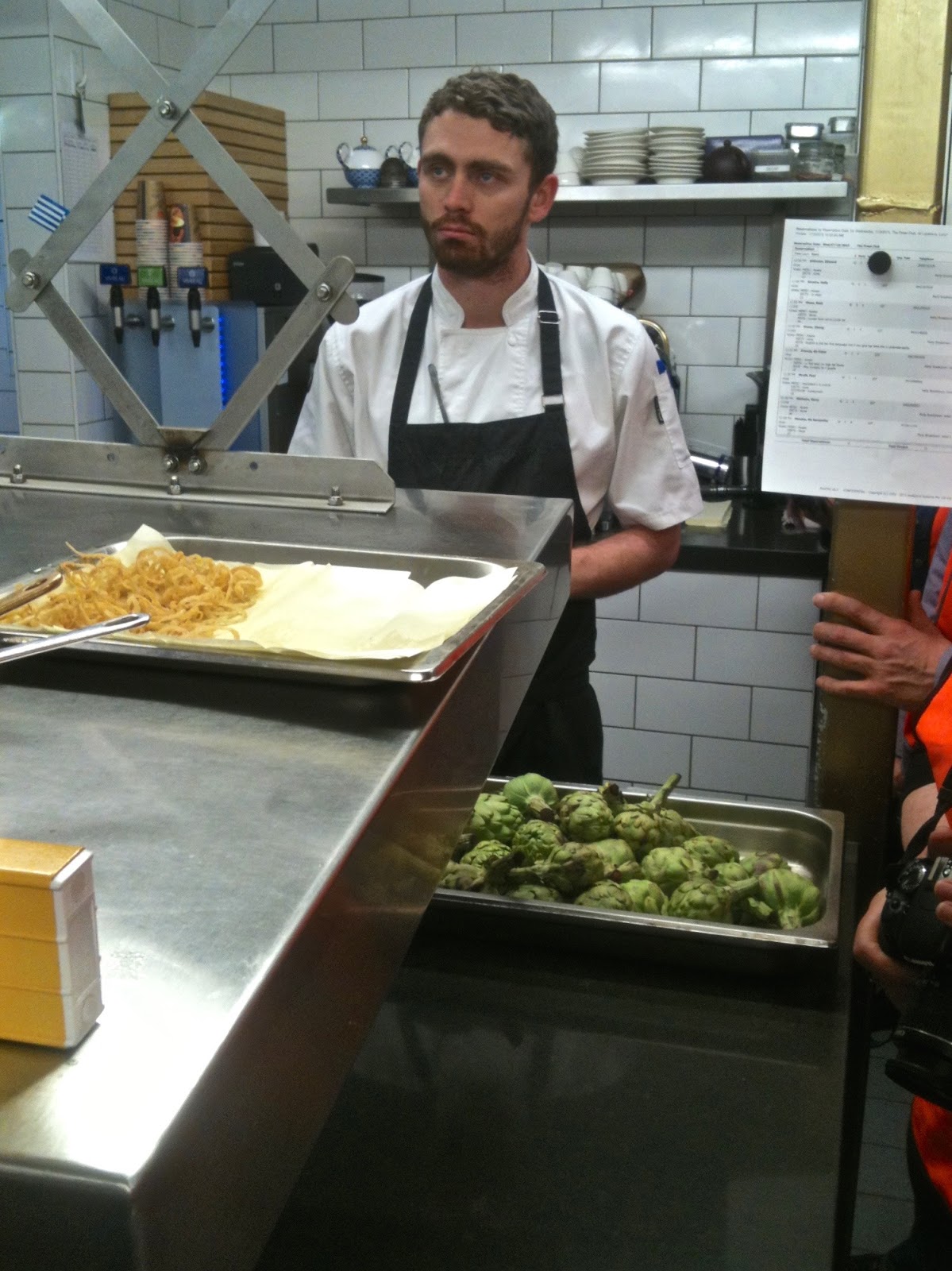
We took a brief look at the dining room before descending downstairs to the main kitchen where the real action was. The rest of the kitchen staff were busy preparing for the lunch and while tolerant of us, regarded us as a distraction.


I've worked in kitchens before and when the atmosphere is bad in the kitchen it seeps into the food and spills over into the service in the restaurant too. I could sense that there was a pretty good atmosphere amongst the staff here and that they were serious about making good food that people would come back for. The question that was running through my head as I was surveying the scene, looking at the artichokes awaiting creative treatment and  meat stock simmering away, was, how much does it cost to eat upstairs? None of us were rude enough to ask this most obvious of questions. 


The tour drew to an end in the refrigerated room amid boxes of mineral water, hunks of meat and boxes of vegetables delivered fresh from the city's markets this morning. Those standing by the door asked questions while those of us pushed into the room's deeper recesses shivered and prayed for a swift exit. This Technopia Tour was much more like a conventional tour than I was expecting; it functioned as a gentle framing device that delivered us to Robert and his kitchen. Taken for what it was, it was an interesting morning's backstage tour of a high-end restaurant that left more than a few of us thing, I'd like to eat here. How it fits within the broader project of Technopia Tours and engages with performance and art languages is another question. This felt to me like a way of making the research that informs the curatorial practice, public. How, exactly, this experience is then reconfigured is something I'd be interested to see.

Wednesday, 28 October 2015

The Melbourne Parliament House Tour: citizen tourists on the loose.


This rather grand building is Parliament House, Melbourne. I was excited at the prospect of taking a tour of it as it would give me something to compare my tour of the Scottish Parliament with. The Edinburgh tour was interesting as much for what it did not say as for what it did. It was, in many respects, like a political campaign that sidestepped uncomfortable issues and 'took hold of the narrative', as current news-speak would put it. With that tour I was aware of a number of the issues that were being glossed over, such as the delays and serious overspend on its construction. However, I know next to nothing about the politics of Victoria and very little about Australia either, except that Prime Minister Tony Abott was pretty widely despised and regarded as an idiot by pretty much everybody I met. This, then, was necessarily a more superficial tour of a parliamentary public relations exercise.


I was in a hurry to catch the 1 PM whistle-stop tour and would never have thought it would have taken me so long to enter the building. The security screening by the team of misanthropic guards took longer than some airports I have travelled through and resulted in the confiscation of my 8cm long flexible camera tripod for reasons they alone will ever know. I stepped into the elegant reception room where a smattering of tourist/citizens were scattered awaiting the tour's imminent start. The man in the loud blue shirt was to become my favourite: true to appearances he made a string of blunt jokes and observations throughout the tour like, "how much? crikey!"


Our guide emerged on the stroke of one, had us leave our bags in a safe storage room, then beckoned us through the barrier. He came over as a smart guy doing a simple but comfortable job. He carefully chose his words so as to avoid sounding as if he favoured one political side or another, yet he also sounded as if he was very aware of the debate and disagreements that characterise a parliament like this. His was a conspicuous neutrality that goes with the job and he gave the impression of someone who had been doing this long enough that it had become second nature to him. Indeed, he managed to sound relaxed and human in this role and even managed a dry sense of humour. 


The first room was being rearranged and didn't look its best. We began with an introduction to the architecture, always a safe bet, unless you the Scottish Parliament, that is. The queen looked down on us as we listened and we also heard how they do weddings here, though it was admittedly expensive, not to say dry as a choice of location. 


This building is divided into an upper and lower chamber, a system directly modelled on the the British parliament. Our guide explained how this lower chamber functions and it basically seems to work tribally with each side closing rank within an oppositional style of government. The sand timer is a nice touch and I am minded to get one for practicing speeches myself. It is so much more visually effective than a digital clock; there is a palpable sense of time slipping away. That was the case with our tour as well: we were up against the clock as this was essentially a 30-minute photo opportunity tour with only time for brief explanations.


We got a look at the gold-leaf clad speaker's mace in the library, the same mace that is featured in this photo and which our guide told us a spicy story about. The story goes that the speaker's mace went missing in the 1891 and rumour had it that it ended up in a nearby brothel that was frequented by politicians, used in mock parliamentary procedures/sex games. To what precise purpose the mace was put he did not elaborate further. It is a nice story, far enough removed from the present to be amusing more than scandalous, and he obviously enjoyed telling it to give the tour some light relief. I have noticed that with dry and potentially boring tours like this one, it is a good strategy for the guide to have one or two tricks up their sleeve like this to inject some life into the tour. The sex theme, in fact, popped up again a little later when we got to the upper chamber. In the discussion of the political affiliations of the members of the legislative council, our guide noted that the upper house is far more welcoming of independents than the lower house. With a slight smile, he seemed pleased to tell us that the State of Victoria elected Fiona Patten of the Australian Sex Party in the last round of elections. Naturally, my new friend in the blue shirt had a lot to say about her!


I was able to take the tour today because the parliament was not sitting. On these off days the building is not completely dead, however, it still forms a backdrop for political interviews. Here the media were lined up waiting for the suit to take the stage in front of the building which grants an air of legitimacy and gravitas to those who stand before it. I remember on the tour of the Scottish Parliament we stopped beside some pretty plain modern concrete steps which our guide told us were often used for interviews. Concrete, I suppose, speaks to the technocrat and in this the aesthetic differences between the two buildings are very significant in building different public impressions of their representatives as individuals and as a whole. Given the choice, if I were a politician I'd take this door any day, but that, I suppose, betrays my soft spot for theatre: the theatre of representative democracy.

Monday, 26 October 2015

The History of Computing in Melbourne Tour


The tour of Melbourne's computer history is, as you might imagine, a specialist tour. I was, therefore, a little nervous before taking it that I might come over as an IT imbecile who possesses superficial background knowledge, asks dumb questions and proves unable to grasp even the most elementary points. I needn't have been. My guide Chris was not out to impress me with his knowledge and use it as a stick to beat me with, he was keener to share it and so, when necessary (i.e. most of the time), translated it into layman's terms. We began informally in a cafe where I joined him taking coffee with two old Macedonian friends of his, a weekly ritual of theirs. I learnt something of modern Greek history and the reasons for their departure and emigration to Melbourne, but more to the point, I dropped in on three old friends happy to welcome me into their day to day life. Melbourne's standard of coffee is said to be very high and whilst my cappuccino was not otherworldly, it was very satisfying and went some way towards countering the fog of jet-lag and lack of sleep I was fighting through, seeing as I'd literally stepped of a plane a few hours earlier. This was, most certainly, a soft landing that, together with the warm, spring sunshine dancing over the trees, made this feel like a city with possibility.


I said goodbye to my two new acquaintances, finished up my coffee and was taken for a short spin around Queen Victoria Market. With no word about computers, we strolled through taking in the spectacle. Markets, particularly working markets that cater for the residents as opposed to tourist markets selling souvenirs and food at inflated prices, are quite addictive. They are similar enough around the world that you can make comparisons with markets you are familiar with and different enough to make such comparisons interesting. In this case I was looking for unusual vegetables and did indeed spot a light green flattened ball about the size of a fist that the vendor said tasted like carrot. He was an older gentleman who looked to be of Chinese descent but spoke with a relaxed Aussie accent and Chris told me there were a significant number of Chinese who came over with the goldrush of the 1850s and who have made Australia their home ever since. What was, on paper, a history of computing tour was turning out to be a far broader Melbourne history 101 class.


Over a very tasty and reasonably priced Greek spinach pie with pumpkin and beetroot salad, we talked about his role at Monash University and then got onto the bread and butter of the tour: the role the city played in the development of the modern computer.


We stopped outside the Royal Exhibition building to learn about the automated machines used for the 1921 census and also looked at a statue that spoke of the Victoria/New South Wales rivalry, which I suppose must still exist. It is a good thing that Chris, my guide, is careful about his appearance; with longer hair he could easily look the part of the mad professor but, as it was, he looked and sounded every bit the part of the serious, retired professor passionate about ideas and engaged with the wider society. He was, then, the expert guide who could go a lot deeper into any of the things he was talking about rather than the blagger guide, i.e. someone reading from a script and trying to succeed on charm alone.


Next stop was Melbourne Museum to take a look at CSIRAC, the world's oldest and only fully intact, first generation computer. It is a huge, metallic hulk of a machine that was state of the art when switched on for the first time in 1949. I listened to Chris talking about how it functioned and watched a period film of it in action, which included an excerpt of the world's first ever piece of computer generated music. Together, this enthusiastic commentary and video transformed this 7-ton lump of metal parked in front of me from a cold-war dinosaur into an important and innovative technical achievement. This is the sort of exhibit that absolutely requires contextualising like this for its true value to become evident, seeing as it was not made for its appearance, doesn't feature interactive games and has no celebrity angle to exploit. 


These are the computer's programmes. I recall, from the accompanying video, that entering them onto CSIRAC was not such a simple procedure. No Apple Store to connect to back then! Chris explained how the memory was held in long mercury filled rods, which we could view from the side. These were a technology imported from radar, and this helped me see how innovations in one field were sometimes passed around providing solutions in another, albeit temporary ones until more specialised technology for the task was developed. This set me off on the inevitable Alan Turing line of enquiry which, I was pleased to learn, was not a completely irrelevant one. It seems as is automating code breaking was important in the development of computers, indeed Melbourne also had a significant role to play here with the military intelligence unit FRUMEL based in the city and working in this field of cryptanalysis. What's more, I learnt that some of the war-time coding techniques and hardware were kept secret for many decades more as they were still of strategic value during the period of decolonisation and independence. In other words, GCHQ was spying on former British colonies, what a shock! CSIRAC seemed to be used for different purposes, however, and I got the impression it represented an early, heroic period in the history of computing when Melbourne was at the forefront of this emerging and powerful technology.


The tour meandered through the city and opposite Federation Square I learnt that this tour has a cousin of sorts: Made by Maths an app that shows the mathematics underpinning key landmarks and buildings in Melbourne. I'm guessing it probably started out as a tour like this one too, and has now moved onto a digital platform. The pattern on the facade of this building, I was told, was made to not repeat itself and required some rather serious mathematics (and computers no doubt) in order to achieve this. I think that these sorts of tours that make a specialist subject accessible to a broad public by making the city itself visible through an unfamiliar frame of reference are tremendously valuable. Most typically, tours that operate within the tourist industry use a format that is immediately recognisable such as, lets say, a historic walking tour, which can then be applied to any given environment. The names and places may change but the experience is more or less the same wherever you go. Tours that approach the city through different specialisms, however, have the potential to step outside of these familiar narratives conveying both new ideas and points of view to the listener and, at the same time, still telling them something about the location too. I have noticed that as universities focus ever more upon producing public facing research, tours have become one way in which research interests are being put out there. For example, the University of Cambridge commissioned the 800 Years of Death and Disease in Cambridge walk and audio tour and then there is Queen Mary's interdisciplinary East End Tour which I  myself managed to review last year.


We tried to enter St Paul's Cathedral but it was inexplicably locked. A little later the same day I managed to gain access and see the next point of the tour: a list of the deans of Melbourne. Stuart Barton Babbage figures on it and he is a descendent of Charles Babbage. Babbage senior is the inventor of the world's first computer, a mechanical device that was never satisfactorily made during his lifetime but which, nonetheless constitutes a first. I felt the relationship of this stop to the tour's subject is somewhat tenuous, as it does not so much tell us about the history of computing in Melbourne as offer a neat way to talk about the history of computers in general, but it does do this and do it quite effectively, too. Not only did this stop introduce Babbage, it also introduced Ada Lovelace, the world's first computer programmer. I was quite unaware of these achievements in the 19th Century that paved the way for the creation of the modern computer so, tenuous or not, I was interested to hear about them.


When we were out on the street the conversation continued and jumped freely around from sectarianism in Melbourne and the purpose of these plastic sheets wrapping tree trunks (possum guards) to indigenous people's status and what the purpose of the tour is. It turns out that this tour manages to cover a number of bases. It is given from time to time to promote IT at Monash, the University of Melbourne and the city more generally, and it is also an excellent way of welcoming new postgraduate students, potential students and interested parties into the department. The tour can take anything up to 8 hours, including lunch, and it offers an informal situation in which those taking it can get to know one another through taking a walk, talking about computers and, it can very usefully orient newcomers to the city itself. Today, however, it was also serving another novel purpose. I had told Chris that I was interested in taking tours of Melbourne and he told me he also happened to be a member of a walking club that was going out into the bush the following Sunday. Today's tour was, then, a test to see if I was A) fit enough to walk for several hours and B) not a jerk who'd mess things up and annoy the walking club's members. I'm happy to say I managed to scrape through on both counts.


We walked down St Kilda Road which, I learnt, was Melbourne's silicon valley in the 70s. The full tour usually starts at Monash University, some way outside the centre, and makes stops along this road where IT companies were previously located before going into the city centre and finishing at the University of Melbourne. This long route has a geographic logic to it that gives the tour some shape. That is helpful since the material itself, while being thematically consistent, does not have a strong narrative or chronology. Our route was not quite so clear cut, however; we snaked our way through the city-centre taking in the sites in a more free-form way. This way of navigating, in fact, lent the walk a lack of artifice that was entirely appropriate: it felt much closer in character to a conversation than to a theatre show, the ghost of which haunts many a guided tour.


We arrived at our final stop Melbourne Observatory, set in the Botanic Gardens that were coming into bloom and alive with many unfamiliar birds. Chris explained that there was a dedicated computer room here many years before CSIRAC or the Ferranti Sirius ever arrived in the city. The computers that filled this room were not machines, they were human; a team of unmarried women who were considered to be highly dependable at making mathematical computations based on astronomical photographs of the Southern night sky. This role of astronomy and mathematics in the development of computing also led us onto the telegram, timekeeping and ultimately the first internet connection in Australia. When I looked at all these inter-related innovations it was hard not to see them as being intrinsically bound up with the spread and maintenance of The British Empire and European colonial expansion and war as a whole, seeing as so many aspects were about making communications quicker and more effective. The history of computing in Melbourne is, therefore, a story that jumps out in many directions crossing the world and straying into global history and commerce too. On the subject of commerce, I should add that this tour is not given for profit, it is an entirely free tour, the rewards of which are far more valuable than however many dollars the university could conceivably charge for it. It is an event that can stimulate genuine engagement with the subject matter, make good personal connections and, if that sounds like your thing, the good news is the next tours are running 31st October and 22nd November 2015, bookings via this link.

Monday, 19 October 2015

The Melbourne Walkabout Tour


The meeting point for Melbourne Walkabout's Laneway Luncheon Tour was set: Federation Square, the gravitational core of this city of 4 million people. Befittingly, the crowds were out in force, as were the Australian Rules Football celebrities and the outdoor broadcasting studio: this was Grand Final day, the culmination of the football season when the two top teams compete for glory. The morning sun was already biting into my pale skin. I clung to the shadows where fans snapped idols and where I reached for the sun block. For a spring morning, it was freakishly hot and it would rise to 32 by the afternoon, the highest ever temperature for a Grand Final, I was later told.


In the swirl of the crowd it was not so easy to find our guide, who was wearing a blue T shirt. I finally spotted her tapping her phone and it was only through using it that the entire group of seven of us was able to assemble.


We glided onto an air conditioned tram and cut our way north up Swanston Street. Between the heat and our group's average age, it was worth saving the legs and taking advantage of the free city-centre trams as there was plenty of walking still ahead of us. This was a good way to get started and put a little momentum behind us.


Standing outside the impressive State Library of Victoria, we were told about how it came into being and we were given the option of taking a look around inside. This tour was not run according to a fixed itinerary with a tight script, it was a walk through the city-centre stopping at many places, and sometimes popping inside when there was collective interest. My group was made up of six older Australian ladies, one half of which was a group of friends over from Sydney. I was quite definitely the odd one out but here our interests were similar: we all wanted to go inside and see the Ned Kelly exhibition.


Before we made it to Australia's most famous outlaw we admired the view from an upper balcony of the library. At the centre of the reading room is the permanently vacated enquiry desk: a blinded panopticon. I worked in the SOAS (Uni of London) library for a couple of years many moons ago, and when I was looking at this sight I was reminded of that time, back in the 90s, when readers would trouble you in person. Nowadays, readers are kept at bay and watched remotely; the NSA and GCHQ tracking their internet usage and discrete CCTV cameras capturing them smuggling their banned-in-the-library chocolate bar into their mouths. 


Then we came upon a thoroughly tamed Ned Kelly. This was not the wild fugitive holding out from the police with gun blazing, this was his iconic body armour professionally displayed in a glass case amidst an exhibition on the man and myth. Kelly has been the subject of more biographies than of any other Australian, including today's figures in the media spotlight such as Shane Warne, Kylie Minogue or Rupert Murdoch. We didn't really hear so much about the Kelly story on this tour, we simply dropped in to see some of the artefacts as the rest of the group were already familiar with the tale. These artefacts also included the Jerilderie Letter, dictated by Kelly, where he tells the story from his point of view and which casts him as a victim of police anti-Catholic persecution. The story certainly has a number of levels to it and a big chunk of its appeal must be that he is seen by some as a Robin Hood figure, while by others as a common criminal. What is uncontentious is that he is highly infamous and as a result of this has spawned a minor tourism industry all of his own today. Search Kelly tours on the internet and you'll see an array of choices that include gastronomic tours of 'Kelly country' and candlelit tours of his site of execution. In the Victorian outback and NSW border area, he must surely be the biggest hook upon which to base a range of outdoor tours, so Kelly country it is.


Outside the library there was a bit of a buzz around a stand where a couple of young ladies were handing our free drinks. Between the hot weather and the girls giving away both glasses of their soft drink and the bottles of concentrate to take home, it was the obvious next stop for our group. We hoovered up the bottles and drank gratefully but when I got home and tried them in the cooler atmosphere of the evening, the 'free give-away' appeal had worn off and I was left with three small bottles of brightly coloured chemicals destined not to make it into my luggage for the flight home.


We were led down Madame Brussels Lane which was introduced to us as being the heart of the city's former red light district. As I mentioned previously, visiting the historical sites of prostitution, such as that which I did on the Qianmen tour of Beijing, doesn't make for nearly as interesting a tour as visiting a living site in the way you are able to on the very popular Amsterdam red light district tours. That said, a good story about this place's past that could have tickled the imagination, so to say, would have brought it to life. I mention this because I heard just such a story on the Parliament House tour, which I will get round to writing up shortly. The story involves the stolen speaker's rod and a certain disreputable establishment favoured by the political class... Here, then, was one of those moments when my Melbourne tours started to link up and inform one another in unexpected ways.


The information we were told about the places we visited was usually brief and just there to paint a picture of how the place used to be or what goes on there now. The researcher in me wanted precision, facts and a narrative, but this was not that sort of tour. This was a 'hang out with a friendly local' sort of tour. The point was not to learn things that you would only forget the next day anyway, it was to spend a pleasant two or three hours seeing parts of the city the casual visitor might otherwise overlook. The ladies on the tour seemed perfectly happy to take the place in in this way, indeed I think this was a lot more to their liking than some sort of study tour led by an expert. They were on holiday, after all, and their guide was an outgoing, younger version of themselves showing them her city.


We frequently stopped outside stores and restaurants where our guide gave us shopping and dining tips. What seemed to be her greatest passion, however, was cocktails. She had an extensive knowledge of the city's cocktail bars and it seemed she had the place mapped out in detail placing one every few hundred meters. I never had Melbourne down as a cocktail city but through her eyes I started to see it in a whole different light.


The lanes are quite diverse in character, some house shops and restaurants, this one has a nightclub at the far end. Many of these lanes thread right through the blocks and it was through these that we mostly walked. This gave the tour a more local and human scale than if we would have focussed upon the major thoroughfares along which the large colonial era public buildings congregate.  


We came to the street art, which our guide was keen to show our group. The ladies were unsure at first whether they liked it or not but warmed to it once they started taking group pictures of themselves in front of it. Maybe it is a complete co-incidence but when I took a street art tour in Berlin it was also given by an Australian lady.


We then piled into a quality chocolate shop where we were offered some samples. Rather good they were and it resulted in a number of purchases.  


This is just a random poster I spotted as we entered some shops. It is simply not right. He looks like a moody Harry Hill. Thinking about it further, however, I started to wonder if tribute bands are a bit of an Australian thing. I have heard it said that the Australian Pink Floyd is as good, if not better, than the original and while the idea of the Aussie Floyd initially sounds like a joke, they are anything but: they have toured extensively for decades and sold over 4 million tickets. Could it be, because the country is so far from Europe and America, bands from there used to visit less frequently creating a ripe market for tribute bands to step in? Nowadays travel is easier, I suppose, but this is another genuine 'tourist theory' like the previous one on Melbourne's traffic lights.


I also spied a particularly opportunistic jewellers.


The tour finished in a cafe somewhere near Queen Victoria Market. We were treated to a dish and beverage; I had the mushroom risotto with a carrot and ginger drink. It was rich and creamy with a nice variety of mushrooms, set off by a watercress garnish. We ate sitting around a large table sharing tourist impressions of Melbourne and stories of home while the Puerto Rican waiter extolled the virtues of the Buena Vista Social Club, which played in the background. After a couple of hours walking in the heat we were about ready for a sit down. Our guide explained that just the week before the weather had been uncomfortably cold requiring a scarf and coat and she was very happy about this sudden turn around. That said, we also started talking about global warming and Australian bushfires. This tour is an informal style of one that is probably, like the meal itself, best enjoyed with friends. I certainly got to see a great deal more of the city than I otherwise would and I also got to hang out with people I'd not otherwise connect with. Of all of the tours of Melbourne I took, this was most probably the most touristic and also easiest of them, and none the worse for that either. Not being into shopping or cocktails, however, I felt that the tour was aimed more at the rest of the group than at me. Still, if that is who actually shows up, then that is entirely appropriate and it gave me a chance to step into their world, if only for one sweaty morning's walkabout in Melbourne.