Showing posts with label food. Show all posts

Monday, 2 November 2015

The Technopia Tour of The Press Club Kitchen, Melbourne


I came to Melbourne to participate in the gallery programme and symposium Performing Mobilities and also a part of the same programme was Technopia Tours offering daily tours of Melbourne at work. Today's tour was a visit to the Press Club kitchen, other tours during the week took groups to a recycling plant, the State Library and a public water facility. Technopia Tours is a curatorial project initiated by Kim Donaldson working in collaboration with both artists and non-artists which has resulted in several previous manifestations in the form of exhibitions and performances. One of the project's strategies, I gathered, was to draw upon tourism and find how it might inform and offer ways into the appreciation and experience of art.


We gathered outside RMIT Gallery where orange, high-visibility jackets were handed out. As a group, we then walked about twenty minutes south through the city-centre to our destination, The Press Club. Wearing these brightly coloured jackets gave us a presence on the street; passers by saw us and quickly then ignored us as we hid in plain view. When we passed others similarly clad, they'd as often as not clock us as fellow workers, the practical people who keep the city moving as opposed to the suits or shoppers who clutter the pavement. That said, we did not precisely look like construction workers or traffic wardens, we were more like a team of inspectors or busy-bodies en route to a construction site.


We arrived at our destination The Press Club. 


We were greeted by Robert the sous-chef who was to lead the rest of the tour. He introduced the restaurant: high-end contemporary Australian/Greek established by the celebrity chef George Calombaris. He spoke confidently and did so as a chef not as a salesman or a tour guide might do. I find it is interesting that when you get given a tour by someone whose main job is giving tours, they have different relationship to and thus take on the location to someone who has a regular job there and who is stepping out of it to show you around. The worker/guide is more liable to be interrupted with questions from other staff, who they will have a deeper relationship with and you get more of a sense of the place being in process. The tour guide is outside of time and floats through.


We were shown the equipment in the experimental kitchen: centrifuges, vaporisers and some scientific devices that I wouldn't know how to even begin describing. He admitted that while some of them were useful there was also a white elephant in there that they had still not figured out any gastronomic use for. Curiously, he also told us that they needed to prove that they were a genuine kitchen using this equipment for food as some of these babies could be used to manufacture illegal drugs. He said that although they do make good use of some of these machines they don't go in for adventurous chemistry style experimentation that would not taste any good. It remains a restaurant kitchen, after all. This makes perfect sense for a serious business but looking at these white metal boxes I was momentarily thrown back to a notorious art-meal I organised which involved all the guests bringing a can of food with the label removed. The three courses that resulted were more, or mostly less successful attempts, to salvage edible dishes out of what we found when the cans were opened. Serious amounts of alcohol were required to wash that stuff down but boy, we would have had some fun with these toys!


We took a brief look at the dining room before descending downstairs to the main kitchen where the real action was. The rest of the kitchen staff were busy preparing for the lunch and while tolerant of us, regarded us as a distraction.
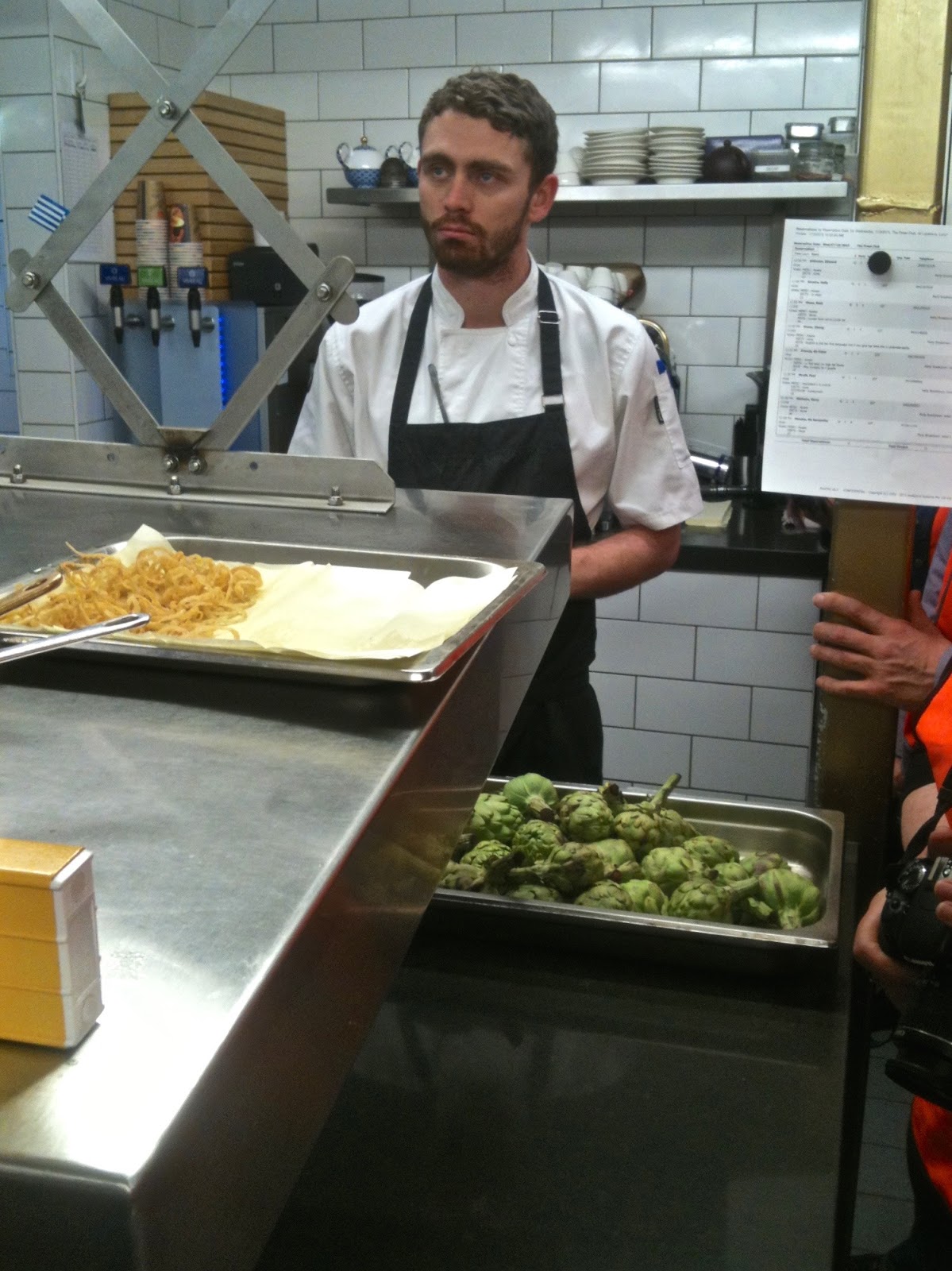

I've worked in kitchens before and when the atmosphere is bad in the kitchen it seeps into the food and spills over into the service in the restaurant too. I could sense that there was a pretty good atmosphere amongst the staff here and that they were serious about making good food that people would come back for. The question that was running through my head as I was surveying the scene, looking at the artichokes awaiting creative treatment and  meat stock simmering away, was, how much does it cost to eat upstairs? None of us were rude enough to ask this most obvious of questions. 


The tour drew to an end in the refrigerated room amid boxes of mineral water, hunks of meat and boxes of vegetables delivered fresh from the city's markets this morning. Those standing by the door asked questions while those of us pushed into the room's deeper recesses shivered and prayed for a swift exit. This Technopia Tour was much more like a conventional tour than I was expecting; it functioned as a gentle framing device that delivered us to Robert and his kitchen. Taken for what it was, it was an interesting morning's backstage tour of a high-end restaurant that left more than a few of us thing, I'd like to eat here. How it fits within the broader project of Technopia Tours and engages with performance and art languages is another question. This felt to me like a way of making the research that informs the curatorial practice, public. How, exactly, this experience is then reconfigured is something I'd be interested to see.

Monday, 24 February 2014

The Walk Eat Talk Eat Tour: come on an empty stomach


I should begin by first making my excuses for this being a tour taken well over a week ago that has only now made it online. I relocated to Beijing while writing this one up and this blog is blocked there along with a great many other seditious online publications, so it has taken a little while to figure out how to get around this impasse. I couldn’t pass this tour off as yesterday’s as it began with a topical sales pitch in Shoreditch Station, where I had arranged to meet my guide. A young man and woman from Beauty Group were stopping passers by and telling them they were lucky enough to be one of the first 25 customers of the morning and could thus take advantage of a tremendous cosmetics offer. Yes, for just £35 I could have walked away with a little black bag bristling with cosmetics that would otherwise have cost me over £100, a perfect Valentine’s Day present, etc. She did her best and I watched as she demonstrated the various pastes, powders, glosses and pencils but my heart wasn’t in it. It was still a £35 sale and when I saw the two of them still there over two hours later I started to doubt the ‘first 25 customers’ line and suspected it was more a device to inject a sense of urgency and exclusivity into what, for me, was at best an only moderately interesting offer.


The station was not only animated by Beauty Group, there was also a tour group assembling there and it was only after they departed that I found my guide Charli who was sporting a purple Walk Eat Talk Eat jacket. She led me out, past the group who had now descended fully into the history of old Shoreditch, and onto Bethnal Green Road. We introduced ourselves and it turned out I had some choices and options of where my tour would take me. Not eating meat this meant avoiding some places but with so many other options available I was not short of places to talk and eat.


Our first stop was bunnychow a South African themed fast-food outlet in Box Park. We got started straight away ordering a ‘Boston Beans’, a hollowed-out bread roll filled with beans, spinach and halloumi cheese served in a box. It was rather good and I started to regret having eaten that porridge for breakfast as I was only slightly hungry and if we were setting out at this pace and there were still 4 or 5 stops to come I knew I’d be struggling soon. This was not symbolic food or light tasting to accompany a story, this was the real deal and I was tucking into a second breakfast.


We then got talking to the chef who told us about the food, its origins, how he came to be making it and about the business here in Shoreditch. This got us onto the crossover between street food and restaurants, the festival circuit and much more besides. It was a pleasure to drop briefly into his world and hear in detail about something I might only otherwise miss entirely. There is something quite nice in general about this structure of tour where you get picked up and dropped in front of a number of people who stop and talk to you for a minute and then carry on about their business while your guide whisks you to the next one.   


Our next stop however did not feature any interviews; we ducked into Albion and I was invited to choose an item from the bakery table. The selection was of familiar British items like scones, macaroons and bakewell tarts but somewhat unfamiliar in that these had been well made elevating them above the Mr Kipling’s box of six. I plumped for the bourbon biscuit.


For a place that is branded as British, Albion seemed surprisingly continental European in tone which, I should add, I see as no bad thing. The espresso machine jumped out at me and made me have to ask, “what is British food?” Coffee, as I heard in a previous tour, has a longer history in Britain than tea so in a sense coffee is a very solid part of the British tradition as it has been consumed in this country for many hundreds of years. On the other hand, the beans are grown far away with packets sporting labels like ‘Produce of Kenya’ and coffee culture has only recently been re-embraced here in the UK where until fifteen years ago, it was pretty much instant coffee or nothing. What’s more, the idea of Britain is itself a historical construct; in the stone age, people ate and drank, not cappuccinos I suppose, but our Neolithic tribes consumed something and people were not busy with the idea of Britain let alone British food, that came much later. The idea of Britain that seems to be most in circulation today is one that is historically located in the period of the British Empire. Here in Albion they were improvising upon this theme but doing so in a contemporary way, a far cry from the Britain of the 1970s and 80s that I grew up in, a land of luncheon meat, spam and inedible school dinners. Today’s spam is electronic and today’s Britain articulated in relation to Europe.


Stopping outside on the street the focus of the tour now switched to history and I was told about Jack London’s visit here at the turn of the century and how Thomas Cook refused to offer him a tour so much was this considered a no go zone for respectable persons. Yes, at the height of empire some parts of the capital remained in desperate poverty. Indeed even the police, so Charli told me, would not venture into this cesspool of crime and deprivation. Times have changed! It is a designer shopping and creative industries hub with tour guides a plenty and now, with the Tour of All Tours focused here, it even has its conceptual tour guide, guiding the visitor around the guides. A sign of the beginning of the end? As we went further into The Boundary Estate and I was told about the efforts of early reformers to improve the district I munched on my quite delicious bourbon biscuit and tried to find sense in these multiple impressions and stories. This evaded me as the place IS as ruptured and in flux as all that and a tour that works off this premise will inevitably have to both feed them and tell them some of the stories.


We stopped for street art around Brick Lane but did not linger too long or get deep into the street art scene as the more dedicated tours of it do.


Next stop was a new chocolate shop on Brick Lane. We were meant to talk to the owner but she was in the midst of an involved business call (i.e. an argument) so we simply admired the high-end chocolates and ordered a chilli hot chocolate. This turned out to be another calorie hit with just enough chilli to wake the mouth up but not so much as to destroy the flavour of the chocolate.


Next came the piadina. This is an Italian fast food served up in a van behind Truman’s brewery. This seemed to be a family run outfit with fresh ingredients brought back from Italy every week, I was told.


What made this stop interesting for me was watching the food being made in front of us. It can be fascinating to watch somebody skilled in preparing fast food at work and while this was not so challenging a dish to make it was good to watch the process all the same. There is a rather tasty Beijing egg pancake with coriander, chilli paste and a dried tofu sheet that is made fresh in front of you here and it sends me into the same low-level hypnosis watching the vendors at work.


We made the near obligatory stop outside the mosque to hear about multiculturalism and were stood beside the Bangladeshi sweet shop to check out their offerings. The man in the background is arriving there carrying two trays laden with brightly coloured spirals of sugar and fat. We could have gotten some but I declined already knowing these sweets and feeling rather full from the onslaught so far. It would be interesting to make a calorie count of the tour and see what it came to, to then subtract the amount exerted in walking and discover the net balance. Applying this logic, what would be required to make a calorific neutral walking and eating tour? A stick of celery every 200 meters?  I guess that wouldn’t take on, not even with hardened vegans. This idea of neutrality is nonetheless an appealing one with carbon neutral travel and carbon neutral companies making much of their balancing equations, or I sometimes suspect, cooking of the books.


We sheltered under a coffee stall outside Spitalfields Church as the weather turned properly grim and I got some historical stories about the church and surrounding area. Stepping over the road I ran into Bill Gee by chance, Bill who is co-curating Inside Out Festival in South Dorset where I’m also making a tour for this Summer. It was funny for him to catch me hard at work researching one of my other tours. Walking through the gastronomically homogenized Spitalfields Market (over-run by chain restaurants like Giraffe and Leon) we arrived at another British themed food store A. Gold on Brushfield Street which caters to city workers and proudly displays all the old brands. I got half a scotch egg which I prudently saved for later. One of the themes of the walk is that ‘British food is not half as bad as people make it out to be’ and on the basis of this tour you could definitely agree with this sentiment. Granted, there are horror kitchens up and down the country, millions of people buy ready to microwave slops from supermarkets and you can still pick up a deep fried mars bar, if you know where to look, but that does not change the fact that there is a quality British cuisine and that it is not indelibly bland but actually rather good. The tour used food as the principal hook to get you from place to place and tell stories not just about food but also about the area on the way. While it can sometimes feel a bit split between these two focuses, for most visitors they are only going to ever take one tour of Brick Lane and combining food and local history is a way to make the experience as a whole an agreeable one. I felt that the history of empire and social class loomed large over what I experienced, yet a tour that articulated this in depth would be a very different sort of tour and quite probably not so enjoyable a one. My one piece of advice for would be tourists taking the Walk Eat Talk Eat Tour is to approach this one on an empty stomach, there’s a lot to take in.

Monday, 27 January 2014

The Secret History of Street Food Tour

In the name of diversity (and a healthy dose of self interest) I was able to take another first for the blog here: a food tour.


My guide Emma from Coutours met me beside the West Cornwall Pasty Company Stand, outside of Liverpool Street Station. It was an easy to find, food related meeting point for this private tour which would take me around the East End and introduce me to some of the foods and stories behind the varied culinary cultures of this part of London. 


We soon came to Spitalfields Market and the adjacent Fruit and Wool Exchange. This building is one I must have seen many hundred times yet I don't recall ever noticing its title up on high. I was told about its former purpose and how it had been turned into offices more recently. We talked about the market and its former dysfunctional days with some affection; produce and people spilling chaotically out onto the streets blocking the roads. The tour's focus was upon history, on what had been there, so we went further back in time and I heard about its Victorian period and the class distinctions which meant the middle and upper classes did not shop for food but rather sent their staff. This focus upon history is of course a very typical one of guided tours which often aim to bring to the surface the invisible or hidden aspects of an area which the visitor might not know or be able to see by themselves. A tour that focuses not on the past but on the present is less common but there are a few locally such as the, the Shoreditch Party Pub Crawl and the Street Art tours. Tours that imagine the future are the least common. These are tours that might be made by a property developer in order to win support from financiers and planning officials. It is these future focussed tours, private tours with glossy CGI brochures, that preceded the transformation of Spitalfields Market, an act of corporate vandalism that has been honoured with awards. My guided Emma expressed mixed feelings about the new Old Spitalfields Market, while something had to be done to arrest the place's freefall during the 80s and 90s, and that something would almost inevitably mean City expansion, it was not as bad as it could have been and enough of the fabric of the market remained for it to still be recognisable as one continuous structure. 


The idea of a food tour immediately set off my salivatory imagination, however the tour took us not only to places where food is served but also to some locations where there was no food to be sampled, such as this site of a former dairy. It was then that the precise nature of the tour became clear to me. While there was food to be had on this tour, as you shall see, the emphasis was far more upon using the history of food as a vehicle to talk about the area's history more generally. Given that food is a very specific expression of a culture and that this area has had many waves of immigration there was plenty to talk about. What's more by approaching this history through the frame of food, there were may original angles on stories that I had heard in other formats on previous tours of this part of London.


An example of local food history is fish and chips, one of the few British signature dishes. Emma explained how the tradition of deep frying fish in batter was introduced into Britain by Portuguese jews. When cooked in this way, the fish preserved well and made it suitable for cooking in advance and then being eaten on the sabbath. The chips, I was told, were popular with Irish immigrants and these were originally the off-cuts of potatoes which were very inexpensive. Inflation being what it is, chips from Poppies could no longer be described as cheap, but they sure were tasty, on a par with Happy Days, which I visited while taking the Queen Mary East End Tour.


This sign 'Your Mum Ate My Meat Porn' was never going to speak to me as I don't eat meat. We passed, in fact, by a great many unexceptional sights such as this and the character of the tour was that we rarely stopped at them but rather they were referred to in passing and the conversation continued as we strolled further through the neighbourhood. This leant the tour a more free flowing atmosphere, it was certainly not a tour of 12 impressive sites that came with tightly rehearsed description of them from the guide, as can happen. Instead observations and details came at a steady pace and every now and again we'd stop so there was time to talk a bit more about what was in front of us, though often as not the conversation continued afterwards as well. This is partly the result of this being a private tour for one but I noticed that Coutours deliberately keeps the tour groups small in number so something of this flavour of personalised and conversational walking is retained. I felt I was being treated like an adult; big tour groups can often have the resonance of being on a school trip.


We then entered the food markets and took a look around at the many stalls from all over the world. To my surprise there were quite a number of Ethiopian vegetarian stalls, they seem to be the latest thing. I settled in front of this Japanese stall and was set off wondering about the etymology of tempura, whether it was also of Portuguese origin or if it was developed quite independently. Answers welcome.


I found myself starting to look at the place as a United Nations of food as the stalls all had their little flags and logos clearly showing where the dishes came from. However, with this international history of fish and chips in mind, I should not have been surprised to to see that the people working at the stalls did not necessarily reflect the flags they were flying. This Japanese stall was run by an Indian man, for instance.


Then we came to our old friends the Dutch who, I was told, introduced some technical innovations in British gardening such as the use of fertilisers, which had a revolutionising effect on the produce and thus dinner table. Nowadays, of course the country is more famous for its tomatoes without flavour and the stem cell burger launched here in London last year, an artificial burger made from growing stem cells in a laboratory.


We stopped in Nude Espresso to warm up, drink coffee and see a local eatery from the inside. Since this was a solo tour I was able to ask questions not only about today's theme of food but also about my preoccupation of tours. Emma was most forthcoming and told me how she became interested in giving tours after having taken one herself in Jordan that came perilously close to falling apart in the desert. I thought this was a rather beautiful and personal beginning which she built upon through a great deal of hard work: giving as many as 2000 tours in a year. That must surely be a truly immersive sink or swim training on the job. Her perseverance has paid off and she has developed a business out of it and created a number of tours angled around different themes and set in various parts of London. She told me she continually develops new tours and is working on a 'scent' tour of Central London right now. We talked a bit more around the process of constructing tours and with our coffee cups drained stepped back out into the fresh air.


Almost inevitably we made our way to the two bagel bakeries, spelled beigel as they are of Polish origin, at the top of Brick Lane. They had sizeable queues snaking out of them since, it being a market day, they were doing storming business. That said, they seem to have a healthy flow of customers at all times of the day and night. Thinking back to what I was told earlier in the tour about shopping historically being for the lower classes I could not help but notice how it has grown in popularity and become a  major form of entertainment for people of all positions within society. While Brick Lane is not Portobello Road, it is a popular street market that is as much about selling the idea of itself as a market as it is about selling any particular goods. People come here to hang out and will not necessarily leave with purchases. The one thing they do buy however is food, as that has become part of the identity of the market, and an integral part of the market experience. This transformation from being a market of good to a market of lifestyle must be one of the main reasons behind the huge growth of street food on Sundays.


Because it was a Sunday many of the cafes and restaurants outside of the Brick Lane were closed and I was told that the East End food tour is more commonly held on a Saturday, when places like Kelly's is open. Having already tried jellied eels and mash (with liquor) before I did not feel I missed out on too much this time round, if anything it was something of a relief not to have to repeat that particular East End delicacy. This got us going on, if and how pie and mash shops could or should be rejigged, as they are something of a dying breed.


Our final stop on the tour was Pellicci's in Bethnal Green, famous for having once been the Krays' local cafe. Once again then, the twins who lived round the corner on Vallance Road made their way into a tour of the East End. I heard about a Kray tour from the point of view of someone who used to drink in an East End pub that would be periodically invaded by a tour group who'd be told, "The Krays shot a guy in that corner" and with that the group would shuffle out. Fortunately for Pellicci's the place was not the scene of a murder or stabbing, as far as I am aware, but rather the scene of many a lunch that was a result of Italian cooking meeting British tastes.