Showing posts with label Xiamen. Show all posts

Monday, 25 March 2024

Barefoot on Sand: a walk about walking


I was in Shanghai recently and went for a walk. I realized that my gait could be improved if I let my arms swing more loosely and made more of a point to get posture and muscular control right. I have both taken and made tours on all sorts of subjects and about a crazy assortment of places but it was a revelation to make a walk where the subject of the walk was the physical act of walking itself. Arriving in Xiamen I had a hunch I should continue with the experiment and take advantage of the cities clean beaches. I resolved to walk barefoot on sand for an hour as an experiment. 


I began at this tall statue, the emblem for the Golden Rooster Film Festival, the Chinese equivalent of the Oscars. The festival is held in Xiamen annually and is an excuse for the film industry from Shanghai and Beijing to have a few days of gorging themselves on seafood in the sun. On the other side of the water, the Taiwanese version is called the Golden Horse and this got me thinking about Golden animals, prestige and films. It sparked the idea for a film festival of my own which might well just happen: The Golden Cockroach! If only for that, this walk was a success as it gave me a name and concept for a future event.


The walk began with the shoes coming off and the ever so slightly smelly feet coming into contact with the warm dry sand. Starting from a standing position, I spent time feeling the weight passing down through the feet and the spine reaching up, getting a sense of relaxed verticality. When walking, there is so much else going on that it becomes much more difficult to focus on these basics so it is good to start off with good posture. I found my feet became much more sensitive and alive when in contact with the sand released from the prison of shoe ware. This in turn gave me more feeling about where precisely my weight was distributed. 


I set off along the beach leaving a trail of footsteps behind me. I settled into a rhythm that let the arms swing fully and lungs breathe in the sea air. Focus was more up and outwards as the sand didn't present obstacles or contain sharp objects that might damage the feet. It was only after a while that I looked down and I realized I was not alone. There are worms living in the tidal area of sand near the shoreline. I'm not sure if it's the same ones, but I was once convinced to try eating worms dug up from the sand here. To be precise, the skin of these worms, set in jelly with a hot sauce smeared over it; it's a local delicacy. All I can say is I tried it once and won't be touching it ever again.


The walk continued and I was in luck, the tide was right out so I could pass around the rocks and continue a long way, walking solely on the sand. The angle of the sand sloping down to the water makes the weight falls more onto one foot than another. This gentle asymmetry made me more aware of what I was doing higher up in the body, I could feel it all the way up to the neck. 


After a while I became more sensitive to the differences between coarse sand and fine sand, dry sand and wet sand. Each behaved very differently underfoot. I never would have expected to have found so much variation. These subtle changes in turn improved my posture as I was getting so much more sensation in my feet than I normally do when wearing shoes. It would be possible to do this for five minutes and experience this as information but doing it for longer was so much more rewarding as it becomes ongoing and sustained feedback. If you want to correct bodily habits, retrain bodily use, this longer sustained work is almost certainly more effective. It requires time and repetition for it to get inside your body and become second nature.


While the focus of this walk was on the act of walking itself, I was not on a treadmill, I was still walking somewhere. The sound of waves is quite good for letting go of chatter but thoughts keep popping up regardless. One thing that kept coming to me, for instance, was that I always used to hate the two towers in the distance, and now there's a new one currently being put up. They are dumb landmarks, notable only for their height, which turn into screens for kitsch once night falls. This mild irritation with them as they symbolize the wrong turn the city of Xiamen has taken, is perhaps why I ended up lived in one of them for a while: so I didn't have to look at it.


It's ironic that just as I was about to finish, I walked past a beach stall selling plastic sandals. I had gone further than anticipated and the hour walk turned into 90 minutes. I could already feel the skin between my toes getting worn down by the abrasive sand so I understand why people spending longer on the sand might want footwear. What this barefoot walk did for me, however, was to make me much more mindful of walking surfaces and gait. The first thing I did when I got home was to go through my shoes and make a careful analysis of each pair, seeing how it impacted my walking. This walk about walking was, therefore, not so much a performance as a really useful exercise. I will surely try it again and most probably also use it when teaching.

Sunday, 24 March 2024

The Three Shadows Curator Tour

Three Shadows Photographic Art Centre in Jimei, to give the place its full title, is one of the better art spaces in Xiamen. It is an offshoot of the main gallery in Beijing which is one of China's dedicated photography galleries. They were having an opening and I was invited, somehow, so along I went. Rather than a drinks reception and hobnobbing, as it the London way, an opening here means something far less fun: the curator's tour.


Thirty of so of us shuffled around the space, dutifully stopping in front of the artworks to drink from the fountain of culture. This tour, like practically every other, took place in the afternoon, not evening. These events are timed so that the artists, team and patrons go to dinner afterwards. If there is any fun to be had, it is later at the dinner: you have to earn it by attending the tour in the afternoon.


As we were going around the exhibition I saw one photograph that I recognized as there is a friend of mine Yingmei in it. Not that you'd recognize her in the pile of bodies. This connection brought to mind the fact that artists here are not typically paid for the inclusion of their work in an exhibition, the money goes towards running costs, the space's owners, the exhibition curators and the shipping of artworks. Artists might be invited to the opening, be offered a room for a night or two and can join the opening banquet. For artists selling artifacts this is just about understandable but for performance artists like Yingmei or I, it doesn't work at all. I was, in fact, once invited to give a performance for a British Council sponsored exhibition at Three Shadows but even for a live performance as part of an exhibition with that sort of institutional support, they refused to pay any fee. Needless to say, they didn't get their performance, but I'm sure the curator's tour was wonderful.  


The sound came out of a loudspeaker that was connected to the microphone via bluetooth. Being placed behind the audience the voice was dislocated. This gave the tour a weird touch that everyone tried to pretend was normal. In retrospect, this was the most interesting aspect of the tour and it is something that could be explored further. Just imagine the voice walking off on its own tour, the curator and their voice heading off on opposite tangents.


The basic frame of the curator's tour was educational: it was to help you understand the artworks. It's unidirectional which is to say, there were neither questions nor discussion. When I come to think of it, the tour might have been for the benefit of the curator more than for anyone else. It builds their public profile and shows everyone that they are doing something. 


The final thing to note is that the tour went on far too long. Three Shadows is rather typical in offering these 90 minute tours for openings, but you can see the same thing in art spaces all over China. This tour was an old one from back in 2016 but I went on a curator's tour just the other week in a different art space and it was exactly the same. Sadly the loudspeaker was not behind the audience this time round but it was, otherwise, the same package.

Sunday, 18 April 2021

The Quick-Fix Photo Tour of Shapowei

I have a passion for quick-fixes and have been taking photos of them for the last five years. It seemed like it was about time to share a bit of the fun with other people and how better to do that than in the form of a tour! This is, therefore, a new tour and a slightly different format to my previous ones: it is a photo workshop as much as it was a guided tour. Still, I must admit: I am back on the street and giving a tour once more. It feels good to be back!

 
The tour is the opposite of most Xiamen tours in the sense that, instead of stopping at one scenic site after another and working our way through the checklist, we seem to stop at things like this: a plastic bag tied around wires on the forgotten side of a building. There is, however, just as much to say about this sort of place as there is about the statue of some leader or an exquisite beach, this assemblage of plastic is raw creativity.


The sort of tours I like are open to unexpected things happening and this one was no exception. As I was waiting to begin the tour I got talking to an Italian student who is studying at the university. I ended up convincing him to come along on the tour and he made a useful contribution to the discussion. What's more, when I set the participants the challenge finding and taking a picture of a quick-fix themselves, he took me to his single-room apartment as it is a nest of quick-fixes. It is also in a fashionable part of the city and costs just 800 rmb a month, that's about £80, so it's no wonder it is like this.


This is the sort of picture the participants came up with themselves. What I like about these pictures, when they are at their best, is that they reveal a story. You can see how someone went about filling in the space and how they worked it out as they went along. What's more, you start to see recurring problems when you record a number of these quick-fixes. With these recurring problems you see common solutions but so too do you notice innovative ones, some of which are exemplary while others could be classed as bodges. Recording the whole range is worthwhile. 


We finished the tour in a community space where we looked at the photos and I gave some advice on how to improve them, both when taking them and through editing. This was, finally a photography workshop in the shape of a tour. It felt good to invite the participants to be active in the tour by first taking pictures then later spotting their own quick-fixes. What I learnt from giving the tour is that taking a good image is not only a technical task it is also deeply connected to thinking visually. It is necessary to have a clear idea of what you are looking at and where the focus of it is, in order to capture the phenomenon with clarity. This has lead me to realize that this tour could be useful to anyone who has to use images when presenting research as it helps to bring the idea of the image and the reality of it, into greater congruence. Learning in action.

Saturday, 8 July 2017

The Subtle Allure of Getting Lost in Jimei


Here we are at the start of our Way-Losing tour of Jimei District, Xiamen. Previously, I have always been cast in the role of the visiting tour guide who tries to get the locals lost. This time round there were some other visitors too, and none of us could precisely say we were local to Southern China, though a couple of us knew their way around Jimei.


The tour was distinguished by torrential rain that fell in sheets shortly after we began. We jumped into the first bus we saw, then another, and this finally led us far from the centre to an area none of us had been to before. The rain abated long enough for us to go looking for a local 'Tire Museum' but drizzle started again and we took shelter around a table dominated by a Teletubbie. I was reminded of performance artist, Gary Stevens, who lent his voice to these creatures, as we sat drinking inexpensive beer in this makeshift bar. Seeing as some of the group had been looking for a bar all along, it worked out just fine.


One of the attractions of a Way-Losing Tour is that there is not too much pressure on having to be led to anything special. On the majority of more conventional tours, you expect to be lead to supposedly important sites and, more often than not, the locations are ever so slightly disappointing. They are rarely the guide's own personal choices, they simply comprise the city's canonical geography and the guide is there to explain it for you. With a Way-Losing Tour, however, places come and go like weather and it is up to you and your fellow way-losers to find significance in them. This puts the tourist in a more active position.


When looking at sites like this and creating your own narratives from them, you have to look a lot more closely than usual. With so many sites and threads in the air I started trying to make connections between them all. Imposing sense on experience is hard, but inevitable; looking for that sense in unfamiliar places was where the creative work lay for me. 


The Blue Mountains, some way off in the distance, was where my imagination kept drifting off to. They exerted a pervasive influence that transcended the muck, mire and petty affairs of the increasingly scrappy streets below. 


Earlier on in the afternoon we had been talking about the shared bike schemes and then we saw an Ofo bike far from the city, cutting its way through one of the many small lakes that the village had been engulfed in. Looking closely at the the village aesthetic I came to see how it was different to the city's but also how, in places, the village popped up in the city too. This got me thinking that to understand how the city works, and why it looks the way it does, it is essential to also understand the outlying villages like these, too. 


A field that marked the furthest point we would reach, and where Xiamen truly ended, provided the set for this domestic scene. There was a fair amount of creative work quietly going on in the background and this got me thinking that this could all be foregrounded in a creative Way-Losing Tour. This was a mixed group, however, with people here for different reaso so this was not going to be that sort of tour. 


Afterwards we ate food in the adjoining town. We got lucky and it turned out to be pretty good. 


It was not over. A bus took us back onto the island and into the city. Weaving our way back I realised that there must be many more buses like the one we took, connecting the villages to the city, something I had underestimated before. Spat out in Sibei, we stumbled into a rare demonstration: Xiamen University professors complaining about housing resale rights. Unable to get a bus or taxi back because they were clogging the road, I realised that on a Way-Losing Tour, problems do not have to be perceived as problems: they are opportunities to discover more about the place and people. This resistance, or will of the city, is one of the things that is expected, even necessary. The frame of the Way-Losing Tour transforms problems, well it has so far, and demands an interesting balance of being engaged but also accepting of just what fate has in store.

Tuesday, 27 June 2017

Way-Losing - in Xiamen - 1st July


The 1st of July will bring us back on to the street and into the wilds of the city. This will be a very particular Way-Losing tour because the city of Xiamen in Southern China is undergoing a profound renovation ahead of the BRICS conference later this year. It is in a state of self-conscious preening. This tour, however, will take place on the completely other side Xiamen, in and around Jimei District on the mainland. For most of those who live on the island this will already make it a step into unfamiliar territory. That will not be enough, however, we will expect nothing short of complete disorientation!

Places on this tour are strictly limited so reservation is essential.

Friday, 20 January 2017

The 42 km Tour aka The Xiamen Marathon


The 2nd of January was a big day for me. Some months earlier I had signed up for the Xiamen Marathon. I followed the instructions, arrived at 7.15 AM, only to be told I could not participate because I had not collected my race number. A trying-to-be-helpful but actually hopeless young lady in a reflective yellow jacket told me race numbers had to be collected the day before. This crucial detail was not included in the communications I received from the race organisers but was instead buried in their website's information on a not so very obvious page. My wife and I tried to get the race assistants to find a manager who could issue a number but the girl in yellow just gave us phone numbers which didn't respond except for one which someone picked up and then immediately slammed back down again.


There was nothing for it but to go home and watch the race on TV. From this point of view, the marathon is basically a two-and-a half-hour tourism promotion. Once the pros had crossed the line and the Ethiopians collected their prize money, the TV coverage wrapped up. 


As I noted when reviewing The Tour of England, sporting events have become another way in which cities are made visible through a sort of tour. With that one, a small number of cyclists followed the route, a few more people lined their way and a considerably larger number of people watched them circle around the city on TV. I think it is very interesting how cameras construct a very selective live video portrait of the city, but what I miss in these TV tours is being inside of frame myself and having firsthand experience of the location. Reality is almost always much more diverse and ambiguous. That’s why the idea of running a marathon, rather than watching one, was so appealing. Well, that and I also wanted to get in shape.


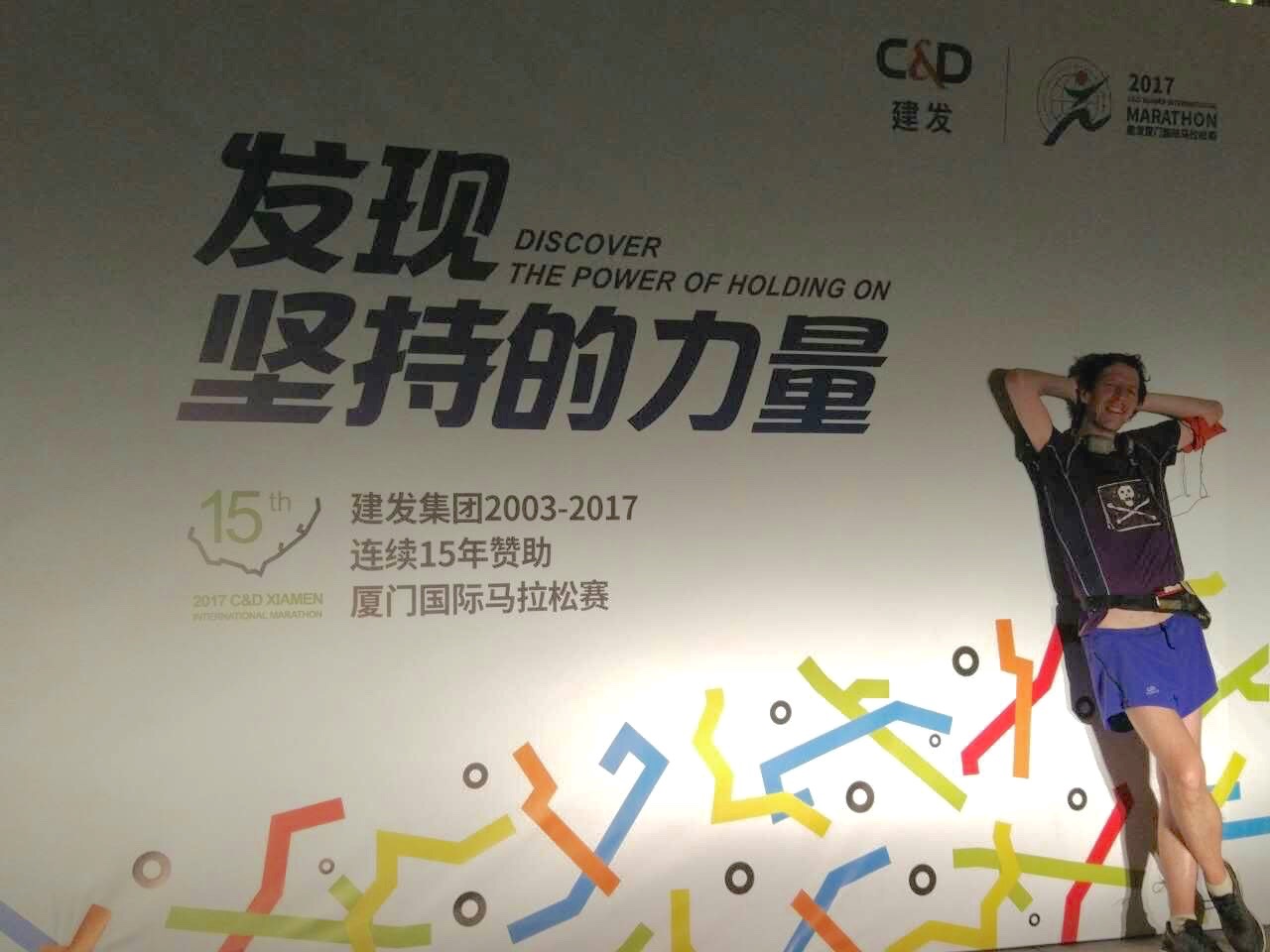
In place of the race number that had been denied me, I donned a pirate flag. I was not going to be running for the corporate sponsors like China Construction Bank and KFC, I was doing this for myself. I know that if I had not been denied a number I would have run the race anyhow, but I started to sense that being excluded was in fact not a bad thing; it alerted me to the true nature of the beast I was dealing with. Call it a stroke of luck or simply the power of self-justification, this race was taking an interesting new tack. I waited six and half hours till the last of the stragglers from the official race had groaned over the line then approached the exhibition centre where the action was. Coming towards me was a tired looking Monkey King. Very few Chinese runners have the gumption to dress up like this and I should admit I was impressed, particularly given the heat. I had been toying with dressing up too, but not being sure if I would complete all 42 km, I was reluctant to fail spectacularly in fancy dress.


The starting point was now freely accessible so I took my mark and at 2.30 in the afternoon set off on this endurance tour. It was an extremely pleasant 24º C; pleasant if you were sitting in the shade sipping tea and eating watermelon, that is. For me it was anything but relaxing, it was sticky, humid and precisely the time of day I would normally avoid running in Xiamen. Never having gotten further than 22 km before, I knew I'd need to pace myself so I set off speed walking. 


Since the roads were no longer blocked off for runners I pounded along the pavements and cycleways on the side of the ring road and must have been quite a sight: a lanky westerner wearing a pirate flag wiggling his bum furiously from side to side. Some people did take pictures and a bemused older man on a mountain bike followed me for a while. Mine was, however, a very solitary marathon, not the crowd experience of the morning. Perhaps because of this, I listened to music on headphones. At first I set my music library on shuffle which served up a hopelessly random selection of audio oddities many of which were slow melodic thinking stew or even worse, Chinese lessons and audio books. I was, however, prepared for what was to come and had downloaded the three CD album The Workout Mix (2011). In any other context this would have been downright painful to the ears but slogging round the sweaty Xiamen ring-road, this relentlessly upbeat electro-kitsch was exactly what I needed. 


Even when I reached the insipid Emall, a long way short of the mid-point, my feet were already complaining. I had read that there are many things that can go wrong when doing marathons. I knew that for me the feet that were quite definitely my weakest link but there was no plan B, I simply had to endure the dull repetitive pain that grew with each kilometre. I dared not take off my shoes to see what the pain consisted of. One good look at that gore would have been the end of my race.


Making this very particular tour up and down the city's tourist coastline was a good opportunity to reflect upon the current transformation of Xiamen. When I first visited the city in 2010 it seemed much more beautiful than today. There was abundant nature bursting out at evert corner, threatening to reclaim this relaxed tea slurping city. But there has been a shift, maybe for older residents they'd say that already in 2010 that shift had already taken place. What was unmistakable was that the city was now being remade according to a much more intentional aesthetic. It looked like it was trying to style itself as a new Hong Kong or Singapore: high rise, malls and manicured nature. The irony here was that in doing so it was destroying the very thing that made it beautiful in the first place and turning itself into just another Chinese city, albeit one with better weather.


I like the comparison here between the battle hardened face at mid-point and the shell shock of the finishing line. My final time was far from heroic: just over five hours. Still, my sole ambition was to complete the 42 km and this now leaves me with something to improve upon. Crossing the deserted finishing line, littered with the detritus of corporate sponsorship, my immediate feeling was of defiance. The pirate held true! The message: don't let companies who don't care for you deny you of your dreams. 


And here I am making my best efforts at an 'it was easy' smile. With distance, I can see that there are some aspects to marathons which, as a format, have made them become almost inherently corporate. Maybe other cities do a better line in them, I don't know. Not having run one before, I did not know what I was letting myself in for. I later learnt from several other people (Chinese and foreigners alike) that they had the same problem obtaining a number from Xiamen Marathon. The organisers just seem to be very poor at communicating and don't bother to improve as the race is heavily oversubscribed. You really are just a small cog in the wheel and the juggernaut keeps on rolling regardless of your experience. I did in fact ask their press office for comment but they, like all the other phone lines and emails, have also not replied.


When I got home I gingerly peeled off my shoes. My long suffering feet were in a sorry shape. On the sides of the heels were white oversized blisters that looked like miniature pitta breads. My big toe was wrecked too, the next day the nail would go an unusual shade of blue. I cannot say for sure but my guess is that this is a result of fake shoes. I first tried on the shoes in a store and then, like the cheapskate I am, ordered the same pair from a Taobao seller. Either Asics are not all they are cracked up to be or I got a poor imitation, something that does happen in China. I have in any case learnt a lesson here about online shopping, and also another one about the nature of marathons, too. There is quite definitely a whole lot more to them than just an unreasonably long tour. They offer a window into the dynamics of the city and to your own, deteriorating state, over the course of 42 km.

Thursday, 7 April 2016

The Taiwan Viewed From The Sea Tour: a teasing boat cruise for mainland Chinese tourists


My experiences of going on tours organised for mainland Chinese tourists has been pretty  consistent: infuriating, ridiculous and, with the benefit of some distance, highly amusing. When I learnt that there was a boat tour from Xiamen that sails rights up to to Taiwanese island of Kinmen but doesn't land on it because the trip is designed for mainland tourists lacking the necessary visa, I needed no further convincing. The tour began with ticketing confusion: the times were not those listed online and the ticket office had been relocated a kilometre down the quayside. Hawkers on the waterfront tried their best to sell us alternative tickets but finally, after a phone call, we located the ticket office and paid our 136 kuai each. We were then escorted back the way we'd come and onto the boat by a jolly man whose breath smelt of alcohol. It was, in fact, completely unclear whether this actually was the original boat we had been trying to take or whether a competitor had snapped us up somehow but it made little difference: we were getting a trip to Kinmen, the sun was shining and we were departing immediately. So far so good.


The boat consisted of a large and loveless cabin lined with narrowly packed rows of hard wooden seats facing a small, tacky stage either side of which an over-powered PA relayed the guide's commentary at an uncomfortably loud volume. We were then urged to go upstairs where, for just a little over 100 RMB each more we could have a small room to ourselves. We were escorted upstairs and when we seemed unconvinced they added we could instead have an outside table with tea for two for just 150 RMB. They were really doing their best to maximise the return on each passenger by squeezing extra money from us. Indeed, throughout the rest of the entire trip there was a sustained effort to make us part with as many RMB as possible. The staff seemed incredulous that me, a Westerner, could possibly choose to remain downstairs and kept on pestering me to change my mind but no, the cabin was where we could watch the guide tell her story and besides, the trip was already over-priced and I wasn't going to encourage them any further. 


I had discovered from the drunk man earlier that this tour had benefitted greatly from the cap on visitor numbers to the island of Gulangyu. Gulangyu is Xiamen's holiday mecca, a once beautiful cluster of colonial villas that has become a tourist trap. Visitor numbers are currently being kept down in an attempt to improve the island's environment and gain UNESCO world heritage status. As a result, a lot of visitors have to wait two or three days before they can make it onto Gulangyu and while waiting they sometimes choose to take this boat tour instead as an alternative. This trip, which used to also include a stop on Gulangyu but no longer does so, is something different. It is a tour that plays with the idea of international travel without ever actually leaving mainland China. It might well be the nearest that a good many of the tourists taking it ever get to going abroad. While looking out over the seaways and watching the constant flow of vessels (Xiamen is the world's 14th busiest port) the staff came back to try and get me upstairs again. Now there was a special offer: just 50 RMB each to go upstairs. I stayed put, I wanted to see if they would come lower still.


Our destination, the Taiwanese island of Kinmen came into view. When we were approaching it the guide said we had passed a line in the waters that marked the sea border. She then got us to check our phones and look for the Taiwanese network we were now attached to. This seemed to raise a lot more excitement than it should, seeing as our phones didn't actually work on these networks and there was no danger of us watching Youtube or connecting to Facebook, just some of the websites blocked in China, including this blog.


Next came the option of having your picture taken with Taiwan in the background. This was an offer too tempting to resist, particularly as the price was a modest 30 kuai. What's more, when we headed up and out to the bow of the boat for the photo, the staff said we could just stay above decks afterwards. So, finally we got up there for 15 each and were to receive a memento as well. Little victories are often the sweetest.


And here are the results. Three of the images are ready-made with the fourth stuck top left and the lot of them, then laminated. The meaning of the images is quite interesting. They frame the tourist excursion as a military manoeuvre. The title refers to this site as the frontline between Taiwan and Mainland China and the pictures are of army lookout posts, Taiwanese flags, a black plume of smoke, presumably the result of a Chinese bomb or missile, and a gun boat scrambled to repel the invaders. Since we were actually making a subtle incursion into Taiwanese waters and our guide repeated a number of times that we all wished to be reunited with our brothers and sisters across the water, I read this image as a way of banalising an ongoing conflict by reframing it as tourism but still maintaining the PRC's territorial claim to Taiwan, nonetheless. This was, quite probably, the most nationalistic tour I have ever taken but what was striking about it was that this was a very casual form of nationalism. There was nothing strident or hectoring about it, it was all delivered in a friendly matter of fact tone.


Photos done and dusted we could then sit outside and enjoy the fine weather. That's when the sales promotions started in earnest: cigarettes, pineapple cakes, knives made from cannon balls, an endless litany of products, all with a Taiwanese twist. We got stories about the products too, such as how President Xi had been given one of these famous knives by Taiwanese President Ma during their recent historic meeting. Unsurprisingly, the newly elected and less Beijing friendly President Tsai, was not mentioned.


We were finally lured below deck, once again, by the knife show. It featured a long-haired man who, it was claimed, was from a Taiwanese ethnic minority. He stood barefooted on top of two knives while the compere, a vulgar young lady in a short red dress, talking up the act into a microphone perpetually on the brink of howling feedback. He then proceeded to put another man on his back and bounce him up and down, all the while balancing on two thin metal blades. It would have been best if he'd have stuck to that but he got dragged into yet another sales promotion. He wanted to give us all 'presents' from Taiwan and the compere then added a price and asked him how much they would cost 'back home'. This prompted some very fake acting and, I was told, a rather dodgy accent too. In any case they managed to shift a few more trinkets on the back of this before we finally arrived back in Xiamen. 


The tour reminded me a little of a bus tour of The Great Wall I once took which also featured endless promotions, the only difference being that that time round we did finally get to see something impressive. This was like the Great Wall tour without the Great Wall. It was as if they had extracted everything of interest and were left with the residue: a floating sales promotion and nationalistic commentary. This trip to go and look at Taiwan and the Taiwanese is, I think it's fair to say, one that will appeal to an almost exclusively mainland clientele. It can be interesting for all of us, albeit for different reasons, to see how the other half lives.

Monday, 15 February 2016

The Nanputuo Tour: a Buddhist Temple jam packed with Chinese tourists


Nanputuo Temple is a large and internationally significant Buddhist temple in Xiamen, South East China. It is both very old and, at the same time, disconcertingly modern; it originated over 1000 years ago with a monk holing up in a cave, has grown over the years and today  features a great deal of more recent construction. My guide was a temple volunteer who offered visitors free tours. She gave the tour in Mandarin, which was racing away far quicker than I could ever hope to hold onto, so I was fortunate to have translation. My last proper visit to a Buddhist temple was a weeklong stay at a Tibetan retreat incongrously located in Pocklington, a village outside of York. That was some twenty years ago and ended badly. It marked the end of my flirtation with Buddhism and also precipitated a split with my girlfriend who I went with and who was having a spiritual experience there. Was karma finally bringing me back round to them today or was I going to be just another tourist looking at the exotic statues and intricate pavilions?  


Because it was the spring festival week, a national holiday throughout China, the tourists were out in force. It was shoulder to should stuff through much of the tour as Xiamen is a top internal tourist destination and Nanputuo one of the city's principal attractions. Here two tourists have stopped to listen to the guide explain the history of a pavilion and take a good look at the tall pale foreigner at the same time. 


She led us around in a clockwise direction. She explained that you should always visit the temple in this way as to go anti-clockwise was against the natural order. I rather liked the fact that the form of the tour was, at least in part, shaped by Buddhist beliefs. Another one of these was that we were not to walk on any of the portals, we had to step over them instead. The contents of her tour were mostly a mix of stories about the history of the site, some Buddhist beliefs and the lives of the monks and masters. A few times I asked her questions and she notionally answered them but in her own way and quickly brought us back to the script she had prepared. She was going to give the tour she wanted to give and not an open-ended enquiry into the life, culture and politics of the site that I might have wished for.


My partner, Sophie, was translating the tour for me and there was a big difference in the way the guide regarded her to how she addressed me. It often happens that when I take tours in China and I am accompanied by a translator, the guide speaks directly to me and the translator then repeats the information in English. Here, the guide concentrated her attention on Sophie and I was mostly a witness to this exchange, which got paused from time to time so that I could get the highlights. 


When we came to the original Nanputuo cave where a monk once lived, our guide showed us how to pray and how to bow. These involved a very specific series of hand gestures, each of which had a significance, and which together made an elegant chain of movements bringing you to the ground and back up. Here I came to feel that perhaps the main purpose the guide put on the tour was that it might serve as a vehicle to rekindle the faith in visitors. She didn't seem so concerned about me as I was foreigner which, strangely, I was quite relived by. I was free to make of the whole thing whatever I wished.


This was one of the more interesting places we stopped at. The guide explained that during the cultural revolution of the 60s and 70s, the temple was closed but believers would walk up the mountain to a concrete barrier that had been put up behind which was this giant rock carving. Beside the barrier visitors would say a silent prayer and then move on, a way of discretely practicing their faith during a period when it was prohibited. Nowadays the temple is not suppressed, on the contrary it is flourishing, although I did notice a large police presence. When I asked the guide why they were here she told us their presence was due to the site being of national significance and being so popular with visitors.


We finished up in the newer and much quieter study centre and charity foundation wing of the temple. Here, Buddhist monks made there way around the fragrant gardens lined with osmanthus bushes. They walked in an unhurried manner that was in complete contrast to the tourist scrum taking place a few hundred meters away. Looking at them, I thought, if I were going to choose a place to be a monk I'd probably chose here rather than up some remote frozen mountain, their life looked rather good. 


With a smile, our guide bid us farewell and disappeared back into the swell of people and clouds of incense hovering around the front gate. She made no appeal for a donation, the tour existed as something in its own right and this leant her tour greater weight as the words and practice really were in line with one another. She did not make too hard an effort to translate the site's world to us, which is what most tours do, she simply offered us an hour-long sample of it while slotting us through the crowds point to point. I've noticed that Samye Ling Monastery in Scotland offers tours that similarly extend the idea of a tour into including Buddhist practices such as meditation, so it is quite possible there is a pattern here. If I compare these with most tours of Christian churches that I have been on, the church tends to take a more touristic point of view and accepts that people might well be more interested in the stained glass windows than God.