Showing posts with label Changting. Show all posts

Thursday, 13 May 2021

The Flying Tigers Tour of Changting


This tour started off as something quite different to what it became: a domesticated cat that turned into a tiger. The group I was visiting the town with were to be shown the historical town centre of Changting but as it was raining and the organizers simply said, if you want to see it,  walk to your left seven minutes and look around for yourselves. This did indeed bring us to a brightly lit building that sat over the remains of the town wall.


Few seemed keen on braving persistent rain so my group was just three European guys. We had the idea of looking round the old town and seeing if there was an Irish Bar or something similar. We traipsed up and down sodden historical alleys and stumbled across a distinctly 21st Century toilet. Outside it has a screen that shows how many cubicles are inside and which are currently in use. In spite of this, there was still no toilet paper.


More or less giving up hope of finding that mythical Guinness we dropped into an insipid cafe then hit the street again. This sign caught my attention. I had known there was an American airbase in Changting and had even asked about it previously but our guide answered vaguely and changed the subject. Now we had stumbled across some traces of this history. 


Next to the banner were some pictures of the steely Claire Lee Chennault. A retired Texan airman, he was in China in 1937 doing a three-month air surveying contract then was propelled into the rank of colonel, aviation instructor and procurer for Chiang Kai-Shek's air force. His is a swashbuckling war story. Working basically as a paid mercenary for the Chinese, he formed a volunteer air corp known as The Flying Tigers which recruited in the US and fought very effectively in China. They were later incorporated into the regular American air force which he re-entered as a Major. He emerged as a war hero, finished an honorary Lieutenant General and is buried in Arlington. In all the accounts, however, he comes over not as military brass but instead as "one of the boys." He is even meant to have opened a brothel in Guilin for his men with the justification "his men needed sex and it was better to have his "boys" visit a brothel that was regularly inspected to reduce venereal diseases."


As we were lighting up the pictures with our phones and studying them a man stepped around the corner and ushered us inside. We walked through a restaurant and into the 'museum' which was closed. He turned the lights on and showed us around. This was not really a guided tour, it worked more on the level of, here are some things, take a look.


One interesting thing that the pictures made much of was Claire's second wife Anna Chennault and the couple's two Chinese American children. There is an interesting history here: after the war the family returned to Chennault's home in Louisiana, where there was still a law forbidding marriages between whites and non-whites, and to a town where there were no non-whites. His status as a war hero apparently silenced any objections to his Chinese wife and mixed-race family. Little of the detail of these stories was conveyed in the exhibition itself, what came over more was a sense of gratitude for help in time of war and pride in connection to the outside world. The other feeling I got was that the exhibition did not need to happen and nobody in authority was going to make it happen. This was one person's passion project. 


This history is one that is not celebrated today, indeed it is more or less written out of the official script as history is viewed as a resource to draw lessons from, and there are no useful lessons to be gained here. This suppression of the history was very clear in the official tours of the town. We were told about the bombing of the town by the Japanese but it was never mentioned why it might have been bombed: it had an American airstrip. Later I even asked our guide, "where was the American airbase?" She said it was very far, a town four or five hours drive away. When I showed her these pictures from the museum she corrected herself and said it was just outside Changting. This conspicuous silence is due to the deteriorating political relationship with the US and it is manifested at the micro level up and down the country. This Flying Tigers collection was, therefore, surprising to find as it was clearly out of step with current policy. That might explain why the place felt it necessary to include some red references so nobody was in any doubt about their patriotism.


We had not forgotten our original purpose of finding an Irish Bar and by now it was woefully clear that was out of the question. Since the guy from the restaurant had been kind enough to show us around the collection, we ordered beers and settled into our Tsingtao. The place was dry, it had a warm wooden feel to it and they brought out a plate of complimentary peanuts. I was definitely warming to it then down the stairs came a Chinese colleague of ours, also on the trip. His group had found this place too and they were upstairs eating and drinking. He giggled and brought down a brown 1.5 liter bottle. He invited us to try "Red Army Coca-Cola." It was sweet, dark rice wine. It was quite easy to drink but between the bottle looking like an oversized hand-grenade and its earthy taste, I was sure it was perfect hangover juice. So, while we didn't find Michael's Blarney Stone, we did enjoy a stroke of luck and got both a nice place to drink and an unexpected tour of the Flying Tigers Museum of Changting.

Monday, 3 May 2021

Red Tourism: how I got surrounded by the Red Army in Changting, China


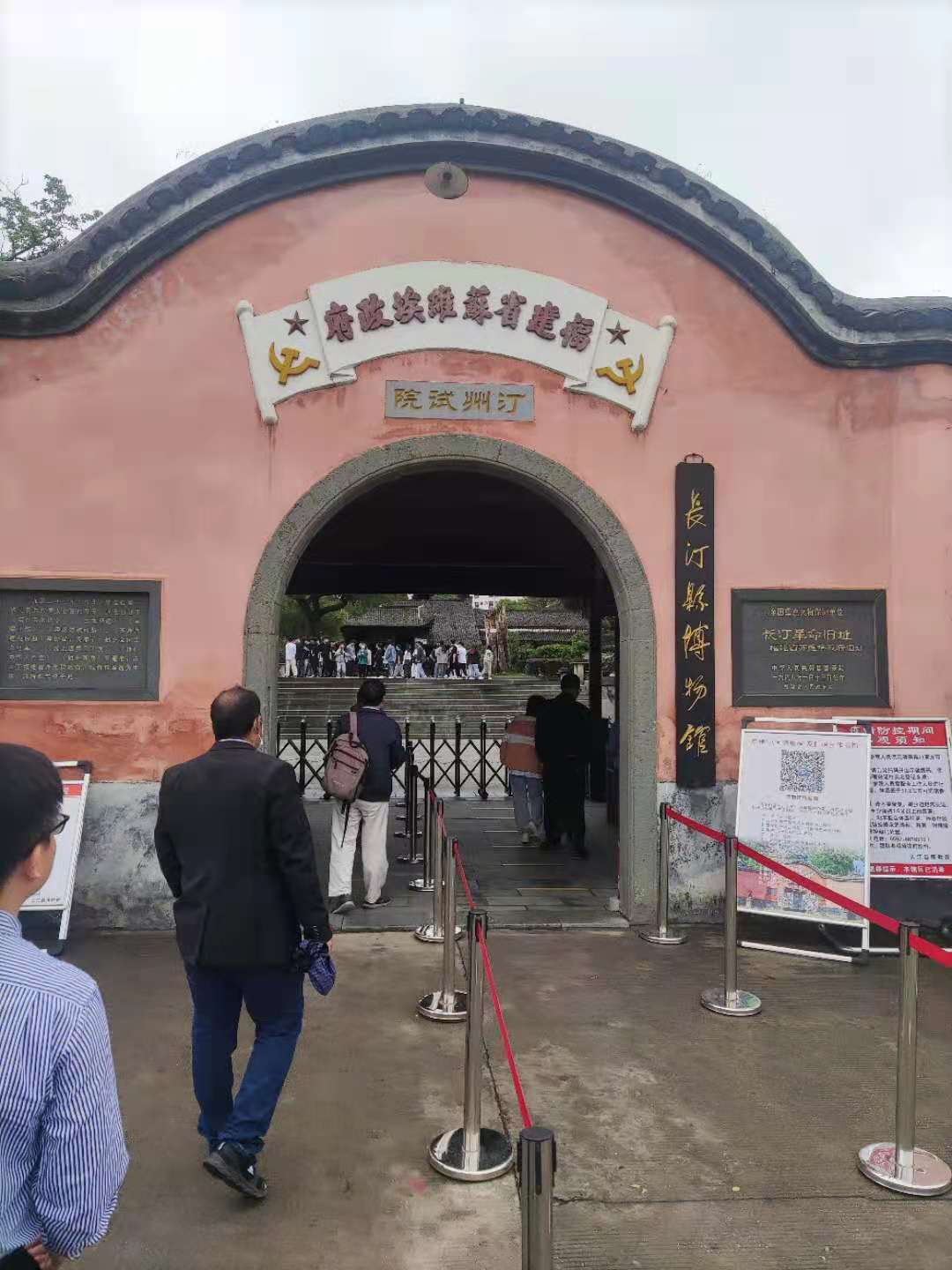
This place, officially known as the Former Site of the Soviet Government of Fujian Province,Red Tourist is a classic 'Red Tourist' attraction. That term really deserves a bit of explanation as, on the face of it, it sounds about as awkward as Marxist-Leninist Ice Cream. Basically, Chinese domestic tourism has taken off in a big way over the last 10 years and people now travel much more within the country than they ever did before. At the same time, the communist party has discovered that it can insert itself into this trend by creating sites that celebrate its history and amplify its ideology. This is such a site.


The town is clearly not used to foreign visitors and nor was the guide. He seemed friendly enough and we had a translator, but many of his points and stories just seemed to go nowhere as we had no context for them. What did slowly become clear was that we were visiting a historic site that at one time was a communist party centre.


We were told that Zhou Enlai, Mao's long-term sideman, described Changting as Little Red Shanghai back in the early 30s when it was under communist control. The meaning here is that you could get anything in Changting that you could get in Shanghai and even more, so plentiful and rich was the town. I'm quite willing to believe it was a prosperous countryside town in the early thirties when it was incorporated into the Chinese Soviet Republic. How long that remained the case is a question and that it had everything Shanghai had and more, stretches credulity. This lead to two observations. The first is that this notion of it being better than Shanghai should be taken more on the level of propaganda, though that didn't stop one Chinese man on the coach repeating it like it was fact. The second is that the term soviet was used several times and when I asked whether and how much the Soviet Union were involved, the translator and guides did not answer the question. They pretended the question was something else or just flat ignored it. 


Here, the guided recited the poetry of Mao in a deep and meaningful voice. This was a performance he obviously gave quite regularly and he looked a little bit pleased with it afterwards. The rehabilitation of Mao, who was at one point officially declared 70% good 30% bad, seems more or less complete.


We were told about the many battle victories of the Red Army who were stationed and recruited in Changting in the early 30s but we were not told about their heavy defeat which precipitated the Long March. This form of history telling that only focusses on edifying episodes from the past can lead to the listeners coming to completely false impressions. I myself had to go and look up the history after this tour as it left far more questions than answers. Like with the other Changting tour I took, I have the feeling that the guides are not used to people asking questions or approaching their tour in a critical manner, so the many gaps in their narrative have never had to have been smoothed over.


Outside it was the turn of the school groups: teenagers dressed up in red army uniform and sneakers. There were a number of such groups and they seemed to be the staple duty visitor on the morning I went. Each group had both their school teacher and a military person in charge of them. These trips are a form of day out for the local schools and they are justified as historical and ideological education. When the group spotted me they seemed to forget ideology for a moment and they swarmed over and wanted their photo taken with the tall westerner, somewhat to the annoyance of their military handler. One or two said, "Welcome to China" something I have not heard in a long time. This was when it truly struck me I was in the countryside where you get to play at being a minor celebrity just by being foreign. The kids were spontaneous and pretty friendly and I must admit finding myself to be the star attraction in a red tourist site made this visit an awful lot more fun.