Thursday, 28 April 2016

The Shikumen Open House Museum Tour: a Shanghai heritage simulation


The Shikumen Museum is a small-scale museum in Shanghai's Xintiandi district that is both housed inside and shows the typical life of a shikumen style of house. These predominantly three-storey houses were popular constructions in the city during the 19th and 20th centuries, though many have since become dilapidated or been replaced with high-rise. You enter the museum through a gift store which seemed to be mostly full of brightly coloured Karl Lagerfeld nik-nacs: busts with oversized heads, handbags and, of course, sunglasses. The shop had no obvious relationship to the museum other than this is where the reasonably priced tickets are bought. 20 RMB will not buy you very much in Xintiandi, this is an area where a coffee can set you back as much as 58 RMB, but it will get you into the museum and, if you come at the right time, onto their guided tour, too.


There is the expression in English, 'too many cooks spoil the broth' and there really should also be the expression, 'too many guides spoil the tour'. I guess we only have the former because people care a lot more about soup than guided tours, but the two of them are equally true. Tours given by two guides almost always suffer when each guide tries to take it in different directions but here the problem was something different again: neither guide really wanted to take the tour in any sort of direction at all. Perhaps in having two of them guiding us around, it offered them safety in numbers. This quite possibly held them back: if either of them were giving the tour by themselves they'd have known they'd had to up their game. As it was, we coasted through. Both of them were volunteers, possibly students, and they gave the impression of not really knowing very much about the place: the young man carried the tour's script rolled up in his hand. Because they basically knew only what was written down for them, they were unable to answer questions with any authority. They were, in effect, a living breathing version of the audio tour.


On the wall of the ground floor living room hung this wedding photo of the previous owners of the building, or so I was told. I took a picture of it and was immediately told by the male guide that it is bad luck to take the picture of a picture of people who have passed away. This was a rare and welcome moment of him going off-script and speaking as himself. I'd never heard of this belief before but one of the others in the group did seem familiar with it so it must come from somewhere. For me, it made me immediately think of the The Ring, the Japanese horror movie about a death curse linked to the reproduction and viewing of a video. So far, I seem to have got away with taking this picture, I have not been attacked by an undead bride with long black hair draped over her face. But who knows? Maybe this Benjamin-esque curse skips one level of mechanical reproduction and is now activated by the internet, a threat to all you readers of this blog. Beware!


We cruised around the museum. When I asked if all the objects were original the guide told me that some had been taken from other houses in the area. What we were looking at was, then, an assortment of objects displayed to appear as if they were the possessions of the family who lived in the building. Here in the master bedroom I asked myself how the curatorial process of accumulating, selecting and presenting the objects changed the look and feel of the space from how it would have appeared a century ago. One thing immediately stuck me as I stood here and gazed around: everything was so neat. In a genuinely lived in house there is almost always clutter. When I mentioned this to one of the guides, he retorted, "it's just a museum." 


We next came to the son's room. Looking at the framed photograph of the young boy, placed at the back of the table, I asked myself who this model boy might have been and wondered why he would have put a picture of himself on his writing desk. Was he a deeply narcissistic or nostalgic young man? The more closely I looked at this boy's things, the more my faith in his veracity was thrown into doubt. Did the ghost family in the photograph ever even have a son or was he and his possessions also something that was picked up from the assorted odds and ends discovered in the other houses? Seeing as this was "just a museum" everything was now floating in the half-light of representation. What was this construction trying to show me? Did this style of shikumen life ever exist?


Arriving at the top floor, we crossed over into a gallery space. Here all pretence of these being traditional buildings was dropped. The two guides left us to make our own way around the exhibition since there was signage next to the exhibits and there were videos that explained all things shikumen, too. The gallery was one of those that documented and presented that which it had replaced, making it into an acceptable object of nostalgia. The actual shikumen that still stand, however, as they usually house poorer residents, are far less likely to invoke such feelings.


I made my way downstairs, through the bling of the gift-shop and stepped outside onto the street. Looking at the museum from the side it became clearer that this is all reconstituted heritage. Most of the buildings on the block were torn down, some redesigning took place to make them suitable as shops, they were then rebuilt using modern materials and a choice selection of original architectural details were put back in place to lend their authenticity. This style of redevelopment is rather new to China where the wholesale obliteration of neighbourhoods followed by the construction of giant malls has been the model. This is, then, a specifically Chinese style of postmodernity where this new cleaned up image of the shikumen has come to displace the old one. This embrace of the simulation has been driven by consumerism and tourism. Tourists come here for the shopping and dining and they come here to take endless selfies in front of the fountains, reconstructed shikumen buildings and shops. With the poor moved on, the buildings cleaned up and luxury brands plastered in every window, this now represents a past worth remembering. The question that remains unclear to me is to what extent the idea of these buildings being heritage is able to spread beyond Xintiandi. Does Xintiandi kick start a popular reevaluation of the urban landscape of Shanghai or, is it simply a high-end shopping mall and tourist destination with seriously over-priced coffee?

Tuesday, 19 April 2016

The Shanghai City Sightseeing Copy Bus


I had noticed the City Sightseeing tourist bus passing me several times in the last few days but resisted its lure as I had already been on their Bath Tour and Stuttgart Tour. They really are the McDonalds of the tourist bus world running their operation in some 35 countries worldwide. I looked more closely at their display, however, and realised that this Shanghai outfit are not connected to them at all, they are owned by a Chinese budget airline who have lifted the name and branding. They are the fake City Sightseeing. I needed no further convincing and, with my wife, bought two 24-hour tickets.


The upper deck was jammed full so we went downstairs, plugged in the headphones and listened to the commentary. It was anodyne stuff delivered in a smooth, slow voice by an American woman: the sound of corporate America fine-tuned for an international crowd. What piqued my interest was the Kenny G soundtrack. While his music is more likely to raise sarcastic comments in the UK, they have a thing for him in China. His music has, since the 90s become the byword for Western sophistication. Until recently, his smooth saxophone was the default soundtrack for cafes trying to appear upmarket, it might still be in less developed areas, I have been into outdoor parks that pump Kenny G and his song Going Home has become the unofficial 'time to go home' music that establishments play at the end of the day. 


City Sightseeing offers five lines that cross the city and it is excellent value for money with a 24-hour hop-on hop-off ticket costing just 30 RMB ($5). The service is mostly popular with domestic tourists but there was a smattering of foreigners too.


After a little while, the bus pulled up where the red and green routes converge and over ambled a man selling drinks in an innovative way. He lifted his bamboo rod up high and from  the top of it passengers could grasp a bottle of water and leave the money for it. Simple but effective. We pulled away and a young boy in front of us immediately started wriggling uncomfortably. His mother unceremoniously lifted him up, tried unsuccessfully to get the driver to stop the bus, then took him to the door in the centre of the bus where he started peeing. All this to Kenny G. We went upstairs at the first opportunity.


The consoles were in multiple languages but, interestingly, the information was not identical. In the Chinese commentary, but not the English one, the guide told passengers not to toss rubbish over the side of the bus from the top deck.  


The soundtrack was activated by GPS: as the bus travelled forward it triggered a new track that referred to a building by the side of the route up ahead. The snag was, sometimes the bus travelled quickly and we skipped onto the next track without ever finishing the previous one. This is an endemic problem which buses that use recordings, rather than live guides, inevitably face.


One thing this tour did do was introduce me to many new bustling, unfamiliar sites in the city centre. Every two minutes the bus would round a new corner where there was again a similar mass of bodies. I should be used to it by now since I live in China, but the sheer numbers remain dizzying. Shanghai has an official population of 24 million and unofficial estimate of 30 million. While I had absolutely no desire to step out and be absorbed into these crowds, it felt good to observe it in order to get a sense of scale.


The bus sometimes got stuck in unglamorous spots such as beside this toilet and refuse site. I'm not sure, but there might also be some recycling going on in this place; there certainly was a lot of it on the audio recording. I remember hearing the same story about how the city got its name and its symbol at least three times. It seemed that whenever they didn't have anything very interesting to say they'd just stick this story back in there one more time. Well, either that or the Kenny G song Jasmine Flower.


The bus seemed to move forwards through the Shanghai traffic in fits and starts and filled up and emptied with little obvious rhyme or reason. The driver occasionally shouted instructions into the microphone, a frustrated Chinese Dalek, but the tourists ignored him content in a world of their own. When you add to this a jumping and repeating soundtrack of corporate america reading communist history, washed down with sugar-coated easy listening while a kid is peeing and tourists scrambling for seats, you start to get the City Sightseeing experience. In a sense this tour is not so much about Shanghai, it is about Chinese mass tourism, but it unfolds on the streets of the city and it required a city like Shanghai for it to happen this way. Discontinuity and plain incongruity are its specialism and, I have to say, compared to their Western namesakes, Shanghai City Sightseeing is much livelier, not to say better value too. Given a choice, I'd pick this copy over the original.

Sunday, 17 April 2016

The Confucius Temple Tour: a 20 minute stroll to the gift shop


This tour of the Confucius Temple started out as something quite different. I was all set to go on a walking tour through an old neighbourhood of Shanghai with a guide from Shanghai Flaneur, a company who look like they are doing some interesting work around urbanism in Shanghai. Arriving at Laoximen, the nearest subway stop, I witnessed a rain storm of biblical proportions. It was raining so hard the water was bouncing high off the pavement and a growing crowd of us cowered inside the exit hall watching this impressive downpour. After a quarter of an hour its violence abated, it settled into a regular patter and I made a run for it. 


I realised I had forgotten my phone so could neither message the guide nor check a map to see how exactly to get to the Confucius Temple our meeting point. I asked people on the street. The first looked at me like I was from the planet Mars while the second pointed over the road and to the right, setting me on the correct track. I arrived dripping and a little late to see a group of five Westerners standing in a tight circle of umbrellas.


When I stepped forward and joined them, the guide explained that the tour was cancelled due to too many people not showing up. The rain had come, she said, at just the wrong moment and put people off. If I were her I would have gone ahead with the tour, but then again I am from the UK and if we stopped doing things whenever there was a shower we'd never get anything done. Huddling from the drips, she explained a little about the route we would have taken and the content of the tour. It seemed to be essentially a historically themed tour that would have introduced us to a poorer neighbourhood where it was still possible to see some of the older patterns of Shanghai's urban organisation and historical buildings before they either get the Xintiandi treatment or erased completely. In any case, once the rain eased they scattered and I headed into the Confucius Temple. I happened to have a guide to the place on my Kindle so out it came.


I had the place to myself as the rain deterring pretty much all visitors. A young woman emerged from a side building, approached me and said she was a volunteer who'd be happy to show me round. I got to take a tour after all, a private tour at that, and the Kindle went back in the pocket. She was from Guangxi and gave me a pretty standard sleepy sort of tour of the buildings and grounds which was over and done with in 20 minutes flat. The basic message was that Confucius was a great teacher who had 3000 disciples and his writings were, as she put it, "the Chinese bible." The Confucian classroom was striking as its layout was practically identical to the Xiamen University classrooms that I have taught in. From this I had to conclude that this traditional form of education and interactive performance activities have rather different spatial demands. This being China, the tour would not have been complete without a visit to the gift shop where I was introduced to another woman who tried to hard-sell me jade, paintings and antiques. I gave her just enough time to allow her to save face but not a moment more to encourage her, said thank you and bolted. I would not have been able to make so swift and graceful an exit previously, so I must be learning something here in China, though I'm not sure that these lessons are precisely Confucian.


That, I thought, was it but in the afternoon I went to the end-point of the Shanghai Flaneur tour as I was due to start another tour with Shanghai Greeters from there. My guide messaged me to say her road was flooded and she could not get out of her apartment, which seemed strange as it was now just fine where I was but this is a big city so who knows. I instead had a go at threading together the route that I would have been taken on had the morning's tour gone ahead. It was indeed an interesting tumbledown neighbourhood and a very different face of Shanghai. I explored it not through the lens of historical urban development, however, but instead through my pet interest of quick-fixes. This area was a treasure trove of them; I particularly liked the looped washing lines that crossed from one side of the street to the other. Cleary they were not going to be of much use today.


Finding my way back to my start point of the temple, I saw visitors had begun to trickle in and approach the keyhole-esque ticket windows. This place, I felt, was not nearly as prestigious as I had imagined it to be, the glitz is all over at the City God Temple. It really does need some sort of interpretation to bring it to life as there isn't a huge amount to see but, due to the authoritarian culture that presently surrounds Confucian teachings, it is unlikely that anything very radical or interactive will be done anytime soon. Still, I imagine that if you were to delve inside of The Analects, you could probably find justification for presenting its contents in a much more dynamic way. It is good to remember that these teachings were, at one time, a radical break with tradition. If it really is "the Chinese Bible" then interpretation, surely, is key.

Saturday, 16 April 2016

The BBC's REAL Shanghai Tour: the dwindling currency of authenticity


The REAL Shanghai is an audio-tour that can be downloaded for free from the BBC. When I was in Taipei recently, I had an interesting conversation about the theme of authenticity and the tourist's experience. I was thinking back to those words as I walked from the metro station to the start point of the audio tour and passed all manner of 'REAL' sites such as these improvised panel walls. I was wondering if the idea of the real city, that the BBC were about to present to me, was going to be any more real than what I was already looking at. 


After an upbeat jazz intro, the tour began uncertainly. According to the map, the cream coloured building on the right was the start point. I listened to the narrator talk about the history and architecture of Broadway Mansions and he said it was an impressive art deco building with commanding view. Yes... a view of a minor road bridge. While it is OK, I couldn't see why he thought it was so very special.   


It turned out that it was marked incorrectly on the map, really quite far off at that. Not only was number 1 quite some distance off, as a result of mistaking waterways, but numbers 4 and 6 were also a little imprecise. It is surprising that this managed to happen and never got corrected. BBC what is going on?


All this would not have been such an issue if it were not for the fact I was walking at a snail's pace. I had woken up in the morning with an intense pain at the top of my right leg. It was as if I had been attacked in my dream and had badly pulled a muscle defending myself. I tried to soldier through the pain but increasingly wondered whether I should I seek medical attention, massage, acupuncture, or something altogether more esoteric. I was getting slower and slower: just lifting this dead lump of a leg and placing it in front of me became a great effort and climbing up or down steps was positively painful. 


I was struck by how inappropriate this dolphin topiary was seeing as how The Yangtze River, which Shanghai sits at the delta of, was until ten years ago the unique habitat of a now extinct species of dolphin. These leafy creatures jumping out of the bushes are not some sort of memorial to the Baiji, these are stereotypical cute dolphins. Memorials tend to be created to benefit someone or something in the present and driving the Baiji to extinction is probably something that there is more desire to forget than remember. By a complete coincidence, when I got home and looked at this picture, I realised that standing in the background is the missing wayward point 1 of the tour, the REAL Broadway Mansions! Completing a tour is, in a way, a similar pleasure to finishing a jigsaw so I was happy to see I had in fact, inadvertently, covered the 9 points of this tour.


Moving onto The Bund, I then ducked into this park, the site of the former British Consulate.  Stepping into this park I got the same immediate sense of discomfort I get when I am in  places like Whitehall. The British ruling class and their bureaucratic representatives have generally felt more like adversaries than friends to me. I took a picture, turned around and immediately walked away. I wanted nothing to do with them, not even with their memory.


Hobbling down the road as quickly as I could, I spotted this interesting poster. The meaning of it, if I understand correctly, is that you should only trust officially registered guides working for reputable companies and should avoid the unregistered people who offer you tours on the spot. Having been on a number of rather typical Chinese tours given by registered guides, I have the feeling the official ones are not necessarily any better than the private ones. They almost inevitably drag you into 'consumption traps' as part of the tour.


Next stop was the promenade with a view of the iconic architecture. Maybe this is the REAL Shanghai in the sense that it is the image of the city that has come to represent it. The problem with it, however, is that these towers are unrepresentative. There are still a majority of poorer and middling neighbourhoods. This is very much the image the city wants to project rather than what the city generally is. Another thing worth mentioning is that this sort of picture is usually 'fixed' today using photoshop to adjust the keystone, as it has been below. While the first is what the camera actually saw, the second is probably closer to how we picture it. The more closely I search for reality, the more I start to realise it can be constituted in very different ways. 


Next came a proper dark tourism site, the scene of the New Year's Eve 2014 stampede in which 36 people died. As far as I could see there was no memorial left behind. These deaths were, like the Baiji, embarrassing to those who control the space and thus not selected for remembering. There is indeed little official embrace of dark tourism in China, the only real exception being the Nanjing Massacre Memorial. The country has a disturbing history of stampedes including the world's most deadly ever (Chongqing 1941) and a string of recent ones too. It is no surprise that city officials are sensitive about this issue and from what I could see, crowd control has been stepped up and has become a far greater concern. Of course, none of this was on the BBC audio track which simply told us how the building in the background was a masterpiece which Charlie Chaplin once stayed in.


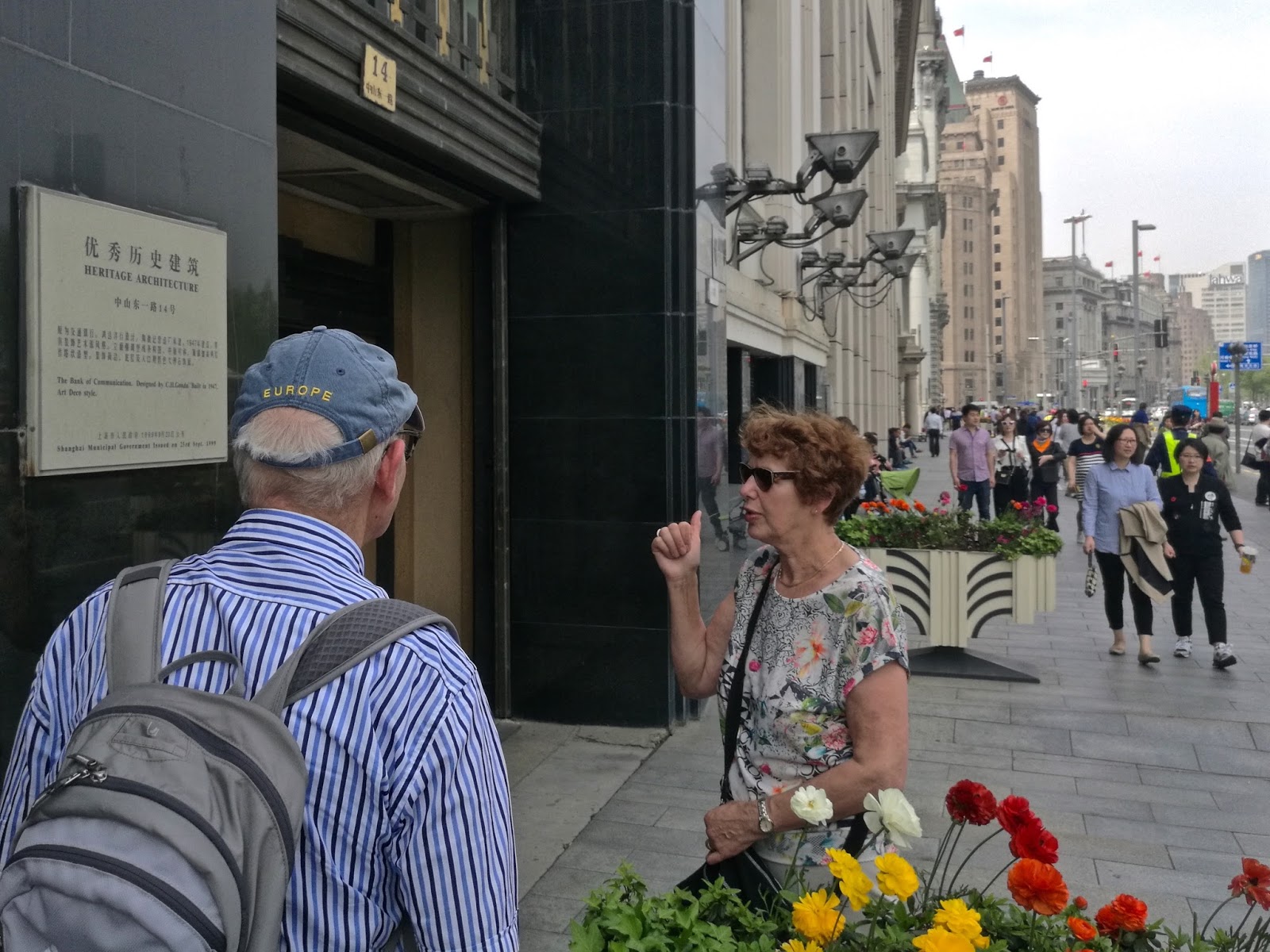
Moving down The Bund the narration settled into describing the banks that line this former colonial drag. The narrator was rather lazy in how he arranged it; he only had two or three sentences to say about each building so he strung these together and told me to look out for these various banks as I made my way to next point.


This tour was essentially one of the Western-styled architecture that can be found on The Bund, which struck me as a rather self-congratulatory sort of tour for the BBC to offer. One way in which authenticity can be understood is that something is original and not a copy of something else. Viewed in those terms, these buildings can be seen as being about as fake as Shanghai Disneyland, which recently opened to feed kitsch to a new generation of China's youth. It is possible that The Bund gains some aura of authenticity with age, namely, the period these buildings were put up in was a unique time in the city's life. But, what I think he was really cracking away at was an idea of this being REAL because it falls into a narrative of Shanghai being a city that always looks to the future. If that is the case then the older neighbourhoods don't have much hope of making it to 2050 and the city is nothing but an oversized sponge for whatever is trendy. I think there is more going on here than just that. The BBC has a big reputation but a tour is only as good as the guide who designs it and this one was so flimsy that one cough would blow it away. Reality is a fragile thing indeed.