Showing posts with label Lijiang. Show all posts

Tuesday, 9 December 2014

The Lijiang Tour: A COART festival experimental performance / tour

This is a necessarily incomplete account of the tour I made and gave in Lijiang for COART festival. It is partial because I was leading just one part of the performance and did not get to see the other parts of it as the public did. The tour of the village was organised by Chinese performance makers Xiao Ke and Zihan Zhou who delegated sections of it to different artists featured in the Now Theatre Programme of the festival, while they took care of the overall system and provided two additional points on the tour, too. 


Unlike some of the chaotic performance stories you hear coming out of Chinese festivals that Western artists tell with a kind of 'I survived it' pride, this event was well organised, well attended and began on time. It started with the public being invited to join a Wechat group set up for the tour. Wechat is the essential app in China right now and it is like Facebook and Skype rolled into one. There was a lighting designer I met at the festival who said he doesn't use name cards anymore, he only works through Wechat. He is far from alone. It was through this group chat that the instructions and suggestions for the tour were passed onto the public. The messages were both practical, telling people where to go, and also artistic, suggesting things to think about or look at.


These messages brought the public to different points around the city where they might encounter a performance such as this dance improvisation on a bridge.


I know a little more about this performance by a young man from the local Naxi ethnicity as it was his which led directly into my part of the work. A theme of the festival was how the different ethnic minorities in this area relate to it as their home. Throughout the festival there were many music and dance performances, as well as documentary film screenings, about the various ethnicities in South West China. My personal favourite was the film Yak Dung (at first given the rough and ready translation 'Bullshit') that seemed to suggest this plentiful residue could be used for absolutely everything. The young man on the horse sang a Naxi song while riding one of the stout horses that drag tourists around the village in decorative carriages. We saw him the previous night singing karaoke in a bar and he is a proper entertainer telling nightclub jokes between numbers. That was fun but I was glad to see this other side of him too. The bar, I should add, was notable for the drinking games already laid out on the table for guests, which of course we played, but I digress.


I awaited my tour group alongside super-translator Zhu Miyi, both of us standing on the same plastic stools that I used for a different performance of mine 'The Customer Is Always Wrong' the previous evening. I like recycling in general and artistic recycling in particular, so these were an ideal portable stage lifting us above the heads, and inevitable phones, of the public. 


The performance was essentially a miniature Tour of All Tours. I introduced the idea of it and then stopped in three locations to talk about different tours that might be had in Lijiang. It had to be necessarily short as I was part of this larger performance and it was being given in two languages: English and Mandarin. I gave a performance in Mandarin the previous day which, with proper preparation and sticking to a pre-written script I can just about manage. Something more improvised like this is quite beyond me right now, however, so it had to be translated, which of course slowed things down considerably. I was blessed with excellent translation and by keeping things to a modest length brought a new energy to the procession without hijacking it and keeping the crowd hostage.


I began with an account of ascending Jade Dragon Snow Mountain a tour I had taken a few days previously. When giving a tour like this, where I project other location's tours onto the site we are in, I always like to make sure I include at least one actual tour from the place I am giving the performance. That gives me a better sense of the location and how the other stories I tell might fit in. It also gives me more material for future tours and, I should admit, it is a nice way to mix business with a little pleasure. The mountain was out of sight from street level, but I spotted a painter's studio by the side of the street with a large, not so subtle, painting of the mountain which he was willing to exhibit outside. This formed a suitable backdrop. 


The other two tours I covered were Political Tours' China at the Crossroads Tour, one which I have not taken myself but have pieced together from internet research and a very curious one which I took in Fujian Province back in 2011. This was a tour of a Hakka ethnic minority village which, upon arrival we discovered was on strike! The villagers were locked in a heated dispute with the Chinese tour bus operators who wanted to replace the local guides with their own. As a small group of Westerners we were not a part of this story so were quietly allowed in round the back and shown around by ourselves. It was a exceptional moment of peace and quiet in a normally bustling Chinese tourist site. 


My mini tour completed, I handed over to another musician who serenaded the group onwards encountering another performance before we rushed through the crowd to the village square where there was a musical finale and much swapping of Wechat contacts. It was a great opportunity to test out how I might approach a Chinese tourist destination and l found, like so many things in China, it quickly became political and I needed to exercise discretion in how to tell the stories and which features to highlight. A pattern I've started to notice in Chinese tourist resorts is that they are all a bit the same: the same selection of small shops and restaurants which finally crowd out everything else turning the place into a tourist consumption zone. Whilst this pattern has its obvious shortcomings it does mean I can insert myself into it relatively easily providing my ironic and critical descriptions of the tours on offer, which are also somewhat standarised yet also diverse in their formats. I saw in Lijiang, for example, horse tours, carriage tours, 4-wheel drive buggy tours, shopping tours, trekking tours and historical tours without looking hard at all. The particularities of each of these tours, especially when they go a bit wrong, can be quite revealing and are anything but standarised. Lijiang proved every bit as rich in possibilities as a tour of a Western tourist location like Bath, so I will definitely have to make a point of developing a tour for a location like this in the not too distant future.

Saturday, 15 November 2014

The Jade Dragon Snow Mountain Tour: altitude tourism in South West China

Jade Dragon Snow Mountain (玉龙雪山) is located near Lijiang in Yunnan, South West China. Lijiang's old towns, once beautiful places, have today become one of the country's top 5 tourist destinations and are swamped with tourism to the near exclusion of anything else. I am here for COART festival, an arts festival which has given me the opportunity to see something of this part of China. I'll write more about Lijiang subsequently but for now I will concentrate on the mountain.


There are different ways to go about ascending; in the old town there are many travel agents who offer package tours that include an ascent as part of a one, two or four day trip around Lijiang. Having already had the Chinese coach tour experience of The Great Wall I wanted to see how the site might reveal itself differently when travelling outside of the structure of a large organised group or, to put it another way, I had had it with the guide turning salesman at every opportunity routine and everything devolving into kitsch. This more independent tour of the mountain began, then, with some advice from the appropriately named K2 hostel, who gave the number of a driver. With the arrangements made for the next day, it was a simple matter of hanging about till she showed up. Yunnan is not a hurried place and it turned out she was waiting at a different gate to the village but, after a while, the van arrived and we got inside. 


She advised us to buy oxygen and pulled up in front of a shop on the edge of the village that sold portable oxygen canisters and nothing else. I've seen some specialist stores before and this place was up there with the best of them. The driver said it would be wise to take some and the man in the store was, predictably enough, more certain still that we absolutely needed to buy some and what's more, we'd need the large canisters. Not knowing what to expect, having never been to so high an altitude before, I suspected he was exaggerating in order to boost sales. Still, we bought two large canister anyway and got back in the van.


We drove for about 40 minutes and during this time the driver expanded upon some of the other tours that could be had in the area. It did not seem as if we were climbing that much, except at the end of the journey, but we must have steadily gained altitude. Lijiang is already 2400 metres above sea level and the base station where we were heading was well over 3000 metres. The air was thinning.


This is a view of the mountains in the background from the car park of the base station. Forget any ideas of Everest Base Station and rudimentary camps used for trekkers and climbers This was a huge car park with shops, a leisure centre and restaurants. They even have a Starbucks.


After buying the ticket for the cable car there was a half-hour queue for the shuttle bus. As is often the case here, we had to queue and a minority tried every trick in the book to jump it. The most common one, which was successfully deployed here, was to have one person in the queue up ahead then other people who vaguely know that person join them. It doesn't matter how vague the relationship is, as long as they could stand beside the person and say hello. And once in, everyone else in their group then joins too. Whole tour groups can sometimes work this technique of one person establishing a bridge and the other 20 then following. This queue was reasonably polite, later in the day when people were in a hurry to get back for dinner, such niceties were dropped and more brazen tactics employed. 


The queue took us not to the cable cars but to a bus that drove a further 20 minutes to the cable car station. Here we got out, queued some more and finally got into one of the 8-person enclosed gondolas. It pulled us high up into the sky and our rapid ascent began. Each time we crossed over one of the supporting pillars the gondola rocked forward and backwards prompting nervous laughter and some white knuckles amongst the 8 of us thrown together in the metal and glass box, dangling giddily from a line leading upto the summit.


As we continued to climb the trees gave way to rocks and snow. I am not so keen on heights, I get mild vertigo, so I looked forward as much as I could at the mountain coming towards us. When I looked behind me at the void stretching out below, I could imagine us falling down into it so easily that I quickly turned forward again. It is an odd thing that altitude does not bother me but heights do.


Arriving at the end of the line we spilled out into a loveless commercial hall that had the surprising addition of a green-screen photo studio. It wasn't in use so I couldn't see what photoshopped location you could be placed into, but the very idea of coming all this way to use a green-screen studio struck me as bizarre. I can only suspect that its purpose is to give you the edge over the other tourists in the altitude stakes by placing you at the very top of the mountain, rather than stopping at the final visitor platform some distance from the summit, as regular visitors must do. 


As you can see, the altitude here is an impressive 4508 metres above sea level. You can travel to this height without having to barely walk a step. That makes this a location that attracts tourists who might not otherwise make it to such an altitude, who, it could be said, shouldn't even really be there. 


From this landing the final ascent on foot is up a wooden staircase weaving around the side of the mountain and its glacier.  


I had never experienced anything like walking in such an atmosphere before. It was necessary to walk slowly and stop regularly to catch breath. Breathing compressed oxygen made this a good deal more bearable. Without it, someone unacclimatised to such thin air as I was, would have been sorely challenged to make it up those staircases. 


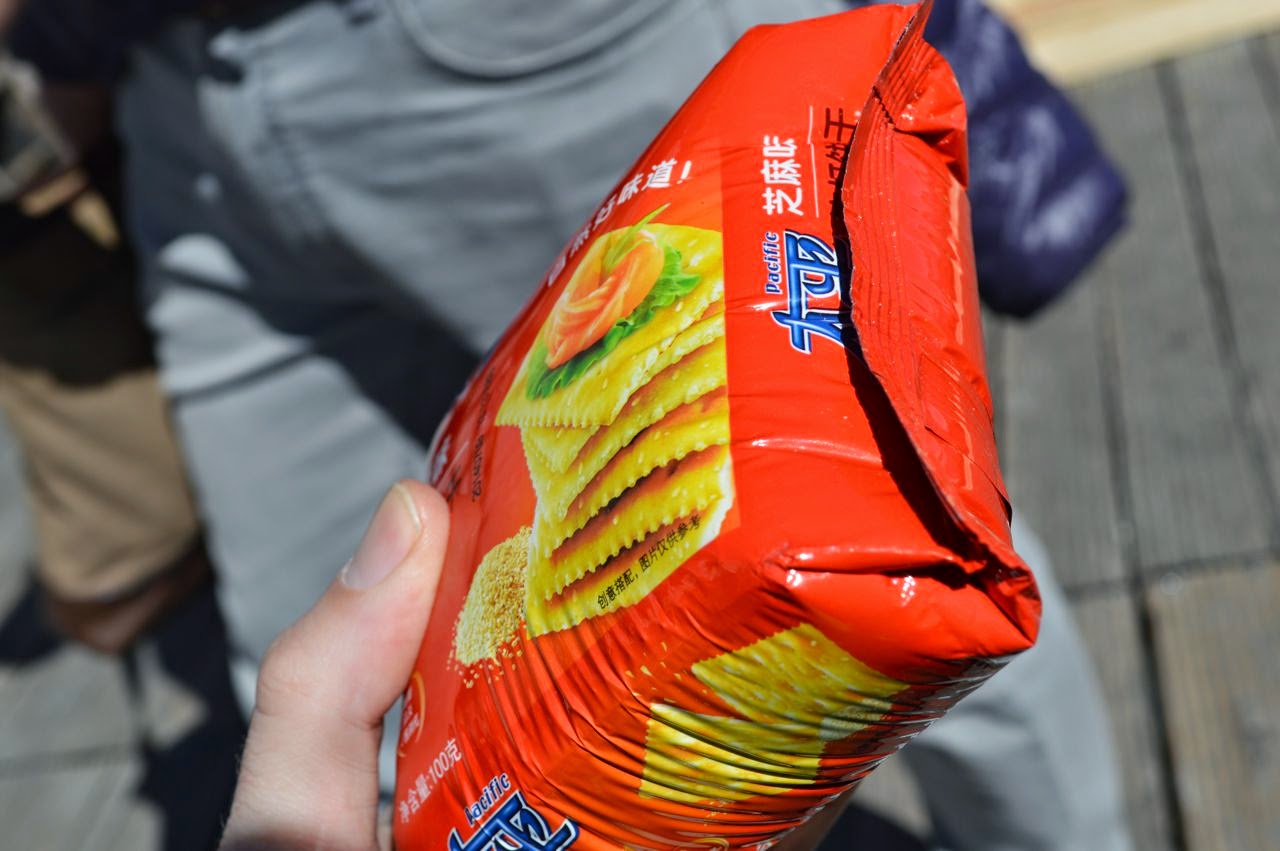
An illustration of the change in air pressure was graphically provided by the packet of biscuits which I pulled out of my bag. 


Whilst the tourists edged their way slowly up the stairs, stopping for breath every 20 paces, the local builders had no such problems. This man carried a large bucket of paint up to the hut under construction, put it down, lit a cigarette then started hard manual labour. I'm guessing that over time the body must adapt to the thin air.


And finally this is the top platform at 4680 metres. It offers an excellent view over the glacier, a natural environment I'd never seen up close before, but more than that, it was a curious location that turned out to host three things.


The first of these was a man sitting at a simple open-air table carving tourist's names onto metallic medals. It was a small but popular business with a constant queue.


Next was a small food stall selling wildly overpriced snickers, red bull and sausages, the small red variety that rotate on a heater. He wasn't doing so much business.


And finally there were people, like myself, taking the obligatory selfie or the friends shot like the pair in the background. While I was wearing more than warm enough clothing, what I should have been more prepared for was the sun. It is very powerful and deceptive at this altitude. I got somewhat roasted as the day went on and have the flaking skin now to prove it.


Coming down by the same route there turned out to be more to the trip than expected. We took a wrong bus when alighting from the cable car and were deposited not at the base station but instead at a lake. This was, in many ways, a more beautiful and relaxing place with fewer visitors.


The lake was supplied by the glacier and was of a stunning aquamarine colour. These sunken trees also drew my attention to its artificial construction, accomplished by a series of small dams creating pools where there must have been a faster flowing descent in the past.


With the light hitting that perfect early evening glow the place took on a wonderful energy. There were a few people milling around, even some wedding photography going on, as there is in most tourist spots in China, but the place itself was big enough to absorb all of this. Also, being lower in altitude at a mere 3500 odd meters, it was possible to walk around without having to make constant recourse to the oxygen. Leaving Jade Dragon Snow Mountain behind I thought I had coped with the altitude challenge pretty well but I found that  in the evening a headache came on that refused to leave me till noon the following day. While the bulk of people and the technology goes a long way to opening up a space like this to the casual visitor, it remains a harsh environment. I won't be in a hurry to go further than 4680 metres and, unless I go on a Tibet tour (not impossible), it's unlikely I'll be in a position to do so anyhow. Once, in this case for me, is quite enough.