Showing posts with label Avebury. Show all posts

Wednesday, 17 September 2014

The Stone Seeker Tour of Avebury

The Stone Seeker Tour is a tour given by author and guide Peter Knight, who is based close to Avebury. He offers a range of activities and tailors his tours to the group or individual. I did not come to this tour with an especial interest in pagan religions and ancient sites, though I should also add, I am not against them either. I would count myself as one of the curious who has visited a few stone circles, mostly in Scotland, and once by chance ended up at a Beltane festival in Wales where I found myself in a sweat lodge with the great unwashed whilst shamanic drummers deep in psychedelic revelries circled the flimsy structure connecting with the ancient ones. At least, that is what they said they were doing afterwards, while sitting around a fire, smoking up a storm. Today's tour was to be a good deal more proper; I was, basically, getting an Earth Mysteries 101 tour of Avebury and the West Kennet Long Barrow. 


The tour started inauspiciously enough at Chippenham train station. It was a short, 12-minute ride out of Bath but it felt like a significant step in terms of atmosphere. Whereas Bath is very cosmopolitan and urban, albeit according to an 18th Century design, Chippenham felt like it belonged far more to the countryside.  


My guide, Peter, picked me up in his car and we drove to Avebury. The stones are accessible free of charge to visitors and not fenced off at all, unlike Stonehenge. This meant we could walk amongst them, touch them, sing at them, perform magic with them, check their auras, ley lines and everything else that was on this afternoon's esoteric agenda. He told me that while he was not such as fan of the restrictions at Stonehenge, they were probably necessary to deal with the sheer volume of visitors. For the type of interactive tour that we had lined up, Avebury was clearly the better location.


We began by looking at the stones with Peter explaining his theory of the stones being gendered with alternate masculine and feminine stones. He knew from which angles to best observe them from, having taken many pictures of them himself.


We noticed these impressively large mushrooms and this provided the cue to discuss the role mushrooms might have played in the rituals that took place here. He said there were no less than 12 varieties of psychoactive mushrooms growing in the area, back in the day. While it is tempting to say that such speculation and ritualistic use of drugs is more a product of the present, such as the Beltane I witnessed, some things in people, like the desire to get out of your head now and then, are, I suspect, fairly constant. What's more, we were not talking about a Friday night down the pub sort of scenario, we were talking about  the use of hallucinogens within sacred rituals.


The next thing we did was to look for faces in the stones, such as this stern face looking out to the side. It is a human capacity to find faces in abstract shapes and the idea here was that the people who constructed the stone circle chose the stones and positioned them such that there would be faces everywhere. I had the feeling the way he had developed his theories had been to read the literature, as it existed, and then spend a lot of time around the stones coming up with ideas of his own and connecting his observations to alternative beliefs from related fields. As such, it all hangs together because it comes from a consistent position but it would be difficult to say with absolute certainty that much of it is definitely true. That is one of the beauties of the stones, that their past usage has been lost in the depths of prehistory and then rediscovered through a mixture of scientific study and contemporary sacred practice. 


I then had a go at dowsing. Avebury, he told me, was on the Michael and Mary ley line which crosses Southern England. He said that it was possible to detect this line using dowsing. I had a go myself and something certainly happened, namely, at a certain point the metal rods pointed together and then, taking a few steps further, returned to a parallel position. This they did without me directing them at all. When he was telling me about the ley line from Cornwall to Norfolk I immediately thought to myself, "that would make a great tour!" I have since noticed that The Avebury Experience already offer an 8-day tour of the line line. Alternative tourism is a definite niche business. Peter did say that he sometimes shows dowsing groups around Avebury and they can spend a full hour on just one small part of it, so much is this a central point on their map. 


This brought us to the so called 'Devil's Seat.' Spending some time with Peter I had the impression that he was quite well suited to being a guide. He knew his stuff, which is a first pre-requisite, and then he also quite liked answering questions. I was a bit afraid I'd say something very dumb but he was easy going and made a few jokes here and there which made things relaxed. 


At this point a group of Americans on some sort of pagan package tour appeared out of the ether. They were mostly women of a certain age with one or two men in robes tagging along. They were clearly here on a mission: three of the women were carrying metal swords. They seemed to be circling the stones but then took a wrong turn and were backtracking looking for a way to cross the road that annoyingly bisects the circle. Peter put them on the right path and then told me that he gets significant interest in his work from the USA and from time to time flies over to give talks or workshops. California, it seems, is where the greatest amount of interest in this sort of stuff is to be found. It was interesting to note how the US has ancient religious sites of its own but that these belong to the people the settlers have largely displaced. Peter, to his credit, said he recognised this and tried to incorporate these into his talks and work when over there as he viewed these cultures as being essentially alike. I am usually rather sceptical of essentialist beliefs, in the sense of we are all one, as they usually conceive of this oneness in very particular terms. Still, I understand the impulse in this case and I wouldn't be surprised if there is something to it. 


At this point we had a go at testing the acoustics of the stones. Many of them had cavities and Peter would speak and make sounds into them. Of all the parts of the tour this is the one which, to the outsider, must have looked the most puzzling.  


There were quite a few other groups visiting the stones for different reasons. There was a school group having their lunch there and I spotted another 'alternative' looking group pounding the ley line. Peter told me that at mid-summer it can get very lively indeed and look a bit like a fancy dress party. I want to go!


Stepping away from the stones we went to the National Trust cafe for lunch. It was strangely normal. We did see some of their guides who were showing the sort of people sitting at the tables here around Avebury. I suspect their tour was very different to mine.


We then drove a short distance outside of the circle to look at a double row of standing stones that branch out from it. Again they all had faces and I was put on the spot by being asked, what do you think this one is? I was quietly happy when I guessed correctly that it was known as the shark stone.


We then drove a little further and stopped close to Silbury Hill. This, I was informed, was a man-made structure and another one of the sacred sites in the area. A huge truncated cone, it is, apparently, a special place for dreaming. Sadly, I didn't have the time for an overnight stay to put that to the test.  
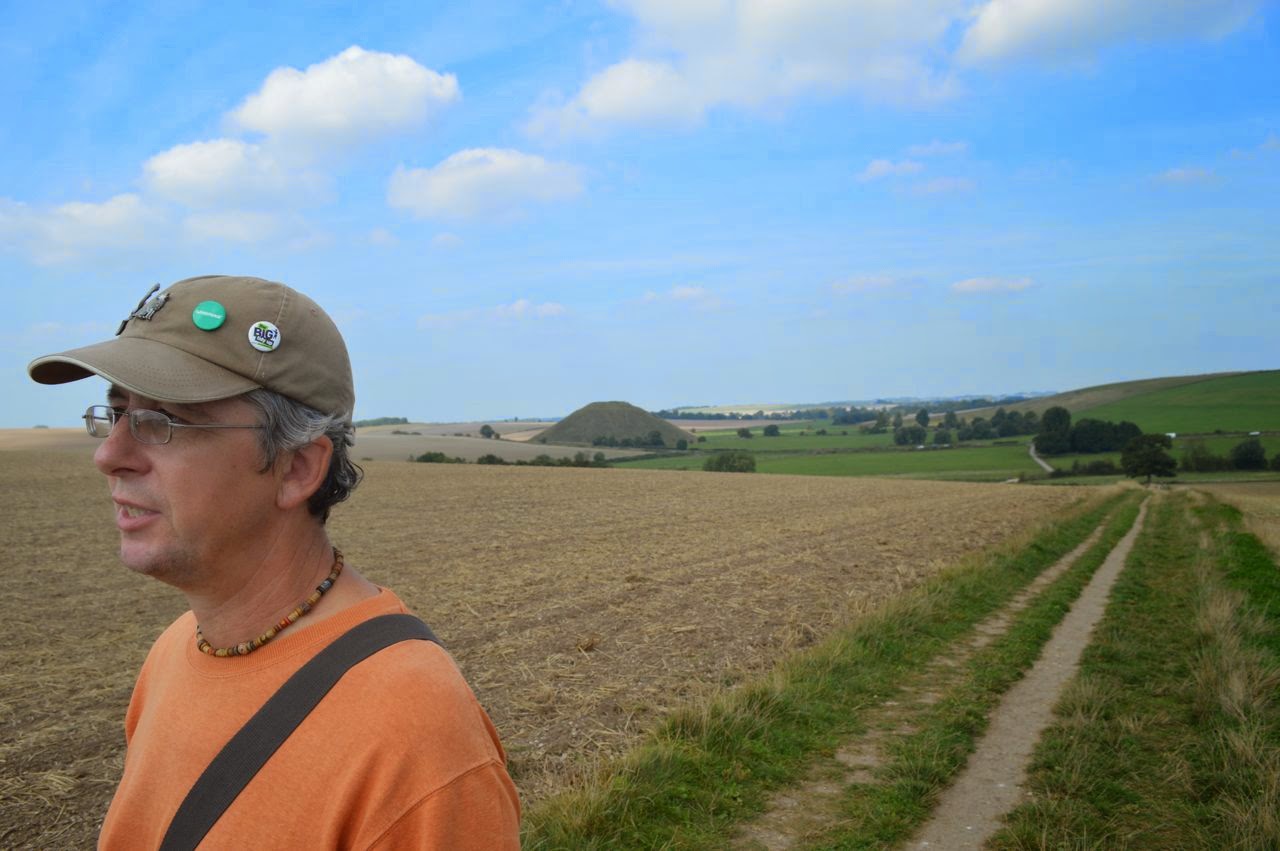

We walked up a gradual hill to the top where the West Kennet Barrow is located. A barrow is a burial chamber and I had seen many small round ones but this one was something else as it was long and narrow one which, happily, is open to the public. 


Again checking the acoustics of the stones, Peter built up a rhythm with his drum and then invited me to stand in front of the stone. He played the drum in front of and around me, I could feel the vibrations moving through my body. This built up over a few minutes and where I was at first rather self-conscious I relaxed into it. This is a tour which itself blends into action, I was no longer just the observer but also the observed and it was all the better for it.   


An elderly couple then entered and asked us to be quiet. Peter told me that this was the first time in the fifteen years that he had been coming here that he had been asked to stop drumming. It's a pity I didn't get a decent picture of how the couple looked, they had the countenance of those who like order. In fact I think they probably prefer order to the barrow: they sniffed around for a couple of minutes and then left. When we were leaving a little later we did some informal cleaning; there were a good few tea lights and the remains of rituals past. Seeing how popular Stonehenge is and also how flat the experience can be, I'm surprised that more people don't try this sort of tour. I daresay there is some marketing and communication issues which conspire to make things how they are, but with just a little effort there is a great deal more you can experience at these ancient sacred sites and the Stone Seeker Tour is a great way to do this which does not demand you be an initiate or anything, you simply have to turn up with an open mind, ready to see faces in stones.

Friday, 29 August 2014

The Mad Max Tour: from Stonehenge to Harry Potter

Mad Max Tours, a bus tour running out of Bath, does involve motorised transport but that's about all it has in common with the post-apocalyptic movie starring Mel Gibson back in the day when he seemed OK, i.e. before he went off and did Braveheart, The Passion of The Christ and turned anti-Semitic. It's so much easier to appear cool when you burst onto the scene and don't have a history behind you.


This tour shares its name with the movie because the woman who originally gave it and who now runs the company is called Maddy, or Mad for short, and her dog, who used to accompany her, was called Max. There is an internal tourist body clock which tends to work a good two hours behind the rest of us and by that reckoning the 8.20 AM start was very early. Still, we knew we had a long day ahead of us that would take us to Stonehenge, Avebury and two picturesque Cotswold villages we had never heard of but which, apparently, were wonderful. What this early start did mean was that I missed breakfast because the place I was staying at was adjusted for these leisurely hours and only started serving breakfast at 8AM. With a stomach looking in vain for food all morning I hopped in the van along with about eight others.


Our  mild-mannered guide and driver introduced himself with some self-deprecating wit and gave a brief outline of the day. He asked where we were from to which the reply was UK, Canada, USA and Hong Kong. There would be a lot of words on this tour so the fact that everyone spoke good English made his work a lot easier. With the obligatory health and safety notice out of the way, we were off. 


While we were driving he spoke through a small microphone. He made a lot of observations on the various things we were passing such as the crops growing in the fields, about which he seemed very knowledgable, at least to a city boy like me. The type of wheat and how it is cut might then be followed by a story about why a certain place got the its name, or, in this instance about the hill in the distance which became briefly famous for a UFO sighting. When we were rounding upon Stonehenge we listened to an audio track about the place narrated by Maddy, who used to give this tour and who didn't sound mad in the slightest. At first it jarred as I would have preferred to have heard about Stonehenge live but it was a pretty good introduction that covered both the known and the unknown mixing history with speculations and stories, so this switching between live and recorded was OK in the end.  


At Stonehenge there was a good deal more audio commentary as we walked around by ourselves listening to the audio guides. This commentary and the new visitor centre more generally, were very professional and no doubt reflected contemporary expert opinions but they were also slightly dull. 


I was not surprised to see that the map I was given didn't show anything like the full extent of the tourists: it acknowledges the visitor centre and the road that ferries you back and forth but after that it glosses over the viewing paths and crowds that line them preferring instead to transport you back to pre-history.  


Running visitors back and forth to the stones were these minibuses that sported the logo 'Step into England's story.' Coming in the run up to the vote for Scottish independence, I could not but notice this wording. I doubt this logo would have been chosen even ten years ago but now this kind of stuff is commonplace. I found that this stamping the flag upon the prehistory of a place tricky when I came across it in China, and I found it just as tricky here: it's the stuff of nationalists. It's not that I am not interested in the past and how we came to today, I simply feel that Stonehenge's builders were not English in the way we think we are and this effort to retrospectively make them so is conspicuous. I much prefer how it used to be: step into prehistory and learn about the stone age or bronze age or whatever. Please, leave England out of the story.


And on the theme of nationalism, our guide told us that a few weeks ago, coincident with the 100th anniversary of the start of World War One, the fields around the visitor centre were awash with poppies, these being the flowers that are used to commemorate the soldiers who died in battle. I spotted just three on my visit which led me to suspect that the burst of flowers a few weeks ago was most probably not the result of nature alone. Our guide would not express a sceptical opinion but neither would he refute mine and when we left Stonehenge, we drove past Larkhill military base, neighbouring the stones, and I had to conclude that The Royal Artillery, whose home this was, were the most likely source of this patriotic blossoming. I find it a pity that scepticism has little place in most tours and while a full on 'sceptics tour' would be a curious creature (and not necessarily a bad one) I do feel that our natural scepticism should be allowed equal space on a tour as elsewhere. The basic situation of most tours tends against this, however, as there is a guide who knows a place and a public who doesn't. Deliberately awakening the critical instinct is only done with a little effort and can, I suppose, look heavy handed if laboured. In fairness though, we were encouraged to take some of the other stories on this tour with a pinch of salt, such as the UFOs and crop circles, of which we'll come to in a moment. 


With Stonehenge ticked off we were on the road again and passed but did not stop at a place I would have been quite curious to have seen. To the left is the way down to The Barge Inn which boasts at being the 'world headquarters' of crop circles. Wiltshire is, we were told, the most active part of the world for these and where better to have your HQ than a pub? I remember reading a somewhat daft book on crop circles in relation to the Mayan calendar and end of the world and what struck me most was the degree of work that went into these 'unexplained' patterns in the fields. Reading between the lines there is a bit of a wacko culture around these circles which, despite the proven hoaxes, continues to read into them all manner of messages from UFOs and suchlike. The Barge Inn is definitely a place to return to at a later date on a more esoteric tour of the region's subcultures. Maybe it will be as much of an anti-climax as Stonehenge, maybe it will be Mecca, for now it is full of potential.


Avebury was completely different story to Stonehenge. The circle was far larger, the surrounding ditch deeper, there was no fencing off and no visitor centre and the general atmosphere was calmer by far. I also remember people randomly smiling at me around the stones and in the street in a way that did not happen anywhere else on this tour. Although our guide would not go too far into what the stones meant he did give us some history of how they came to be how they are. The Christian Church, he told us, over a number of centuries damaged and buried many of the stones in an attempt to suppress the pagan faith. They clearly did not succeed! He told us that some of the stones were recovered from the ground and returned to their original positions, which seemed natural to do given this was not only an archeology dig but also a living place of worship.  


It was a lot of fun to have a go at dowsing. When I tried it, the rods converged as I approached the stones and then at the last moment swung back parallel when I was right up close to the stone. When some of the other people tried the same thing with the same metal rods they didn't move at all. I couldn't say why that was but it definitely happened and I would quite like to try this more.


The bookshop in Averbury was particularly well stocked in new age and esoteric books about the stones, earth mysteries and related topics. Unlike Stonehenge, which was rather dry and commercial, Avebury looked as if the people who really cared the most about the stones played a far greater role in setting the tone of the place. On the shelves of the bookstore I noticed this book by Peter Knight which I was happy to see because I have been in touch with him about his tours. I'm all set to return to Avebury in a week or two and be shown round by him on his alternative tour that will include drumming, dowsing and more. That couldn't be further away from the Stonehenge visit and, to be honest, whether or not I believe what I am told, the very fact that it comes from someone who genuinely cares about the rituals and meanings of the stones in a complete and not narrowly academic way, should, at very least, make for a great tour.


Next stop was Lacock where we ate our lunches separately. I felt it was a pity that the group was an unsociable one but that is something that it is probably impossible to fully predict or manage. Following lunch we had an informative walking tour around the village. 


This brought us to one of the principal reasons that the village is so firmly on the tourist map. This pleasant but unremarkable house featured in several of the Harry Potter films as, we were told, Harry's parents' home. With an important featured location, and a number of further incidental locations used in the films, Lacock is now actively marketed as a Potter destination. I met an American couple not long ago who took a Harry Potter coach tour around London and they complained that the sites they were taken to didn't look the same as in the film clips they watched while driving between locations. The problem was the film uses a lot of special effects, so many that in some places you had to really look hard to recognise it as the setting of the clip you had just watched. And to make matters worse, some locations were blocked off by Palestinian protesters... Not so here in Lacock. Film tourism seems to be very big and villages that do not appear in films, like Little Bredy where I am also currently working on a tour, are deserted. Some time I will have to write about my appearance in one of the Harry Potter movies, but that will have to wait for another moment. 


Our final destination was Castle Combe, seen here in the movie War Horse. The church had this display up in a corner recording some scenes shot in the village once declared, "the prettiest village in England." That is a difficult title to live up to and it seems the place today has opted to endure the occasional minibus of proletarians like us rolling in and taking snaps and concentrate instead on high-end tourism with a hotel where prices start at £210 a night, then add in golf, dining and other profitable distractions. Strangely, there was an informal book sale in the church to raise money for the place and there was a conspicuously good selection of books on Marxist theory and philosophy. They were clearly all left by one person and they made odd bedfellows with a Hollywood movie set and luxury country resort.


It was funny to notice that we were not the only tour group in Castle Combe. As well as Chinese tours visiting Bath and Stonehenge, as I wrote about recently, there must also be a Chinese operator who includes Castle Combe on one of their itineraries. Their tour buses really do get everywhere these days. Well, everywhere except Little Bredy.


The final stretch of the road back into Bath was graced with music and a rainbow, a fortuitous and beautiful ending to the day. I was left with the feeling that because Bath city centre is so famously attractive, it can create an attention vortex that leads its surroundings relatively neglected. This tour showed me that Bath can be regarded not only as a day-trip or weekend destination, but can also a base from which to go out and see the surrounding attractions too. I am not sorry to have seen Stonehenge and to have had a typically underwhelming experience: I had to see it once for myself in order to have an opinion. Avebury, however, is rather special and is a place I'll return to. As for the filmset villages, they are pretty but also victims of their own success in showing themselves off. It is quite fitting, in a way, that Lacock is inundated with tourists taking pictures of it as it is the birthplace of photography: Fox Talbot's first ever photograph was, we were reliably informed, of a window in Lacock Abbey.