Showing posts with label 2012. Show all posts

Sunday, 16 August 2015

The Flaneur audio tour of the Queen Elizabeth Olympic Park, London

Legacy was a word that was banded around endlessly about the Olympic Park and the 2012 games as a whole. The Olympics were, we were told, going to regenerate East London  through sport and through the creative businesses that would flock to the Lea Valley. Flaneur is an audio tour that was commissioned for the new Queen Elizabeth Park and I took it some three years after the games had finished, at a time when this legacy should already be manifest. How did the rhetoric match the reality?


To enter the park I had to first past through the belly of the beast; Westfield. I'm no fan of malls and this one is a true behemoth. I simply cast my eyes down and kept marching till I reached the other side where this billboard caught my eye. It's text is quite typical of the positive sounding claims made about the games and it's legacy which, when you stop to examine them, start to become vague and problematic. If 'over a third of all London artists [sic] studios are in east London' that would put the other two thirds in North, South and West London. That is not so startling a statistic really. This ad also seems to either claim that East London is a capital city, when it is just one part of a capital city, or else their point is that the arts community in East London is larger than any other capital city's. How this claim was arrived at I can only guess, and what's more, I rather suspect it is out of date. From what I see, artists are deserting London in their droves right now, forced out by unaffordable rents. Neighbouring Hackney Wick, which used to have a thriving gallery and studio scene, has been decimated by the arrival of the games. These sorts of vacuous billboards proliferate around the Olympic Park and were a good preparation for the audio tour that followed.


The starting point of this audio tour, which can be downloaded for free, is just beside the RUN sculpture. There seems to be a thing with the Olympics of using imperatives, ASPIRE and INSPIRE being the most overused and under-realised of them with sport participation in the UK plummeting post-Olympics. Inspire a generation my ass. But what of the art?


The walk is very short; it runs to a little only 20 minutes in length. Even though it was so brief, it did not however fly by quickly as it never really got into any real substance or develop into anything with a sense of purpose. Rather, it felt like it was more or less an extended advert for a property developer with an ambient soundtrack added. The music  sounded like it had been lifted from a 'Deep Forest' relaxation CD with a chello stuck on top to give it a more artsy sound and the narrator, while aspiring for a breathy sensual sound, never quite managed to completely shake off the harsh nasal tones of a station announcer informing you of a rail replacement bus service. Sound effects were added, such as birdsong, but there were in fact no birds in this part of the park, so this only masked the sterility of the area rather than contributing substantially to the audio tour.


The tour talked about homes for both humans and for animals. Here I should make it known that, as a result of the London games, I lost my home in 2012. I was made homeless by a housing association and social housing provider, Poplar Harca and Phoenix Housing, in order that they could settle homeless people in my flat and qualify for some Olympic grants. That is the level of insanity that was prevalent back then and which is whitewashed over in this work. The original Olympic bid said affordable homes would be an integral part of it but these homes failed to materialise. Indeed, Newham Council have been moving people out of the borough and even out of London entirely, redeveloping council estates and reducing the availability of affordable housing. To ignore all of this and simply celebrate the flogging off, on the cheap, of the athletes' village to the likes of the Qatari royal family, is either inexcusable ignorance or downright misrepresentation.    


The tour took us to the River Lea which was described as being massively improved as a result of the games. I know the area from before 2012 and I beg to differ. Yes it was a mess before; it was a toxic industrial dump that had been swallowed up by nature. You might stumble across an old fridge or an unusual, even rare plant, there was no telling what you'd find, it was a genuinely mysterious place. What's more, the river flowed just fine along the navigation channel along which boats still pass. The stretch of the river flowing through the Olympic Park was, and still is, decorative, not functional. What the narrator failed to say is that the changes brought about by 2012 have poisoned other parts of the river in order to create this showpiece. What's more, there was much talk on the audio tour of dramatically cleaning up the area, of 'repaying a debt', yet the cleaning process was only ever superficial as there was found to be too much noxious waste on the marsh. This waste included nuclear contamination from the old nuclear reactor on Marshgate Lane, and thorium dumped before controls were put on nuclear dumping at the start of the 60s. The contamination is still preset and the best the Olympic Delivery Agency could do was to put a thick plastic sheet down while the deeper problems were buried in the rush to make the site ready for the Summer of 2012. I recently heard about a debacle surrounding cycle bridges over the river, quite possibly those pictured above, which were built, moved, demolishing and rebuilt for completely contradictory reasons, according to a friend of mine who lives in the area. He told me he thought it was a case of the contractors ensuring they squeezed every last penny out of the budget. All this is, of course, great material for an audio tour and was, also, completely absent in Flaneur.


The commissioners were probably happy enough with this audio tour, after all it played to their vanity, but as a piece of art it is, quite frankly, dreadful. This is not unlike the other privatisation deal glossed over into a public improvement tour that I reviewed in Bath, but Flaneur does not even have the kitsch appeal or variety of voices that feature on the Bath Spa tour. The level of research here would appear to be no greater than the recycling of the Olympic Park's press releases. As such, this is bland PR dressed up as art which finishes, appropriately enough, with a single word imperative: ascend. Taking this tour is like reliving the doublespeak of 2012: aspire = work for free, inspire = give us more money and ascend = now go home.

Thursday, 9 January 2014

The Meet the 1% Tour

This tour is something of a relative of The Occupy Tour in that both its theme and core audience were practically identical. The form, however, is different enough to make it worth covering as a separate tour.


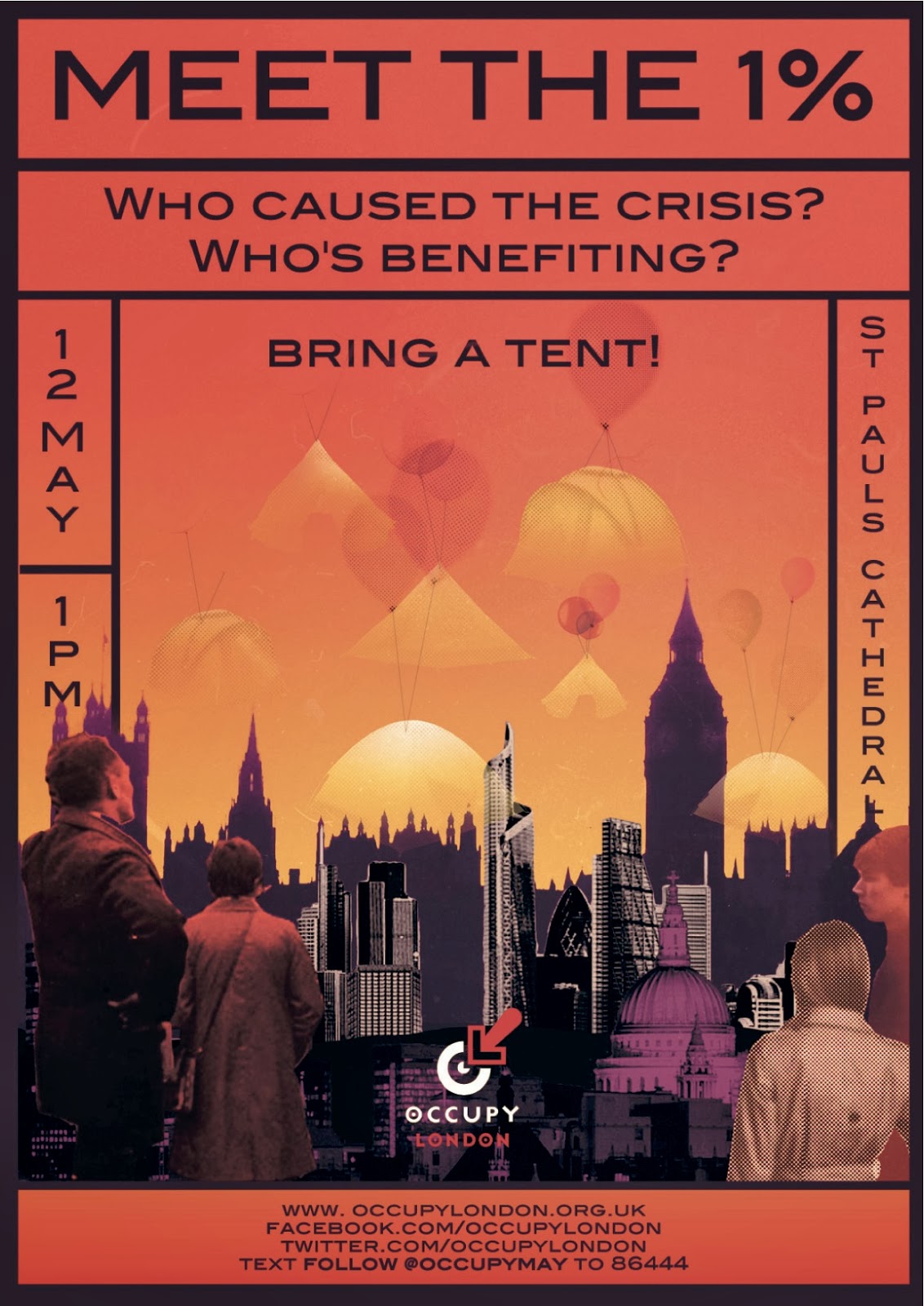
It was a one-off event that took place on the 12th May 2012, a day that was marked in 350 cities, spread over many countries, with similar Occupy style events commemorating the start of the Spanish Indignados Movement. It was advertised in London with colourful posters, such as those above, and publicised through the network left behind by Occupy London, even though the tents had been cleared away by the police some months earlier.


I learnt about it over a cup of tea at Richmix when someone who was there that day kindly took the time to explain a bit more about it to me. This is, therefore, a historical record of a tour, though one that belongs in the recent memory rather than a historical tour such as Daniel Defoe's A Tour Through the Whole Island of Great Britain (1724-26) which I am also currently reading, since he was also walking around Shoreditch and The City. 


This is the map that was produced for the event and which you can download HERE. It has been quite nicely produced and one aspect of it that I like is that it makes The City of London clearly visible, highlighting it in green. This should make a circumnavigation easier, which incidentally, is what Dafoe did in his tour, walking around the perimeter of built up London as it then stood, a city then creeping some distance outside of this boundary but not remotely like today's sprawling metropolis that spills out in all directions and has its contemporary circumnavigations, like Ian Sinclair's London Orbital, set upon the M25 ring road. This map highlights different addresses around The City but it does not prescribe a route that connects them. People coming on the 12th May were encouraged to print out a copy of this map and follow the Twitter feed that would, amongst other things, supply suggestions on where to go. The open-ended nature of the map is part of its design; the designers state, "Our map for Meet the 1% is an essential tool for finding your way around on Saturday, but we also see it as a resource to move beyond our own programme of events. We’re deliberately leaving plenty of opportunity for those who attend to determine their own course of action on a more autonomous basis. It doesn’t take much to make a statement. When “urban exploration” is classed as “extremist activity” — as the City of London police did last year — walking the streets you live in can itself become a political act."


The organisers did not know how many people to expect and thought it could be just a small gathering making a tour around The City but in the event some 500 + people turned up at St Pauls where the day began with speeches. These covered a range of topics as you can see in this video of the day, the first half of which was focussed around St Pauls before the tour headed off around other locations.


Many of the people on the tour were veterans of the camps and meetings that characterised the 4-month occupation of The City. It was, therefore, a bit of a get together for this network which had been scattered as a result of the evictions. I was told that the demise of the camps had come as a significant blow to many who had invested a great deal in Occupy, leaving homes, jobs and even partners to participate in it. With a Summer of flags looming, this was to be the last show of numbers of the protesters on London's streets. 


The tour did not have any clearly identifiable leaders. Different people had prepared self-contained actions at various points on the map such as describing the company's activities  over a megaphone or various other peaceful direct actions. The rationale here, I suppose, was that even if an organiser/activist were identified and arrested, the tour could still continue. The Anonymous mask was worn by some in line with this. This reminded me of The Critical Mass Tour which I recently covered, which also had a diffuse organisational structure to avoid individuals being singled out. It strikes me that there must have been an organising team all the same, as you cannot get 500+ people on the street without an effort, so they must have done a pretty good job at covering their tracks and working in cells. Unless of course they have been infiltrated by police spies, which is a distinct possibility, given the widespread practice of doing this against all manner of protest groups in the UK. In which case, the police did a good job at not blowing their spies' cover.


Naturally, the police were out to 'protect the peace' and whilst they were originally outnumbered, they came in increasing numbers as the day went on. They started to 'kettle' the marchers on Fetter Lane but relented after a while and let them continue. The marchers were aware of the likelihood of this and the route they followed avoided too many narrow streets as these spaces aid the police in forcibly containing the marchers. 


This is the reverse side of map which carries the key to the sites. The categories that are listed are: banks, hedge funds, financial services firms, stock exchanges, lobbyists, crisis profiteers and crisis profiteers - health. It was prepared with the assistance of Corporate Watch who are located over in Whitechapel. It struck me that while the Occupy Tour was somehow caught between being a political narrative tour and a political site-seeing tour, this Meet the 1% Tour was closer to being political sightseeing cum protest carnival. The narrative elements were less significant and the size of the crowd made the group an entity in itself, and one that seriously changed the nature of the space and consequently the face of the 1% they were intent upon meeting. Walking in such numbers, the police inevitably come out in response.


There was a lot of self-recording of the march and pictures posted online as well as some videos like this short one, set rather appropriately to London Calling by The Clash. When the tour came to Bank and The Royal Exchange a significant group stayed behind there while smaller splinter groups scattered around the city, visiting other points on the map. In this way it was very difficult for the police to contain everybody. The tour was therefore more of an invitation to make your own journey rather than to follow a prescribed path. Some took the initiative and started putting up Occupy sticker tape on buildings while others stayed behind at The Royal Exchange. It is here that the main clash with the police occurred following a contested issuance of 'section 14', a police order to disperse the crowd. This is caught on video here. Another instance of police surrounding the protesters/tourists and 'kettling' them took place and this dragged on for hours with snatch squads pulling people out but failing to charge them with any offence.  


As a memento of the day, I saw some of the tape used on May 12th now adorning my guest's laptop. It seems like this was a tour that was fondly remembered and seen as one event amongst many coming out of ongoing political activism based in London and connected to an international network that is as widely spread as the financial and political networks that its supporters oppose.