Showing posts with label spitalfields. Show all posts

Tuesday, 22 July 2014

The London Tour of All Tours: a meta-tour / performance around Spitalfields and The City

A long time in the making, the East London Tour of All Tours finally hit the streets last weekend.


The tour is up and running and manages to include most of the tours that were taken in the Shoreditch and City area towards the end of 2013 and which are reviewed on this blog. The arm pointing up high is to Broadgate Tower.


In the background is the work of Space Invader and a stop on the food tour. As was typical in Stuttgart, locations accumulate multiple perspectives with a number of tours having a go at defining them.


The weather was bright and sunny and the addition of a hat proved to be most useful to say nothing of its elegance. 


Something that I hoped would happen did: we encountered some other groups on route who I was able to identify and describe. This makes me think that a flexible structure which allows me to talk about tours when the group appears in front of us is great and when we are on the tour and don't see them, which is more typical, to still have a solid plan. I've gone some way to allowing enough spaces and options into this tour for this to happen but still need to get used to these encounters to play them fully for all they are worth.


The locations proved to offer a very large dynamic range, particularly on the Sunday when Brick Lane was heaving with people and The City completely deserted. 


There is still another weekend of tours to come and it will no doubt still evolve a bit more. Bookings via Richmix. I must thank two people in particular, Elo Masing for supplying some of these pictures and Rosa Farber for assisting with the trial runs and for also providing some of these images. Thank you!

Friday, 17 January 2014

The Denis Severs House Tour: a candlelit tour of an artist's installation

Having stumbled across Denis Severs House on Folgate Street on the Spitalfield Stories Tour back in December, I had the occasion to take a tour of the property. I was however slightly early so I had a pint in The Golden Heart, round the corner on Commercial Street, as advised on The Sound Map Tour. It was suitably eccentric with a scatty, opinionated and welcoming landlady, random music, a man reading 'The History of History' and that increasingly rare thing in this part of London: the presence of artists.


Refreshed and diligently ten minutes early for the tour's start time of six, I knocked on the front door, it half opened and I was told to wait and not go anywhere. As I stood on the pavement a group of three arrived, also looking for the tour, I reassured them they were at the right address and then, at the stroke of six, the door swung open. A rather serious man took our names, checked them against a list on his ipad and explained the rules of the tour. We were not to touch anything, we should not talk, phones must be turned off, we should follow the route from the basement to the top of the building and we were not allowed to take any pictures. This picture above is of a subsequent group being given the same briefing at the entrance to the house, all of the pictures below are from the website of Denis Severs House.


My group descended into the basement and our eyes slowly adjusted to the candlelight. Looking around a house lit by genuine candlelight is a rare experience now in this age of health and safety and while the texts were a strain on the eyes the flames illuminated the space with a soft, warm, shimmering dance. Shadows were so much darker than they typically are this made the paintings that featured contrasts that Rembrant would be proud of, look far more understandable. That is not to say all paintings were like this, far from it, there were also more conventional portraits also adorning the walls.


The house is presented as the work of artist/curator Denis Severs who lived  in the property and designed rooms in order that they should capture the feeling of different periods. The objects and arrangements are therefore not strictly authentic but rather convey an atmosphere of the past which in practice means that the decoration can in places look somewhat camp, even flamboyant. A central conceit to the tour is that the occupants of the various rooms have just left as you stepped in so you should be able to sense their presence through the various clues left behind. The fire is still burning, there are smells of food in the space, a broken saucer lies in pieces on the floor as if the occupants had fled in haste. Sounds of footsteps around the house and the exterior sound of church bells chime to give the space an added sense of life. 


Scattered around the building are small slips of paper with advice for the visitor written upon them such as, "you either see it, or you don't" and warnings that the property is protected by hidden security cameras.  I had a sense that the space had been very deliberately arranged over a long period of time by first Severs and subsequently, the curators. As such, a detailed rationale for the building and the lives of its imaginary occupants must have been built up layer by layer. This interior story remained somewhat invisible for me and what I saw was an accumulation of details and an interplay between the paintings, texts, objects and rooms. It was like Poirot with the crime removed. It may even be that they slips of texts instructing me to look more carefully and absorb the situation had the dual effect of both drawing me in and, at the same time, keeping me out. It was as if they had been written with the presumption that the visitor would not understand which left me wondering, what was there precisely to understand? Placing it within artforms it is most close to an immersive installation yet it sits somewhat outside of the contemporary art discourse and neither does it look like it was made to be of historical or heritage appeal only. It is a product of its own unique circumstances.


The house is being run as a serious business and due to its proximity to The City, must have a relationship with the financial sector. Some of the other people on the tour were clearly city workers, though this was not uniformly the case. From Trip Advisor I see it is also popular with tourists as well as with a broader cross-section of Londoners. When I was walking around I could see that more visitors could have been squeezed inside, but the house was run with the idea of preserving the integrity of the experience. With timing and numbers strictly managed, there was no excess of visitors in the building at any single point in time so it was possible to take the tour at my own pace and have quiet moments alone in the rooms. This was quite in contrast to standing in queue after queue and feeling like you are on a tourist conveyor belt, as some similarly structured tours can be, such as the tour of HMS Destroyer that I took last year. 

Saturday, 14 December 2013

Queen Mary University's East End Tour

Today's tour was a little fractured beginning and ending with other tours... maybe it can be called a sandwich tour. The filling, however, is in no doubt, that was an audio tour provided by Queen Mary University of London.  


The sandwich metaphor can be stretched just a little further as I began my evening in search of the Charnel House in Spitalfields which I had been made aware of on a different tour and marked on the map as occupying the same spot as Costa. Today I found it and to my surprise it is not right to call it the Costa Charnel House, it is much more the Pret a Manger Charnel House, as you can see in the picture. There do seem to be an inordinate number of these sandwich stores in the city.


The Queen Mary University East End Tour began round the corner at Liverpool Street Station. There is something very appealing about starting tours at stations as they are portals full of potential and generally not observed closely enough since people are usually in a hurry coming and going. To encourage this transitory nature, there are, apparently, sonic devices called MOSQUITOS that emit a sound that is particularly annoying to people under 25. These devices are used (by people over 25 we can safely assume) to discourage gangs from congregating and Liverpool Street Station is meant to be one of the stations that has this ultra-sonic sound played as a constant. I was unable to hear it and so simply put on my earphones and started the audio recording. The Queen Mary Tour told me to exit via the Broadgate escalator and in this respect  treated the station much like everybody else: a non-place that leads you elsewhere.


The instructions were at first quite clear and spoken by a woman who articulated very thoroughly. She told me to go down this lane, which I did, and that is where the tour got going with some descriptions of the narrow passage. The narrator acted as the host and from time to time introduced lecturers from Queen Mary who would speak on their specialist topics. Here for example there was, if I remember correctly, a professor talking about how the East End was viewed as being a terrible place full of crime and social problems. The fact that the experts were from different departments of Queen Mary made it clear to me that this tour was an inter-disciplinary initiative bringing together the likes of the English department with the Geography department. This was interesting in that it demonstrated how geographically framed tours (e.g. an East End Tour) by their nature tend to dip into different subjects; a bit of history, a bit of politics, a bit of geography and, why not, a bit of literature. Still, there was an assumption about what it was interesting to talk about and this mostly meant talking about the past. A tour that mixed two disciplines and did not take such a historical frame would be far more curious indeed. You could mix, for example, crime and botany and while you'd have two rather separate streams of information you'd probably find some points where they informed one another.


The tour took me to many familiar spots, such as Petticoat Lane Market. I'm not going to refer back to the audio so I can be clear about what was said, I think it is better to rely on memory so that what I write here is what is remembered, the impressions the tour left me with. Here then, I think I was told that this was one of London's oldest markets. I seem to remember they added some market sound effects too: audio doubling.


I passed Happy Days fish and chip shop which is one of the Jack the Ripper sites and I remember Barnaby, the guide on Ripping Yarns Tour, saying they do really good fish and chips. He was absolutely right. With a bag of chips in hand, I continued my tour.


Once again I got the immigrant story of the area and it was the Jewish Soup Kitchen that was the site for the telling of the story this time round. The tone was quite high and modestly academic with quotes from period sources and considered commentary. The story was, however, identical to that told on regular tourist tours.


Because this tour was going over well trodden ground, I interested myself by looking at the sites obliquely, such as at this 'designated locked site' on the side of Christ Church. I listened obediently to the story then to the instructions telling me where the next listening point was and then stopped the recording and made my way there. This form of engagement with the tour was less intense than a guided tour during which you are still more part of a tour during those marches between locations and it was certainly much less intensive than the immersive Sound Map Tour which surrounds you from start to finish.


True to form the tour took in the Brick Lane Mosque and there I heard about its history, as I had on almost every other tour that comes this way. It might be necessary to map the points that appear on multiple tours and those that only feature on a single tour. A specialist tour of tours would try to connect the single use points whereas a generalist tour of tours would select only points that feature on at least two or three tours. What is nice to observe are points that feature in multiple tours and which are talked about in completely different ways, like SO Gallery on Brick Lane which combines Jewish heritage and contemporary art.


The tour took me to the park where there was a story about discrimination against  Bangladeshis in the 70s. The story finished in a curious way. The narrator said, "if you want to end your tour now, go to Aldgate East Tube station over the road." She didn't go so far as to say, "you'd be a mug to continue" but there was something of a sense of "you've seen the best of it" in her tone of voice. Taking this a step further I imagine a tour in which you are repeatedly invited to finish it at one point after another and in a variety of ways. 


There next followed a long walk from the park to Whitechapel during which there were no recordings. This is more or less that same problem that the Walk The Line Tour faced: this stretch of road is not obviously interesting. I therefore had to think of the young lady on the Chinese tour bus I previously mentioned who pointed out a TESCO whenever she passed one. Since there is this one on the route, I do so in memory of her. I was starting to think I should have taken the narrator's advice and quit while I was ahead.


I also noticed several stores with signs like this: 


Money Transfer | Job Centre | Travels & Tours | Hajj & Umrah 

This got me thinking about pilgrimage and hajj as a tour. It's a huge topic that I'll have to return to at some point, hopefully in the context of a pilgrimage site or tour. Briefly though, I remember visiting Lourdes in Southern France and being surprised at how this Catholic pilgrimage destination managed to be simultaneously kitsch and impressive. I also remember hearing about virtual Hajj that was a big story a while back. When Second Life was in its prime you could send your avatar on pilgrimage to Mecca and I seem to remember other forms of virtual pilgrimage too. More research that needs to be done!


I downloaded the MP3 audio files and PDF map onto my phone but I found that my phone would not open the map file. This meant I was reliant on the audio instructions to find my way. By about two thirds of the way through, the audio instructions started becoming vague and I had to start guessing and looking around to make sure I was on the right path. As there was no street sign to indicate Mile End Road, for example, I had to scan the business plates till I found this one confirming I was on the right road.


The tour took me to progressively less and less glamorous locations such as this slither of green space that used to be important for meetings and public speaking. It is hard to imagine that happening now. You'd have to shout over the buses that roar past and the relentless flow of Mile End Road.  


The nadir moment of the tour for me came when I realised I must have completely missed one of the audio stops. I could not see anything like the place I was looking for and so I just pressed PLAY and listened to the next track hoping I could get a clearer picture of the place from the recording. I found myself listening to a discourse on geometry and social values while looking into Topps Tiles. At this point I realised I might as well make what I will of the tour and find my own sense in it. This was actually quite a liberating moment as I stopped feeling like I was making a mistake but instead allowed it all to be experience that could be interpreted however I wished.


Cut adrift then, I came to SFC (Stepney Fried Chicken) nestled alongside Stepney Green tube station. While I might smile at the woman who maps the country with TESCO I must admit I have my own version of this with the fried chicken outlets that proliferate in London. I used to take pictures of their signs and after some months had quite a collection. There is a nice transference of signifiers in these as they are basically copying KFC (Kentucky Fried Chicken) which in turn is probably a copy of something else, and substituting Kentucky with another location, usually plucked from the American South. Some however are resolutely local like SFC and then there are the PFCs (Perfect Fried Chicken) which in turn have their imitators who copy the PFC logo but insist they are Philadelphia Fried Chicken. Where the copy of the copy will go next is anyone's guess...


Making my way back to Liverpool Street I passed the locations I missed towards the end of the Queen Mary Tour and saw how I managed to miss them. I have to admit it did not feel like any great loss as I listened to the information anyway, none of which was of a nature that depended on being there. When I arrived back in The City I came across another tour of sorts, I was barged aside by a trail of Santa Claus clad joggers. I passed them twice in fact and their distinctive costumes made them stand out in the street. Earlier in the day I had read about a City of London run and now I was amidst another group making their high speed tour of The City. It is debatable to what degree a race like this is really a tour but for me it is enough that they make this formalised circuit of the City as a group. 


I wondered what the route of their tour was and where they would finish and I guessed it must be nearby as some of them looked like they were at breaking point. I opted for Spitalfields Market, made my way there and sure enough I found a large number of city workers in Santa outfits eating mince pies and drinking mulled wine. I also saw them being timed and something of the charity operation they were doing this for. So the way this 5K race works is that the runners represent their companies and both the individual winners and fastest company teams are awarded a prize, symbolic I suppose, on a small podium. While I have a general sympathy for people doing daft things in public the Santa outfit has become a bit overused in my opinion; I saw a similar gathering of jogging Santas last year in Portsmouth, I've seen Santa dressed pub crawls and the goodwill that the costume typically invokes has also been used by Fathers For Justice who have campaigned in Santa outfits on several occasions. Maybe what I mean by this is simply that it has become ever so slightly ordinary.

Friday, 29 November 2013

The Spitalfields' Stories Tour: a tour designed to make you healthy

Today's tour was a self-guided tour in the sense that my guide was not a living breathing tour guide but instead 4 sheets of A4 that I printed at home from a free download I found on the Internet. I have written about this idea of the self-guided tour on an earlier blog so I won't repeat what I wrote there, but, this tour has given me the opportunity to expand upon those ideas somewhat. Suffice to say, when making my way around Spitalfields on this tour, I tried to follow the map and usually succeeded.


A Walk Through Spitalfields Stories has been designed to be read as an A5 booklet but working out the paging and folding it accurately on Commercial Street is a little optimistic. Best do that before you set out. As you'll see, mine is messy and distressed from being stuffed into my back pocket. 


I set out in search for Number 1, the starting point of this circular walk. Without too much effort I found it: SOUP KITCHEN. 


It was possible to stand more or less on the same spot as the photographer who took the picture in the booklet did, and to then recreate it. The difference here is the picture has been cropped at both top and bottom. The accompanying text from 1892 gives a snippet of information that can then be placed alongside the building today.


En route to number 2, I rounded the corner and came to the spot that the Spanish Jack the Ripper tours always seemed to be occupying. It was a little earlier in the day so it was empty this time and I had a good look at what was purportedly London's most lawless street 125 years ago. Nowadays it is a car park protected by dogs.


My circular tour took me next to this lamppost where a Charles Dickens quotation was my framing text, a quote about people leaning on lampposts that suggests though neither confirms nor denies that this was the precise lamppost Dickens had in mind. I have never had much time for Dickens personally even though I know he is much feted in the UK. It may in fact be because he is so celebrated and contemporary adaptations of his novels invariably grace abject poverty with nostalgia that I have such a hard time with his work. In any case, this passageway, I was told on a Ripper tour, was used for a scene in one of the Harry Potter films and this has put it firmly on the contemporary tourist map. There are indeed dedicated film location tours; I ought to cover one sometime soon. What's more, the film industry is seen as a way in which a city may be marketed. The recent Day of the Doctor being an example of this, the Olympic marathon another. However, I find that the media generated images of the city do not correspond to the actual experience of living or working in it as they tend to favour the tourist sites. When walking though these streets then, the visitor is simultaneously walking through a mental film set and comparing the streets to scenes from film and TV. This does not happen in the same way in an undistinguished small city that does not feature in the media. In Leighton Buzzard you really are, I'm guessing, in Leighton Buzzard. 


The game then with this tour was essentially twofold. First it was locating the image on the paper in the actual street you are walking down, such as the door to the synagogue here. Second, it was reading the place through the frame of the historical quotation beside it. That at least was the ostensive game. Add to this the task of following the map which sometimes had stretches without designated stopping points. It is quite a simple proposition and it is one that leaves you with enough space to bring your own thoughts to bear. There is not so much room for ambiguity and getting involved in situations, it functions as a reliable guide rather than an unreliable guide such as Alley's Travels in China would do today.    


And so to another familiar spot, the starting point of The Alternative Tour. Something that I did not mention when writing about that tour but which has struck me many times since is how it was a tour of street art which ignored a certain type of street art completely. It was very much focussed upon the art in public space that has grown out of the graffiti tradition and made no mention at all of public art, like this sculpture or corporate art that litters the squares and lobbies of offices all over the City of London. I would be interested in how these different forms of art and their economies could be compared to one another within a single tour. 


Number 8 was a historical photograph not one from today and so it was impossible to tell for sure which building Dan Cruickshank, yes he of The Bridges of London Tour was referring to. I therefore had to take my bearings from the map. 


And this is the 'charnel house' as far as I could tell: COSTA. Little do they realise in the bottom floor on the left, just behind Santa Claus, that they are sipping Lattes where human remains were once collected. This COSTA must also be the one where my anti-capitalist guide on The Alternative Tour got his coffee from. Suddenly this tour I was on was starting to become a vortex sucking in all the previous tours I had taken. The quietness of this tour allowed the references from all the previous tours to find their way in and invade the rather minimal narrative that it was constructing.  


A feature of this part of London is roads and passageways that bear no name. This I guess is the result of it being a very old part of the city that has been redeveloped in a very modern way. Whilst I was never remotely lost it was not always clear where I was on the map. I would have to look at an historic map to see if this passage had an old name which was simply no longer indicated or whether this was a new space. Somehow I find it hard to image new public space being created but I remain uncertain what the exact status of this space between the two buildings is. 


I came to 18 Folgate Street which is described as a time capsule.


There is nothing very much to see and so I dutifully took a picture and continued on my path. It was only later when looking up the weblink to Denis Severs House that I see that behind this door there really is something to see. What's more, if you look on their website they propose a tour. And so a new door opens in my research of tours in and around Shoreditch and Spitalfields. 


Next came Spitalfields market. I remember the place from the mid-1990s as a shabby artistic haunt; nowadays the The City of London has eaten it up and this is what you see on the outside.


On the inside there are still market stalls and food available but these days it is chains like Gourmet Burger and the stalls sell middle class kids rather than vegan slops and second hand tape recorders. What is odd however is that it still trades on the idea of creativity even though the artists are long gone. I guess that is the genius of creative industries.


This is the map that I was following; the route looks a little like a dog with a long tail that stretches East as far as Brick Lane. It is indeed a 'circular' route however there is a gap between number 16 Christ Church and number 1 the Soup Kitchen. This then makes me wonder if it might not be interesting to make a fully circular tour that not only returns to the starting point but which also revisits the entire route a second time using a different framing text.


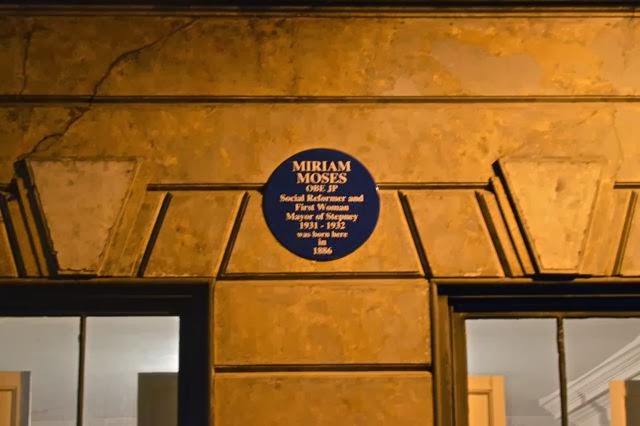
Something I learned recently was that many of these blue plaques are not official in the sense that they have not been approved by English Heritage the body that has historically granted sites this status. This is just such an unofficial plaque. This one does not even indicate upon whose authority it has been put in place.


By the time I made it around to 19 Princelet Street it was really rather dark and I got to see how my new camera really did a better job than my old little pocket camera. Expect better night shots from now on.


I had tried on the Alternative Tour to take a picture of this metal sculpture that sits on the top of a post beside Christ Church. It had simply been a blur and so here is it is. The way these different tours were interweaving was, I realised, a consequence of them taking place within a concentrated geographical space. When I made the Stuttgart Tour of Tours I was taking the entire city as my frame and as such had to construct connections whereas here they were happening very naturally. 


Here for example was my first Jack the Ripper tour group of the evening. I was finishing around 5.15 PM and the Ripper industry had already started for the evening.


Which led me to Jack the Clipper on my way between point 16 to point 1 the start of the circular tour. I had heard that the Ten Bells pub had tried to change its name to a Jack the Ripper Theme pub but backed down after protests from women's groups. This barber shop was not so inconvenienced. This then completed my tour and my abiding feeling was that this tour was constructed simply to get people walking it being framed as a healthy and interesting activity. The booklet was part-funded by the National Heath Service and there was a section extolling the benefits of walking. The quotes were a bit random so they never constructed a very precise narrative or theme beyond 'this is all historical stuff that people once wrote about this place'. This meant that I was rarely that deeply involved in the tour on offer but was able to use it as a way to consider the space and how it is to follow a written guide rather than a live guide.  

Monday, 18 November 2013

An Alternative Jack The Ripper Tour: conspiracies and comedy

After taking a Jack the Ripper Tour last week and seeing just how many there were pounding the streets of the East End, I decided that I really had to take at least one more in order to be able to make some sort of comparison between them. That's how I ended up taking the Ripping Yarns Jack the Ripper Tour.


The starting point of the tour was Tower Hill tube station. This is a little more central than Whitechapel and properly on the tourist map of the city. I don't know whether we started here because if it is easier to get tourists to come here or because our guide was a Beefeater, who work and live in the Tower of London, pictured behind. In any case, I had heard that the less serious even sensationalistic tours are more likely to be found starting at Tower Hill and I was looking forward to something trashy. Once our guide started addressing us, however, I realised that this was not one of the B-list tours but was something altogether more respectable. Ever so slightly disappointed (no cheap laughs tonight!) I settled into the tour that I was actually being given and listened with interest as our guide Barney started warming up the group and introducing the tour and the story of Jack the Ripper. 


The tour took us through unfamiliar streets that were not obviously part of the Jack the Ripper story, but the locations were used to tell us about what East London was like in the 1880s and about the lives of the ripper's victims, all of whom were working as prostitutes. It flowed naturally enough and we finally joined the now familiar route stopping at the first site that the previous tour had also stopped at. We would shadow a similar route to theirs through much of the tour, making slight alterations, but essentially visiting the same locations. I had to ask whether this uniformity of route is due to the locations themselves and how the streets are laid out (one murder site is omitted as it is too far off route) or whether it is as much due to the way the narrative is told. I guess this is something that guides have spent considerable time thinking through and you would probably need to depart from the chronological telling of the murders in order to make a significantly different route.


Our guide was a gifted storyteller and natural joker who had been giving this tour for some four years so he knew his script inside out. Maybe because of that, and in order to keep it fresh, he also allowed himself to talk about funny things that he had seen and heard recently whilst being a guide. He knew the details of Ripper story well so we remained on that thread but he found ways to personalise it and see the funny side of it at every turn. He spoke quickly and with a choice turn of phrase and I wondered if foreigners whose English was not good would be able to follow him. He did explain some phrases from time and his energy was itself infectious, so I suspect it would all work out fine for most visitors. 


Once again there were the A4 laminated pictures distributed around our group showing the victims, locations and so on. He used fewer than the previous tour, however, and carried the story more through his patter, which was more than able to paint the scene. The pictures that we did see were generally less clearly printed and certainly a good deal less gory than the tour of the other night. He made far less of a point of trying to shock us with gruesome images and viewing them was very much an optional thing for the curious.


I heard that there had been an American woman who had taken one of the competing tours and had written an article complaining about them. I had a look for this online but was unable to find it as there is such a deluge of information and reviews about the various tours on offer. I also had to reflect that there will be some people who will inevitably find such a tour in bad taste, but I have the impression that they will probably be a minority. The group I was amongst seemed like a petty normal bunch of people and not a blood thirsty mob of sickos, much indeed like the previous tour group who were on the other Jack the Ripper tour I took. What is probably a more interesting question to ask is, how is it that this story has become popular and acceptable to be interested in. 


Whilst each tour is working with the same basic story and historical records, which will be more or less familiar to the guide, the tour will have a distinct focus and point of view that sets it apart from the others. So where my previous tour was historical in tone, even historical to the point of being about 'Ripper Studies' this tour focused upon the identity of the killer. In this sense it took the police force's point of view which made perfect sense given our guide was an ex-serviceman. The way this take on the story was delivered was very present and convivial and this brought it out of the detective story frame as there was no urgency or suspense to it and took us much more into the tourist frame of reference.


Just as on the other evening, the small Spanish group were out and once and again they managed to arrive first at this vantage point. Whilst the attitude between the guides and different groups seemed more or less harmonious, when a small group took the best spot while a large groups had to settle for a second best location, it did't sit so well with the crowd. It is all public space, however, and nobody has more or less right to it so the best thing was to do as our guide did and just get on with it from the other side of the road.


Much was made of the this message that was purportedly left by Jack the Ripper. He suggested it can be interpreted as relating to the freemasons.


When we came to Mitre Square we saw not one but two other Jack the Ripper groups. The group behind ours was on the murder site of 'Ripper Corner' while the second group had to content themselves with the building site and we parked ourselves by the offices. This gave me the idea that it would be rather amusing to sit in Mitre Square one evening and watch the various groups come and go. I might just do that and count them.


We were near the end of our tour which was to take a total of two hours and twenty minutes. I was fine with this duration but I did hear some people in our groups talking to one another about getting cold and tired by this point. The extra leg of the journey that comes from starting at Tower Hill certainly adds to the duration and makes this longer than the average Ripper tour. I imagine if the weather was poor that would compound this. Fortunately it was merely dry and cool which I'll happily settle for.


The prime suspect was revealed at the end of our tour and a plot involving the royal family imagined. This was the point where the tour went beyond the realm of the historical and into conjecture, which we were perfectly happy to accept as the Ripper story, being so far away in time and encountered via Hollywood, belongs more or less to the realm of fiction, even if it is based around real events.


The tour concluded with collecting £8 from each of the twenty people who were on the tour. This was done on the basis that there was no need to pay if you were not satisfied. Everyone paid and we made our way back to Tower Hill and into the night.