Showing posts with label Occupy. Show all posts

Tuesday, 22 July 2014

The London Tour of All Tours: a meta-tour / performance around Spitalfields and The City

A long time in the making, the East London Tour of All Tours finally hit the streets last weekend.


The tour is up and running and manages to include most of the tours that were taken in the Shoreditch and City area towards the end of 2013 and which are reviewed on this blog. The arm pointing up high is to Broadgate Tower.


In the background is the work of Space Invader and a stop on the food tour. As was typical in Stuttgart, locations accumulate multiple perspectives with a number of tours having a go at defining them.


The weather was bright and sunny and the addition of a hat proved to be most useful to say nothing of its elegance. 


Something that I hoped would happen did: we encountered some other groups on route who I was able to identify and describe. This makes me think that a flexible structure which allows me to talk about tours when the group appears in front of us is great and when we are on the tour and don't see them, which is more typical, to still have a solid plan. I've gone some way to allowing enough spaces and options into this tour for this to happen but still need to get used to these encounters to play them fully for all they are worth.


The locations proved to offer a very large dynamic range, particularly on the Sunday when Brick Lane was heaving with people and The City completely deserted. 


There is still another weekend of tours to come and it will no doubt still evolve a bit more. Bookings via Richmix. I must thank two people in particular, Elo Masing for supplying some of these pictures and Rosa Farber for assisting with the trial runs and for also providing some of these images. Thank you!

Tuesday, 8 April 2014

The Tour of All Tours at the Bookwork Literary Festival, Beijing 2014

Here are some pictures from the performance of The Tour of All Tours in Beijing, presented as part of the Bookworm Literary Festival 2014.


The tour started in the bookworm itself with a review of an audio tour around the station area.  


The tours that were covered were very different with a good number of them from other cities. The details were smoothed over so as to make it ambiguous whether this was a tour of Beijing or a projection of the tourist gaze. The one exception that would not allow itself to be smoothed over was the 'Occupy Beijing Tour'. This was so unlikely that it was interesting in its own right in so far as it described a tour that would not be permitted. Standing in front of the Bank of China, we started to look a little like the tour we were describing. 


Rather than describing this performance, something best left to someone watching it, it is more interesting to describe how it seemed to function. The format of the tour, even with the caveat of it being an art tour, brings with it a way of watching and participating. That and the great weather meant for a laid back audience.


The group was made up more of Westerners than of Chinese spectators, so we attracted a bit of attention in our own right as a minor spectacle. The hat no doubt helped.


It was great to be able to talk about The Olympics and East London and make comparisons between Hackney Wick and Sanlitun, an area that was developed significantly ahead of the games. Certain structural similarities connect the areas such as the displacement of poor people and their not very profitable businesses.


I enjoy those moments in the tours between stops when you talk in a more informal way with the spectators. I have to retain a performance sensitivity yet engage with people in an unforced manner. It is in these moments that you realise there is no escape from performing. The mask of sincerity is usually the best option. 


Something I was not counting on happened. Taking the group through Yashow Market, I lost 2 or 3 people as they were spirited away into shopping mode upon seeing a dress they liked the look of. That is when I realised that it is not just me who engages in the event in more ways than one but so to do the spectators: as tourist, as art viewer, as shopper and as self, to name but four. As for the baby, he was probably the most centred of us all and hadn't leant the different roles he could play in this game of being the tourist.

Thursday, 9 January 2014

The Meet the 1% Tour

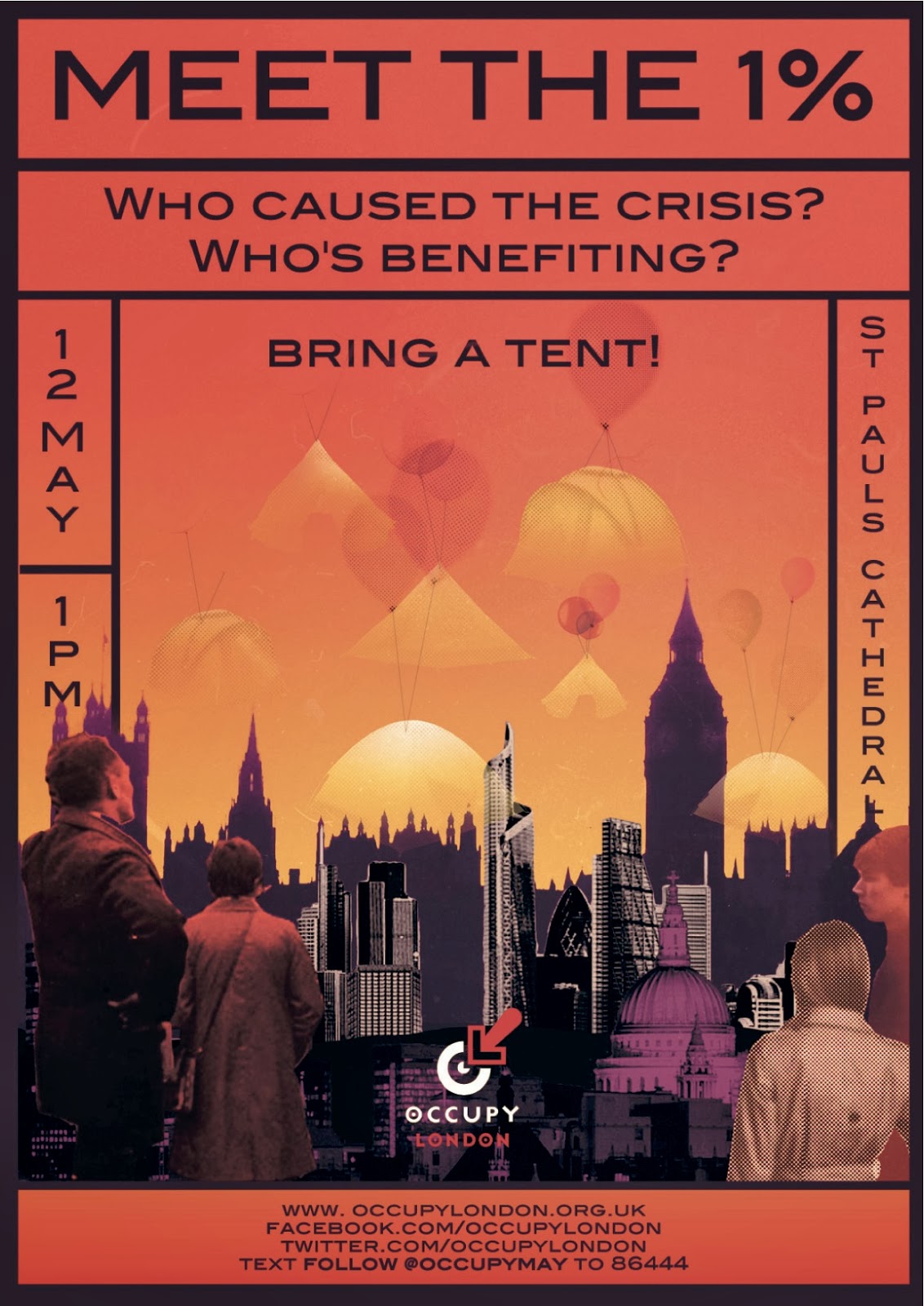
This tour is something of a relative of The Occupy Tour in that both its theme and core audience were practically identical. The form, however, is different enough to make it worth covering as a separate tour.


It was a one-off event that took place on the 12th May 2012, a day that was marked in 350 cities, spread over many countries, with similar Occupy style events commemorating the start of the Spanish Indignados Movement. It was advertised in London with colourful posters, such as those above, and publicised through the network left behind by Occupy London, even though the tents had been cleared away by the police some months earlier.


I learnt about it over a cup of tea at Richmix when someone who was there that day kindly took the time to explain a bit more about it to me. This is, therefore, a historical record of a tour, though one that belongs in the recent memory rather than a historical tour such as Daniel Defoe's A Tour Through the Whole Island of Great Britain (1724-26) which I am also currently reading, since he was also walking around Shoreditch and The City. 


This is the map that was produced for the event and which you can download HERE. It has been quite nicely produced and one aspect of it that I like is that it makes The City of London clearly visible, highlighting it in green. This should make a circumnavigation easier, which incidentally, is what Dafoe did in his tour, walking around the perimeter of built up London as it then stood, a city then creeping some distance outside of this boundary but not remotely like today's sprawling metropolis that spills out in all directions and has its contemporary circumnavigations, like Ian Sinclair's London Orbital, set upon the M25 ring road. This map highlights different addresses around The City but it does not prescribe a route that connects them. People coming on the 12th May were encouraged to print out a copy of this map and follow the Twitter feed that would, amongst other things, supply suggestions on where to go. The open-ended nature of the map is part of its design; the designers state, "Our map for Meet the 1% is an essential tool for finding your way around on Saturday, but we also see it as a resource to move beyond our own programme of events. We’re deliberately leaving plenty of opportunity for those who attend to determine their own course of action on a more autonomous basis. It doesn’t take much to make a statement. When “urban exploration” is classed as “extremist activity” — as the City of London police did last year — walking the streets you live in can itself become a political act."


The organisers did not know how many people to expect and thought it could be just a small gathering making a tour around The City but in the event some 500 + people turned up at St Pauls where the day began with speeches. These covered a range of topics as you can see in this video of the day, the first half of which was focussed around St Pauls before the tour headed off around other locations.


Many of the people on the tour were veterans of the camps and meetings that characterised the 4-month occupation of The City. It was, therefore, a bit of a get together for this network which had been scattered as a result of the evictions. I was told that the demise of the camps had come as a significant blow to many who had invested a great deal in Occupy, leaving homes, jobs and even partners to participate in it. With a Summer of flags looming, this was to be the last show of numbers of the protesters on London's streets. 


The tour did not have any clearly identifiable leaders. Different people had prepared self-contained actions at various points on the map such as describing the company's activities  over a megaphone or various other peaceful direct actions. The rationale here, I suppose, was that even if an organiser/activist were identified and arrested, the tour could still continue. The Anonymous mask was worn by some in line with this. This reminded me of The Critical Mass Tour which I recently covered, which also had a diffuse organisational structure to avoid individuals being singled out. It strikes me that there must have been an organising team all the same, as you cannot get 500+ people on the street without an effort, so they must have done a pretty good job at covering their tracks and working in cells. Unless of course they have been infiltrated by police spies, which is a distinct possibility, given the widespread practice of doing this against all manner of protest groups in the UK. In which case, the police did a good job at not blowing their spies' cover.


Naturally, the police were out to 'protect the peace' and whilst they were originally outnumbered, they came in increasing numbers as the day went on. They started to 'kettle' the marchers on Fetter Lane but relented after a while and let them continue. The marchers were aware of the likelihood of this and the route they followed avoided too many narrow streets as these spaces aid the police in forcibly containing the marchers. 


This is the reverse side of map which carries the key to the sites. The categories that are listed are: banks, hedge funds, financial services firms, stock exchanges, lobbyists, crisis profiteers and crisis profiteers - health. It was prepared with the assistance of Corporate Watch who are located over in Whitechapel. It struck me that while the Occupy Tour was somehow caught between being a political narrative tour and a political site-seeing tour, this Meet the 1% Tour was closer to being political sightseeing cum protest carnival. The narrative elements were less significant and the size of the crowd made the group an entity in itself, and one that seriously changed the nature of the space and consequently the face of the 1% they were intent upon meeting. Walking in such numbers, the police inevitably come out in response.


There was a lot of self-recording of the march and pictures posted online as well as some videos like this short one, set rather appropriately to London Calling by The Clash. When the tour came to Bank and The Royal Exchange a significant group stayed behind there while smaller splinter groups scattered around the city, visiting other points on the map. In this way it was very difficult for the police to contain everybody. The tour was therefore more of an invitation to make your own journey rather than to follow a prescribed path. Some took the initiative and started putting up Occupy sticker tape on buildings while others stayed behind at The Royal Exchange. It is here that the main clash with the police occurred following a contested issuance of 'section 14', a police order to disperse the crowd. This is caught on video here. Another instance of police surrounding the protesters/tourists and 'kettling' them took place and this dragged on for hours with snatch squads pulling people out but failing to charge them with any offence.  


As a memento of the day, I saw some of the tape used on May 12th now adorning my guest's laptop. It seems like this was a tour that was fondly remembered and seen as one event amongst many coming out of ongoing political activism based in London and connected to an international network that is as widely spread as the financial and political networks that its supporters oppose.

Monday, 6 January 2014

The Occupy Tour: an anti-capitalist tour of The City of London

Finally I have got round to taking The Occupy Tour, a tour that is based upon the financial crisis and London's role within the historical development and current state of global capitalism. If that sounds like a lot of digest, you're right it is, but it all boils down to an anti-capitalism tour, more or less, and one that proved to be very well attended too.


The tour started on the steps of St Paul's Cathedral, the site that the Occupy protesters took after being prevented from occupying the London Stock Exchange back in 2011. I remember standing on these same steps back then and listening to the geographer David Harvey speaking to a large crowd on the relation of capital to city space and how he strongly supported the Occupy initiatives that were taking place worldwide. I think his writings should be worth looking at in relation to both this tour and The Tour of Tours more generally as he does go into the contested functions of public space quite considerably. This tour began not with a reading from Harvey, however, but instead with a reading from the letters of St Paul about possessions and money, a reading that addressed, rather aptly, the church's compromised role in finally supporting the eviction of the protesters.


The tour made its way from point to point taking shelter whenever possible from the rain. It should not be a shock in London to have to deal with a bit of rain when on a tour, but it has been a particularly damp time recently and I have the feeling I been enduring one sodden tour after another of late. Between stops we were encouraged to play "Spot the Tax Dodger". Predictably enough Starbucks was on the list and so too was Boots who, we were told, have assigned their corporate headquarters to a post office box in Switzerland, a move detailed in the UK Uncut campaign. 


We stopped outside many buildings that belonged to the different people and institutions who, we were told, were in their own ways responsible for the crisis. Our two guides took it in turns to explain the roles each of these different institutions played such as here describing the evolution of the Lord Mayor of London's office. This was quite interesting but what gave the tour an extra twist were the responses of the people inside the buildings. Here, we had someone opening the door and asking the tour to move away. We did... about 10 meters to the right, so that we were now assembled in front of another of their doors. The man then banged futilely on this other door from the inside to show his displeasure, but the street belonged to the crowd so the quotes from then Prime Minister Gordon Brown in 2006 and 2007 on the wisdom of light touch regulation of financial services, kept on flowing.


We came to the headquarters of the Rothschild family's businesses in London and heard how they built their empire, in part, through acting as the financier of national war bonds. Their present status is less important, we were told, as they had relaxed into being merely super wealthy and producing hyper-expensive wine in their vineyards in France. Now I think of it, I was once shown a large number of bottles of their wine whilst taking a truly surreal tour around the Reignwood Wine collection in Beijing. I might have to repeat that wine tour this spring when I will again be in Beijing so I can cover it here on the blog.


Once again we came across disapproving security guards speaking into their radios and not quite knowing what to do with us. Finally a colleague of his emerged and said, "No photographs, private property." It was the best he could come up with, a symbolic way of saying, "We don't like you, you are not welcome."  


They used a lot of laminated A3 pictures to illustrate their stories, such as this one on the founding of the stock exchange. I'm quite familiar with this use of cards having seen it on many other tours but the one thing that was more novel and which I rather liked was their hats. The rest of their clothing was relatively normal and would not attract much attention but their hats gave the whole tour a theatrical, not to say sartorial, lift. Top hats function as historical references that reminded me of the Victorian and Georgian eras, which was quite appropriate with this tour in which the past and present constantly intermingled. This mixing of time frames was, in fact, both the tours strength and weakness. It allowed them to make connections and explain how we got here, however, it was at the same time so scattered that it was impossible to extract a clear argument or thread from the tour, which instead felt like a catalogue of annoying and unjust things about the City of London.


The two of them performed well as a double act; here they are talking about Monty Norman the Nazi sympathising Governor of The Bank of England. What's more, they didn't just rely upon each other, they also brought members of the audience into their act by asking them to answer questions, translate phrases and even sing songs. Compared to the last time I took a tour with two guides who were at crossed purposes, this was a very harmonious duo. 


The tour came to The Guildhall, a site already known to me from The Machiavelli Reinterpreted Tour and here they made a gently provocative gesture through writing on the wall of The Guildhall in chalk. This diagram explains the medieval system of representation in The City of London which today ensures the mayor remains a person appointed by the banks.


We then stood in front of Chicago University's European Campus located in Woolgate Exchange but were cleared off this spot by another zealous security guard who had a contented 'job well done' look on his face when he managed to get us to the other side of the street. I can only think that these men have a very poor understanding of public relations as these actions only heightened the sense that these institutions had something to feel ashamed of and were embarrassed by this attention. Security guards and those who manage them tend to see things differently.


Chalk was again used to good effect to produce this table showing the income of the top 1% and level of public debt in an effort to debunk the free-market theories of the Chicago School of economic thought. The apparent failure of these economic theories and policies to behave as predicted has not yet made any apparent dent on the prestigious university campus located in the heart of the financial city. I would have liked one of their economics professors to have come out of the building and defended the theories, but that was not to be. It was a Saturday after all.


We then went over to Deutsche Bank where the topic was the consolidation of debt and the financial products and instruments that were behind the collapse of sub-prime mortgages. This was made a little more entertaining by including a rap composed by a former employee of the bank on the subject of the Collateralized Debt Obligation Market.

"CDO Oh Baby" to the tune of Ice Ice Baby by Vanilla Ice


Yo vip let's kick it!
C D O oh baby, C D O oh baby
All right, stop, collaborate and listen
Spreads are wide with a technical invasion
Home Eq Subs were trading so tightly
Until Hedge Funds Bot Protection daily and nightly
Will they stop? Yo I don't know

Turn up the Arb and let's go
To the extreme Macro Funds do damage like a vandal
Now, BBBs are trading with a new handle
Print, even if the housing bubble looms
There are never ends to real estate booms
If there is a problem, yo, we'll solve it

Check out the spreads while my structurer revolves it
C D O oh baby, C D O oh baby"

The guards looked on unimpressed as usual but did not intervene. In the background there is some of the bank's substantial art collection on show and I noted that they offer tours of their art collection, I might just have to take one to see things from that point of view. 


The last stop on the tour was the Moorgate branch of Nat West, a bank that is owned by RBS. There was a whole lot more talk about the government bailout of this bank and its unethical investments and as I was listening to this I looked around and saw the sentry box that marks the 'ring of steel' the security checkpoints installed in the 90s to tighten police control of the city's entrances and exits following IRA bombings. It was striking how it seems to more or less follow the old Roman Wall of London which, incidentally, is a tour route as well. This city within a city, or even state within a state, as some consider it, is essential to any understanding of what is going on elsewhere in the city and well beyond. The tour concluded with many thank yous, a steadfast refusal to accept money for the tour, encouragement to get involved with the issues raised and current campaigns such as that to remove the post of The City Remembracer and a final near ubiquitous gesture that I was not expecting. They said, "if you have enjoyed the tour then rate us on Trip Advisor!" It seems like this company and its website is the glue that connects people with tours in London today. 


The tour finished in the Red Lion where the bar staff kept trying to pour short pints, ie not fill up the glass completely, even though it was an over-priced generic city pub. On second thought that might precisely be why they were pouring short but that, in any case, didn't deter a significant tranche of anti-capitalists mixing and talking about the tour, about Occupy and much else besides. I've come to notice that the tours that generally finish in the pub are the ones where there is already a greater degree of connectedness between those taking it: tours around a very specific topic or political tours, like this one. The more general tourist oriented tours rarely have this social dimension. While most of the tours I've reviewed so far that have ended this way have been lefty tours, I would be shocked if this were not also the case with other groups and different political persuasions. I don't quite have it in me to test a BNP or EDL tour, if such a thing exists, but I can well imagine it finishing in a pub too.