Showing posts with label China. Show all posts

Monday, 3 May 2021

Red Tourism: how I got surrounded by the Red Army in Changting, China


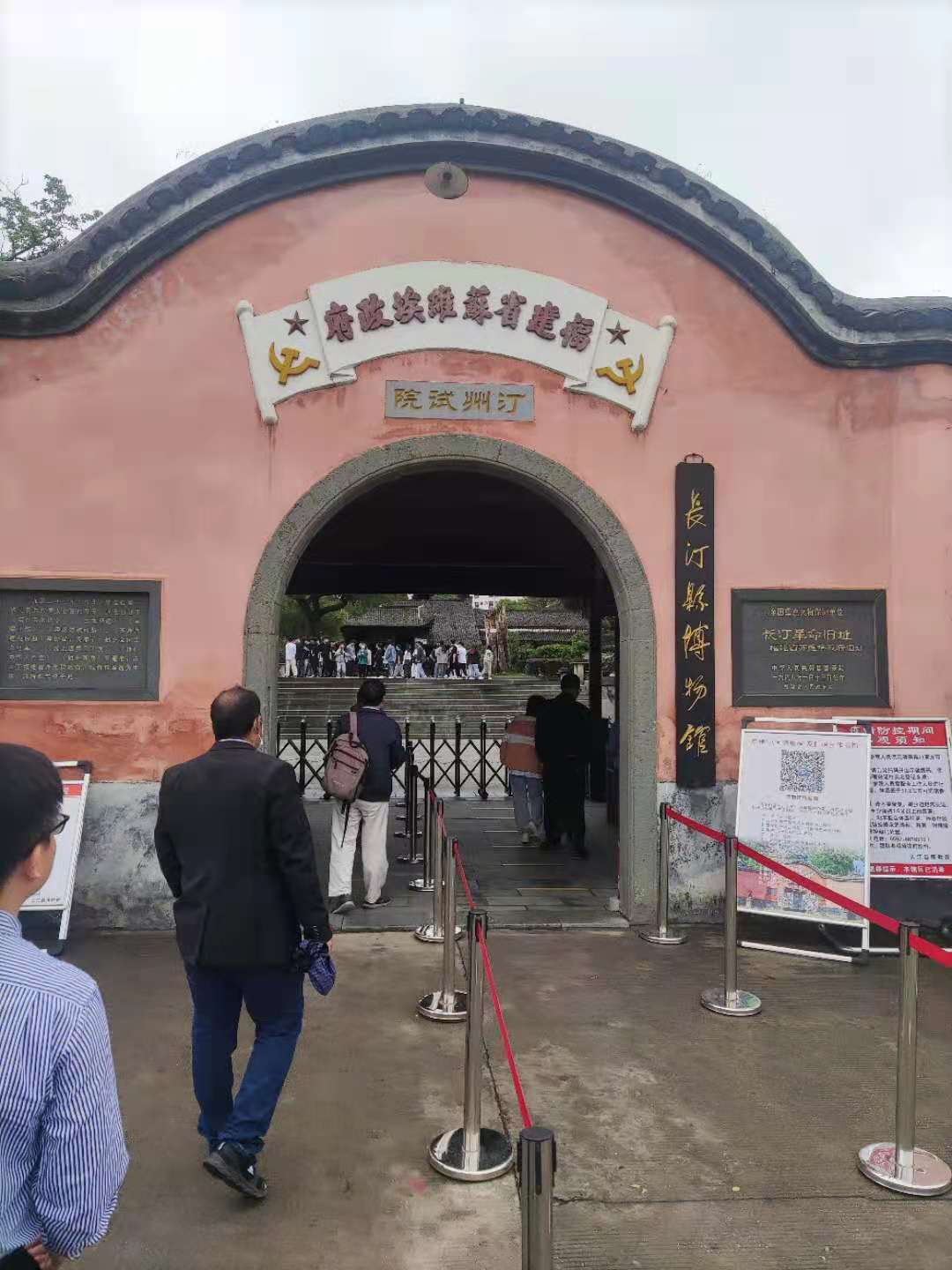
This place, officially known as the Former Site of the Soviet Government of Fujian Province,Red Tourist is a classic 'Red Tourist' attraction. That term really deserves a bit of explanation as, on the face of it, it sounds about as awkward as Marxist-Leninist Ice Cream. Basically, Chinese domestic tourism has taken off in a big way over the last 10 years and people now travel much more within the country than they ever did before. At the same time, the communist party has discovered that it can insert itself into this trend by creating sites that celebrate its history and amplify its ideology. This is such a site.


The town is clearly not used to foreign visitors and nor was the guide. He seemed friendly enough and we had a translator, but many of his points and stories just seemed to go nowhere as we had no context for them. What did slowly become clear was that we were visiting a historic site that at one time was a communist party centre.


We were told that Zhou Enlai, Mao's long-term sideman, described Changting as Little Red Shanghai back in the early 30s when it was under communist control. The meaning here is that you could get anything in Changting that you could get in Shanghai and even more, so plentiful and rich was the town. I'm quite willing to believe it was a prosperous countryside town in the early thirties when it was incorporated into the Chinese Soviet Republic. How long that remained the case is a question and that it had everything Shanghai had and more, stretches credulity. This lead to two observations. The first is that this notion of it being better than Shanghai should be taken more on the level of propaganda, though that didn't stop one Chinese man on the coach repeating it like it was fact. The second is that the term soviet was used several times and when I asked whether and how much the Soviet Union were involved, the translator and guides did not answer the question. They pretended the question was something else or just flat ignored it. 


Here, the guided recited the poetry of Mao in a deep and meaningful voice. This was a performance he obviously gave quite regularly and he looked a little bit pleased with it afterwards. The rehabilitation of Mao, who was at one point officially declared 70% good 30% bad, seems more or less complete.


We were told about the many battle victories of the Red Army who were stationed and recruited in Changting in the early 30s but we were not told about their heavy defeat which precipitated the Long March. This form of history telling that only focusses on edifying episodes from the past can lead to the listeners coming to completely false impressions. I myself had to go and look up the history after this tour as it left far more questions than answers. Like with the other Changting tour I took, I have the feeling that the guides are not used to people asking questions or approaching their tour in a critical manner, so the many gaps in their narrative have never had to have been smoothed over.


Outside it was the turn of the school groups: teenagers dressed up in red army uniform and sneakers. There were a number of such groups and they seemed to be the staple duty visitor on the morning I went. Each group had both their school teacher and a military person in charge of them. These trips are a form of day out for the local schools and they are justified as historical and ideological education. When the group spotted me they seemed to forget ideology for a moment and they swarmed over and wanted their photo taken with the tall westerner, somewhat to the annoyance of their military handler. One or two said, "Welcome to China" something I have not heard in a long time. This was when it truly struck me I was in the countryside where you get to play at being a minor celebrity just by being foreign. The kids were spontaneous and pretty friendly and I must admit finding myself to be the star attraction in a red tourist site made this visit an awful lot more fun. 

Tuesday, 15 May 2018

City Centre: a networked walk


I learnt about City Centre through the Walking Artists Network and the idea was people in different places around the world would all follow the same instructions for a walk on May 12th. In this way we'd walk together while also being apart. The walk is one of the many collected in the book Ways To Wander and Blake Morris, who made the call out, has made it his job to try out the whole book.


Choosing a meeting place was not too hard as there is a general consensus, even among Nanjingers, that the centre of the city is Xinjiekou. At the very centre of this area (in the background) is a roundabout, the intersection of the city's main, north-south and east-west roads. At our meeting point, a silly elephant sculpture. 

Our first task was deciding which direction would lead us out of the city centre. This was a weighty decision as it would determine much of what would follow and since many of us knew the city well it was also an unwelcome one. I didn't want to already have too clear a picture in my head of where I'd go and what I'd see so it was left to a game of spin the bottle. Our clothing remained in place as the bottle pointed to the west.


In order to take our modest Journey to the West, we had to descend into the subway station as there are no pedestrian crossings at street level. I have always found this surrendering of the centre of the city to an inaccessible traffic roundabout deeply troubling and I'm irrationally happy when, late a night, I see pedestrians climbing over the barriers and running across the roads. Underground, there is a mirror of the roundabout above with the 24 exits of the station spiraling out from it. At the centre of this underground pedestrian junction, it is possible to reach the centre. This is what it looks like.


Below the central axis was a large model of a luxury real estate development out in the far suburbs. The city is busy eating up the surrounding countryside and as this is a powerful economic force right now it was perhaps fitting to see how, at the very heart of the city, it was the suburbs that we found. We knew we were never get this far out in our walk, but it was good we found them all the same. To understand the city it is necessary to understand what is happening out on its edges right now.


Following the walking instructions of Tom Hall, we edged our way outwards. It is, in many respects, so familiar a score that I already had a good idea of what we'd find. The expectation and the reality are rarely identical, however, and formalising the process of walking out from the centre might just, I figured, change the nature of the experience. What's more, I also wanted to see how it would be to conduct this walk with a group of people, who would come, what we'd talk about and how this group's experiences would compare to other walkers elsewhere.


We covered some distance. The buildings became less lofty but so too were the roads more narrow so there remained a sense of clustering wherever we went. As we headed further out the shops changed and became shabbier, bowel challenging noodle bars, pink light massage parlors and electric scooter repair shops. 


And then, all of a sudden, we came up again the old city wall from the Ming dynasty, which dates back roughly 600 years. None of us were quite sure whether this delineated the edge of the city back then or not, but it clearly was a boundary of sorts both then and now. Today, it marks the edge of the city centre while the contemporary perimeter wall is invisible and forever being moved further and further out into the countryside. Nowadays, satellite towns orbit around Nanjing in the hope of being incorporated in the sprawling metropolis. The city has become rhetorical and speculative, a shape-shifting creature that is far more than just an accumulation of bricks and steel. 


One of the ubiquitous features of the city is the shared bikes. They followed us wherever we went. These two seemed to be enjoying a private moment together, in plain sight. 


As we got further out there was more water. If we would have walked further, we would have  reached the Yangtze in an hour or two. We had to content ourselves with the Qinhuai River, a tributary that flows through the city.


The texture of the city is not uniform and as we left the centre we came to modern residential developments. The one in the foreground is called New City while the old city centre remains visible, a ghost haunting the broken horizon. The city has, in several locations outside the centre, tried to start again and reinvent itself as a 21st century conurbation. These attempts, such Hexi, are usually partial as the real economy cannot fully support an entire community living in luxury high rise apartments. Metropolitan aspirations are then redesigned and more familiar patterns of services and uses of space reassert themselves. New City had so far staved off the bulk of this by not including a commercial centre. 


To the south was this lake, part of the unfortunately named Wanke residential compound.


Walking around the large expanse that Wanke had carved aside for itself, we came to older residential neighbourhoods. These shielded off ailing public housing that was kept alive through patchwork interventions, the equivalent of architectural life support. 


I had expected that this journey would lead us from the familiar to the unfamiliar so I was surprised when, just as I was saying it is time to grab lunch and head back into the centre, we came across this park. I realised I had been here before. Just a month earlier I had come here for a photoshoot and the picture was still on my phone. We made an approximation of the happy couple then headed back to the centre via another route.


To get a sense of completeness it was to the exact same spot we returned. It turned out that  the walk did break some ice and engender fresh connections. From this new group I expect more activities; next month we pledged to walk again. As for the other walkers elsewhere in the world, I'll add links to those walks below, as and when I find them.

Thursday, 4 January 2018

The Tour of Hunan - From Zhangjiajie to Changsha - dispatches from the frontline of tourism in China


The Tour of Hunan was a four-day coach trip that was run by a local tour operator designed to show foreigners the highlights of the province. The coach became our second home, my back slowly locked itself into the shape of seat. They managed to turn a holiday into the chore by packing in as many iconic sites scattered across the four corners of Hunan as possible. Each day we seemed to drive for around six hours, starting in the early morning with shorter rides later in the day. With a 6.30 AM wake up call each day, it felt like work.


By submitting to this gruelling timetable we were able to catch attractions like this bed that Mao once slept in. This is a tricky exhibit as it has to ride a fine line between looking both stately enough for the Great Helmsman and yet humble enough for a junior scholar in a backward province. I must have taken a lot of effort to find that sweet spot in the middle!


And here he is again leading the coach through his home province. His presence seemed strangely apolitical, he seemed to function more by offering an, albeit premature, celebrity endorsement of the sites.  


The historic towns we visited were the homogenised type that had been given the tourist makeover. Coach after coach spilled out tourists who raided the streets buying up souvenirs and fake luxury brands. While this scene of consumption could be anywhere in China, the tourists themselves add some local colour. Buddhist monks were even getting in on the act, I like very much the disciple, here sporting a red Hello Kitty bag that almost matches his robes.


The drum shops reminded me of Lijiang in Yunnan, a tourist town that has been similarly transformed and which sports an unlikely number of them. These shops seem, at first, completely arbitrary and it remains a mystery to me who actually buys these drums. What I do see in them now, however, is that they evince the growing contact between China and Africa which they frame within the field of leisure. I should like to better understand what Africa currently represents in the tourist mindset here, this is something very much in flux.


We had a rotating cast of tour guides. Our primary guide had a habit of talking too much about stuff of no relevance. For example, when she was telling us what the dinner would be one evening, she launched into a story about fish, which we weren't going to have, and how her daughter had got a fishbone stuck in her throat and had to go to the doctor to get it removed only to be told there was no bone there. Well meaning but not informed about the sites at all, she went on extended improvisations with the microphone at the front of the bus. Alongside her was a local guide who spoke no English but who took care of the restaurant and hotel bookings.


At most of the sites we visited we there were then guides specific to the attractions we were being wheeled in front of so we'd sometimes have three levels of simultaneous guides, none of whom really made the place any the more interesting but who did at least keep up some sense of momentum.


I had recently come across a tongue in cheek article on cocktails you can make with ingredients from a Chinese convenience store. Over the four days I tested them all. This Baileys style drink was probably the most palatable. 


The interminable coach rides between sites were, on one of the days, augmented by the driver adding in some private business of his own. We made a stop to pick up some boxes and bags at a petrol station the the edge of one of the towns and then made a large swooping detour for him to go to his home town where the coach pulled and his wife ran to meet us and take a sack of pomelos from the bottom of the coach. Cocktail time.


One of the parks was full of monkeys. They seemed like used to the tourists and this one was not in the least phased by the circle of phones that surrounded it.


The cable car ride to the higher peak was not for those with vertigo. 


Zhangjiajie is stunning, an unreal assemblage of oversized toothpicks bound together with lush tree cover. We were given fifteen minutes to take pictures before it was time to move on.


One of the more absurd things the guide kept on stressing was that the mountains featured in the film Avatar. Even though this blockbuster movies was meant to lend the site greater kudos, it only brought it down in my mind to the world of aspirational CGI and middle of the road acting.


There was even a video machine there which could film you and then stick you on top of a dodgy animated bird flying high over peaks of Zhangjiajie. They had a special talent for making something very ordinary and kitsch out of an absolutely stunning natural location. 


We were vastly outnumbered by the domestic tourists who had a much clearer idea of what to do with a site like this. Their's was a near military style sweep: go to prime photo spot, selfie sticks out, take turns with group shot, break into solo and duet shots then move on the next site. Our tour was a pale, self-conscious imitation of theirs: we have the photos too but ours are not as cleanly composed, are far fewer in number and we never managed smiles like theirs. Being a tourist requires practice.

Wednesday, 22 March 2017

Audio Tour Experiments


recently wrote about tours whose contents are disconnected from or only loosely connected to their geography. I followed this observation up today with an experiment. The idea was, to make an audio tour that is based upon a text from one time and space and to inscribe it, through precise spoken word directions, onto an entirely new context. In practice this became, how does Adam Smith's The Wealth of Nations sound when listened to in a Chinese shopping district.


The results were quite interesting. Unlike most tours, the content is not primarily delivered during stops but rather it flows as you walk along and you have to make the connections yourself. This means that some parts of the text work better than others: the parts where there are links to be made. The choice of route is important too as it can both contextualise the ideas and, potentially, comment upon them. Too deliberate a route and text may feel contrived i.e. listening to Das Kapital while circling the New York Stock Exchange, but too random a combination also has its pitfalls: you might wonder why you are listening to Madame Bovary while walking through a zoo. 


What is quite certain is that this is an area ripe for working in. I've taken book study tours before such as a Machiavelli Tour in Central London where we listened to and debated his ideas as we walked, but this is something different again. A more acerbic but entertaining tour of the mall would have been provided by Arthur Smith's 1894 Chinese Characteristics but Baudrillard's Simulations could work equally well. Hmm. I will be busy!

Saturday, 18 March 2017

The Presidential Palace Tour: the parrot's guide


The Presidential Palace in Nanjing is a large historical site that was once very important. That's about all I knew about the place. When we arrived I thought this building was part of it but it turned out to be a historic themed shopping and eating district built alongside the palace. Often in China, it is hard to know where one starts and the other stops. 


A lack of knowledge needn't prohibit anyone from being a guide: after entering I rented the audio tour and started repeating what I heard. At first I was too ambitious: I listened to the Chinese commentary and gave a very rough and ready summary. More satisfying was  listening to the English commentary and trying to repeat it word for word, with added enthusiasm.


I'm reading Tour Guiding Research (2015) and the authors make a sharp distinction between having a living guide, like the dynamic fellow in black above, and listening to audio tours. While I agree that there usually is a clear experiential difference between the two, the line can be pretty grey at times. I've followed robotic sounding tour guides who might as well have been pre-recorded and here, in the Presidential Palace, I was simply repeating the words of the audio tour, live, to a small audience. Was that enough to make it a guided tour? I've followed guides who speak into your ear via a wireless microphone system, so that even if you are not able to see the guide behind the crowd, you can still hear them. What's more, the technology is developing rapidly to the extent that this distinction is becoming muddier with each year. Still, a living breathing guide my group of two got, even if their guide knew absolutely nothing about the location. 


I found myself repeating stories about a government officer who recognised the situation was hopeless and poisoned himself and another about the liberation of the palace by the PLA in 1949. It was straight down the line communist party history but it must have sounded rather off-key when related by a British man who was camping it up and had no real knowledge of the site. I shall definitely have to explore this parrot method more fully. It can be a good way to take a step back from the intended meaning of a tour, something that is a breath of fresh air when the tour is trying its level best to ram a message down your throat rather that trying than interpret a site in all its multiplicity.  


In spite of the buildings being historically important, and not only in terms of Republican China, they were surprisingly functional. The passageways and stairs had scuff marks and stains half way up the walls from the endless press of tourists rubbing up against them.


The audio tour took us on a long figure-of-eight sweep around the palace and gardens. By the time we reached the stables my legs were heavy, throat dry and there was no more humour to be found in parroting this ridiculous recording. This is not untypical; these sort of tours in China often seem to wear you down by design so you can feel you got value for money rather than deliver an exquisitely timed introduction to a site. The stables were notable for looking older and rougher but, on closer inspection, this was a modern rustic effect for they were a reconstruction of the original stables.


When I wrote about Geyuan Garden and how the historic buildings there had pipes and decrepit machinery quietly rattling away round the back, this is what I meant. The Presidential Palace was exactly the same. I was not taken here by the audio tour, of course, but the joy of these tours is you can follow your own interests between stops. This audio tour is a sort of cultural dinosaur that disguises its age by using a decent quality wireless cuing system. This sort of tour will almost certainly continue to exist for a while more as it is kept alive out of a sense of duty. Given that state of affairs, finding and developing more strategies to rewire the narratives and inject some life into what genuinely are interesting and diverse sites, should be a worthwhile endeavour.

Thursday, 9 March 2017

The Reality Tour of Nanjing


Moving to a new city brings with it many new opportunities for tours. As well as tours of local museums and historical sites, the usual suspect tours, there are often more informal tours that also accompany any move. This tour is one of those: I moved to the Nanjing last week and was offered a tour of the neighbourhood by a friend and colleague.


As we walked the streets and talked about the city and university that we both work at, the  subject we, or I should really say, seemed to keep drifting back to was accommodation. When I arrived fresh off the train I was first taken to this building with the glass door where the foreign staff are housed. My passport was scanned and I was handed a key by a surly receptionist before I was whisked away to a gloomy concrete block in a different corner of the campus. It seems I got the bum deal and ended up in the overspill apartment block which does not have central heating. When we passed beside this block, which is so suffocatingly hot you have to leave the windows open in mid-winter, I was left to rue my misfortune at being assigned to my fridge of an apartment in a city where winter temperatures can drop to -10ºC.


He has a wonderfully sculptural hand which he frequently used to point things out: the subway station over here, the main shopping area down that way. The fact that the hand and finger weren't perfectly aligned made them all the more addictive.  


As we made our way around one of the scruffier parts of the city centre, we talked about the job, the students and our colleagues. None of them were actually there in front of us so this conversation produced a sort of collage of urban bustle and Chinese higher education. Trying to simultaneously focus on the two lead to elisions and omissions but I daresay that some of the connections were not wholly random. While it was clear I was not meant to read one through the other, it strikes me that it can be hugely pleasurable to do just that. This, in fact, might just be the basis of an interesting audio tour experiment: take a forty minute talk on a specialist topic and inscribe it onto a landscape with definite 'turn left, stop at the lights,' directions spoken within the body of the talk. For example, a few pages from the popular economic book Why Nations Fail grafted onto Leeds City Centre might make for an interesting experience. 


His city tour didn't include or even mention the nearby local market but instead brought us to the nearest supermarket which was decked out with card lanterns. Neither did we go through nor talk about the alternative entrance to the campus on the west wall. When I stopped to think about this I realised I have a thing for knowing my entrances and exits and would include them in even a rudimentary tour. The simple fact was he used a different set of coordinates to mine and moved between them using a different system of navigation too.  


Where our mental maps seemed to converge was at the parcel delivery office. I rather liked that this tour was not only based upon the showing of places and things as a detached observer, it also included the guide engaging in some of his daily life actions. Here, the showing took place, at least in part, through the doing. This style of tour is not unusual for  workplace initiation tours or if you have family visiting and you are not busy but it is interesting to imagine how it could function otherwise. Taken to its logical conclusion it would mean a person shows you their unadulterated daily life: you accompany them for a period of time and they explain what they are doing while doing it. I believe that there have been attempts by artists in Berlin to do just this, to effectively market themselves as a lifestyle, but how successful this has been I cannot say. I would imagine the observer's presence must inevitably alters the guide's daily activity because people want to show the best of themselves. This reality tour principle does, however, have the potential to be something rather unusual, if taken to its logical extent.  


The tour came to a close in a very special way. After we stepped outside the university shop, he cleared his throat, spat on the pavement and muttered, "I'm becoming a bit Chinese." I have heard of a number of Westerners, well Western men, adopting this habit after spending time here. Where he still showed his foreignness was in how he forcefully spat it out whereas the far more common way I see the pros here do it is that they first hawk up a glob of phlegm, manoeuvre it to the front of the mouth then simply open wide and let it dribble out. In any case, this was a fittingly unaffected way to end for this reality tour of Nanjing: pavement punctuation, a full stop written on the concrete.