Showing posts with label guided tour. Show all posts

Monday, 3 May 2021

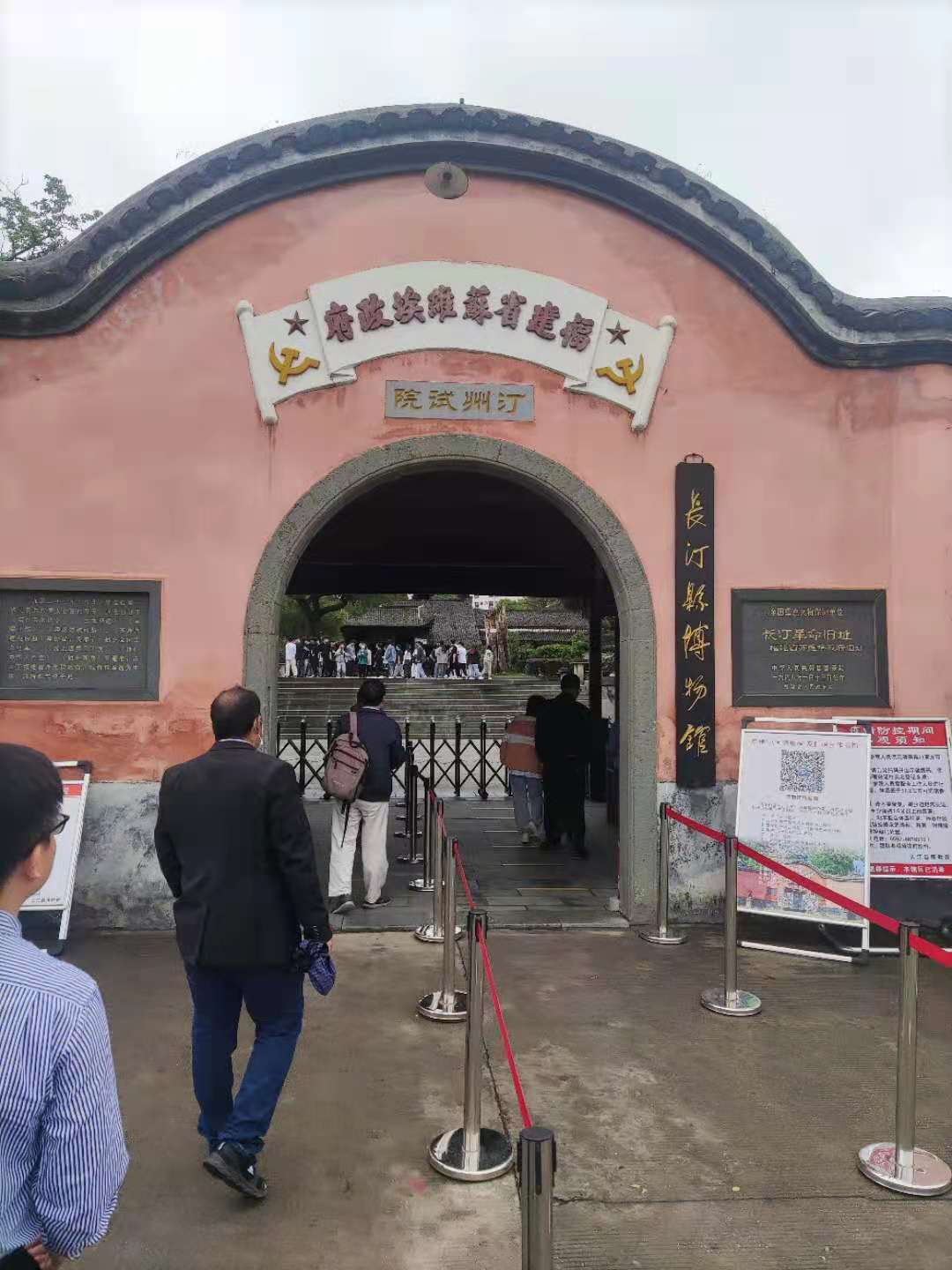
Red Tourism: how I got surrounded by the Red Army in Changting, China


This place, officially known as the Former Site of the Soviet Government of Fujian Province,Red Tourist is a classic 'Red Tourist' attraction. That term really deserves a bit of explanation as, on the face of it, it sounds about as awkward as Marxist-Leninist Ice Cream. Basically, Chinese domestic tourism has taken off in a big way over the last 10 years and people now travel much more within the country than they ever did before. At the same time, the communist party has discovered that it can insert itself into this trend by creating sites that celebrate its history and amplify its ideology. This is such a site.


The town is clearly not used to foreign visitors and nor was the guide. He seemed friendly enough and we had a translator, but many of his points and stories just seemed to go nowhere as we had no context for them. What did slowly become clear was that we were visiting a historic site that at one time was a communist party centre.


We were told that Zhou Enlai, Mao's long-term sideman, described Changting as Little Red Shanghai back in the early 30s when it was under communist control. The meaning here is that you could get anything in Changting that you could get in Shanghai and even more, so plentiful and rich was the town. I'm quite willing to believe it was a prosperous countryside town in the early thirties when it was incorporated into the Chinese Soviet Republic. How long that remained the case is a question and that it had everything Shanghai had and more, stretches credulity. This lead to two observations. The first is that this notion of it being better than Shanghai should be taken more on the level of propaganda, though that didn't stop one Chinese man on the coach repeating it like it was fact. The second is that the term soviet was used several times and when I asked whether and how much the Soviet Union were involved, the translator and guides did not answer the question. They pretended the question was something else or just flat ignored it. 


Here, the guided recited the poetry of Mao in a deep and meaningful voice. This was a performance he obviously gave quite regularly and he looked a little bit pleased with it afterwards. The rehabilitation of Mao, who was at one point officially declared 70% good 30% bad, seems more or less complete.


We were told about the many battle victories of the Red Army who were stationed and recruited in Changting in the early 30s but we were not told about their heavy defeat which precipitated the Long March. This form of history telling that only focusses on edifying episodes from the past can lead to the listeners coming to completely false impressions. I myself had to go and look up the history after this tour as it left far more questions than answers. Like with the other Changting tour I took, I have the feeling that the guides are not used to people asking questions or approaching their tour in a critical manner, so the many gaps in their narrative have never had to have been smoothed over.


Outside it was the turn of the school groups: teenagers dressed up in red army uniform and sneakers. There were a number of such groups and they seemed to be the staple duty visitor on the morning I went. Each group had both their school teacher and a military person in charge of them. These trips are a form of day out for the local schools and they are justified as historical and ideological education. When the group spotted me they seemed to forget ideology for a moment and they swarmed over and wanted their photo taken with the tall westerner, somewhat to the annoyance of their military handler. One or two said, "Welcome to China" something I have not heard in a long time. This was when it truly struck me I was in the countryside where you get to play at being a minor celebrity just by being foreign. The kids were spontaneous and pretty friendly and I must admit finding myself to be the star attraction in a red tourist site made this visit an awful lot more fun. 

Thursday, 9 March 2017

The Reality Tour of Nanjing


Moving to a new city brings with it many new opportunities for tours. As well as tours of local museums and historical sites, the usual suspect tours, there are often more informal tours that also accompany any move. This tour is one of those: I moved to the Nanjing last week and was offered a tour of the neighbourhood by a friend and colleague.


As we walked the streets and talked about the city and university that we both work at, the  subject we, or I should really say, seemed to keep drifting back to was accommodation. When I arrived fresh off the train I was first taken to this building with the glass door where the foreign staff are housed. My passport was scanned and I was handed a key by a surly receptionist before I was whisked away to a gloomy concrete block in a different corner of the campus. It seems I got the bum deal and ended up in the overspill apartment block which does not have central heating. When we passed beside this block, which is so suffocatingly hot you have to leave the windows open in mid-winter, I was left to rue my misfortune at being assigned to my fridge of an apartment in a city where winter temperatures can drop to -10ÂșC.


He has a wonderfully sculptural hand which he frequently used to point things out: the subway station over here, the main shopping area down that way. The fact that the hand and finger weren't perfectly aligned made them all the more addictive.  


As we made our way around one of the scruffier parts of the city centre, we talked about the job, the students and our colleagues. None of them were actually there in front of us so this conversation produced a sort of collage of urban bustle and Chinese higher education. Trying to simultaneously focus on the two lead to elisions and omissions but I daresay that some of the connections were not wholly random. While it was clear I was not meant to read one through the other, it strikes me that it can be hugely pleasurable to do just that. This, in fact, might just be the basis of an interesting audio tour experiment: take a forty minute talk on a specialist topic and inscribe it onto a landscape with definite 'turn left, stop at the lights,' directions spoken within the body of the talk. For example, a few pages from the popular economic book Why Nations Fail grafted onto Leeds City Centre might make for an interesting experience. 


His city tour didn't include or even mention the nearby local market but instead brought us to the nearest supermarket which was decked out with card lanterns. Neither did we go through nor talk about the alternative entrance to the campus on the west wall. When I stopped to think about this I realised I have a thing for knowing my entrances and exits and would include them in even a rudimentary tour. The simple fact was he used a different set of coordinates to mine and moved between them using a different system of navigation too.  


Where our mental maps seemed to converge was at the parcel delivery office. I rather liked that this tour was not only based upon the showing of places and things as a detached observer, it also included the guide engaging in some of his daily life actions. Here, the showing took place, at least in part, through the doing. This style of tour is not unusual for  workplace initiation tours or if you have family visiting and you are not busy but it is interesting to imagine how it could function otherwise. Taken to its logical conclusion it would mean a person shows you their unadulterated daily life: you accompany them for a period of time and they explain what they are doing while doing it. I believe that there have been attempts by artists in Berlin to do just this, to effectively market themselves as a lifestyle, but how successful this has been I cannot say. I would imagine the observer's presence must inevitably alters the guide's daily activity because people want to show the best of themselves. This reality tour principle does, however, have the potential to be something rather unusual, if taken to its logical extent.  


The tour came to a close in a very special way. After we stepped outside the university shop, he cleared his throat, spat on the pavement and muttered, "I'm becoming a bit Chinese." I have heard of a number of Westerners, well Western men, adopting this habit after spending time here. Where he still showed his foreignness was in how he forcefully spat it out whereas the far more common way I see the pros here do it is that they first hawk up a glob of phlegm, manoeuvre it to the front of the mouth then simply open wide and let it dribble out. In any case, this was a fittingly unaffected way to end for this reality tour of Nanjing: pavement punctuation, a full stop written on the concrete.   

Tuesday, 7 February 2017

The Tour of Geyuan Garden: a heritage nightmare


Geyuan Garden is, apparently, one of the four most prestigious gardens in the whole of China. I would never have guessed. Numbed from a 24-course Spring Festival feast the night before in which the baijiu toasting went on long and hard, I dragged my way around the residence and formal gardens. It was piercingly cold and despite the many layers I was bound up in, I was still freezing. I was here thanks to a family outing which I got hoovered up into and before even setting off I was saying to myself, this was an absurd moment to come sightseeing. It truly was, and yet so many did.


Rather than following any one single guide, the way this place seemed to work was that the place was flooded with so many guides you could hop on and off their tours and surf your own course around Geyuan. The guides all seemed to be women, mostly under thirty, wearing costumes that featured dashes of shocking pink. The look was of history tarted up according to the tastes of someone lacking in any deep sophistication.


The guides congregated around the built up areas explaining thing like, who this was the former home of, or what that assemblages of stones meant. They looked like they were following a tight script and there were no questions except the obvious ones like, where are the toilets? And the most inevitable one of the lot, where is lunch?  


The crowds were nothing short of crazy. I am used to China, I've been here a while now and learnt how to switch off and find privacy in public, but this was something else. This was the third day of Spring Festival. There didn't seem to be any limit on the number of visitors, this was the moment for Geyuan to fill the coffers. The crowd was very accepting, however, sardine tourism probably came as no great surprise and most people simply made the best of it. The guides cranked up their microphones, great big bottlenecks swelled around gateways and some  boys got bored and ran wild: it was the usual low-level tourist chaos.


There is a certain level of ennui I have come to associate with Chinese heritage sites: once you've seen one you've more or less seen them all. There may be exceptions but Geyuan isn't one of them: we trudged from one unconvincing restoration job to the next. When you look around the backsides of the buildings you see hastily slapped together concrete, wires poking through rough holes in the walls and air conditioning units. I was reminded of what Paul Theoux wrote about sightseeing in China, "It has all the boredom and ritual of a pilgrimage and none of the spiritual benefits."


Guyuan has a bamboo garden and this was probably my favourite part of the experience on account of it being ever so slightly less packed solid. That said, I was not crazy for it either as it was all a bit too intentional in its aesthetic for my tastes. 


The garden worked well enough as a backdrop for selfies and group pics, which seems its primary purpose these days. I watched a constant stream of people with phones in hand carefully framing up shots, finding the right expression and then waiting for the moment that the crowd thinned enough so the background no longer resembled the Shanghai Metro rush hour. I think the attraction of the place is that it lets visitors imagine they are in one of the immensely popular costume dramas, but it was doomed to fail on a day like this. There is a paradoxically repressed yet rampant and distinctly Chinese strand of postmodernity at play here. Geyuan is not precisely a pastiche or simulation but a thorough restoration that approximates these in form and function and which offers temporal continuity to the Han who voraciously consume it in a very contemporary and disconnected way. Some sort of narrative continues, whether it has any veracity or not is irrelevant, the point is it must go on, like Burroughs word virus, to reproduce itself and continue being told.


Some distance away from the garden is the Yangzhou Slender West Lake which is truly the cherry on the cake. Actually, I shouldn't get started on Chinese copies of Western cakes, that is a whole sorry topic in itself. This scenic spot, clustered around the water, is in a similar vein to Geyuan but more expansive and thus less crowded. In places it is beautiful, but it is also deeply frustrating. As I looked around a Buddhist monastery I asked myself, what went on here during the cultural revolution? What about other ups and downs? When, how, why and by whom was it restored? The site could be very interesting if there was a way to unpick the different layers, or even more so if there was a desire to make them visible, but there was none of this. The site had been designed to smoother questions and promote historical feel-good. This is not a uniquely Chinese phenomenon, British stately homes often give me the creeps too with their Downton Abbeyesque faux historical projection. The lingering impression I was left with here was that heritage used this way can never be true to itself. It is a fiction that refuses to recognise itself as one even when the cracks in the visage are glaring and there for all who want to see. 

Sunday, 10 April 2016

The Longshan Temple Tour: a fortune teller predicts more of the same


I was in Taipei attending a conference on urban heritage and on day four, once we had all got a bit tired of listening to one another speak, a tour was laid on to break things up a little. We took a bus ride out from the conference centre to Lungshan or Longshan Temple, it seems to be spelt both ways.


We were divided into three groups each led by different guides from the Institute of Modern History. My group's guide's approach to guiding us round the temple was to first point at things and ask us what we thought it was and to then go on to explain it if, as it often did, her questions drew blanks. This made for a more interactive tour than that of the stereotypical "on your right is..." style of guide. She was trying to awaken our curiosity rather than dampen it.


We would have been guessing a long time, however, around some of the features of the temple. She needed to explain how these two red blocks of wood could be used to tell your fortune.


She was keen to point out the depictions of the Dutch on this incense burner. Compared to  the guide who showed me around Nanputuo Temple, the closest equivalent space I have been guided around to this, she was a far more secular sort of guide. She did not present herself as a believer and try to convert us, she presented herself as an expert in the customs and architecture. This was all fine but it took the edge off it.  


There were a number of different gods in the temple, or statues of them in case, and a busy throng of people circling around, stopping in front of one or another, depending on what they were praying for. I recognised one of the gods as Mazu, a sea god also popular in Xiamen, and here we stopped in front of another, where she showed us a fertility offering that had been left. This was a working temple that people came to, first and foremost, to pray and a tourist attraction, only secondly.


The tour became more interactive again when we came to a god who you could pray in front of in order to meet your future love. It was mostly popular with the young women but a few guys were busy tossing red blocks of wood too, and an older lady as well. Hope springs eternal.


After the inevitable group photos on the temple steps which I read to be the end, the tour unexpectedly sparked back into life. One of the other two guides led the lot of us to an adjacent alley that sold Chinese medicinal herbs. This being a Sunday afternoon, there was little action so we heard about what we would have seen if we had come any other day of the week. In this case it felt like a second best but there are places I can think of where that's not the case. The City of London, for example, is bustling and contemporary during the week but like a ghost town on Sundays making the multiple layers of history more visible. As it was, we looked at a lot of plastic sheets and imagined exotic items arranged behind them.


We walked round the corner and into a gallery that proudly displayed this poster sporting an  unfortunate piece of English as a second language typography. The exhibition was a student show of paintings and design. If I had tried to explain, they would probably have thought I was a pervert, so I simply said nothing.


The final leg was led by the other guide which gave me the chance to compare the three of them. They all wore the same id tags and were employed by the same institution meaning there were some similarities in their basic tone and content. However, I realised that my original guide was the most talkative of the three. While it is often thought that the location is meant to be the point of interest and the guide simply there to bring it to life, I rather feel things are the other way round in reality. I'd rather listen to an incredible guide in a boring place than a boring guide in an incredible place. Of course, in reality things are rarely so polarised and it is easier to build the brand identity of a location or institution than that of an individual tour guide. The best guides tend to rise through these systems, anyhow, and the freaks get weeded out yet, it does also mean that the status quo is often what is most rewarded. That indeed was my enduring feeling with this tour: there was nothing wrong with it, it was perfectly professional and even friendly yet, it was also entirely predictable. It was, finally, a tour of the temple not of the guide's learning, imagination or personality, even if I did catch a glimpse of all of these. If I could use those two red wooden blocks to read the future of Longshan Temple, I rather suspect their message would be that nothing much was going to change anytime soon. 

Sunday, 30 August 2015

The Scottish Parliament Tour

I am in Edinburgh this week giving some performances as a part of the Forest Fringe programme. Whilst here I have had time to look around and I noticed the Scottish Parliament offers free hour-long tours of the building. It is possible to just show up, pass through the security and take a place on a tour. That is precisely what I did and I only had to wait 10 minutes for it to begin. An ideal start, but what of the rest of the tour?


We were asked to assemble by this picture of the queen. Our guide then asked us not to take pictures whilst on the tour; the images which feature here are either ones I took afterwards or else 'stock imagery' (i.e. google image searches) grabbed from the internet. In general, I find that places that want to control their appearance in this way are generally A) projecting a neurotic public face B) fighting a losing battle and C) have something to hide. Was that true of the Scottish Parliament?


Our guide turned out to be a Portuguese lady who spoke English reasonably well and with a noticeable Scottish accent. I thought about the choice to have her as the public face of the parliament and it struck me as very progressive pro-European casting. She explained the architecture to us, pointing out features like the boats in the roof design, and then outlined how the parliament functions. We learnt who the MSPs are, how they are elected, how legislation is drafted and then we got to see their debating chamber.


We were led through security doors into one modern space after another and given the hard sell over how good a building this was. It struck me, however, that it was not quite as stunning as she was making out and that she massively downplayed the public outcry over it coming in three years late and ten times over the original budget. She also said that it had a projected lifespan of 100 years, yet I would be surprised if it lasts half that. In short, the tour included a healthy dose of spin.


Be that as it may, she had a nice self-deprecating humour and held our attention. That said, I had something else going on during the tour which diverted my, and finally, the group's attention. I had made myself fried cabbage, lettuce and dried tofu for lunch. It was very tasty but by mid-afternoon when walking these corridors of power it came back in the form of a stream of very powerful silent farts. This was not just one or two leaking out but a veritable gas cylinder on slow release pumping foul smelling farts into the parliament. I could not leave the tour as we were inside the security doors and so I simply had to try and step aside from time to time and let them out stealthily. They were however bigger and more powerful than me and this odorous cloud hung over the tour, unacknowledged, but far from not unnoticed. This made for a delightfully British situation.


This was the first parliament tour I have gone on and it should be interesting to take another, so as to have something to compare this one with. Something tells me that they will mostly follow similar lines, politics being so much about the management of appearances, though I could be completely mistaken. Next time round I'll probably have something safer for lunch, though I should admit this quite alternative agenda did elevate the experience into something more playful which revealed a strong capacity for avoiding the elephant in the room. Finally, then, this was indeed a political tour. 


An additional thing worth mentioning is that the tour I have been giving here this week in Edinburgh for the festival has used the following tours as templates: Loop Beijing, the Amsterdam Free Walking Tour, the City Sightseeing Bus of Bath, the Avebury Earth Mysteries Tour, the Anti-Japanese Museum of Beijing Audio Tour, the Queen Mary University East End Tour, the Chinese Bus Tour of Stonehenge, the Bath Ghost Walk and, last but not least, the Scottish Parliament Tour.