Showing posts with label police. Show all posts

Thursday, 9 January 2014

The Meet the 1% Tour

This tour is something of a relative of The Occupy Tour in that both its theme and core audience were practically identical. The form, however, is different enough to make it worth covering as a separate tour.
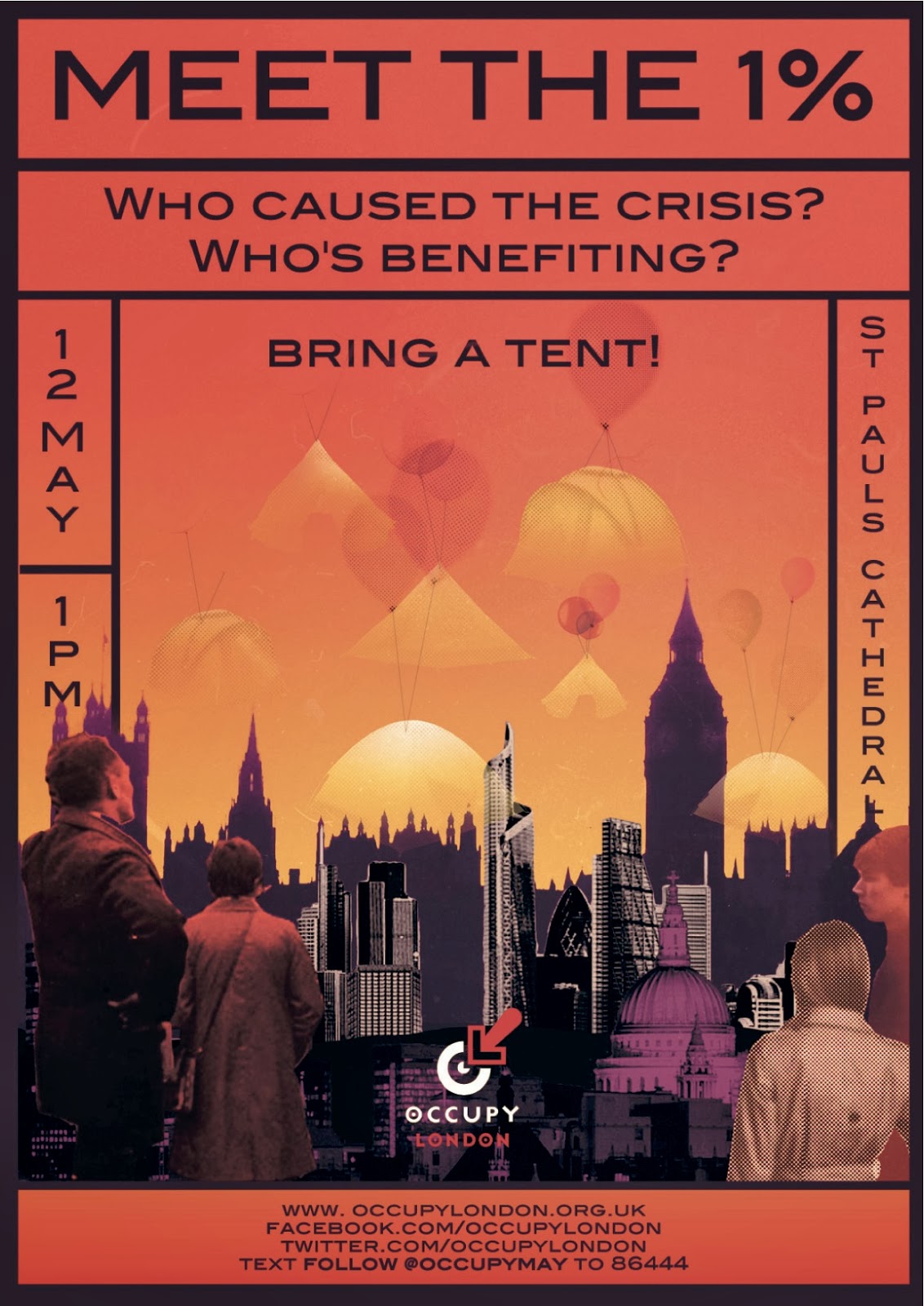

It was a one-off event that took place on the 12th May 2012, a day that was marked in 350 cities, spread over many countries, with similar Occupy style events commemorating the start of the Spanish Indignados Movement. It was advertised in London with colourful posters, such as those above, and publicised through the network left behind by Occupy London, even though the tents had been cleared away by the police some months earlier.


I learnt about it over a cup of tea at Richmix when someone who was there that day kindly took the time to explain a bit more about it to me. This is, therefore, a historical record of a tour, though one that belongs in the recent memory rather than a historical tour such as Daniel Defoe's A Tour Through the Whole Island of Great Britain (1724-26) which I am also currently reading, since he was also walking around Shoreditch and The City. 


This is the map that was produced for the event and which you can download HERE. It has been quite nicely produced and one aspect of it that I like is that it makes The City of London clearly visible, highlighting it in green. This should make a circumnavigation easier, which incidentally, is what Dafoe did in his tour, walking around the perimeter of built up London as it then stood, a city then creeping some distance outside of this boundary but not remotely like today's sprawling metropolis that spills out in all directions and has its contemporary circumnavigations, like Ian Sinclair's London Orbital, set upon the M25 ring road. This map highlights different addresses around The City but it does not prescribe a route that connects them. People coming on the 12th May were encouraged to print out a copy of this map and follow the Twitter feed that would, amongst other things, supply suggestions on where to go. The open-ended nature of the map is part of its design; the designers state, "Our map for Meet the 1% is an essential tool for finding your way around on Saturday, but we also see it as a resource to move beyond our own programme of events. We’re deliberately leaving plenty of opportunity for those who attend to determine their own course of action on a more autonomous basis. It doesn’t take much to make a statement. When “urban exploration” is classed as “extremist activity” — as the City of London police did last year — walking the streets you live in can itself become a political act."


The organisers did not know how many people to expect and thought it could be just a small gathering making a tour around The City but in the event some 500 + people turned up at St Pauls where the day began with speeches. These covered a range of topics as you can see in this video of the day, the first half of which was focussed around St Pauls before the tour headed off around other locations.


Many of the people on the tour were veterans of the camps and meetings that characterised the 4-month occupation of The City. It was, therefore, a bit of a get together for this network which had been scattered as a result of the evictions. I was told that the demise of the camps had come as a significant blow to many who had invested a great deal in Occupy, leaving homes, jobs and even partners to participate in it. With a Summer of flags looming, this was to be the last show of numbers of the protesters on London's streets. 


The tour did not have any clearly identifiable leaders. Different people had prepared self-contained actions at various points on the map such as describing the company's activities  over a megaphone or various other peaceful direct actions. The rationale here, I suppose, was that even if an organiser/activist were identified and arrested, the tour could still continue. The Anonymous mask was worn by some in line with this. This reminded me of The Critical Mass Tour which I recently covered, which also had a diffuse organisational structure to avoid individuals being singled out. It strikes me that there must have been an organising team all the same, as you cannot get 500+ people on the street without an effort, so they must have done a pretty good job at covering their tracks and working in cells. Unless of course they have been infiltrated by police spies, which is a distinct possibility, given the widespread practice of doing this against all manner of protest groups in the UK. In which case, the police did a good job at not blowing their spies' cover.


Naturally, the police were out to 'protect the peace' and whilst they were originally outnumbered, they came in increasing numbers as the day went on. They started to 'kettle' the marchers on Fetter Lane but relented after a while and let them continue. The marchers were aware of the likelihood of this and the route they followed avoided too many narrow streets as these spaces aid the police in forcibly containing the marchers. 


This is the reverse side of map which carries the key to the sites. The categories that are listed are: banks, hedge funds, financial services firms, stock exchanges, lobbyists, crisis profiteers and crisis profiteers - health. It was prepared with the assistance of Corporate Watch who are located over in Whitechapel. It struck me that while the Occupy Tour was somehow caught between being a political narrative tour and a political site-seeing tour, this Meet the 1% Tour was closer to being political sightseeing cum protest carnival. The narrative elements were less significant and the size of the crowd made the group an entity in itself, and one that seriously changed the nature of the space and consequently the face of the 1% they were intent upon meeting. Walking in such numbers, the police inevitably come out in response.


There was a lot of self-recording of the march and pictures posted online as well as some videos like this short one, set rather appropriately to London Calling by The Clash. When the tour came to Bank and The Royal Exchange a significant group stayed behind there while smaller splinter groups scattered around the city, visiting other points on the map. In this way it was very difficult for the police to contain everybody. The tour was therefore more of an invitation to make your own journey rather than to follow a prescribed path. Some took the initiative and started putting up Occupy sticker tape on buildings while others stayed behind at The Royal Exchange. It is here that the main clash with the police occurred following a contested issuance of 'section 14', a police order to disperse the crowd. This is caught on video here. Another instance of police surrounding the protesters/tourists and 'kettling' them took place and this dragged on for hours with snatch squads pulling people out but failing to charge them with any offence.  


As a memento of the day, I saw some of the tape used on May 12th now adorning my guest's laptop. It seems like this was a tour that was fondly remembered and seen as one event amongst many coming out of ongoing political activism based in London and connected to an international network that is as widely spread as the financial and political networks that its supporters oppose.

Saturday, 30 November 2013

The Critical Mass Tour

Always on the lookout for new tour experiences, I got on my bike and joined the Critical Mass Tour yesterday. It is easy to know when and where to find it: 7PM on the last Friday of the Month from under Waterloo Bridge. It has been like that for as long as I have known and I was on a Critical Mass ride quite some years ago, maybe as far back as 10 years ago. It was therefore an overdue and exciting proposition, as it offered a wildly different sort of tour to those so far covered on the blog.


I made my way to Waterloo Bridge and found quite a crowd already assembled. Many hundred cyclists gathered on all sorts of bikes, including quite a number on the so-called 'Boris Bikes': the rental bikes named after the populist conservative Mayor of London, administered by the city and sponsored by a bank that does not need promoting. It was surprising to see so many as I thought Critical Mass was for hardened cyclists only. Also, since this ride was of an indefinite duration, I thought it would be unattractive to those renting bikes by the hour. Happily, I was wrong. The protocol is you arrive anytime after 6PM to be ready to start cycling at 7PM. While cyclists gathered there was a lot of chat and some, mostly, restrained drinking: I saw a guy next to me swigging from a bottle of Captain Morgan but most contented themselves with a single beer.  


At 7PM there was a swelling of noise: horns, bells, cries and inarticulate bloke-ish guttural sounds. It was the sign; we were off! We slowly emptied the Southbank and cycled past The National Theatre on our way up to the main road. This site is for me a curious one that I can't help but read more into than was probably intended. Maybe that's simply because I was previously much more involved in these spaces through the arts than I was through tours and so I come to them with an eye that still sees them as stages. I did in fact make a short POPLAR TV video outside the National Theatre last year: National Theatre To Screen Sport.


We set off and headed North over Waterloo Bridge. This is Somerset House on the right. It was not so easy to take pictures and ride at the same time but I tried my best to juggle the two. Crossing the bridge took us into the heart of London and I had to ask myself if this  happens every Critical Mass time or whether the group sometimes heads off on a very different tact. 


We descended into a road tunnel that is usually reserved for motor vehicles. There was much excited yelling as the bikes accelerated down into the tunnel, deep into the car zone. The relationship with motor vehicles is particularly bad at the moment owing to a spate of fatal accidents in the last month. Earlier in the day there had been a mass "die in" outside Transport for London's offices in protest at their transport policy and inertia at implementing agreed to improvements to the cycling infrastructure. All of this was still very much in the air as we made our way through the city.


Once we got going and settled into a rhythm I started looking a bit more at how the ride functioned. One quality that makes it deliciously slippery is the fact that there is no designated leader or organiser. There is a webpage, which is no longer updated, and this, I can imagine, might be so that nobody may be held responsible for the Critical Mass. That said, I did notice that there were people at the front of the group who did have opinions and were were not afraid to express them. For example, we were at this point approaching Oxford Street and I heard three cyclists say between them that we should avoid that road as it would mean battling buses. They then disappeared at speed towards the front to try and have their sway and lo and behold we avoided Oxford Street. Another quality is that some people dressed up. This man is wearing an animal costume. The tricky thing with it must be the tail, I hope he managed to avoid getting his tail caught up in the spokes of his back wheel. 


Predictably enough the people who hate Critical Mass the most are the taxi drivers. This chap in particular was a nasty piece of work who drove into a stationary cyclist who was standing in front of him in order to try and clear her from the road. No excuse. Lizard brain.


This then sparked off a heated exchange with a passerby who seemed to have a lot of opinions and thought of himself as a peacemaker. To be honest I thought of him as a twit in a shiny grey suit who was covering the driver. Instinct was to take my lock and smash the drivers windscreen so he could have a taste of his own medicine but of course I was far too polite and just took pictures.


Not everyone was in such bad humour however. There was actually quite a varied response to the ride from the people in cars and those standing by the sides of the street. Some smiled and waved, others stared disapprovingly but everyone noticed: you could hardly not see 700 bikes stream past. The cyclist standing here is blocking the car from going into the mass of bikes and this was a common activity. At junctions bikes block the way so cars can't force their way into the pack and it was this job of enforcing the blockade which was the one that the more experienced 'Massers' took on more readily and which also put them potentially into conflict situations like that with the white taxi.


I saw a few people drinking beer as they cycled but most kept their hands on the handlebars or reaching to their phones to take pictures. There was however a bit of a Friday night atmosphere about the ride all the same and quite a number thought things through enough to take a supply with them. This was not just a demonstration or a ride, it was also a party.


That was underscored by the music. This bike was trailing a sound system and it was just one of 4 or 5 that were playing different sorts of music, everything from dance music to opera. The opera in particular was unexpected and not the typical soundtrack for a demonstration.


We headed West along Piccadilly and then down into another road tunnel. There was a bit of a thing with the tunnels, enjoying the forbidden fruit. 


And then after passing near Victoria we came to Buckingham Palace and the bikes gathered around this famous monument whose name I have never bothered to learn. Many of the riders sat back and opened up those cans of beer they'd been saving, others made circles around it, this man with two skateboarders in tow. There were quite a number of young skateboarders who mostly raced around the front of the pack. I remember last time I went on a Critical Mass it also stopped at this same spot and this gets me asking, what is the geographic palette it works with? I can't imagine a mass of bikes making its way to Crystal Palace in South London, that would be too far to get home for anyone living in the North and so my guess is there must be some unwritten rules. I did in fact cycle at the front to find out how the direction was chosen and I heard people shouting "LEFT!" from time to time so I guess it is mostly self-regulating. 


I left them to it as it looked to me as if the evening was settling into a bit of a party in front of the palace.  I was wrong on that front, that's for sure. The video below was posted on youtube which more or less shows what happened after I left: the night had quite a bit more cycling still to go.

https://www.youtube.com/watch?v=7skLQ4QyXaA


My current Tour of All Tours research is centred on Shoreditch and today's tour did not go there, the nearest it got was Tower Bridge, which you can see in the video. Critical Mass could visit Shoreditch however so there is no reason why I cannot mention it as a tour that sometimes passes that way, even if it is an infrequent and irregular occurrence. It will be back East I go tomorrow however as there are still quite a number of tours still to cover in the area.

Monday, 18 November 2013

An Alternative Jack The Ripper Tour: conspiracies and comedy

After taking a Jack the Ripper Tour last week and seeing just how many there were pounding the streets of the East End, I decided that I really had to take at least one more in order to be able to make some sort of comparison between them. That's how I ended up taking the Ripping Yarns Jack the Ripper Tour.


The starting point of the tour was Tower Hill tube station. This is a little more central than Whitechapel and properly on the tourist map of the city. I don't know whether we started here because if it is easier to get tourists to come here or because our guide was a Beefeater, who work and live in the Tower of London, pictured behind. In any case, I had heard that the less serious even sensationalistic tours are more likely to be found starting at Tower Hill and I was looking forward to something trashy. Once our guide started addressing us, however, I realised that this was not one of the B-list tours but was something altogether more respectable. Ever so slightly disappointed (no cheap laughs tonight!) I settled into the tour that I was actually being given and listened with interest as our guide Barney started warming up the group and introducing the tour and the story of Jack the Ripper. 


The tour took us through unfamiliar streets that were not obviously part of the Jack the Ripper story, but the locations were used to tell us about what East London was like in the 1880s and about the lives of the ripper's victims, all of whom were working as prostitutes. It flowed naturally enough and we finally joined the now familiar route stopping at the first site that the previous tour had also stopped at. We would shadow a similar route to theirs through much of the tour, making slight alterations, but essentially visiting the same locations. I had to ask whether this uniformity of route is due to the locations themselves and how the streets are laid out (one murder site is omitted as it is too far off route) or whether it is as much due to the way the narrative is told. I guess this is something that guides have spent considerable time thinking through and you would probably need to depart from the chronological telling of the murders in order to make a significantly different route.


Our guide was a gifted storyteller and natural joker who had been giving this tour for some four years so he knew his script inside out. Maybe because of that, and in order to keep it fresh, he also allowed himself to talk about funny things that he had seen and heard recently whilst being a guide. He knew the details of Ripper story well so we remained on that thread but he found ways to personalise it and see the funny side of it at every turn. He spoke quickly and with a choice turn of phrase and I wondered if foreigners whose English was not good would be able to follow him. He did explain some phrases from time and his energy was itself infectious, so I suspect it would all work out fine for most visitors. 


Once again there were the A4 laminated pictures distributed around our group showing the victims, locations and so on. He used fewer than the previous tour, however, and carried the story more through his patter, which was more than able to paint the scene. The pictures that we did see were generally less clearly printed and certainly a good deal less gory than the tour of the other night. He made far less of a point of trying to shock us with gruesome images and viewing them was very much an optional thing for the curious.


I heard that there had been an American woman who had taken one of the competing tours and had written an article complaining about them. I had a look for this online but was unable to find it as there is such a deluge of information and reviews about the various tours on offer. I also had to reflect that there will be some people who will inevitably find such a tour in bad taste, but I have the impression that they will probably be a minority. The group I was amongst seemed like a petty normal bunch of people and not a blood thirsty mob of sickos, much indeed like the previous tour group who were on the other Jack the Ripper tour I took. What is probably a more interesting question to ask is, how is it that this story has become popular and acceptable to be interested in. 


Whilst each tour is working with the same basic story and historical records, which will be more or less familiar to the guide, the tour will have a distinct focus and point of view that sets it apart from the others. So where my previous tour was historical in tone, even historical to the point of being about 'Ripper Studies' this tour focused upon the identity of the killer. In this sense it took the police force's point of view which made perfect sense given our guide was an ex-serviceman. The way this take on the story was delivered was very present and convivial and this brought it out of the detective story frame as there was no urgency or suspense to it and took us much more into the tourist frame of reference.


Just as on the other evening, the small Spanish group were out and once and again they managed to arrive first at this vantage point. Whilst the attitude between the guides and different groups seemed more or less harmonious, when a small group took the best spot while a large groups had to settle for a second best location, it did't sit so well with the crowd. It is all public space, however, and nobody has more or less right to it so the best thing was to do as our guide did and just get on with it from the other side of the road.


Much was made of the this message that was purportedly left by Jack the Ripper. He suggested it can be interpreted as relating to the freemasons.


When we came to Mitre Square we saw not one but two other Jack the Ripper groups. The group behind ours was on the murder site of 'Ripper Corner' while the second group had to content themselves with the building site and we parked ourselves by the offices. This gave me the idea that it would be rather amusing to sit in Mitre Square one evening and watch the various groups come and go. I might just do that and count them.


We were near the end of our tour which was to take a total of two hours and twenty minutes. I was fine with this duration but I did hear some people in our groups talking to one another about getting cold and tired by this point. The extra leg of the journey that comes from starting at Tower Hill certainly adds to the duration and makes this longer than the average Ripper tour. I imagine if the weather was poor that would compound this. Fortunately it was merely dry and cool which I'll happily settle for.


The prime suspect was revealed at the end of our tour and a plot involving the royal family imagined. This was the point where the tour went beyond the realm of the historical and into conjecture, which we were perfectly happy to accept as the Ripper story, being so far away in time and encountered via Hollywood, belongs more or less to the realm of fiction, even if it is based around real events.


The tour concluded with collecting £8 from each of the twenty people who were on the tour. This was done on the basis that there was no need to pay if you were not satisfied. Everyone paid and we made our way back to Tower Hill and into the night.