Showing posts with label Tower. Show all posts

Wednesday, 18 December 2013

The Machiavelli Tour

The The Machiavelli Interpreted Tour is one that I found out about via the Walking Artist Network, which is worth signing up to if this sort of thing floats your boat. It was held on the 500th anniversary of Machiavelli's seminal text The Prince being first mentioned in a famous letter the author wrote to Franceso Vettori. I also note that the tour is also on the Artangel 100 list along with The Tour of All Tours!


We gathered beside The Tower of London in a cafe and signed in with the organiser. I found, to my surprise, that I knew some of the  fifteen odd people who were on the tour and, interestingly, knew them from quite different contexts. Some were more from performance, others were in academia and there was one woman I could swear I had spoken to before but who I couldn't for the life of me place. Encouraged, I guessed this meant I was in the right place and in good company. It also echoed an idea I had recently when writing about the Queen Mary University East End Tour, namely, that walks and tours are almost inherently interdisciplinary bringing together somewhat disparate ideas and histories in the same way the city functions to bring together and connect people in a defined geographic space. 


We stepped out onto the terrace and, with The Tower of London as a backdrop, were given a short introduction to the event by its curator Mary Ann Hushlak. There were few formalities with health and safety which gave the sense this was not a tourism industry product but rather a walk that had grown out of an engagement with political and ethical thinking, and an interest in walking considered as an art event.


We were asked to find partners to walk and talk with, and we were reassured we would rotate as the walk progressed. This walking in pairs is something of a format that I was amused to see is also common with children in school groups. I was at The British Library yesterday and saw a group of 8 year-olds in yellow reflective tops enter in pairs, wait in line while their teacher found their guide, before they descended noisily into the basement. We were more or less the same as them save the reflective waistcoats, the high pitched chatter and the fact that ours was a walking reading group. I had already heard about a Walking Reading Group, a new format for me, operating in East London and had been meaning to attend one of their walks, but now I found my way onto another one. The idea is, when walking, you talk in a different way to how you do sat in a cafe or seminar room. What's more, because we switched partners every ten to fifteen minutes it meant there was not the problem of getting stuck with someone tiresome or running out of things to say. It also meant, however, that some conversations had to be dropped mid-sentence as a reading from The Prince began and we had to fall silent. My first partner was a Greek theatre director and translator of medical and literary works. This was not a typical cross-section of the British public. 


We stopped after a short walk in a garden and former execution site, right next to where the Ripping Yarns Jack the Ripper Tour begins. We then listened to artist Bram Arnold, who was waiting for us, give a short reading from The Prince. He was dressed smartly, in some way assuming the role of a contemporary Machiavelli or, at the very least, dressing and speaking in a way that was supportive rather than disruptive to the text. With a bite-sized snippet of renaissance political philosophy to chew over, we resumed our march north into The City.


The drizzle began to fall as we passed through Leadenhall Market so this was the last place I felt able to use my better camera as it was dry under the market hall's cover. It was back to pocket snaps for the rest of this route until the very end of the walk when it dried up enough. Leadenhall Market is another Harry Potter film location and so features on the Potter tours. It was also one of the places the London Olympic Marathon got rerouted to when the Whitechapel / Mile End route to a stadium finish got dropped. The tourist imagination flows so much more fluidly here. 


We made up way up Bishopsgate and past the stalled construction site of The Pinnacle or, as I know it, The Pimple. I call it The Pimple for two reasons. One, it is currently no more than a static concrete stub rising out of a construction site, a stub awaiting a court ruling and planning permission before it can soar up to compete with The Shard or be torn down and redeveloped in some other way. Two, even if it does get the go ahead it will be about as attractive as an oversized zit. Have you seen the design? No wonder it's having difficulty getting off the ground.


The choice of doing the tour on a Sunday around noon was a good one. The City has a uncanny quality at this time; it is practically a zombie film waiting to happen. These deserted streets revealed a very different character to that of their weekday buzz: the historical layers were far clearer. Some of the stretches between the reading locations were as long as fifteen minutes, which is far more than you'd find on a guided tour. These spaces were filled with conversations which were made all the easier by the lack of modern traffic jammed into medieval streets and medieval people jammed into modern suits screaming into mobiles and fighting their way through a corporate rat race.


We stopped in front of Guildhall and were told about its history, as indeed were two other groups also parked on this multi-tour site. There was a trio to the left who were getting a Spanish tour and a larger group in the distance getting what looked like a heritage site tour. The woman in black caught in the middle was, like me, taking photographs and so was floating around and joining the group from different vantage points. The other place where there were tours others than ours was around Westminster. I noticed that there you can take tours of parliament, but they are not so cheap. In fact, come to think of it, I did request a tour of Big Ben from my MP (you have a right to a free tour but must book it via them). I emailed my request but nobody ever got back to me... and they want a raise.


We made a stop at Bart's and had a brief historical reference to The Huguenots and how they related to this location followed by another reading from The Prince. The tour was in a sense a two hander with the curator introducing some of the locations and Bram then giving a reading. They were co-ordinated as a pair and in no way like the Tour with Two Guides that I reviewed earlier this year. Here you can get a good view of the group and, as you can see, people were sensibly dressed and as you might be able to imagine, in some sense an 'in-crowd'. This made for some harmony when we were talking to one another as there were plenty of shared interests and possibilities to take the conversation in engaging directions. I had to ask myself however, "What if this walking reading group had been drawn from a very different pool of people? Would it have worked if it had been business people or politicians and lobbyists paying £100 a head to participate?" I suspect they might well have been interested in conversing with one another using The Prince as their starting point. That said, from what I gather, you are more likely to see people from Meryl Lynch and KPMG together on the 5km City Race or last week's Santa Run than on tours like this.


We passed the plaque that marked the place of William Wallace's execution (yes he of Braveheart), next to Smithfield Market. We passed it in conversation and did not stop to investigate. It was the Scottish flags that caught my attention and I took this snap. I now realise he took a similar tour to ours on his day of execution: he was taken from The Tower of London and brought here. His journey was considerably less comfortable, however; he was dragged naked through the streets behind a horse. This did make me briefly imagine an execution themed guided tour which would consist of gruesome stories and graphic descriptions of people similarly transported before being disemboweled and their genitals cut from them and burnt in front of their eyes. The list of tortures employed is long, so a full-length tour could surely be sustained. The route would pass through many spots we ourselves passed through and the collaging of financial services and Pret a Manger with cruel, degrading, barbaric tortures and executions might make for an interesting tour.


We stopped at a damp and mirror like Paternoster Square, the original target of Occupy. The reading concluded here with some observations on the character of men and how they prefer the well trodden path to the revolutionary one. This canny thinking on the reliability of ones supporters must have been relevant to all sides during the tent occupation of St Paul's Churchyard and Finsbury Square in 2001/12. These connections between the various passages from The Prince and sites we stopped at were allowed to exist but were not underscored at all. Incidentally, although Occupy have long since been evicted, they are still running tours and I will be taking the Occupy Tour of The City in January and also finding out about the 1% tour that took place last year too. Reviews to follow.


About half way into the tour the rain picked up from a light drizzle to a proper shower. Umbrellas up and carry on regardless was the only option. Here we found ourselves in a quiet corner of Central London that was pretty much typical of the places we were led to. The route was chosen with considerable care to weave us through the city using minor roads and passages which had the effect on depositing us at familiar locations in often surprising ways. Bram, our reader, did not accompany us and so made his own way between the designated reading sites. This 'now you see me now you don't' approach was probably not so tricky to achieve as we, as a group, were usually very indirect and thus slower than him. This spot here was the exception where we waited a moment for him to come down the steps behind us. I have had the experience of seeing a person on a route who magically seemed to reappear further along and must have needed to race 'backstage' to make such a reappearance. No such tricks were needed here. Not even a bike. I did question how necessary this reticence was as it did not bring so much more to the reading except perhaps to absent Bram from the ensuing conversations


A general trend in the readings was to say it is better for a ruler to start his reign violently, get the evil out the way early and then rule justly over subjects who will then be too afraid to rebel. This was held out as being a superior ethical position as doing the opposite would only in practice result in more bloodshed in the long run. The unpalatability of this stance and impossibility of selling it to a populace are clear, however. Many chins were scratched over the course of the afternoon.


I found that over the two and half hours of the walk I developed strategies for how to deal with the new walking partners I was thrown in with. I started rather naively with the sociable, "Hello, who are you? How did you find out about this? Oh you know such and such, is that through XYZ? Oh and have you read The Prince?" line of approach. This was fine at first but as we progressed I grew tired of it as it had echoes of speed dating and I found myself repeating questions and answers from previous conversations. I therefore switched tact and got onto Machiavelli more directly. The conversations were none the poorer for this. Later in the pub, one line of discussion was around why dating had switched so much to online sites. One thought was that there are fewer contexts for unforced encounters between strangers than previously and there was no consensus in society as to what sort of flirting was acceptable and what was not, leading to caution in the public sphere. Walks, one woman smartly observed, were a rather good way for people to meet someone, particularly for the over 30s who might be somewhat beyond boozed up nightclubs and the sorts of encounters that you can expect to have in them. Machiavellian dating strategies? No, a rather simple and direct approach but one that does make it clear that many intentions and ideas are in circulation in these walking talking groups and political philosophy may simply be a pretext.


We came to a halt in front of the Foreign and Commonwealth Office and here there was some idea that this might be where Machiavelli, if he were alive today in the UK, might be employed. Seeing as he was a professional diplomat this is not impossible. Other ideas were that he he might be a Jonathan Powell like figure, Downing Street's Chief of Staff and advisor to the last government. I'm not so sure that this is exactly how to imagine him, however, as he was a playwright and man of letters as much as he was a diplomat. The Prince is not only an early work of political science, it is also written with much flair and rhetorical flourish. He seems to delight in exposing hypocrisy and cutting to the chase with the justification that his harsh ethical code is a superior basis upon which to act as a leader. What's more, the book was written to win favour with the Medici's and reinstate him from exile so the intention of the text as a whole is anything but transparent. Today I cannot see the political and literary worlds in the UK as having room for such a dual figure, the best we seem to manage is Jeffrey Archer or should I say Lord Archer who, despite resignations over scandals and imprisonment, is still pumping out pageturners destined to fill the shelves of charity shops the length and breadth of the kingdom. 


We passed parliament square where there were many flowers fanned out around Nelson Mandela's statue as this was the day of his burial. Round the corner a bevy of Ukrainians with banners were lined up protesting at their government. It is something of a circus though one all the poorer for the absence of the late Brian Haw who was 10 years resident here until his recent death. I would have liked to have gone on his tour if he ever gave one.


The walking over, we retired to The Red Lion, perhaps the most famous political pub in Westminster and to underscore this point one of us saw Frank Fields MP exiting as we descended into the cellar. For a place so supposedly bound up with centuries of power politics it was a surprisingly unremarkable place to the eye. Berlin has Cafe Einstein, for example, and while it is not crazily ostentatious it is a high-class establishment suitable for the political and intellectual elite to meet and mingle. The Red Lion however, looks much like any other unfashionable local boozer that fills up at the weekend. From this I am not sure what to conclude: whether it indicates a lack of taste, a desire to retain a down to earth place to relax in or what. I'll pay the place a visit again on a weekday and see if it tells more.


Over a pint of beer and a mince pie I talked about the tour with some of the others around a table. The curator then joined us and asked if we'd like to know more about the route. You bet we did! We were then given what amounted to a key to unlocking the rationale behind the places we passed through and their connection to the text. There were explanations for practically every road and passage, for building after building that we passed oblivious to, consumed in conversations on politics, ethics, the city, language, the renaissance or else flirting, buttering up professional contacts and 101 more things besides. From this I had the impression that the basic premise of the walk was a psychogeographical one: the city is full of power architecture that exerts an influence upon the individual as they pass through it. Even if this impact was unconscious, we were being exposed to it and it was informing our conversations around The Prince. While that may be true I also felt that I would have liked to have been able to take this onboard more deliberately whilst doing the tour rather than receiving it as a postscript, even if that meant disrupting the free flow of the conversations. With so many symbols and forms of architecture to view and so many alternative ways to understand the spaces we passed through, some tuning of the city to Machiavelli might have made the walking element more meaningful for me. On the other hand, I must admit that this space of meaning was instead colonised by the conversations and I was fortunate enough to have an interesting succession of walking partners. Either way, it seems, Machiavelli does still have relevance today and this event gave us an intriguing format to consider his ideas.    

Monday, 16 December 2013

The Imposter's Tour

This is a rather unusual tour, even by the standards of this blog. It is a tour of Broadgate Tower which in itself is nothing particularly special other than that there are no public tours of the tower offered right now. What qualifies it as unique is that I had to assume a completely different identity to my own in order to take this tour. 


I arranged a tour of office spaces in order to get a better picture of a private corporate tour, since most of the tours so far covered here have been public one way or another. As the gentrifying march of the City of London, north into Shoreditch, and east into Spitalfields, is one of the key themes to have emerged as a subtext to the many tours I've taken locally, I felt it necessary to get at this story from the inside, as it were, rather than only hearing it from the perspective of the soon to be displaced. I was told I'd find the entrance opposite the giant reindeer, and so it was while in the background is the mouth of Liverpool Street Station, a short walk away.


I arranged an appointment with a company that specialises in renting office space in Broadgate Tower to smaller businesses. I made up a cover story that was inspired by a scene from the James Bond film Skyfall, that was filmed in the building, a scene in which the tower was made over to look like a swanky office block in Shanghai. My cover story was that I was representing a Chinese film producer, a Mr Gao, whose movie was going to be filmed in London next December. This film, Snow Warrior, would require an office for its team to do pre-production work starting in October and they would require more space still, once the full production team arrived for the shoot. Many of the shots were to take place in Hackney and Tower Hamlets, hence the logic of siting their production office here in Broadgate Tower rather than in Soho next to Chinatown, which would seem a more natural choice. With my story prepared I turned up at reception in the company of a friend Elo, who was cast as the photographer. To dress the part I had to wear a suit and tie. The suit was no problem but I was surprised to find that the only tie I had to hand was a bit of a joke tie I acquired recently, a tie decorated with the flags of the European member states. In order to justify the Eurocrat tie, I came up with the story of having to go to a meeting at Europe House immediately after this tour.    
  

The reception desk downstairs asked our business, took our names and issued entry passes. We ascended an escalator into the future then used the passes to open a polished steel security gate and gain access to the lifts. These lifts were unlike any I have previously used for when I saw one open I jumped inside and looked for the button to stop at the twelfth floor in vain. A woman already standing inside politely evicted me, pointing back outside where I found a glass panel in the wall which, when pressed, asked me to select a floor. Pressing twelve, it paused a moment, then indicated I should go to lift C which opened, we stepped inside and were whisked skyward.


After a false start at the wrong reception we found the right one, were greeted with a smile and asked to sit. Refreshments were offered and our contact was called. After a short pause she came around the corner and introduced herself. She took us to an office where we sat and began the tour. This started with questions about what I was looking for and I launched into the Mr Gao story. It seemed to go pretty well and I was relieved I had prepared my story sufficiently in advance so that I could just roll it out with a smile.


The tour of the offices then began. We were shown into some empty offices and also into working offices like this one. There was an absence of clutter, as much of the equipment like photocopiers, binders and water coolers, is shared and located outside. 


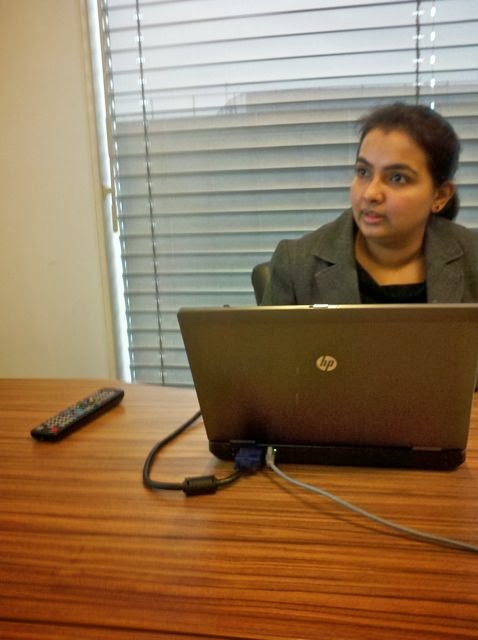
One after another, I entered the spaces and talked about Mr Gao's requirements. It became easier to maintain this story once it had got a bit of momentum up; it was almost as if I were starting to believe it myself. Given the context, I had to think of The Yes Men and their infiltration of the corporate sector to make activist art. While I am well accustomed to switching between different fronts in daily life, this level of pretence is something else and required some acting skills, quick thinking and complete investment in the mask coupled with a relaxation into the role, inhabiting it as myself and bringing personal qualities like humour and inquisitiveness to it. While it is completely unforgivable and I in no way condone it, I do start to see how it was possible for British police infiltrators to settle into their roles of  environmental activists to the point that they formed sexual relationships with the people they were spying on and even fathered children with them. It was Plato who said "the mask which the actor wears is apt to become his face.There is something mildly intoxicating about maintaining a front and the thrill this can provide could, I imagine, blind one to the ethical dimensions of it.


This is the view out a window facing North and East out over Hackney. Running across the centre of the picture is the Overground line with Shoreditch High Street Station the concrete lump in the middle. My tour of tours next year will be covering part of this territory and surveyed from up here it mostly looks like low-level run-down buildings, railway yards and waste grounds begging for redevelopment. The City might imagine itself doing the area a favour by recasting Shoreditch in is own image; where there was once deprivation let there now be tall, shiny offices with a Pret a Manger on the ground floor! A curious marketing hook that was cast my way by my guide was that this was a creative space somehow distinct from the number crunchers down the road in the heart of The City. The basic idea is that the frisson of Shoreditch rubbing against 
The City produces a different sort of business environment. Evidence used in support of this was that there were recruiters renting offices here. They qualified as creative in this world.


This is the view opposite and to the south. It didn't strike me at the time but it does now that if you had a good vantage point and a very powerful lens you could probably read what was on the desks of these people. Reason enough to draw the blinds. 


This is one of the meeting rooms I was shown around. I seem to remember this room was called Battersea, another was named Camden. They all bore the names of respectable London neighbourhoods giving the offices a connection to the wider city they were located in. There were no Leytonstones or Newhams however, this was a city of desirable neighbourhoods only. These rooms came with video conferencing facilities and tea and coffee were provided as part of the package too. They were really quite desirable for what they were. I learned that some of them were leased not only by the hour for meeting but more long-term. There was an independent business school that used two of the larger ones as classrooms into which were packed, predictably enough, a largely Chinese student body learning the finer points of global investment.


We returned to the office and talked over the terms and prices. Unfortunately the computer presentation didn't want to open so I missed out on that but I received it in a file to go over at my leisure. It is not at all what I require but I can imagine the package would be of interest to businesses looking for a foothold in The City. I was struck by the fact that Broadgate Tower advertised itself as a filming location and made it easy for people to film inside of it. Skyfall was not an isolated event but part of consistent stream of media productions that use the building to portray such things as intrigue, Shanghai, chic dining, insider trading and 
the future.


And here is Elo who got roped into the story as the photographer. This was a good role for her to play as it was close enough to her real life presence that it could be played quite naturally. What's more, it meant that I had my hands free and could concentrate on playing my role with the documentation being both taken care of and explained as part of our story: Mr Gao would want to see pictures of the space. Thank you Elo.


Our tour of Broadgate Tower concluded with us returning our security passes. Here I had to take this picture myself with my phone as taking a picture of the security infrastructure with a camera would draw attention to us for sure. The phone however is a godsend as I could appear to be looking at messages, perhaps finding the address of my next meeting... at Europe House in Westminster.

Thursday, 5 December 2013

The Sound Map Tour: an immersive audio tour of Brick Lane

The Sound Map Tour is an audio tour of Brick Lane and the surrounding streets. Like the Walk The Line Tour, it is also one that can be downloaded for free from the Internet, this time from the Sound Map Website. They have produced four London sound walks and these have been made on a commercial basis. Probably due to this Brick Lane walk being slightly out of date, you no longer have to pay for it. 


The tour starts opposite the Beigel Shop at the top of Brick Lane and is introduced and led by author Tarquin Hall, who stakes his local credentials by saying he once lived in a flat looking over the Beigel Bake. The tour begins with some words of warning, which basically amount to keep your eyes open and if anything goes wrong, take off the headphones and pause the recording.


Unlike the Walk The Line tour, this tour has been properly researched, a polished script written, it has been well recorded and a specially commissioned sound track added. There are even three interviews, such as one with the proprietor of the beigel shop. I couldn't say if the grey haired man standing behind the counter was or was not the man I was listening to, but the recording said he was with a man in his 70s so it is quite possible that I was hearing him speaking while simultaneously watching him at work. This uncertainty, not knowing if it was or was not him, added a pleasant ambiguity.  


The tour made its way down Brick Lane and I could not but notice Broadgate Tower in the background, itself the site of a number of tours that I've been researching, and which I will try to cover. Perhaps the most tangential of them is it being a stopping point on a Skyfalll film location tour. This most recent of Bond films had to work to a tighter budget than anticipated and the tower had to stand in for a Shanghai office block, as it was too expensive to film in China. You can see the building featuring heavily in the out takes video starting at 18 seconds. There are a number of different tours that will take you there as part of a Bond themed tour.


I was perfectly comfortable taking the tour without a map, even though there was one provided as a safety net. It was possible because the narrator had a system for getting people to the right place, holding them there while he was talking and then setting them off in the right direction to the next stop. It basically involved him saying walk to the next junction and stop at the corner. Some music would play or he'd continue his story and he'd check in to make sure you were on course. Once that story was complete, you'd go the next track and you'd get your instructions on where to walk next. The sound was, therefore, pretty much constant and this made the tour far more immersive than the other audio tours I have taken, where you are switching between recordings and map. This was much more like being inside a movie, in no small part also due to the sound design which added music and footsteps to the recording. There was just enough time to make it from one point to the next, though it might be a struggle to do this on a market day as you'd have to fight your way through the crowds. The one thing I had to keep fiddling with was the volume; sometimes there would be traffic backed up and I needed it loud to cut through the car engines, other times the street fell quiet and the soundtrack felt abrasive.


The tour took me to The Vibe Bar and the narrator talked about the changing occupants and usage of Truman's Brewery. The general idea was that change was a feature of the area and nothing new in itself. Every now and again, when something bad happened, the narrator would introduce it with, "Sadly, ...." which became a bit of a running theme not only about changes for the worse but also unfortunate historical events such as a racist nail bomb attack. 


I arrived at one of the more fashionable shopping and eating areas and sailed straight through.  


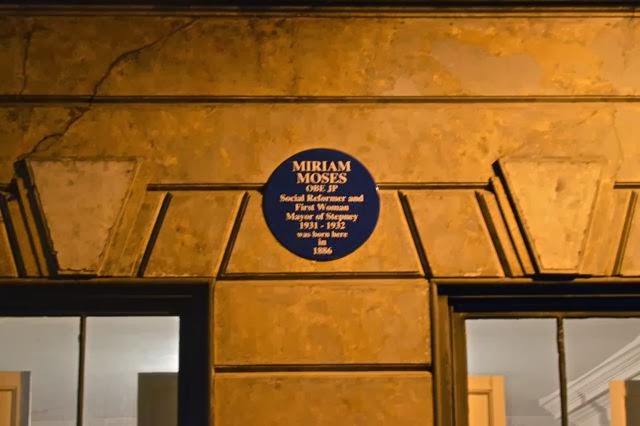
Continuing on the blue plaque theme from previous tours, I spotted a further two on this tour. One is that of Anna Maria Garthwaite, who got a bona fide English Heritage plaque, and the other is Gizmo (a dog) who gets his own more homemade plaque outside the Golden Heart. I noticed that there is a website that attempts to record all the plaques and monuments in London. This would be the perfect resource for constructing a plaque tour. Standing outside the pub, the narrator  told me about the celebrity regulars, interviewed the landlady and encouraged me to pop in for a pint. I was however in a bit of a hurry so didn't take up the offer.


I passed the Ten Bells and got a short history of the pub's connection to Jack the Ripper and heard  how the pub was for over 10 years named The Jack The Ripper as you can see on the right. Not a pub popular with the ladies, I suspect, back then. He talked about how the Ripper tours have been a local attraction and source of revenue for some years.


The tour took me into Taj Stores, a sizeable Bangladeshi supermarket, where the story of the Bangladeshi community began. Listening to an audio-tour out in the street is one thing but inside a store it becomes more curious as you are being told information about the people whose space you are standing in and who are right in front of you. What's more, they don't know that you are listening to someone telling you about them; you could be listening to Lady Gaga for all they know. This information gap can made me feel ever so slightly self-conscious, as if I were spying on them. 


The immigration theme continued down the road with the traces of the Jewish immigrants being highlighted. The remaining traces were relatively few in number. To compensate for that, klezmer music played while the history of Jews in the area was recounted. This music returned at least once again later in the tour and became a theme to announce "jewish section of the narrative" in the same way that there was an Indian sounding theme that returned when you were in the general bounce-down-Brick-Lane-moments of the tour. In this respect the music was there to always support the narrative, both thematically and rhythmically. This was an carefully composed audio tour and not a work of audio art that made you ask questions about the status of the different elements.


Somewhat inevitably, the tour again took in the mosque. The story was again that of tolerance and change in the area. I heard, once again, how the building had been transformed from a Christian to a Jewish to a Muslim place of worship. Having heard this a few too many times due to the professional distortion of being a reviewer of local tours, I was more interested in the Renault.


While the narrator talks and you make your way from one point to another, you do of course see things which are not directly part of the script. In fact the majority of the things I saw were not mentioned as he was busy telling a story not listing the objects I could see when walking down the road. Come to think of it, that might make for a rather unusual sort of tour: no story just a recitation of what is there... or was to be seen, when the recording was made. This is much in the mode of George Perec's Species of Spaces where, for example, he suggests, "force yourself to see more flatly" (page 51). I'm not quite sure how I'd describe these artery thickening sweets, but I certainly saw many trays of them as I made my way down Brick Lane. 


Cafe Naz was another point of interest. I stopped and listened to an interview with the owner about his thriving restaurant whilst looking at the building site which is what remains of Cafe Naz. With a walking tour this dislocation does not happen as the guide can change his story to suit reality but with an audio tour, whose narrative is fixed in time, this must be quite common. The narrator talked about the process of change and so this was, to an extent not as jarring as it might otherwise be. It does strike me, however, that this must be a major drawback for most audio tours: their limited life span.  


I then came to the end of Brick Lane and heard about the main local bank that is used to transfer money back to Bangladesh, particularly to the Syhlet region, where the majority of the Bangladeshis who have settled in the area were said to have first come from. I also heard how this has created not just a pocket of Syhlet in London but also a reciprocal pocket of London in Syhlet as people have taken back things they have learned to like here, such as marmite. 


The tour concluded on Whitechapel High Street, close to Aldgate East tube. My overall impression was rather positive: it was intelligent and skilfully put together. This form of immersive audio tour has the effect of taking you properly into the tour, but this in turn can have the effect of removing you somewhat from the place. It was not so long a tour, about an hour in length, so it did not feel like an imposition but rather it gave a condensed impression of the Brick Lane and its life, both past and present. The contrast between this and The Walk The Line Tour is great and goes to show what can be done with a bit of effort. 

Friday, 29 November 2013

The Spitalfields' Stories Tour: a tour designed to make you healthy

Today's tour was a self-guided tour in the sense that my guide was not a living breathing tour guide but instead 4 sheets of A4 that I printed at home from a free download I found on the Internet. I have written about this idea of the self-guided tour on an earlier blog so I won't repeat what I wrote there, but, this tour has given me the opportunity to expand upon those ideas somewhat. Suffice to say, when making my way around Spitalfields on this tour, I tried to follow the map and usually succeeded.


A Walk Through Spitalfields Stories has been designed to be read as an A5 booklet but working out the paging and folding it accurately on Commercial Street is a little optimistic. Best do that before you set out. As you'll see, mine is messy and distressed from being stuffed into my back pocket. 


I set out in search for Number 1, the starting point of this circular walk. Without too much effort I found it: SOUP KITCHEN. 


It was possible to stand more or less on the same spot as the photographer who took the picture in the booklet did, and to then recreate it. The difference here is the picture has been cropped at both top and bottom. The accompanying text from 1892 gives a snippet of information that can then be placed alongside the building today.


En route to number 2, I rounded the corner and came to the spot that the Spanish Jack the Ripper tours always seemed to be occupying. It was a little earlier in the day so it was empty this time and I had a good look at what was purportedly London's most lawless street 125 years ago. Nowadays it is a car park protected by dogs.


My circular tour took me next to this lamppost where a Charles Dickens quotation was my framing text, a quote about people leaning on lampposts that suggests though neither confirms nor denies that this was the precise lamppost Dickens had in mind. I have never had much time for Dickens personally even though I know he is much feted in the UK. It may in fact be because he is so celebrated and contemporary adaptations of his novels invariably grace abject poverty with nostalgia that I have such a hard time with his work. In any case, this passageway, I was told on a Ripper tour, was used for a scene in one of the Harry Potter films and this has put it firmly on the contemporary tourist map. There are indeed dedicated film location tours; I ought to cover one sometime soon. What's more, the film industry is seen as a way in which a city may be marketed. The recent Day of the Doctor being an example of this, the Olympic marathon another. However, I find that the media generated images of the city do not correspond to the actual experience of living or working in it as they tend to favour the tourist sites. When walking though these streets then, the visitor is simultaneously walking through a mental film set and comparing the streets to scenes from film and TV. This does not happen in the same way in an undistinguished small city that does not feature in the media. In Leighton Buzzard you really are, I'm guessing, in Leighton Buzzard. 


The game then with this tour was essentially twofold. First it was locating the image on the paper in the actual street you are walking down, such as the door to the synagogue here. Second, it was reading the place through the frame of the historical quotation beside it. That at least was the ostensive game. Add to this the task of following the map which sometimes had stretches without designated stopping points. It is quite a simple proposition and it is one that leaves you with enough space to bring your own thoughts to bear. There is not so much room for ambiguity and getting involved in situations, it functions as a reliable guide rather than an unreliable guide such as Alley's Travels in China would do today.    


And so to another familiar spot, the starting point of The Alternative Tour. Something that I did not mention when writing about that tour but which has struck me many times since is how it was a tour of street art which ignored a certain type of street art completely. It was very much focussed upon the art in public space that has grown out of the graffiti tradition and made no mention at all of public art, like this sculpture or corporate art that litters the squares and lobbies of offices all over the City of London. I would be interested in how these different forms of art and their economies could be compared to one another within a single tour. 


Number 8 was a historical photograph not one from today and so it was impossible to tell for sure which building Dan Cruickshank, yes he of The Bridges of London Tour was referring to. I therefore had to take my bearings from the map. 


And this is the 'charnel house' as far as I could tell: COSTA. Little do they realise in the bottom floor on the left, just behind Santa Claus, that they are sipping Lattes where human remains were once collected. This COSTA must also be the one where my anti-capitalist guide on The Alternative Tour got his coffee from. Suddenly this tour I was on was starting to become a vortex sucking in all the previous tours I had taken. The quietness of this tour allowed the references from all the previous tours to find their way in and invade the rather minimal narrative that it was constructing.  


A feature of this part of London is roads and passageways that bear no name. This I guess is the result of it being a very old part of the city that has been redeveloped in a very modern way. Whilst I was never remotely lost it was not always clear where I was on the map. I would have to look at an historic map to see if this passage had an old name which was simply no longer indicated or whether this was a new space. Somehow I find it hard to image new public space being created but I remain uncertain what the exact status of this space between the two buildings is. 


I came to 18 Folgate Street which is described as a time capsule.


There is nothing very much to see and so I dutifully took a picture and continued on my path. It was only later when looking up the weblink to Denis Severs House that I see that behind this door there really is something to see. What's more, if you look on their website they propose a tour. And so a new door opens in my research of tours in and around Shoreditch and Spitalfields. 


Next came Spitalfields market. I remember the place from the mid-1990s as a shabby artistic haunt; nowadays the The City of London has eaten it up and this is what you see on the outside.


On the inside there are still market stalls and food available but these days it is chains like Gourmet Burger and the stalls sell middle class kids rather than vegan slops and second hand tape recorders. What is odd however is that it still trades on the idea of creativity even though the artists are long gone. I guess that is the genius of creative industries.


This is the map that I was following; the route looks a little like a dog with a long tail that stretches East as far as Brick Lane. It is indeed a 'circular' route however there is a gap between number 16 Christ Church and number 1 the Soup Kitchen. This then makes me wonder if it might not be interesting to make a fully circular tour that not only returns to the starting point but which also revisits the entire route a second time using a different framing text.


Something I learned recently was that many of these blue plaques are not official in the sense that they have not been approved by English Heritage the body that has historically granted sites this status. This is just such an unofficial plaque. This one does not even indicate upon whose authority it has been put in place.


By the time I made it around to 19 Princelet Street it was really rather dark and I got to see how my new camera really did a better job than my old little pocket camera. Expect better night shots from now on.


I had tried on the Alternative Tour to take a picture of this metal sculpture that sits on the top of a post beside Christ Church. It had simply been a blur and so here is it is. The way these different tours were interweaving was, I realised, a consequence of them taking place within a concentrated geographical space. When I made the Stuttgart Tour of Tours I was taking the entire city as my frame and as such had to construct connections whereas here they were happening very naturally. 


Here for example was my first Jack the Ripper tour group of the evening. I was finishing around 5.15 PM and the Ripper industry had already started for the evening.


Which led me to Jack the Clipper on my way between point 16 to point 1 the start of the circular tour. I had heard that the Ten Bells pub had tried to change its name to a Jack the Ripper Theme pub but backed down after protests from women's groups. This barber shop was not so inconvenienced. This then completed my tour and my abiding feeling was that this tour was constructed simply to get people walking it being framed as a healthy and interesting activity. The booklet was part-funded by the National Heath Service and there was a section extolling the benefits of walking. The quotes were a bit random so they never constructed a very precise narrative or theme beyond 'this is all historical stuff that people once wrote about this place'. This meant that I was rarely that deeply involved in the tour on offer but was able to use it as a way to consider the space and how it is to follow a written guide rather than a live guide.