Showing posts with label Jack. Show all posts

Thursday, 2 January 2014

The Undiscovered East End Tour

I managed to squeeze in one last tour for 2013 and once again it was a tour of London's East End. I should admit I was even tempted to turn New Year's Eve into a tour using one of the self-guided architecture tours as a starting point but the weather had other ideas.


And indeed it also had other plans for this tour; it was, quite simply not a guided tour sort of day. Unphased, Luke our guide waited at the statue opposite McDonalds sporting an orange umbrella, exactly as I was told to recognise him. Since Easyjet don't bother with East London (an oversight I feel) there was no confusion of corporate colours. Having found him I ducked back under cover, the station's ultrasonic 'Mosquitos' were preferable to the rain. 


We were a small but hardy group made up of South Londoners, friends from Cologne who had reassembled for a London visit, two Australians and I. The tour was from a company called Undiscovered London and yes, while the name is a bit of an oxymoron for a company giving guided tours, the East End is off the main tourist piste so it can be thought of more as meaning undiscovered by you. This is a daily tour that starts at 11AM so it is probably fair to say that it is one that is geared principally at visitors to the capital.


This tour was in a certain respect refreshingly traditional in that it did not try to tell a single story or focus upon one theme exclusively, but rather, made its way through the East End stopping at one point of interest after another. In this sense it was in the best way generalist: one moment the evacuation of jewish children, the next 16th Century hospitals then a bit of street art. In the crowded market place of London tours there is a tendency for tours to carve out a niche for themselves by having a unique angle to mark them out and while this can result in excellent tours there remains a need to simply show people around an area and talk about the various things that can be interesting to different sorts of visitor. When done well this sort of generalist tour becomes a collage of places and stories that can give a taste of how complicated and open-ended the place itself is. Here for instance we were told about the medieval psychiatric hospital that stood on what became Liverpool Street Station. What's more, we heard how Bedlam, as it became known, offered visitors self-guided tours of the wards where visitors could witness inmates in distress and so on. The health service has been looking for additional profit making activities for a while then. 


For the first time I was taken to the Charnel House on a tour. The story here was of the hospital fields (Spitalfields) and how the dead were temporarily buried then exhumed and the bones placed here to save space. This is probably the more interesting story from the visitor's perspective yet from the point of view of someone who knows East London the more present narrative is that of The City's aggressive expansion eastwards in the form of Norman Foster's 1 Bishops Square. Incredibly, this won London Planning Award's best new public space. It is important to take stock of just how conflicted various interest groups (stakeholders in today's corporate parlance) can be: local residents, city investors, tourists, hospital authorities, the dead. 


We passed the public toilets in Spitalfields Market which were recommended for being both clean, publicly accessible and free to use, a rare thing today following the wholesale closure of public toilets by local authorities. There is an unusual London tour that caught my eye which comprises of a tour of toilets led by Lootours. Unfortunately they don't stray this far East, they focus on the West End's commodes so I won't have occasion to be reviewing that tour anytime soon.


Where a fortnight ago there stood Santas quaffing mulled wine following their city running tour we now sat and listened to a summary of the Jack the Ripper story. I suspect we stopped here not because it was on the ripper route but because it offered us a moment of reprieve from the elements. With the essentials of the murdering spree covered we were told that we had saved ourselves the three hours of going on a ripper tour. This was a nice little gag that got me thinking about how much time going on a tour of tours would save you. "Take this tour and save yourself two and a half days" might make a good tag line. This reference to the ripper tours also made me realise that I was getting a bit of a tour of tours having already heard about the Bedlam tour and now getting a potted ripper tour. I now see that many tours are developed from recycling existing tours, adding some new details or combining some previously separate information and putting a new spin on them. Completely original tour research is more unusual and almost inevitably gets sucked into other tours, unless it is too geeky. This leaves a tour of tours in the paradoxical space of being both a properly original focus and at the same time an ultimately parasitic form of tour.


We were then treated to a colourful explanation of the etymology of the phrases "shit-faced" and "saved by the bell". These were new to me and the first in particular was based on something that could be seen in the street still: the ghost of a sewer running down the centre of the passage. We had earlier been introduced to cockney rhyming slang too and this interest in local language was very welcome as it really made the invisible visible. It even got me imaging that this topic was rich enough to deserve a specialist language tour of its own.


Moving on however we were next onto street art. I had the feeling that compared to The Alternative Tour which is a specialist street art tour, we were given a simpler snapshot of a number of works that covered who the artists were and was followed by some observations on the different styes.   


I noticed that this piece carried the signature not only of the artist but also a link to Global Street Art (top left) the company promoting and facilitating much of this work locally. Having run into Lee Bofkin from this company whilst on The Walk the Line Tour I start to see their hand more widely in the area.   


True to form we stopped, like practically every other tour, outside the the mosque and heard about its multi-faith history. I think the only tour I have taken than did not bother with the mosque was the Whitechapel Gallery First Thursday bus.


I enjoyed the way that many of the points we stopped at were quite unspectacular such as this wall. It was the small metal plaque up on the wall that was the point of interest here and which prompted a history of London's fire services following the Great Fire of 1666. Rather than this being a tour that showed us 'wow' sites, it typically used details such as these to tell stories. The balance of interest was then upon interpretation over spectacle.
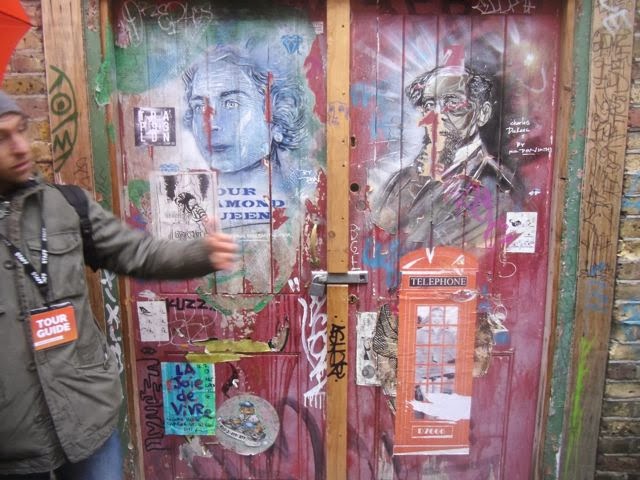

We stopped at something I have passed before but never previously paid attention to: patriotic street art. I had sort of assumed that this type of art would be iconoclastic but was proved wrong here, unless of course there is a deeper irony that I am missing.


We came to the yard behind Truman's Brewery and were shown quite a number of larger pieces of street art. There was the inevitable Bansky, some other large sculptures and a piece by Space Invader. An interesting thing that our guide said about this last artist's work is that the placement of these mosaics around the city of Paris when viewed on a map creates a picture of a space invader in its own right.


This map details the pieces Space Invader left in the 4th arrondissement of Paris. I don't quite see a space invader here but I do like how the city map has been thoroughly reconfigured to suit its new purpose yet enough vestiges of conventional maps remain to remind you of official ones. In late 90s Paris I did somewhat similar but less refined work using stickers, texts, photos and maps, so this work evokes both nostalgia and respect seeing these concepts fully developed and given a consistent graphic style. What I also like is that this map proposes a tour of the various works, some of which will and some of which won't still remain in place. While guided tours of street art can be interesting and rewarding, when the artist his or herself creates tours of their own work, effectively curating their own solo show in the city/gallery space, a rather different sort of tour is offered.


Our guide stopped to tell us about The Krays and how the area we were walking through was formerly their territory, they being the senior London gangsters of the 60s. He said that the streets were in some ways safer back then, suggesting that they did a good job at keeping competing criminals off the street. It was striking that once again it was crime that made the neighbourhood famous, from Jack the Ripper to The Krays, the East End has been popularised as a, maybe even the, place of violent crime in the UK. Historically there may be something to this but how many parts of Central London haven't had a few grizzly events take place in them? Still, the idea has somehow stuck that these are dark and dangerous streets and visitors will often still come with this expectation when in fact the worst thing likely to happen is that they are harassed by over zealous waiters offering 25% discounts on meals, and even they seem to have calmed down somewhat. The Krays have only more recently been given the film treatment and maybe we'll see their status rise with time and distance from their actions. I will in fact be taking a Kray Twins tour to see what sort of story is spun, a tour that boasts a celebrity guide no less, too. Hooks a plenty. Meat hooks. 


We rounded off the tour at the bottom of Brick Lane. We were directed the various ways we were all heading, some back to Liverpool Street Station others back up Brick Lane in search of curry. Chillies was recommended and it looked like there would be a small post tour gathering of our guide and the young men from Cologne around a table for lunch. Finally we got onto the subject of Trip Advisor. We were all encouraged to rate the tour 5 stars if we enjoyed it. I'm fortunate writing here that I don't deal in stars. I find them superficial when it comes to arts reviews in the papers and don't want to reproduce a system I distrust. What I can say however is that this tour was engaging and varied, that Luke our guide was both personable and enjoyed his job and despite the lousy weather this was a fun way of introducing the area to visitors who knew nothing of it.

Friday, 29 November 2013

The Spitalfields' Stories Tour: a tour designed to make you healthy

Today's tour was a self-guided tour in the sense that my guide was not a living breathing tour guide but instead 4 sheets of A4 that I printed at home from a free download I found on the Internet. I have written about this idea of the self-guided tour on an earlier blog so I won't repeat what I wrote there, but, this tour has given me the opportunity to expand upon those ideas somewhat. Suffice to say, when making my way around Spitalfields on this tour, I tried to follow the map and usually succeeded.


A Walk Through Spitalfields Stories has been designed to be read as an A5 booklet but working out the paging and folding it accurately on Commercial Street is a little optimistic. Best do that before you set out. As you'll see, mine is messy and distressed from being stuffed into my back pocket. 


I set out in search for Number 1, the starting point of this circular walk. Without too much effort I found it: SOUP KITCHEN. 


It was possible to stand more or less on the same spot as the photographer who took the picture in the booklet did, and to then recreate it. The difference here is the picture has been cropped at both top and bottom. The accompanying text from 1892 gives a snippet of information that can then be placed alongside the building today.


En route to number 2, I rounded the corner and came to the spot that the Spanish Jack the Ripper tours always seemed to be occupying. It was a little earlier in the day so it was empty this time and I had a good look at what was purportedly London's most lawless street 125 years ago. Nowadays it is a car park protected by dogs.


My circular tour took me next to this lamppost where a Charles Dickens quotation was my framing text, a quote about people leaning on lampposts that suggests though neither confirms nor denies that this was the precise lamppost Dickens had in mind. I have never had much time for Dickens personally even though I know he is much feted in the UK. It may in fact be because he is so celebrated and contemporary adaptations of his novels invariably grace abject poverty with nostalgia that I have such a hard time with his work. In any case, this passageway, I was told on a Ripper tour, was used for a scene in one of the Harry Potter films and this has put it firmly on the contemporary tourist map. There are indeed dedicated film location tours; I ought to cover one sometime soon. What's more, the film industry is seen as a way in which a city may be marketed. The recent Day of the Doctor being an example of this, the Olympic marathon another. However, I find that the media generated images of the city do not correspond to the actual experience of living or working in it as they tend to favour the tourist sites. When walking though these streets then, the visitor is simultaneously walking through a mental film set and comparing the streets to scenes from film and TV. This does not happen in the same way in an undistinguished small city that does not feature in the media. In Leighton Buzzard you really are, I'm guessing, in Leighton Buzzard. 


The game then with this tour was essentially twofold. First it was locating the image on the paper in the actual street you are walking down, such as the door to the synagogue here. Second, it was reading the place through the frame of the historical quotation beside it. That at least was the ostensive game. Add to this the task of following the map which sometimes had stretches without designated stopping points. It is quite a simple proposition and it is one that leaves you with enough space to bring your own thoughts to bear. There is not so much room for ambiguity and getting involved in situations, it functions as a reliable guide rather than an unreliable guide such as Alley's Travels in China would do today.    


And so to another familiar spot, the starting point of The Alternative Tour. Something that I did not mention when writing about that tour but which has struck me many times since is how it was a tour of street art which ignored a certain type of street art completely. It was very much focussed upon the art in public space that has grown out of the graffiti tradition and made no mention at all of public art, like this sculpture or corporate art that litters the squares and lobbies of offices all over the City of London. I would be interested in how these different forms of art and their economies could be compared to one another within a single tour. 


Number 8 was a historical photograph not one from today and so it was impossible to tell for sure which building Dan Cruickshank, yes he of The Bridges of London Tour was referring to. I therefore had to take my bearings from the map. 


And this is the 'charnel house' as far as I could tell: COSTA. Little do they realise in the bottom floor on the left, just behind Santa Claus, that they are sipping Lattes where human remains were once collected. This COSTA must also be the one where my anti-capitalist guide on The Alternative Tour got his coffee from. Suddenly this tour I was on was starting to become a vortex sucking in all the previous tours I had taken. The quietness of this tour allowed the references from all the previous tours to find their way in and invade the rather minimal narrative that it was constructing.  


A feature of this part of London is roads and passageways that bear no name. This I guess is the result of it being a very old part of the city that has been redeveloped in a very modern way. Whilst I was never remotely lost it was not always clear where I was on the map. I would have to look at an historic map to see if this passage had an old name which was simply no longer indicated or whether this was a new space. Somehow I find it hard to image new public space being created but I remain uncertain what the exact status of this space between the two buildings is. 


I came to 18 Folgate Street which is described as a time capsule.


There is nothing very much to see and so I dutifully took a picture and continued on my path. It was only later when looking up the weblink to Denis Severs House that I see that behind this door there really is something to see. What's more, if you look on their website they propose a tour. And so a new door opens in my research of tours in and around Shoreditch and Spitalfields. 


Next came Spitalfields market. I remember the place from the mid-1990s as a shabby artistic haunt; nowadays the The City of London has eaten it up and this is what you see on the outside.


On the inside there are still market stalls and food available but these days it is chains like Gourmet Burger and the stalls sell middle class kids rather than vegan slops and second hand tape recorders. What is odd however is that it still trades on the idea of creativity even though the artists are long gone. I guess that is the genius of creative industries.


This is the map that I was following; the route looks a little like a dog with a long tail that stretches East as far as Brick Lane. It is indeed a 'circular' route however there is a gap between number 16 Christ Church and number 1 the Soup Kitchen. This then makes me wonder if it might not be interesting to make a fully circular tour that not only returns to the starting point but which also revisits the entire route a second time using a different framing text.


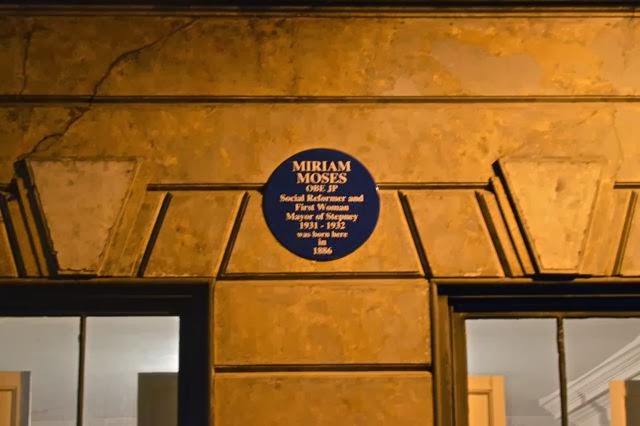
Something I learned recently was that many of these blue plaques are not official in the sense that they have not been approved by English Heritage the body that has historically granted sites this status. This is just such an unofficial plaque. This one does not even indicate upon whose authority it has been put in place.


By the time I made it around to 19 Princelet Street it was really rather dark and I got to see how my new camera really did a better job than my old little pocket camera. Expect better night shots from now on.


I had tried on the Alternative Tour to take a picture of this metal sculpture that sits on the top of a post beside Christ Church. It had simply been a blur and so here is it is. The way these different tours were interweaving was, I realised, a consequence of them taking place within a concentrated geographical space. When I made the Stuttgart Tour of Tours I was taking the entire city as my frame and as such had to construct connections whereas here they were happening very naturally. 


Here for example was my first Jack the Ripper tour group of the evening. I was finishing around 5.15 PM and the Ripper industry had already started for the evening.


Which led me to Jack the Clipper on my way between point 16 to point 1 the start of the circular tour. I had heard that the Ten Bells pub had tried to change its name to a Jack the Ripper Theme pub but backed down after protests from women's groups. This barber shop was not so inconvenienced. This then completed my tour and my abiding feeling was that this tour was constructed simply to get people walking it being framed as a healthy and interesting activity. The booklet was part-funded by the National Heath Service and there was a section extolling the benefits of walking. The quotes were a bit random so they never constructed a very precise narrative or theme beyond 'this is all historical stuff that people once wrote about this place'. This meant that I was rarely that deeply involved in the tour on offer but was able to use it as a way to consider the space and how it is to follow a written guide rather than a live guide.  

Monday, 18 November 2013

An Alternative Jack The Ripper Tour: conspiracies and comedy

After taking a Jack the Ripper Tour last week and seeing just how many there were pounding the streets of the East End, I decided that I really had to take at least one more in order to be able to make some sort of comparison between them. That's how I ended up taking the Ripping Yarns Jack the Ripper Tour.


The starting point of the tour was Tower Hill tube station. This is a little more central than Whitechapel and properly on the tourist map of the city. I don't know whether we started here because if it is easier to get tourists to come here or because our guide was a Beefeater, who work and live in the Tower of London, pictured behind. In any case, I had heard that the less serious even sensationalistic tours are more likely to be found starting at Tower Hill and I was looking forward to something trashy. Once our guide started addressing us, however, I realised that this was not one of the B-list tours but was something altogether more respectable. Ever so slightly disappointed (no cheap laughs tonight!) I settled into the tour that I was actually being given and listened with interest as our guide Barney started warming up the group and introducing the tour and the story of Jack the Ripper. 


The tour took us through unfamiliar streets that were not obviously part of the Jack the Ripper story, but the locations were used to tell us about what East London was like in the 1880s and about the lives of the ripper's victims, all of whom were working as prostitutes. It flowed naturally enough and we finally joined the now familiar route stopping at the first site that the previous tour had also stopped at. We would shadow a similar route to theirs through much of the tour, making slight alterations, but essentially visiting the same locations. I had to ask whether this uniformity of route is due to the locations themselves and how the streets are laid out (one murder site is omitted as it is too far off route) or whether it is as much due to the way the narrative is told. I guess this is something that guides have spent considerable time thinking through and you would probably need to depart from the chronological telling of the murders in order to make a significantly different route.


Our guide was a gifted storyteller and natural joker who had been giving this tour for some four years so he knew his script inside out. Maybe because of that, and in order to keep it fresh, he also allowed himself to talk about funny things that he had seen and heard recently whilst being a guide. He knew the details of Ripper story well so we remained on that thread but he found ways to personalise it and see the funny side of it at every turn. He spoke quickly and with a choice turn of phrase and I wondered if foreigners whose English was not good would be able to follow him. He did explain some phrases from time and his energy was itself infectious, so I suspect it would all work out fine for most visitors. 


Once again there were the A4 laminated pictures distributed around our group showing the victims, locations and so on. He used fewer than the previous tour, however, and carried the story more through his patter, which was more than able to paint the scene. The pictures that we did see were generally less clearly printed and certainly a good deal less gory than the tour of the other night. He made far less of a point of trying to shock us with gruesome images and viewing them was very much an optional thing for the curious.


I heard that there had been an American woman who had taken one of the competing tours and had written an article complaining about them. I had a look for this online but was unable to find it as there is such a deluge of information and reviews about the various tours on offer. I also had to reflect that there will be some people who will inevitably find such a tour in bad taste, but I have the impression that they will probably be a minority. The group I was amongst seemed like a petty normal bunch of people and not a blood thirsty mob of sickos, much indeed like the previous tour group who were on the other Jack the Ripper tour I took. What is probably a more interesting question to ask is, how is it that this story has become popular and acceptable to be interested in. 


Whilst each tour is working with the same basic story and historical records, which will be more or less familiar to the guide, the tour will have a distinct focus and point of view that sets it apart from the others. So where my previous tour was historical in tone, even historical to the point of being about 'Ripper Studies' this tour focused upon the identity of the killer. In this sense it took the police force's point of view which made perfect sense given our guide was an ex-serviceman. The way this take on the story was delivered was very present and convivial and this brought it out of the detective story frame as there was no urgency or suspense to it and took us much more into the tourist frame of reference.


Just as on the other evening, the small Spanish group were out and once and again they managed to arrive first at this vantage point. Whilst the attitude between the guides and different groups seemed more or less harmonious, when a small group took the best spot while a large groups had to settle for a second best location, it did't sit so well with the crowd. It is all public space, however, and nobody has more or less right to it so the best thing was to do as our guide did and just get on with it from the other side of the road.


Much was made of the this message that was purportedly left by Jack the Ripper. He suggested it can be interpreted as relating to the freemasons.


When we came to Mitre Square we saw not one but two other Jack the Ripper groups. The group behind ours was on the murder site of 'Ripper Corner' while the second group had to content themselves with the building site and we parked ourselves by the offices. This gave me the idea that it would be rather amusing to sit in Mitre Square one evening and watch the various groups come and go. I might just do that and count them.


We were near the end of our tour which was to take a total of two hours and twenty minutes. I was fine with this duration but I did hear some people in our groups talking to one another about getting cold and tired by this point. The extra leg of the journey that comes from starting at Tower Hill certainly adds to the duration and makes this longer than the average Ripper tour. I imagine if the weather was poor that would compound this. Fortunately it was merely dry and cool which I'll happily settle for.


The prime suspect was revealed at the end of our tour and a plot involving the royal family imagined. This was the point where the tour went beyond the realm of the historical and into conjecture, which we were perfectly happy to accept as the Ripper story, being so far away in time and encountered via Hollywood, belongs more or less to the realm of fiction, even if it is based around real events.


The tour concluded with collecting £8 from each of the twenty people who were on the tour. This was done on the basis that there was no need to pay if you were not satisfied. Everyone paid and we made our way back to Tower Hill and into the night.  

Thursday, 14 November 2013

The Jack The Ripper Tour

This is a tour I have been interested in covering for some time now. Back in May when I attended the symposium on Critical Tourism at NIDA  in Lithuania I remember listening to the presentation At the Grave of Santa Claus: Sketches of Thanatourism given by Aldis Gedutis. This was the first time I heard about the concept of dark tourism. I realised when I started turning my attention to East London that there is a prime example of just such a tour in Whitechapel: The Jack the Ripper Tour. Indeed, it seems to be held up as one of the iconic dark tours. In this informative literature review on the subject of thanatourism it is written: 

a range of tourist experiences has been created from the lightest shades (haunted houses at amusement parks) to the darkest (Auschwitz). This sub categorisation of dark tourism enables a broader perspective into the motivations of visitors depending on the 'degree of darkness'. For example, the motivations of a tourist on a Jack the Ripper tour in London will differ from those of a tourist at the Killing Fields in Cambodia.  


The tour began prosaically enough with a rendezvous beside a tube exit where I found a growing line of budding dark tourists checking in with the really rather welcoming guide. The only thing that was perhaps less welcoming was the London weather; a fine drizzle enveloped us and would continue to haunt the tour. It never rose to more than a faint shower, but it still managed to remove most of the pleasure from being outside on this Autumnal evening. 


I knew that there was more than just one Jack the Ripper tour as, when I was looking online and found the one I finally took, I saw several competing tours all vying for attention. Our guide explained that this explosion of Ripper tours is a relatively recent phenomenon that started as little as two years ago. My tour was given by Lindsay, a historian and researcher who has specialised in Jack the Ripper and is a definite contributor to the field of 'Ripper studies'. Many of the alternative tours are not led by experts but by actors in costumes so there are some very real differences in the character of these tours all dealing with the same basic subject matter.


We were led around Whitechapel and Spitalfield stopping at various murder sites and former homes of the victims. In general the locations have changed a lot so there was not so much of the original architecture to see; the tour succeeded of failed mostly on the ability of the guide to tell the story of the murders. The approach our guide took was to lead us chronologically through the Jack the Ripper story starting with the unattributed murders and then talking us through each of the subsequent killings. In the absence of sites that screamed murder, our guide relied upon showing us laminated grainy pictures to introduce images into the tour. This is one of the victims.


At one point our guide started to talk not so much about the murders themselves but more about the Jack the Ripper phenomenon, and in particular about film and TV adaptations. Michael Caine was apparently rather good in one version, we then got onto Johnny Depp and the film From Hell, and finally,  there was much of Ripper Street, a BBC production currently being shown. This, mind you, is just the tip of the iceberg, the number of B-movies and exploitative documentaries must be great. What then is the motivation to come on the tour, is it morbid dark tourism or is it not also coloured with the fascination of celebrity? 


For the most part, our guide gave a precise account of the murders and the social context in which they took place. This was not a dry historical lecture however, she had been giving the tours long enough to also be skilled at telling the story and getting the most out of her material. That is not to say she milked it, the tour generally stayed sober but she did affect a Cockney accent once or twice and placed herself into a role within a scene dramatising it lightly. She never stopped being herself however or got into embarrassing acting situations. 


At one of the tour's locations we had to settle for a less good position as a Spanish Jack the Ripper tour group that had been trailing us all evening got to the best position before us. It was striking how they really had been on the same path as us pretty much throughout the evening. I even started to wonder whether they were simply recycling the tour I was on and delivering it in Spanish. This did make me think that I really should take a few foreign language tours of London's East End. I might start to research French ones as I'd at least be able to follow them pretty well.


Here she is demonstrating the wounds suffered by one of the victims. This was a running feature of the tour: sometimes mere stabbings but more often mutilations and gory details retold and choreographed. 


As we were entering our final site, Mitre Square, we passed beside a building site and crossed another Jack the Ripper group leaving the square. The guides knew each other and exchanged greetings. Apparently there are as many as ten different tours and this is the most popular location, a point they all converge upon nightly. As such, there are often many groups vying for the best spot in the square. I imagine it on a busy night looking like Speakers Corner.


Mitre Square was, on most sides, a building site with boards concealing the construction work behind them. Our guide told us that, over the years she has been giving tours she has seen the site evolve and, as a historian, has taken a keen interest in documenting the evolution of this Jack the Ripper murder site. This degree of interest, or should I say this line of enquiry, struck me first as fetishistic but then upon reflection, I can see how the history and management of historical sites can be a very interesting subject to study. It was simply surprising to hear about it whilst on a tourist walk as it was a level of meta-commentary well beyond that of, "funny things that have happened whilst I have given tours."  


Here our guide showed another of the victim pictures; this one more graphic than most. She warned the group to turn away if they would be upset by seeing it, but of course this only made people more curious to see it. She often closed her eyes when showing these pictures and I was not sure if this was as a mark of respect for the victim or to give the image gravitas and make the group feel less self-conscious about staring at the picture. I had a feeling it was more the latter and I suspect it worked: you don't want to be observed looking at ghoulish images.


Just as our tour ended, another group arrived in Mitre Square and they were led by a guide dressed up in an old fashioned police costume. This was yet another of the competing Jack the Ripper Tours and he had a good-sized tour group in tow. I had to ask how being dressed in a vintage police uniform and assuming that point of view would alter the nature of the Jack the Ripper tour, this is something I will only be able to say if I take that tour, I guess. Somehow I have resolved to take another one of these as it seems to me the variation between them should be interesting to observe and, I suspect, there are some far more camp dark tours of Whitechapel than this one.


Throughout the tour our guide had to pause whilst police cars raced past sirens blaring. This was because of a car accident that took place very close to our walking route. Looking at the real police who were trying to disperse the small crowd that had formed to watch the medics and fire crew at work I could not but think about the tour I had just taken. Some terrible things resist being staged while others, like these serial killings that took place over 125 years ago have spawned a small entertainment and scholarly industry of its own. I had to wonder if it is distance from the event which allows this to happen. Right now it would be unthinkable to offer a Moors Murders tour outside Manchester, as one of the perpetrators is still alive and in prison. But will this too, one day, become yet another point on the thanatourist's map, and if so, what is the process by which this transformation takes place?