Showing posts with label East. Show all posts

Monday, 27 January 2014

The Secret History of Street Food Tour

In the name of diversity (and a healthy dose of self interest) I was able to take another first for the blog here: a food tour.


My guide Emma from Coutours met me beside the West Cornwall Pasty Company Stand, outside of Liverpool Street Station. It was an easy to find, food related meeting point for this private tour which would take me around the East End and introduce me to some of the foods and stories behind the varied culinary cultures of this part of London. 


We soon came to Spitalfields Market and the adjacent Fruit and Wool Exchange. This building is one I must have seen many hundred times yet I don't recall ever noticing its title up on high. I was told about its former purpose and how it had been turned into offices more recently. We talked about the market and its former dysfunctional days with some affection; produce and people spilling chaotically out onto the streets blocking the roads. The tour's focus was upon history, on what had been there, so we went further back in time and I heard about its Victorian period and the class distinctions which meant the middle and upper classes did not shop for food but rather sent their staff. This focus upon history is of course a very typical one of guided tours which often aim to bring to the surface the invisible or hidden aspects of an area which the visitor might not know or be able to see by themselves. A tour that focuses not on the past but on the present is less common but there are a few locally such as the, the Shoreditch Party Pub Crawl and the Street Art tours. Tours that imagine the future are the least common. These are tours that might be made by a property developer in order to win support from financiers and planning officials. It is these future focussed tours, private tours with glossy CGI brochures, that preceded the transformation of Spitalfields Market, an act of corporate vandalism that has been honoured with awards. My guided Emma expressed mixed feelings about the new Old Spitalfields Market, while something had to be done to arrest the place's freefall during the 80s and 90s, and that something would almost inevitably mean City expansion, it was not as bad as it could have been and enough of the fabric of the market remained for it to still be recognisable as one continuous structure. 


The idea of a food tour immediately set off my salivatory imagination, however the tour took us not only to places where food is served but also to some locations where there was no food to be sampled, such as this site of a former dairy. It was then that the precise nature of the tour became clear to me. While there was food to be had on this tour, as you shall see, the emphasis was far more upon using the history of food as a vehicle to talk about the area's history more generally. Given that food is a very specific expression of a culture and that this area has had many waves of immigration there was plenty to talk about. What's more by approaching this history through the frame of food, there were may original angles on stories that I had heard in other formats on previous tours of this part of London.


An example of local food history is fish and chips, one of the few British signature dishes. Emma explained how the tradition of deep frying fish in batter was introduced into Britain by Portuguese jews. When cooked in this way, the fish preserved well and made it suitable for cooking in advance and then being eaten on the sabbath. The chips, I was told, were popular with Irish immigrants and these were originally the off-cuts of potatoes which were very inexpensive. Inflation being what it is, chips from Poppies could no longer be described as cheap, but they sure were tasty, on a par with Happy Days, which I visited while taking the Queen Mary East End Tour.


This sign 'Your Mum Ate My Meat Porn' was never going to speak to me as I don't eat meat. We passed, in fact, by a great many unexceptional sights such as this and the character of the tour was that we rarely stopped at them but rather they were referred to in passing and the conversation continued as we strolled further through the neighbourhood. This leant the tour a more free flowing atmosphere, it was certainly not a tour of 12 impressive sites that came with tightly rehearsed description of them from the guide, as can happen. Instead observations and details came at a steady pace and every now and again we'd stop so there was time to talk a bit more about what was in front of us, though often as not the conversation continued afterwards as well. This is partly the result of this being a private tour for one but I noticed that Coutours deliberately keeps the tour groups small in number so something of this flavour of personalised and conversational walking is retained. I felt I was being treated like an adult; big tour groups can often have the resonance of being on a school trip.


We then entered the food markets and took a look around at the many stalls from all over the world. To my surprise there were quite a number of Ethiopian vegetarian stalls, they seem to be the latest thing. I settled in front of this Japanese stall and was set off wondering about the etymology of tempura, whether it was also of Portuguese origin or if it was developed quite independently. Answers welcome.


I found myself starting to look at the place as a United Nations of food as the stalls all had their little flags and logos clearly showing where the dishes came from. However, with this international history of fish and chips in mind, I should not have been surprised to to see that the people working at the stalls did not necessarily reflect the flags they were flying. This Japanese stall was run by an Indian man, for instance.


Then we came to our old friends the Dutch who, I was told, introduced some technical innovations in British gardening such as the use of fertilisers, which had a revolutionising effect on the produce and thus dinner table. Nowadays, of course the country is more famous for its tomatoes without flavour and the stem cell burger launched here in London last year, an artificial burger made from growing stem cells in a laboratory.


We stopped in Nude Espresso to warm up, drink coffee and see a local eatery from the inside. Since this was a solo tour I was able to ask questions not only about today's theme of food but also about my preoccupation of tours. Emma was most forthcoming and told me how she became interested in giving tours after having taken one herself in Jordan that came perilously close to falling apart in the desert. I thought this was a rather beautiful and personal beginning which she built upon through a great deal of hard work: giving as many as 2000 tours in a year. That must surely be a truly immersive sink or swim training on the job. Her perseverance has paid off and she has developed a business out of it and created a number of tours angled around different themes and set in various parts of London. She told me she continually develops new tours and is working on a 'scent' tour of Central London right now. We talked a bit more around the process of constructing tours and with our coffee cups drained stepped back out into the fresh air.


Almost inevitably we made our way to the two bagel bakeries, spelled beigel as they are of Polish origin, at the top of Brick Lane. They had sizeable queues snaking out of them since, it being a market day, they were doing storming business. That said, they seem to have a healthy flow of customers at all times of the day and night. Thinking back to what I was told earlier in the tour about shopping historically being for the lower classes I could not help but notice how it has grown in popularity and become a  major form of entertainment for people of all positions within society. While Brick Lane is not Portobello Road, it is a popular street market that is as much about selling the idea of itself as a market as it is about selling any particular goods. People come here to hang out and will not necessarily leave with purchases. The one thing they do buy however is food, as that has become part of the identity of the market, and an integral part of the market experience. This transformation from being a market of good to a market of lifestyle must be one of the main reasons behind the huge growth of street food on Sundays.


Because it was a Sunday many of the cafes and restaurants outside of the Brick Lane were closed and I was told that the East End food tour is more commonly held on a Saturday, when places like Kelly's is open. Having already tried jellied eels and mash (with liquor) before I did not feel I missed out on too much this time round, if anything it was something of a relief not to have to repeat that particular East End delicacy. This got us going on, if and how pie and mash shops could or should be rejigged, as they are something of a dying breed.


Our final stop on the tour was Pellicci's in Bethnal Green, famous for having once been the Krays' local cafe. Once again then, the twins who lived round the corner on Vallance Road made their way into a tour of the East End. I heard about a Kray tour from the point of view of someone who used to drink in an East End pub that would be periodically invaded by a tour group who'd be told, "The Krays shot a guy in that corner" and with that the group would shuffle out. Fortunately for Pellicci's the place was not the scene of a murder or stabbing, as far as I am aware, but rather the scene of many a lunch that was a result of Italian cooking meeting British tastes. 

Thursday, 2 January 2014

The Undiscovered East End Tour

I managed to squeeze in one last tour for 2013 and once again it was a tour of London's East End. I should admit I was even tempted to turn New Year's Eve into a tour using one of the self-guided architecture tours as a starting point but the weather had other ideas.


And indeed it also had other plans for this tour; it was, quite simply not a guided tour sort of day. Unphased, Luke our guide waited at the statue opposite McDonalds sporting an orange umbrella, exactly as I was told to recognise him. Since Easyjet don't bother with East London (an oversight I feel) there was no confusion of corporate colours. Having found him I ducked back under cover, the station's ultrasonic 'Mosquitos' were preferable to the rain. 


We were a small but hardy group made up of South Londoners, friends from Cologne who had reassembled for a London visit, two Australians and I. The tour was from a company called Undiscovered London and yes, while the name is a bit of an oxymoron for a company giving guided tours, the East End is off the main tourist piste so it can be thought of more as meaning undiscovered by you. This is a daily tour that starts at 11AM so it is probably fair to say that it is one that is geared principally at visitors to the capital.


This tour was in a certain respect refreshingly traditional in that it did not try to tell a single story or focus upon one theme exclusively, but rather, made its way through the East End stopping at one point of interest after another. In this sense it was in the best way generalist: one moment the evacuation of jewish children, the next 16th Century hospitals then a bit of street art. In the crowded market place of London tours there is a tendency for tours to carve out a niche for themselves by having a unique angle to mark them out and while this can result in excellent tours there remains a need to simply show people around an area and talk about the various things that can be interesting to different sorts of visitor. When done well this sort of generalist tour becomes a collage of places and stories that can give a taste of how complicated and open-ended the place itself is. Here for instance we were told about the medieval psychiatric hospital that stood on what became Liverpool Street Station. What's more, we heard how Bedlam, as it became known, offered visitors self-guided tours of the wards where visitors could witness inmates in distress and so on. The health service has been looking for additional profit making activities for a while then. 


For the first time I was taken to the Charnel House on a tour. The story here was of the hospital fields (Spitalfields) and how the dead were temporarily buried then exhumed and the bones placed here to save space. This is probably the more interesting story from the visitor's perspective yet from the point of view of someone who knows East London the more present narrative is that of The City's aggressive expansion eastwards in the form of Norman Foster's 1 Bishops Square. Incredibly, this won London Planning Award's best new public space. It is important to take stock of just how conflicted various interest groups (stakeholders in today's corporate parlance) can be: local residents, city investors, tourists, hospital authorities, the dead. 


We passed the public toilets in Spitalfields Market which were recommended for being both clean, publicly accessible and free to use, a rare thing today following the wholesale closure of public toilets by local authorities. There is an unusual London tour that caught my eye which comprises of a tour of toilets led by Lootours. Unfortunately they don't stray this far East, they focus on the West End's commodes so I won't have occasion to be reviewing that tour anytime soon.


Where a fortnight ago there stood Santas quaffing mulled wine following their city running tour we now sat and listened to a summary of the Jack the Ripper story. I suspect we stopped here not because it was on the ripper route but because it offered us a moment of reprieve from the elements. With the essentials of the murdering spree covered we were told that we had saved ourselves the three hours of going on a ripper tour. This was a nice little gag that got me thinking about how much time going on a tour of tours would save you. "Take this tour and save yourself two and a half days" might make a good tag line. This reference to the ripper tours also made me realise that I was getting a bit of a tour of tours having already heard about the Bedlam tour and now getting a potted ripper tour. I now see that many tours are developed from recycling existing tours, adding some new details or combining some previously separate information and putting a new spin on them. Completely original tour research is more unusual and almost inevitably gets sucked into other tours, unless it is too geeky. This leaves a tour of tours in the paradoxical space of being both a properly original focus and at the same time an ultimately parasitic form of tour.


We were then treated to a colourful explanation of the etymology of the phrases "shit-faced" and "saved by the bell". These were new to me and the first in particular was based on something that could be seen in the street still: the ghost of a sewer running down the centre of the passage. We had earlier been introduced to cockney rhyming slang too and this interest in local language was very welcome as it really made the invisible visible. It even got me imaging that this topic was rich enough to deserve a specialist language tour of its own.


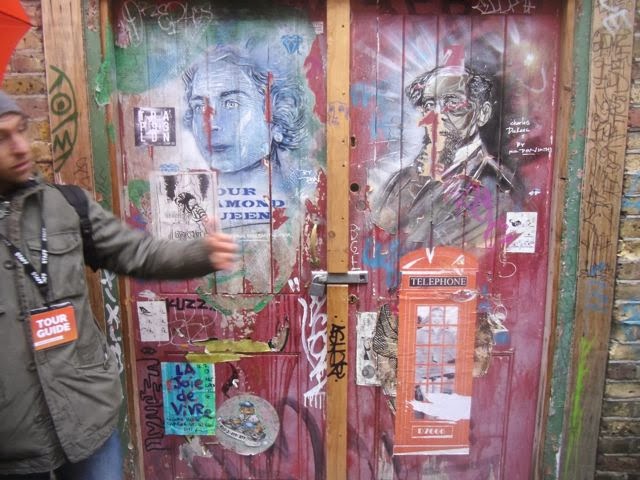
Moving on however we were next onto street art. I had the feeling that compared to The Alternative Tour which is a specialist street art tour, we were given a simpler snapshot of a number of works that covered who the artists were and was followed by some observations on the different styes.   


I noticed that this piece carried the signature not only of the artist but also a link to Global Street Art (top left) the company promoting and facilitating much of this work locally. Having run into Lee Bofkin from this company whilst on The Walk the Line Tour I start to see their hand more widely in the area.   


True to form we stopped, like practically every other tour, outside the the mosque and heard about its multi-faith history. I think the only tour I have taken than did not bother with the mosque was the Whitechapel Gallery First Thursday bus.


I enjoyed the way that many of the points we stopped at were quite unspectacular such as this wall. It was the small metal plaque up on the wall that was the point of interest here and which prompted a history of London's fire services following the Great Fire of 1666. Rather than this being a tour that showed us 'wow' sites, it typically used details such as these to tell stories. The balance of interest was then upon interpretation over spectacle.


We stopped at something I have passed before but never previously paid attention to: patriotic street art. I had sort of assumed that this type of art would be iconoclastic but was proved wrong here, unless of course there is a deeper irony that I am missing.


We came to the yard behind Truman's Brewery and were shown quite a number of larger pieces of street art. There was the inevitable Bansky, some other large sculptures and a piece by Space Invader. An interesting thing that our guide said about this last artist's work is that the placement of these mosaics around the city of Paris when viewed on a map creates a picture of a space invader in its own right.


This map details the pieces Space Invader left in the 4th arrondissement of Paris. I don't quite see a space invader here but I do like how the city map has been thoroughly reconfigured to suit its new purpose yet enough vestiges of conventional maps remain to remind you of official ones. In late 90s Paris I did somewhat similar but less refined work using stickers, texts, photos and maps, so this work evokes both nostalgia and respect seeing these concepts fully developed and given a consistent graphic style. What I also like is that this map proposes a tour of the various works, some of which will and some of which won't still remain in place. While guided tours of street art can be interesting and rewarding, when the artist his or herself creates tours of their own work, effectively curating their own solo show in the city/gallery space, a rather different sort of tour is offered.


Our guide stopped to tell us about The Krays and how the area we were walking through was formerly their territory, they being the senior London gangsters of the 60s. He said that the streets were in some ways safer back then, suggesting that they did a good job at keeping competing criminals off the street. It was striking that once again it was crime that made the neighbourhood famous, from Jack the Ripper to The Krays, the East End has been popularised as a, maybe even the, place of violent crime in the UK. Historically there may be something to this but how many parts of Central London haven't had a few grizzly events take place in them? Still, the idea has somehow stuck that these are dark and dangerous streets and visitors will often still come with this expectation when in fact the worst thing likely to happen is that they are harassed by over zealous waiters offering 25% discounts on meals, and even they seem to have calmed down somewhat. The Krays have only more recently been given the film treatment and maybe we'll see their status rise with time and distance from their actions. I will in fact be taking a Kray Twins tour to see what sort of story is spun, a tour that boasts a celebrity guide no less, too. Hooks a plenty. Meat hooks. 


We rounded off the tour at the bottom of Brick Lane. We were directed the various ways we were all heading, some back to Liverpool Street Station others back up Brick Lane in search of curry. Chillies was recommended and it looked like there would be a small post tour gathering of our guide and the young men from Cologne around a table for lunch. Finally we got onto the subject of Trip Advisor. We were all encouraged to rate the tour 5 stars if we enjoyed it. I'm fortunate writing here that I don't deal in stars. I find them superficial when it comes to arts reviews in the papers and don't want to reproduce a system I distrust. What I can say however is that this tour was engaging and varied, that Luke our guide was both personable and enjoyed his job and despite the lousy weather this was a fun way of introducing the area to visitors who knew nothing of it.

Saturday, 14 December 2013

Queen Mary University's East End Tour

Today's tour was a little fractured beginning and ending with other tours... maybe it can be called a sandwich tour. The filling, however, is in no doubt, that was an audio tour provided by Queen Mary University of London.  


The sandwich metaphor can be stretched just a little further as I began my evening in search of the Charnel House in Spitalfields which I had been made aware of on a different tour and marked on the map as occupying the same spot as Costa. Today I found it and to my surprise it is not right to call it the Costa Charnel House, it is much more the Pret a Manger Charnel House, as you can see in the picture. There do seem to be an inordinate number of these sandwich stores in the city.


The Queen Mary University East End Tour began round the corner at Liverpool Street Station. There is something very appealing about starting tours at stations as they are portals full of potential and generally not observed closely enough since people are usually in a hurry coming and going. To encourage this transitory nature, there are, apparently, sonic devices called MOSQUITOS that emit a sound that is particularly annoying to people under 25. These devices are used (by people over 25 we can safely assume) to discourage gangs from congregating and Liverpool Street Station is meant to be one of the stations that has this ultra-sonic sound played as a constant. I was unable to hear it and so simply put on my earphones and started the audio recording. The Queen Mary Tour told me to exit via the Broadgate escalator and in this respect  treated the station much like everybody else: a non-place that leads you elsewhere.


The instructions were at first quite clear and spoken by a woman who articulated very thoroughly. She told me to go down this lane, which I did, and that is where the tour got going with some descriptions of the narrow passage. The narrator acted as the host and from time to time introduced lecturers from Queen Mary who would speak on their specialist topics. Here for example there was, if I remember correctly, a professor talking about how the East End was viewed as being a terrible place full of crime and social problems. The fact that the experts were from different departments of Queen Mary made it clear to me that this tour was an inter-disciplinary initiative bringing together the likes of the English department with the Geography department. This was interesting in that it demonstrated how geographically framed tours (e.g. an East End Tour) by their nature tend to dip into different subjects; a bit of history, a bit of politics, a bit of geography and, why not, a bit of literature. Still, there was an assumption about what it was interesting to talk about and this mostly meant talking about the past. A tour that mixed two disciplines and did not take such a historical frame would be far more curious indeed. You could mix, for example, crime and botany and while you'd have two rather separate streams of information you'd probably find some points where they informed one another.


The tour took me to many familiar spots, such as Petticoat Lane Market. I'm not going to refer back to the audio so I can be clear about what was said, I think it is better to rely on memory so that what I write here is what is remembered, the impressions the tour left me with. Here then, I think I was told that this was one of London's oldest markets. I seem to remember they added some market sound effects too: audio doubling.


I passed Happy Days fish and chip shop which is one of the Jack the Ripper sites and I remember Barnaby, the guide on Ripping Yarns Tour, saying they do really good fish and chips. He was absolutely right. With a bag of chips in hand, I continued my tour.


Once again I got the immigrant story of the area and it was the Jewish Soup Kitchen that was the site for the telling of the story this time round. The tone was quite high and modestly academic with quotes from period sources and considered commentary. The story was, however, identical to that told on regular tourist tours.


Because this tour was going over well trodden ground, I interested myself by looking at the sites obliquely, such as at this 'designated locked site' on the side of Christ Church. I listened obediently to the story then to the instructions telling me where the next listening point was and then stopped the recording and made my way there. This form of engagement with the tour was less intense than a guided tour during which you are still more part of a tour during those marches between locations and it was certainly much less intensive than the immersive Sound Map Tour which surrounds you from start to finish.


True to form the tour took in the Brick Lane Mosque and there I heard about its history, as I had on almost every other tour that comes this way. It might be necessary to map the points that appear on multiple tours and those that only feature on a single tour. A specialist tour of tours would try to connect the single use points whereas a generalist tour of tours would select only points that feature on at least two or three tours. What is nice to observe are points that feature in multiple tours and which are talked about in completely different ways, like SO Gallery on Brick Lane which combines Jewish heritage and contemporary art.


The tour took me to the park where there was a story about discrimination against  Bangladeshis in the 70s. The story finished in a curious way. The narrator said, "if you want to end your tour now, go to Aldgate East Tube station over the road." She didn't go so far as to say, "you'd be a mug to continue" but there was something of a sense of "you've seen the best of it" in her tone of voice. Taking this a step further I imagine a tour in which you are repeatedly invited to finish it at one point after another and in a variety of ways. 


There next followed a long walk from the park to Whitechapel during which there were no recordings. This is more or less that same problem that the Walk The Line Tour faced: this stretch of road is not obviously interesting. I therefore had to think of the young lady on the Chinese tour bus I previously mentioned who pointed out a TESCO whenever she passed one. Since there is this one on the route, I do so in memory of her. I was starting to think I should have taken the narrator's advice and quit while I was ahead.


I also noticed several stores with signs like this: 


Money Transfer | Job Centre | Travels & Tours | Hajj & Umrah 

This got me thinking about pilgrimage and hajj as a tour. It's a huge topic that I'll have to return to at some point, hopefully in the context of a pilgrimage site or tour. Briefly though, I remember visiting Lourdes in Southern France and being surprised at how this Catholic pilgrimage destination managed to be simultaneously kitsch and impressive. I also remember hearing about virtual Hajj that was a big story a while back. When Second Life was in its prime you could send your avatar on pilgrimage to Mecca and I seem to remember other forms of virtual pilgrimage too. More research that needs to be done!


I downloaded the MP3 audio files and PDF map onto my phone but I found that my phone would not open the map file. This meant I was reliant on the audio instructions to find my way. By about two thirds of the way through, the audio instructions started becoming vague and I had to start guessing and looking around to make sure I was on the right path. As there was no street sign to indicate Mile End Road, for example, I had to scan the business plates till I found this one confirming I was on the right road.


The tour took me to progressively less and less glamorous locations such as this slither of green space that used to be important for meetings and public speaking. It is hard to imagine that happening now. You'd have to shout over the buses that roar past and the relentless flow of Mile End Road.  


The nadir moment of the tour for me came when I realised I must have completely missed one of the audio stops. I could not see anything like the place I was looking for and so I just pressed PLAY and listened to the next track hoping I could get a clearer picture of the place from the recording. I found myself listening to a discourse on geometry and social values while looking into Topps Tiles. At this point I realised I might as well make what I will of the tour and find my own sense in it. This was actually quite a liberating moment as I stopped feeling like I was making a mistake but instead allowed it all to be experience that could be interpreted however I wished.


Cut adrift then, I came to SFC (Stepney Fried Chicken) nestled alongside Stepney Green tube station. While I might smile at the woman who maps the country with TESCO I must admit I have my own version of this with the fried chicken outlets that proliferate in London. I used to take pictures of their signs and after some months had quite a collection. There is a nice transference of signifiers in these as they are basically copying KFC (Kentucky Fried Chicken) which in turn is probably a copy of something else, and substituting Kentucky with another location, usually plucked from the American South. Some however are resolutely local like SFC and then there are the PFCs (Perfect Fried Chicken) which in turn have their imitators who copy the PFC logo but insist they are Philadelphia Fried Chicken. Where the copy of the copy will go next is anyone's guess...


Making my way back to Liverpool Street I passed the locations I missed towards the end of the Queen Mary Tour and saw how I managed to miss them. I have to admit it did not feel like any great loss as I listened to the information anyway, none of which was of a nature that depended on being there. When I arrived back in The City I came across another tour of sorts, I was barged aside by a trail of Santa Claus clad joggers. I passed them twice in fact and their distinctive costumes made them stand out in the street. Earlier in the day I had read about a City of London run and now I was amidst another group making their high speed tour of The City. It is debatable to what degree a race like this is really a tour but for me it is enough that they make this formalised circuit of the City as a group. 


I wondered what the route of their tour was and where they would finish and I guessed it must be nearby as some of them looked like they were at breaking point. I opted for Spitalfields Market, made my way there and sure enough I found a large number of city workers in Santa outfits eating mince pies and drinking mulled wine. I also saw them being timed and something of the charity operation they were doing this for. So the way this 5K race works is that the runners represent their companies and both the individual winners and fastest company teams are awarded a prize, symbolic I suppose, on a small podium. While I have a general sympathy for people doing daft things in public the Santa outfit has become a bit overused in my opinion; I saw a similar gathering of jogging Santas last year in Portsmouth, I've seen Santa dressed pub crawls and the goodwill that the costume typically invokes has also been used by Fathers For Justice who have campaigned in Santa outfits on several occasions. Maybe what I mean by this is simply that it has become ever so slightly ordinary.