Showing posts with label self-guided. Show all posts

Tuesday, 18 August 2015

The Allenheads Geo Trail: British Stoats, Canadian Geese and American Squirrels

I am now in Allenheads, Northumberland, the highest village in England, perched up towards the Scottish border. It is in the North Pennines which is, among other things, a European Geopark, that's to say an area with a particularly interesting geological landscape. There is a geotrail that introduces visitors to the area, and it is available as a free brochure and also viewable online. The village is home to Allenheads Contemporary Arts, where I am currently staying, and I've just started to develop a new project with them which will take place next year.


The centre of the village is quite definitely the pub and it from here that the trail departs. From my brochure I learnt that a stone's throw away from the pub is the washing floor where lead ore was once processed, when the village was the centre of a thriving network of lead mines. This is now a forlorn space with the village's centre of gravity pulled 100 meters over to the Allenheads Inn, as the village's economy has shifted away from industry and nominally towards tourism. 


I had already taken some walks around the area but I would not have noticed that there was a path that lay ahead of me if I were not on this trail. The brochure was useful then, as it revealed more ways in and out of the village than I was previously aware of. This is all good information to have as I'll be making a performance here next year and these entrances and exits are likely to figure highly. The village can be imagined as a stage equipped not only with windows and doors, but also with trap doors, curtains that may be parted and wires that pull the actors high into the skies, otherwise known as the helicopter that deposits VIPs here for the the grouse shoot. 


There were a great many abandoned buildings that I came across, which together, said much about the fate of the countryside here. Depopulation has occurred on a large scale and the area has not yet become desirable enough for these more remote buildings to become in any way desirable. With some of them it feels like a matter of time before someone puts them right again and turns them to good purpose but with others, lost far out in the fields where no roads pass close by, they look set to tumble into the ground.


I came across this little fellow popping up from behind a rock. Is it a stoat or a weasel?


The path became broken and indistinct, the ground damp and muddy underfoot. I thought I had lost my way but it was simply a matter of the directions being sparse and the path rarely used. It is always a dilemma when describing routes to know how much information to give. A little bit of difficulty can be a pleasure, as uncertainty is rewarded with the joy of finding the correct path. Too much information denies this and can turn the experience into being all about the directions and not the landscape. The problem is, we are all a little different in how much we prefer difficulty over ease, and how well we can follow directions. Apart from this one stretch, the rest of the route was pretty simple and the level of information was about right for me.


Then the animals got bigger. Not getting out into the countryside so often these days, I was unsure how friendly the cows and bullocks were likely to be. I inched my way forwards and he turned out to be largely indifferent to my presence, much to my relief. I quickly made my way over the style only to enter another field of bullocks who were similarly absorbed in their grass. 


This stone building turned out not to be as empty as it appeared to be on the outside. As I passed, a family of sheep came out to see who the visitor was. It seems these structures have tenants after all. 


Flying above me were birds that I can only guess were Canada geese, though if you have a better shot, do leave a comment. Actually, when it comes to shots, when I returned to the Allenheads Inn at the end of the walk, I met some of the men working on the grouse shoot who had just finished work. They told me about a Canadian marksman who had recently visited, whose shot was so bad, it was embarrassing. As the shoot is now extremely expensive, it has become a rich man's game, and not all rich men (and it mostly is men) have the time to balance making their money with practicing their shooting.


I stopped at number 10 on my map looking for the great limestone and found instead a sheep exploring the water's edge. The walk was, in fact, full of moments like this that didn't fit in with the brochure, but were nonetheless enjoyable as moments in themselves and which gave the tour is true flavour. This geotrail is one that gives you time to think in a quiet place where you will probably not see a single person.


The geotrail also highlights a number of chapels that the miners, many of them devout Methodists, used to use for worship. What puzzled me about this one, which is now a private home, is that it was built in 1900, after the mines had all closed. Poor timing. 


Wherever I walked water flowed or was gathered in bogs, streams, rivers and reservoirs.  Allenheads is water rich. I read in my geotrail leaflet that the area was close to the equator, some 300 million years ago, when "limy ooze, sand and mud in tropical seas and deltas hardened into the limestone, sandstone and shale." Allenheads today felt far from tropical, the nighttime temperature dropped to 6°C, and that is mid-August. It was however exciting to imagine the land constantly moving and changing, that the identity of the landscape itself is very much in flux.


As I made my way around this route I had, running in my mind, the memory of an amusing video I had seen earlier in the day. This video, The Life and Peculiar Times of Allen Heads, tells a cock and bull story about a mole catcher who lives in the area and is a fugitive from the police. It features still shots of a great many sites around the village, pulling them into its loopy narrative, which hovered or should I say burrowed, its way around this geotrail. When the credits rolled at the end I was not in the least surprised to see Allenheads Contemporary Arts played an instrumental role in its creation. This is not an average village lost in the countryside.


There was not much information contained in the brochure so, while it was themed around geology, I cannot say I learnt a great deal. The limited space for words is one side to this but it is also true that when walking one has a limited appetite for stopping and reading. A guide would be the most informative way to learn about the land but I did also start considering how more information could presented through other means without, for example, the walker getting sucked into their phone. Audio would probably be the best way to deliver information, but a continuous audio tour would be too long and inflexible, and the map and audio entry system is not perfect either, as it can be a distraction from the walk. I suspect that at some point in the not too distant future GPS cued audio will become widespread, but until then we'll just soldier on with these other formats. 


Returning into the village I spotted this poster warning of the dangers of grey squirrels. The  immigrant squirrel issue is very current here and considerable efforts are made by the likes of the Red Squirrel Survival Trust to preserve them by controlling the numbers of greys, i.e. killing them. The American squirrels arrived in 1876 and their subsequent vilification by no less than Prince Charles is interesting to observe in what it says about attitudes to nature. Specifically, it makes me ask if there is an idea of a golden age when the flora and fauna of the British Isles can be defined as native with everything arriving afterwards deemed foreign. If so, when would that point in time be? After tomatoes and potatoes arrived from America but before the grey squirrels came? If the point hinges more upon some species being desirable, or cute, while others are deemed 'invasive', like the infamous Japanese knotweed, what we are usually talking about is fighting an un-winnable battle against plants and animals that rather enjoy the conditions on this island. While I am not saying we should make no efforts to manage the land, I think we often overestimate our power to control nature. 


And that makes me wonder, how do things look if we view ourselves as an invasive species? If this video, showing the migration of man out of Africa, were accompanied not by a new-age corporate jingle, but instead by war cries and martial music it might suggest this  negative narrative quite convincingly. From an ecological point of view, it is probably fair to say we are a good deal more destructive that any squirrels or weeds. If we were able to be a bit more effective at controlling the harm we do to the rest of the globe that would be a fine thing, but then again, we are nature, neither the managers of it nor even, it seems, of ourselves.

Friday, 29 November 2013

The Spitalfields' Stories Tour: a tour designed to make you healthy

Today's tour was a self-guided tour in the sense that my guide was not a living breathing tour guide but instead 4 sheets of A4 that I printed at home from a free download I found on the Internet. I have written about this idea of the self-guided tour on an earlier blog so I won't repeat what I wrote there, but, this tour has given me the opportunity to expand upon those ideas somewhat. Suffice to say, when making my way around Spitalfields on this tour, I tried to follow the map and usually succeeded.


A Walk Through Spitalfields Stories has been designed to be read as an A5 booklet but working out the paging and folding it accurately on Commercial Street is a little optimistic. Best do that before you set out. As you'll see, mine is messy and distressed from being stuffed into my back pocket. 


I set out in search for Number 1, the starting point of this circular walk. Without too much effort I found it: SOUP KITCHEN. 


It was possible to stand more or less on the same spot as the photographer who took the picture in the booklet did, and to then recreate it. The difference here is the picture has been cropped at both top and bottom. The accompanying text from 1892 gives a snippet of information that can then be placed alongside the building today.


En route to number 2, I rounded the corner and came to the spot that the Spanish Jack the Ripper tours always seemed to be occupying. It was a little earlier in the day so it was empty this time and I had a good look at what was purportedly London's most lawless street 125 years ago. Nowadays it is a car park protected by dogs.


My circular tour took me next to this lamppost where a Charles Dickens quotation was my framing text, a quote about people leaning on lampposts that suggests though neither confirms nor denies that this was the precise lamppost Dickens had in mind. I have never had much time for Dickens personally even though I know he is much feted in the UK. It may in fact be because he is so celebrated and contemporary adaptations of his novels invariably grace abject poverty with nostalgia that I have such a hard time with his work. In any case, this passageway, I was told on a Ripper tour, was used for a scene in one of the Harry Potter films and this has put it firmly on the contemporary tourist map. There are indeed dedicated film location tours; I ought to cover one sometime soon. What's more, the film industry is seen as a way in which a city may be marketed. The recent Day of the Doctor being an example of this, the Olympic marathon another. However, I find that the media generated images of the city do not correspond to the actual experience of living or working in it as they tend to favour the tourist sites. When walking though these streets then, the visitor is simultaneously walking through a mental film set and comparing the streets to scenes from film and TV. This does not happen in the same way in an undistinguished small city that does not feature in the media. In Leighton Buzzard you really are, I'm guessing, in Leighton Buzzard. 


The game then with this tour was essentially twofold. First it was locating the image on the paper in the actual street you are walking down, such as the door to the synagogue here. Second, it was reading the place through the frame of the historical quotation beside it. That at least was the ostensive game. Add to this the task of following the map which sometimes had stretches without designated stopping points. It is quite a simple proposition and it is one that leaves you with enough space to bring your own thoughts to bear. There is not so much room for ambiguity and getting involved in situations, it functions as a reliable guide rather than an unreliable guide such as Alley's Travels in China would do today.    


And so to another familiar spot, the starting point of The Alternative Tour. Something that I did not mention when writing about that tour but which has struck me many times since is how it was a tour of street art which ignored a certain type of street art completely. It was very much focussed upon the art in public space that has grown out of the graffiti tradition and made no mention at all of public art, like this sculpture or corporate art that litters the squares and lobbies of offices all over the City of London. I would be interested in how these different forms of art and their economies could be compared to one another within a single tour. 


Number 8 was a historical photograph not one from today and so it was impossible to tell for sure which building Dan Cruickshank, yes he of The Bridges of London Tour was referring to. I therefore had to take my bearings from the map. 


And this is the 'charnel house' as far as I could tell: COSTA. Little do they realise in the bottom floor on the left, just behind Santa Claus, that they are sipping Lattes where human remains were once collected. This COSTA must also be the one where my anti-capitalist guide on The Alternative Tour got his coffee from. Suddenly this tour I was on was starting to become a vortex sucking in all the previous tours I had taken. The quietness of this tour allowed the references from all the previous tours to find their way in and invade the rather minimal narrative that it was constructing.  


A feature of this part of London is roads and passageways that bear no name. This I guess is the result of it being a very old part of the city that has been redeveloped in a very modern way. Whilst I was never remotely lost it was not always clear where I was on the map. I would have to look at an historic map to see if this passage had an old name which was simply no longer indicated or whether this was a new space. Somehow I find it hard to image new public space being created but I remain uncertain what the exact status of this space between the two buildings is. 


I came to 18 Folgate Street which is described as a time capsule.


There is nothing very much to see and so I dutifully took a picture and continued on my path. It was only later when looking up the weblink to Denis Severs House that I see that behind this door there really is something to see. What's more, if you look on their website they propose a tour. And so a new door opens in my research of tours in and around Shoreditch and Spitalfields. 


Next came Spitalfields market. I remember the place from the mid-1990s as a shabby artistic haunt; nowadays the The City of London has eaten it up and this is what you see on the outside.


On the inside there are still market stalls and food available but these days it is chains like Gourmet Burger and the stalls sell middle class kids rather than vegan slops and second hand tape recorders. What is odd however is that it still trades on the idea of creativity even though the artists are long gone. I guess that is the genius of creative industries.


This is the map that I was following; the route looks a little like a dog with a long tail that stretches East as far as Brick Lane. It is indeed a 'circular' route however there is a gap between number 16 Christ Church and number 1 the Soup Kitchen. This then makes me wonder if it might not be interesting to make a fully circular tour that not only returns to the starting point but which also revisits the entire route a second time using a different framing text.


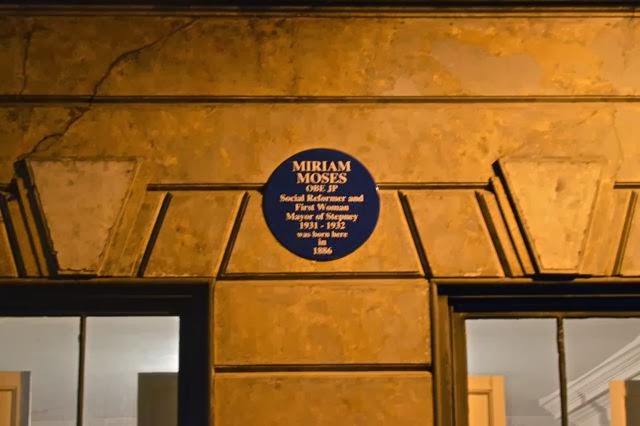
Something I learned recently was that many of these blue plaques are not official in the sense that they have not been approved by English Heritage the body that has historically granted sites this status. This is just such an unofficial plaque. This one does not even indicate upon whose authority it has been put in place.


By the time I made it around to 19 Princelet Street it was really rather dark and I got to see how my new camera really did a better job than my old little pocket camera. Expect better night shots from now on.


I had tried on the Alternative Tour to take a picture of this metal sculpture that sits on the top of a post beside Christ Church. It had simply been a blur and so here is it is. The way these different tours were interweaving was, I realised, a consequence of them taking place within a concentrated geographical space. When I made the Stuttgart Tour of Tours I was taking the entire city as my frame and as such had to construct connections whereas here they were happening very naturally. 


Here for example was my first Jack the Ripper tour group of the evening. I was finishing around 5.15 PM and the Ripper industry had already started for the evening.


Which led me to Jack the Clipper on my way between point 16 to point 1 the start of the circular tour. I had heard that the Ten Bells pub had tried to change its name to a Jack the Ripper Theme pub but backed down after protests from women's groups. This barber shop was not so inconvenienced. This then completed my tour and my abiding feeling was that this tour was constructed simply to get people walking it being framed as a healthy and interesting activity. The booklet was part-funded by the National Heath Service and there was a section extolling the benefits of walking. The quotes were a bit random so they never constructed a very precise narrative or theme beyond 'this is all historical stuff that people once wrote about this place'. This meant that I was rarely that deeply involved in the tour on offer but was able to use it as a way to consider the space and how it is to follow a written guide rather than a live guide.  

Friday, 6 September 2013

The Sun Walk: a continuous dawn to dusk walk in the direction of the sun

For some, a self-guided tour simply means taking a tour without a guide accompanying you and showing you the way. In this sense, the Memoryscape audio-tour of Victoria Park, reviewed here on thetourofalltours, could be described as self-guided. I found, however, that when taking that tour there was both a voice and map offering me directions along a distinct, predetermined route and that I either followed the tour as it had been laid out or I did something else. There was very little room for me to exercise my own choice of route and still remain on that tour. If I try to imagine a self-guided tour in a way that excites me I like to imagine it more as a tour that requires the walker's active contribution to a significant degree. This is, admittedly, a blurry definition and it might be good to do a few tests around the margins to see how well it stands up, but for now it works well enough for me.


This is an example of a self-guided tour I made in 2003, though it might better be described as a sun-guided tour. What I did was to begin this day-long tour at sunrise on Trafalgar Square and then walk in the direction of the sun until it set in the evening. Using the sun as my guide, I walked first eastwards, veered south as the morning wore on and then made my way more towards the setting sun in the west, though with less energy as my legs tired in the late afternoon and early evening, thus accounting for the asymmetric pattern of the walk. I finished south of Croydon. 


The ways the roads are laid out did not allow me to follow the sun as precisely as I would have been able to had I been on a vast expanse of open land. Instead, I had to work with the contours of the road layout which, in South London, is cut up and obstructed by the many overground train lines that criss-cross it. I was frequently confronted with a choice of paths and had to decide which of them would most likely allow me to continue walking towards the sun the most precisely. This, then, is a tour of South London that I would call self-guided as I both had the idea (which has almost certainly been done before but by whom or when I have no idea) and had to make many choices of which way to go in the moment of making the walk. I think of these two aspects of conception and execution, it is second, the choosing the path as I went that was the more significant. I believe it is possible, even inevitable, that when you take someone else's concept for a tour and then try it out yourself, you'll experience vastly different results.