Monday, 9 December 2013

The First Thursday Tour: Whitechapel Gallery's free bus tour of exhibition openings

The First Thursday Bus is a free bus tour that you can take on, unsurprisingly enough, the first Thursday of the month. It has been running a while now and it is part of the much broader First Thursday initiative by which East London galleries stay open late and often hold not so very private views the same evening. The bus tour departs from Whitechapel Gallery and takes you to a selection of participating galleries.  


I was instructed to arrive at 6.45 in order to pick up my ticket. Upon arrival I found the front desk besieged with hipsters as there was another event taking place in the gallery that evening and people were picking up tickets. The staff were ticking off names, answering the phone, handing out different coloured stickers for the various events and answering the inevitable random questions. There was also a 'meet-up group' trying to form amongst those standing around but nobody seemed to know who was and was not part of that group so it  was slow to happen and more than a little self-conscious. Next to this there were book stalls and some people selling raffle tickets for a youth project. It was proper London art bustle.


The tickets for the tour were not all collected so someone from the gallery went around checking to see who was on the waiting list, handing out yellow stickers accordingly. Because it is free to enter into the ticket lottery to go on the tour (you apply a few days in advance) there must routinely be quite a number of people who do not collect their tickets. If you really want to do this tour then, it is probably quite possible to get on it simply by arriving in advance at around 6.30 and adding your name to the waiting list. Nothing beats actually being there.
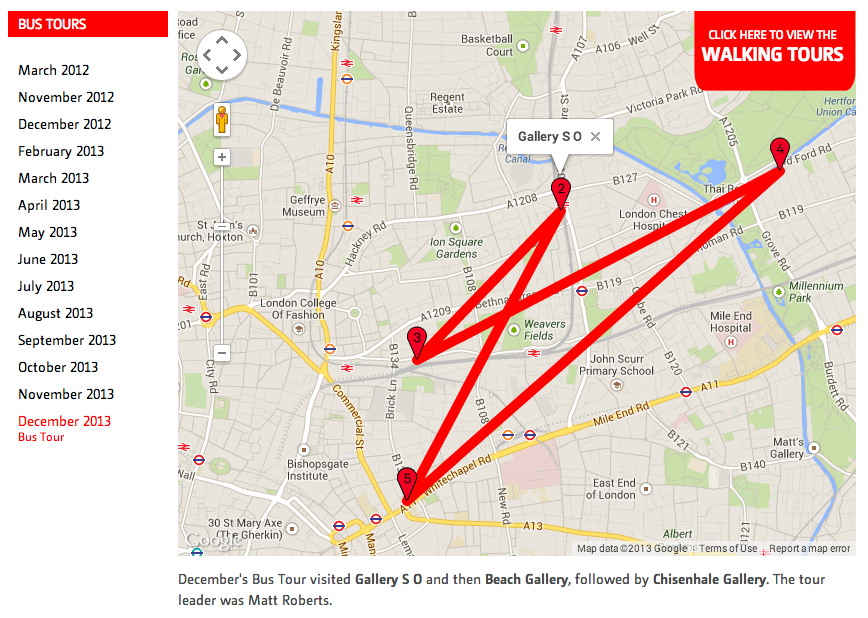


I don't how it happened but the map of the tour on the official website is wrong. As well as having no number 1, Gallery SO is actually located on Brick Lane and not north of Bethnal Green as shown above. The rules dictating the shape of the tour, as far as I understand them, are 1) it starts at 7PM 2) visits 3 galleries in the East End and 3) returns to Aldgate East at around 9PM or shortly after. This time frame is set so that it works with the timing of the private views most of which are winding down by 9. It is interesting to note that there is another First Thursday tour also available from the gallery and that one is a walking tour which obviously covers a shorter distance. Common to both are these bold red lines which connect one gallery to the next like a teleporter zapping you from opening to opening. For those pounding the pavements they must therefore decide for themselves how to make their way from one point to the next as the precise walking route is not specified. Some roads might present themselves as the obvious path but there is an element of active choice here as it is not always obvious. While at first I thought this an oversight I now see potential in deliberate ambiguity and will have to file this thought away in order to retrieve it at a later point when I need to direct people somewhere but not direct them too precisely.  


The bus was waiting for us outside the gallery. It was a nice comfortable Mercedes.


The 20-odd seat bus filled slowly and there were quite a number of empty seats. It was perhaps a little over half full and I had the whole back row to myself. We left Whitechapel 10 minutes behind schedule, probably the result of the ticketing being so complicated and hoping a few latecomers would arrive to bolster numbers.


First stop was SO Gallery which I was excited to enter because it had already featured in the Sound Map Tour I had taken barely a week before. This overlapping of spaces is what happens when working with several tours that cross a more restricted geographical space. It invited me to speculate whether there was a connection between the Jewish heritage referenced in the previous tour and the art of the current one. 


After the gallery's curator said a few words we then got an introduction to the exhibition from Leo Fitzmaurice, the artist whose work filled the space for his solo show Post Match. He talked about his inspiration and process but generally avoided trying to define the meaning of the work too firmly. The exhibition comprised of the tops of cigarette packets that had been unfolded and modified in order to look like footballer's tops. It was a simple idea that was well realised and which allowed for many connections to be made between the worlds of smoking and football. To me at least, it invited a semiotic reading of these two fields that had been unified in the artwork, and the subsequent rubbing of tangential orders of symbols (eg. the Bundesliga vrs cigarette brand design) against one another to produce new meanings. Thinking about this further the CH N KATZ. sign above the window is not so different, or at the very least, has the potential to create a similar crossover of symbols.


When I stepped out of the gallery I saw someone I know, Hydar Dewachi, being dragged into a disagreement with a man on the street. It seemed to be about the right to take photographs and the man on the left appeared to be angry and looking for someone to shout at. I was about to jump in and come to Hydar's defence but the tour bus was waiting for me (I was last person to leave the gallery) and my intervention would probably have only escalated the tension. I later heard that thankfully things resolved themselves OK. It was for me a moment that popped me out of the First Thursday Tour and into a very different situation. I guess most conventional tours function like worlds unto themselves and such events do not happen though I did notice that on the Winterthur Tour people taking it bumped into friends of theirs who happened to be passing in the street, so this is not unprecedented. 

Developing this idea, it amuses me to imagine tours that encourage this fluidity more, either by deliberately going to places connected to the individuals on the tour or going to public meeting spots where such things happen as a matter of course. This First Thursday Tour did already have something of that quality as First Thursdays is, for people connected to the London art world, a significant monthly socialising event. I did in fact bump into another person I knew while waiting at Whitechapel Gallery and met him again later in the evening on the street outside. This happened because I  was in a context I have a place within. As for general public meeting spaces, those are few in number in London as the city is large and anonymous. In smaller cities these function better, such as the pedestrianised cafe zone in the centre of Zagreb. Even there though, it is not a hub for everyone but it does function far more effectively as a random meeting zone to the extent that if you are in a hurry it is a place best avoided. 


Dave Roberts, of Dave Roberts Foundation was our tour guide. He gave a brief introduction at the start of the trip and said a few words about each space, like he is doing here, before we arrived at them and the coach emptied. The coach was in fact very well equipped for guided tours, there was even a microphone just to his right that he could have used in order to look and sound like a proper tour guide. He was never going to go there however.


Beach, the next gallery we stopped at, was smaller and much more crowded. They were showing the work of an artist usually associated with street art who had recently moved into making ceramic 3D works. There was also another event taking place simultaneously in the gallery and a woman was handing out bottle after bottle at the entrance. I was less excited about the work, indeed there was less of it on display, this place was more about meeting people and taking advantage of the drinks. On leaving I took one for the bus ride.


By the time we were back on the bus and moving agin we were running late and our last stop was still a little bit of a drive away and the traffic was inching along Brick Lane. By this time a few people had dropped out of the tour and a new couple had joined us as there was plenty of space. There was in general a more informal atmosphere on the bus with the drinks flowing and people chatting to one another who an hour and a half ago had been strangers. Drawing close to our destination Chisenhale Gallery, we were given another short introduction as to the sort of gallery it is, namely a publicly funded space that typically offers rising artists their first major solo show in London. 


We entered and were immediately asked to take our shoes off before proceeding any further. I have heard of performances at which the audience is required to be fully nude, fortunately this was a more modest request but one which changed our relationship to the space nonetheless.


We entered the gallery proper and sat on the carpeted floor in front of the screen and watched the video. Unlike the other galleries there were no drinks and there was no scene, in fact we were the only people in the gallery. We watched a video work of Jordan Wolfson that was a mix of animation and exterior shots mostly taken around SoHo in the artist's native NYC. The work was OK and reminded me of when I briefly worked for a SoHo gallery in the 90s but I found myself drifting off and asking myself how this piece of work ended up in front of me. I came to the conclusion that this is a two part question the first part of which is how I ended up on the First Thursday Tour: how the tour came into existence and how Chisenhale Gallery ended up on this tour. The other side of the question is how did this video end up being shown in this gallery and that is also a rather complicated issue, particularly as this was not the work's first showing and Chisenhale usually commissions. Both these questions are basically questions about the mechanics of the London (and global) art world where private and public money mix and different interests are served. A woman from the gallery talked a little about the work and why it was here when we were back outside but I felt there was a lot more to this encounter that was left unsaid. To really get inside of a seemingly simple question such as "how did I end up looking at this?" could easily be a PhD study in itself so I will not go any further here as I've probably already said enough.  


The evening ended when the bus dropped us off at Aldgate East a three-minute walk from Whitechapel Gallery. My over-riding impression of it is this is the sort of tour that does not feed you that much information but instead is rather open-ended and you can make of it what you like, depending on what you bring to it in the first place. Someone who hates art and thinks it pretentious will most likely come away thinking it was evening spent amongst tossers while someone interested in contemporary art and the edgy fashion of the London art scene will be right in their element and return bringing their friends next time round.

Thursday, 5 December 2013

The Sound Map Tour: an immersive audio tour of Brick Lane

The Sound Map Tour is an audio tour of Brick Lane and the surrounding streets. Like the Walk The Line Tour, it is also one that can be downloaded for free from the Internet, this time from the Sound Map Website. They have produced four London sound walks and these have been made on a commercial basis. Probably due to this Brick Lane walk being slightly out of date, you no longer have to pay for it. 


The tour starts opposite the Beigel Shop at the top of Brick Lane and is introduced and led by author Tarquin Hall, who stakes his local credentials by saying he once lived in a flat looking over the Beigel Bake. The tour begins with some words of warning, which basically amount to keep your eyes open and if anything goes wrong, take off the headphones and pause the recording.


Unlike the Walk The Line tour, this tour has been properly researched, a polished script written, it has been well recorded and a specially commissioned sound track added. There are even three interviews, such as one with the proprietor of the beigel shop. I couldn't say if the grey haired man standing behind the counter was or was not the man I was listening to, but the recording said he was with a man in his 70s so it is quite possible that I was hearing him speaking while simultaneously watching him at work. This uncertainty, not knowing if it was or was not him, added a pleasant ambiguity.  


The tour made its way down Brick Lane and I could not but notice Broadgate Tower in the background, itself the site of a number of tours that I've been researching, and which I will try to cover. Perhaps the most tangential of them is it being a stopping point on a Skyfalll film location tour. This most recent of Bond films had to work to a tighter budget than anticipated and the tower had to stand in for a Shanghai office block, as it was too expensive to film in China. You can see the building featuring heavily in the out takes video starting at 18 seconds. There are a number of different tours that will take you there as part of a Bond themed tour.


I was perfectly comfortable taking the tour without a map, even though there was one provided as a safety net. It was possible because the narrator had a system for getting people to the right place, holding them there while he was talking and then setting them off in the right direction to the next stop. It basically involved him saying walk to the next junction and stop at the corner. Some music would play or he'd continue his story and he'd check in to make sure you were on course. Once that story was complete, you'd go the next track and you'd get your instructions on where to walk next. The sound was, therefore, pretty much constant and this made the tour far more immersive than the other audio tours I have taken, where you are switching between recordings and map. This was much more like being inside a movie, in no small part also due to the sound design which added music and footsteps to the recording. There was just enough time to make it from one point to the next, though it might be a struggle to do this on a market day as you'd have to fight your way through the crowds. The one thing I had to keep fiddling with was the volume; sometimes there would be traffic backed up and I needed it loud to cut through the car engines, other times the street fell quiet and the soundtrack felt abrasive.


The tour took me to The Vibe Bar and the narrator talked about the changing occupants and usage of Truman's Brewery. The general idea was that change was a feature of the area and nothing new in itself. Every now and again, when something bad happened, the narrator would introduce it with, "Sadly, ...." which became a bit of a running theme not only about changes for the worse but also unfortunate historical events such as a racist nail bomb attack. 


I arrived at one of the more fashionable shopping and eating areas and sailed straight through.  


Continuing on the blue plaque theme from previous tours, I spotted a further two on this tour. One is that of Anna Maria Garthwaite, who got a bona fide English Heritage plaque, and the other is Gizmo (a dog) who gets his own more homemade plaque outside the Golden Heart. I noticed that there is a website that attempts to record all the plaques and monuments in London. This would be the perfect resource for constructing a plaque tour. Standing outside the pub, the narrator  told me about the celebrity regulars, interviewed the landlady and encouraged me to pop in for a pint. I was however in a bit of a hurry so didn't take up the offer.


I passed the Ten Bells and got a short history of the pub's connection to Jack the Ripper and heard  how the pub was for over 10 years named The Jack The Ripper as you can see on the right. Not a pub popular with the ladies, I suspect, back then. He talked about how the Ripper tours have been a local attraction and source of revenue for some years.


The tour took me into Taj Stores, a sizeable Bangladeshi supermarket, where the story of the Bangladeshi community began. Listening to an audio-tour out in the street is one thing but inside a store it becomes more curious as you are being told information about the people whose space you are standing in and who are right in front of you. What's more, they don't know that you are listening to someone telling you about them; you could be listening to Lady Gaga for all they know. This information gap can made me feel ever so slightly self-conscious, as if I were spying on them. 


The immigration theme continued down the road with the traces of the Jewish immigrants being highlighted. The remaining traces were relatively few in number. To compensate for that, klezmer music played while the history of Jews in the area was recounted. This music returned at least once again later in the tour and became a theme to announce "jewish section of the narrative" in the same way that there was an Indian sounding theme that returned when you were in the general bounce-down-Brick-Lane-moments of the tour. In this respect the music was there to always support the narrative, both thematically and rhythmically. This was an carefully composed audio tour and not a work of audio art that made you ask questions about the status of the different elements.


Somewhat inevitably, the tour again took in the mosque. The story was again that of tolerance and change in the area. I heard, once again, how the building had been transformed from a Christian to a Jewish to a Muslim place of worship. Having heard this a few too many times due to the professional distortion of being a reviewer of local tours, I was more interested in the Renault.


While the narrator talks and you make your way from one point to another, you do of course see things which are not directly part of the script. In fact the majority of the things I saw were not mentioned as he was busy telling a story not listing the objects I could see when walking down the road. Come to think of it, that might make for a rather unusual sort of tour: no story just a recitation of what is there... or was to be seen, when the recording was made. This is much in the mode of George Perec's Species of Spaces where, for example, he suggests, "force yourself to see more flatly" (page 51). I'm not quite sure how I'd describe these artery thickening sweets, but I certainly saw many trays of them as I made my way down Brick Lane. 


Cafe Naz was another point of interest. I stopped and listened to an interview with the owner about his thriving restaurant whilst looking at the building site which is what remains of Cafe Naz. With a walking tour this dislocation does not happen as the guide can change his story to suit reality but with an audio tour, whose narrative is fixed in time, this must be quite common. The narrator talked about the process of change and so this was, to an extent not as jarring as it might otherwise be. It does strike me, however, that this must be a major drawback for most audio tours: their limited life span.  


I then came to the end of Brick Lane and heard about the main local bank that is used to transfer money back to Bangladesh, particularly to the Syhlet region, where the majority of the Bangladeshis who have settled in the area were said to have first come from. I also heard how this has created not just a pocket of Syhlet in London but also a reciprocal pocket of London in Syhlet as people have taken back things they have learned to like here, such as marmite. 


The tour concluded on Whitechapel High Street, close to Aldgate East tube. My overall impression was rather positive: it was intelligent and skilfully put together. This form of immersive audio tour has the effect of taking you properly into the tour, but this in turn can have the effect of removing you somewhat from the place. It was not so long a tour, about an hour in length, so it did not feel like an imposition but rather it gave a condensed impression of the Brick Lane and its life, both past and present. The contrast between this and The Walk The Line Tour is great and goes to show what can be done with a bit of effort. 

Tuesday, 3 December 2013

The Walk The Line Tour


The Walk The Line Tour is a free audio tour that you can download from London Transport Museum's website. It comes as five separate walks and the one I took is the Shoreditch to Whitechapel walk. The Overground is the name of the line, or more precisely network, that this walk nominally follows and this network is a consolidation of a string of separate tube and rail services that were notoriously unpredictable. I remember one part of it being called the North London Line back in the 90s when it was a joker service that came and went pretty much when it felt like it. It changed hands and became known as The Silverlink Metro for a while, and under new management was only modestly better. There was something about the line that seemed intrinsically slack. This section of the overground, around Shoreditch, a section previously known as the East London Line, was always slightly different from the other tube lines; taking it was like entering into a parallel tube service. When I studied in New Cross I took it often and I remember the train announcements were sometime so informal that it was like being on a mini-bus with friends with the driver chatting and saying hello to everyone as they got on and off. It was smartened up for the Olympics and there is no chat now. There is, however, a community engagement policy and that is how, I suppose, this audio took came about. 


Shoreditch High Street Station is where the walk begins. The tour guide is a woman from the Boundary Estate Womens' Group and she tells you about the new station and she seems to be very happy with it saying they have regenerated the neighbourhood. She even expresses her hope that Starbucks can move in.


This is the map that comes with the walk and which you can either download onto your phone or print out and follow off the page. With the title 'Walk The Line' you might imagine that the newly spruced up line might feature as the defining element of the walk, but not a bit of it. As you can see, the walk first visits the The Boundary Estate then heads South down Brick Lane, goes by way of Spitalfields Market and Petticoat Lane Market, before heading along Whitechapel Road to its end point Whitechapel Station. The train line follows a very different route and heads first East above Allen Gardens crosses Valance Road then heads South into Whitechapel. This walk does not follow the line at all, but rather, uses the two stations as its bookends.


Following the map's suggested route I saw a long line of people queuing to get into this building. I tried to guess the purpose of the queue asking myself which celebrity was inside or what sort of audition was taking place but could not tell, so I asked one of the people. It was a discount designer clothing sale, which came as an anticlimax.


Round the corner I passed the local coffee shop, Allpress, which seemed to be doing a steady trade. I can't exactly see why Starbucks would be an improvement upon it, but then again, I'm not so into global tax-dodging brands in general.


I arrived at the first stop on the tour, the Boundary Estate, and I can only guess the tour took me there because the commission for it had fallen on the Boundary Women's Group. This is a way to say the estate was not on the route at all, quite the opposite, and there was conspicuously little to see here. The guide gave a very personal impression of what the area was like from the point of view of a local resident. She neither went deeply into the history of the place, just a few dates was enough, nor into her relationship to the place. In this respect local residents often know very little 'visitor information' about their neighbourhood and their knowledge is often more practical along the lines of where to go to top up your Oyster card without having to wait in a queue. On the other hand, while we all have relationships to the places we live in, transforming these into a tour requires a very specific set of skills that are not always sufficiently appreciated. I don't know the exact process by which this tour was put together, but something was clearly lacking and It may well be as much the fault of London Transport Museum for commissioning this group and not supplying adequate support to help them turn their stories and impressions into a half-decent tour. It could also be a case of me expecting more from a community project than either the community involved in making it or London Transport Museum, who commissioned it, ever did.


Leaving the estate and following the route I next passed Richmix on Bethnal Green Road. This is going to become a central spot on my tour of the area as this is going to be the starting point of The Tour of All Tours which will be presented by Richmix next Summer. Something I noticed that never struck me before, is that they have their own blue plaque beside the door. The Heritage Lottery funding plaque has copied the basic design of the English Heritage blue plaque and then squashed it a little so that it becomes oval shaped. This must constitute the second unofficial blue plaque spotted on these Shoreditch tours so far. More will no doubt reveal themselves. A final thing to mention is that I will be doing something in this venue before next Summer: on 31st January, Chinese New Year's Day, I'll be giving a performance of The Customer Is Always Wrong, in the studio upstairs.  


Making my way down Brick Lane I saw two artists at work on a side street. My interest in their work had been awakened from taking a street art tour, so I decided to take a closer look.


On that tour I was told that a significant aspect of street art is the legality of the work. Having heard how a street artist was sentenced to 2 years for defacing a train recently and how 5 years had even been handed out by a Sheffield court, I figured the two young women would not be taking their time to spray so openly if they faced similar treatment. That's why I was interested to take their picture and that's how I got talking to Lee Bofkin who was watching them approvingly. Lee, it turns out, has been instrumental in getting the site owners' approval for a great quantity of the street art in the area to be made legally, and for then promoting the artists' work. Lee said he was not, however, involved in street art tours at all.


A curious omission on the Walk The Line Tour was the old Shoreditch Station, just off Brick Lane. This nondescript brick building that sports some less consensual street art was the end stop on the East London Line. It represents the bad side of the neighbourhood and so was, I am guessing, not included in the Walk The Line Tour, a tour that had practically zero interest in the railway line. The park behind me in this photo is one that I remember hearing a funny, though wholly unverified, story about. The artists Gilbert and George, who live just around the corner, were walking through this park dressed in their identical suits when a gang of skinheads spotted them and shouted, "Oy! Get um!" The two conceptual artists knew the neighbourhood well enough to know this was no idle threat and had to sprint, high-speed, out of the park and back onto Brick Lane to avoid a good kicking. The scene somehow reminds me of the closing sequence of The Benny Hill Show, though through a more violent East London lens.


The walk took me past the many vintage markets and food stalls that thrive in the area and which contribute to the current Camden Town-ification of Brick Lane.


The audio tour stopped somewhat short of the Mosque and talked about it having been a church and synagogue in the past, a line that is repeated in virtually every other tour, no matter what the subject of the tour may be. Even street art tours, like the one I stumbled across here, go over this history.


Next stop was Spitalfields Market. In the Spitalfields Stories Tour I mentioned how it had changed and become more corporate. This was an observation echoed in this tour, however, it was also one welcomed and it was described as a trendy place and one of the best markets in London. What was strange is that the guide went onto say that the things on sale were also very expensive no longer affordable to local residents. It was as if she was celebrating being priced out of her own local market. That's when I started to suspect that she perhaps had an idea of who I the listener was and that she was showing me the most up-market version of the local area that she could, in the belief that that is what I wanted to see. Today the market was hosting a vinyl day for independent record labels. There were a great many stalls selling records and quite a crowd of people milling about.  


Then I noticed Doug from The Alternative Tour bouncing up and down to keep warm beside the goat statue, the COSTA charnel house in the background. What's more Doug had a friend who, with beard, leather jacket and cap, also looked the part to give their tour. Later in my tour I did in fact notice Doug's colleague giving their street art tour. 


I then made my way to the next point, Petticoat Lane, where I noticed they have put up street maps that are oriented so that the top side of the map points in front of you as you stand facing the map and the bottom of the map indicates what is behind you. I have to say I dislike this sort of map and much prefer those that have North at the top and South at the bottom. I'm guessing that these sort of maps are more easily read by people who have never learnt to read conventional maps as there must be some reason why they are springing up right now; I saw then in Glasgow city centre recently too.


There was a short description of Petticoat Lane Market, again from the point of view of a local shopper, but what was more captivating was the film that being made on the street. It looked like a low-budget film as there was not the usual paraphernalia of the film set, but the director and cameraman were planning their shot carefully and rehearsing the movement of the steady-cam.  


Then the street came alive with a bike gang. At first I wondered if this was a flashback to the Critical Mass Tour from a few nights before but no these cyclists were in fact the extras for the scene: a gang of 8 young men on BMXs. They cycled at speed towards the council estate and then charged up the stairs. I was then taken back to the idea of the image of the city being fashioned more through movies than reality and was reminded that the image of the city is not consistent, people in the area sometimes have access to professional quality equipment and also participate in the generation of images too. The identity of the city is multiple and contested, not the sole property of Harry Potter and Sherlock Holmes.


The walk then took me on a long stretch with no audio along Whitechapel Road. There are two tours that this dreary trudge brings to mind. First of all, the blue paint on the road indicates CS2 the 'cycle superhighway' upon which four cyclists have been killed so far, with more deaths seemingly inevitable. One indeed was killed at the junction in the background. I wouldn't advise anyone to take a bike tour of CS2 unless they were a TFL executive. This story of the failed transport strategy was very much the subtext of The Critical Mass tour I recently took. The second tour that I had to think of was the Whitechapel Gallery First Thursday's Tour. This is a free bus tour which you apply to by lottery and which takes you to a number of gallery openings in East London on the first Thursday of the month in the company of a curator. I added my name to the lottery and am pleased to say have just been offered a place on the tour this week. Review to follow soon.


And so I finally came to the Starbucks that has been denied Shoreditch. I did not dally.


A little further along Whitechapel Road I saw a Tesco supermarket set back from the main road. This brought to mind something I heard about a coach tour recently. It was a coach tour to Stonehenge and Bath and one of the passengers was a girl who particularly liked shopping at Tesco because, she said, they have good meat and dairy. Apparently, for the whole tour, she kept on commenting, "Oh look a Tesco" when the coach passed one. Not information that the tour guide included in his commentary, but something that the other people taking the tour got anyway.


There was a brief stop by the East London Mosque and a few comments about the Citroen Garage on the side which apparently was the site of a no longer used station. The guide said she herself did not know about this lost station until recently either and this gave me the impression that she had done a little bit of local history research prior to recording to tour so that she had enough to say.


Final stop was Whitechapel Station which she described as a place, "we all know and use." This again thew me as to who this "we" was. Was this a tour by and for local residents, or for whom exactly? I couldn't exactly say. Anyway, Whitechapel station and market was its usual unruly self and this brought to mind the Olympic Marathon route change that I mentioned on a previous blog. Despite official assertions that the reason the race would bypass East London was not because the area is poor and would give a negative impression of London to the global audience, it is hard to see the snub in any other way. The marathon is, after all, a tour of the city that presents it in a very specific way through the interaction of sport and architecture. 


Thankfully POPLAR TV was at hand to cover the 2012 race in the satirical McMarathon report.