Showing posts with label bus. Show all posts

Saturday, 5 November 2016

The Dazu Rock Carving Tour: an international artists' group brings fresh eyes to a Chinese package tour


I consider myself a veteran having taken quite a number of Chinese bus tours. Almost every time I've been on it has turned out to be so bad it has been paradoxically great; there is a perverse pleasure in being shunted around as one of the masses within the world's largest domestic tourist industry. Today was going to be another tourist bus experience, a day trip to the Dazu Rock Carvings. There was to be a curious twist, however. The group was made up of artists and curators from around the world brought together for an exhibition in the Chongqing and now enjoying a day off. Many of the foreigners were new to China and most had never been on a package tour like this before. Little did they know what was awaiting them.


We got off in style with the bus waiting for us in a different place to where we had been told to assemble and when we finally connected, we were then driven through the mounting morning rush hour traffic to a point in the city centre where we disembarked and waited for a new coach to take us onwards. This quickly came and we were carried off again into the thick of the now slowly creeping traffic, our guide urging us, in Chinese, to relax. Mystified but excited to be rolling out of the city, we finally reached a B-List stop-over attraction after an hour or two. This turned out to be a newly reconstructed historical site that housed a few souvenir stalls. It seems its primary purpose was as a toilet stop.


We broke out into groups and seemed to quickly exhaust the site's potential, our visit lacking any context or, beyond the restrooms, purpose. The thirty minutes we had to look around were more than enough.


Our next stop, the China Dazu Best Kitchen Culture Museum was another story completely! This was a place that stretched the definition of museum to well beyond breaking point: it was very plainly a shop and restaurant with an attitude. The Dazu in the title is the giveaway: this meant we had arrived in the vicinity of our destination, the Dazu rock carvings. The 'museum' was a coach party's lunch and shopping stop par excellence. What's more, looking around it in the company of a group of artists new to China, allowed me to relive my first encounters with Chinese bus tours. Some were downright incredulous.


The best that can be said about the lunch was that it was adequate in quantity, though half my table of nuisance weirdo non meat-eating foreigners (myself included) wouldn't touch most of it.  


We went back through the 'museum' which merged seamlessly into a showroom and shop. Outside, three old ladies were selling pomelos which turned out to be both good value and fresh. I think I must have spent more time with them than I did with the exhibits.


We finally arrived at the Dazu rock carvings where we were separated into a Chinese speaking group and an English speaking group. We weren't briefed on the site beforehand so didn't really know what to expect, but by this time it was clear that the best attitude to take was just to relax into the experience and let it be whatever it was going to be. We were joined by an American doctor and his Chinese student, who, for a while seemed to become our guide.


On the site proper, a new guide took over. She introduced herself as Angela and she told us she was a native of Dazu who had been giving tours for several years. She spoke through a microphone which relayed her voice into our headphones. In this way the there was not the usual earsplitting chaos of competing amplified guides that often come in places like this. What's more, her English was quite clear and she seemed to actually like and respect the place. 


She did have this habit, however, of sometimes sounding too rehearsed. For example, at one point she said the women of Dazu are known for their beauty, and as she said this she put on a falsely modest smile and tilted her head to one side. This might have been a spontaneous comment and gesture she once made, many years ago, but by now it seemed to me to have hardened into a moment she performed every time she stopped at this point. I understand that it is perhaps too much to expect that she gives the tour for five years in a foreign language and still sounds fresh. I was happy enough with what we got, which was already significantly better than average. Still, this makes me think that tour guides and actors performing long runs face a similar problem of appearing stilted. Their solutions are often different though not unrelated. From what I've seen, the most successful tour guides get over this difficulty by making their tours more interactive, primarily opening up to the group they are leading but also sometimes responding, in the moment, to the living site they are visiting. It might be a stretch, but you could say this is the tour guide equivalent of the Meisner method.


I have to admit I was more interested in the carvings depicting hell than those showing heaven. I never imagined the Buddhists would be so thorough in their administration of suffering. It seems to me that hell lends itself more to art than heaven: there is greater drama in suffering than in comfort. I immediately though of the Chapman brothers' Hell sculpture which exaggerates and locates torment to such a degree it reaches a level of black humour.  


The most famous carving, the 31-metre long sleeping Buddha, was under wraps and was barely mentioned. As the tour went on I started to realise that our guide was not just contextualising a historical and artistic site, she was also using it to deliver the messages of the sculptures. The site, I learned, was educational and devotional and, contained within the carvings, were many stories and morals drawn from different sources (Buddhist, Taoist and Confucian) instructing the viewer how to live. We were therefore treated to some of these ideas, and when she finished telling us to be nice to one another she tilted her head to the side again, and give a little smile. 


The Buddha was not the only one sleeping. Once out of the gate it was not so much a case of exit through the gift shop as exit along the gift shop road. There was a relentless duplication of stalls at each of which sat, or slumbered, mostly middle-aged women. They sold a fantastic array of Buddhist souvenirs riffing off a rock and stone theme, factory produced antiques, plastic replica swords and tray-loads of shiny plastic children's toys. Business was decidedly slow and I counted at least three stall owners who had slipping into their afternoon nap. 


We were urged, no implored, to take a ride back to the coach in one of these cars but a group of us walked anyway. There was a bit of a cultural difference here. Most Chinese tours I have taken try to reduce walking and physical exertion to a bare minimum. I can only speculate that this is because using the body is associated with physical labour, poverty and the past whereas tourism is modern, effortless and connotes wealth. Still, walk we did and, as well as saving ourselves 5 RMB each, it brought us once again to the monumental pastiche structures that clustered around the entrance. These behemoths testament to a fetishised history that announces YOU HAVE ARRIVED at a national level tourist attraction.

Sunday, 25 September 2016

The Dublin Bus Tour: what sort of authenticity do you want?


When I learnt that Dublin Cityscape offers a circular bus tour of the city that is almost half the price of their main competitor, I was immediately sold, which maybe earns me the title of Dublin Cheapskate. We piled aboard at St Patricks Cathedral and took to the top deck. This first part of the route turned out to be a particularly desolate stretch; public housing in a state of mild decay, empty plots abandoned to weeds and tedious corner shops selling a predictable arsenal of goods with which to assault body and mind. To compensate for this, the driver sang us a song about a fair Dublin lady. He sang like... a bus driver.


Here is the bus's route, shown in green, which sort of resembles a bug with two antenna pointing out to the left. There were some deals thrown in at stops along the way, one them being a €1 discount on entry to the rapidly approaching Guinness Storehouse. It was a little too early in the day and we were not even 30 minutes into this two and a half hour bus tour. Another time. 


Viewed from the top deck of the bus, the city often appeared very ordinary; a mish-mash of unspectacular buildings hosting a chaotic assortment of business and people. There was no obvious magic, it looked much like a middling British city just about keeping its head above water. This first impression of Dublin lacking in style did change over time and once the eyes adjusted and I learnt more about the city's substance, the place grew on me. That process took more time than the two and half hours of the bus ride, however. Because this was a relatively long tour that included more than a few B-list locations, it inevitably showed a more flat and realistic portrait of the city. 


It would be unfair to say that the tour was uniformly mundane, however, it did also include the formal side of the city such as the official residence of the president, even if it was only seen from afar. The driver's stories and jokes were considerably better than his singling and he did include a joke about the building's current resident, the diminutive Michael Higgins.


After what seemed like an age spinning around interminable suburbs, we finally came to the city centre. Actually, it was an age of driving up and down grey streets that was lightened up  with some creative nicknames for places and monuments, the best being "the floozie in the jacuzzi". The one topic he kept returning to was the Easter Rising of 1916 which lead to the country's subsequent independence. As this year marked the 100th anniversary of this event that was to become the modern state's foundation story, it was something very much in the air. The General Post Office played a central role in the rising and we heard much of the fate of the leaders, executed by the British Army.


Time was ticking and we made a lunch stop to take advantage of a two for the price of one meal promotion that come with the tour. This was also the opportunity to try a drop of the iconic beverage and assert that it is much better drank locally. It was a fine pint but I must say I have also tasted great Guinness outside of Ireland. I rather think this aura of authenticity, drinking at the source, so to speak, is a little exaggerated. Yes I appreciate that the general standard is probably higher over here but there is also an element of exclusivity in saying you have travelled and sampled rather than just stumbling round the corner to your usual dumb local in Hounslow. Whether it be national pride or touristic kudos, there is every reason to continue to assert Guinness is better in Dublin because those who have not tried it are in no position to refute the claim. So I should rephrase my opinion: it was a superb pint, so much better than anything back home.


On the subject of beer, hopping abroad the service once again and driving on, our new driver pointed out the Dublin Convention Centre which, he said, looked like a giant can of beer being held to the mouth. If that is the product of an alcoholic imagination, I must also share one with him, it does fit.


The new driver continued more or less where the old one left off with the Easter Uprising, a narrative that was reinforced everywhere I looked. I read an interesting article How does Dublin remember? that makes the point that the manner of the remembrance is very much a reflection of the contingencies of the present. Apparently, until quite recently, the 1916 guided tours where very niche and given almost exclusively to tourists. That has changed with the implementation of the peace process in the north and 1916 less associated with an ongoing armed conflict. A noticeable absence in the narrative, however, was the Irish Civil War which followed independence, as that, presumably, could still be divisive. The Ken Loach film The Wind That Shakes The Barley is set in that period and is centred around the question of, what sort of state were the Irish rebels fighting for. It's well worth watching if, like me, your history classes at school studiously ignored this important period of Irish and British history. Not the final word, but a good place to start.


The day was wearing on and I spied one of the company's employees in the depths of a mid-afternoon lull. I remember that feeling only too well from countless summer jobs that were a character-building blot on my teenage years.


The bus stopped beside Trinity College and while waiting this song, And The Band Played Waltzing Matilda, played through the sound system. I heard it afresh and, for the first time,  made a connection between Irish soldiers (then part of the British army) fighting in the 1st World War and the battle for independence that had begun back home in Ireland. That is a connection not in the original song by Eric Bogle but is a new layer that comes out in this cover of it by The Dubliners. Ronnie Drew's voice is well-matched with this song and I'm guessing his is the voice that bus drivers aspire to, a seemingly artless art that is, of course, very difficult to actually produce. 

And the old men march slowly, old bones stiff and sore. They're tired old heroes from a forgotten war.

And the young people ask, what are they marching for? And I ask myself the same question.


There is only so many hours you can spend viewing a new city from the top of a bus and it was high time to continue on foot. We pulled up beside a very louche statue of Oscar Wilde and shortly afterwards spilled out onto the street. The driver had mentioned the literary greats and how they were celebrated in the Dublin Writers Museum. When I stopped to think about it, however, they all left Dublin. I was already familiar with this phenomenon coming from the city of Portsmouth which tries to claim Charles Dickens and Sir Arthur Conan Doyle as its own on, I should add, considerably more tenuous grounds. Nonetheless, the fact that Wilde, Shaw, Joyce and Beckett all left the city in order to make their names, is not a side issue. For all the Bloom's Day celebrations that have become a part of the city's calendar, those who stayed and those who came are, I would suggest, the city's greatest literary heritage. 


And so off the bus and into Temple Bar we strode where yet another version of the authentic Dublin was on display. I daresay if I lived in the city I'd avoid the area like the plague because of the tourists, junkies and high prices. That said, unattractive though it may be, it certainly was a spectacle and might well be, for many visitors, the city's definitive one. Which sort of authenticity did I want? All of them, I'd greedily assert, and more besides. Two days was not enough.

Monday, 12 September 2016

Way-losing in London: how to get lost in the capital


Some years ago I produced a map, not unlike the one above, which re-imagined London by stripping back the names of tube stations so that they simply described what was to be found at their site. Oxford Circus thus becomes Circus while Westbourne Park can be renamed either bourne or Park. One of the ideas here was to remove the familiar markers, often denoting ownership and association, and to see afresh the city as a collection of sites. 

This is a detail of the above map that includes our starting point. Since we has not decided whether we'd be venturing north or south of the river on our disorientation mission, it felt right to begin our journey in the uncommitted zone of a bridge over The Thames. We set out  in the direction most of us knew the least: North West. This didn't initially yield anything very unusual; we quickly arrived at a barrier clad Trafalgar Square with bikes circling and modest crowds murmuring their modest approval. As we snaked our way through Mayfair and Marylebone we stopped to discuss what being lost might look like and in response to this, we switched our logic of navigation several times so as to remain on the scent of being lost rather than progressing in too calculating a way towards our indeterminate goal. While none of the various approaches could possibly deliver us to the promised land while still in this most familiar of terrains, they all did their part in paving the way. We became more sensitised to the particularities of the sites we encountered, though unlike the above map where they sit isolated from one another in a sea of white, ours were still connected by our mental threads.


We squeezed onto a bustling double decker heading north and after some time stepped out at what was to be a random, and hopefully mysterious, bus stop. Chance delivered us to Golders Green, a Jewish neighbourhood in NW London that was, for a few of us, still relatively familiar. Getting lost was not going to be so easy after all. We walked through some side streets now thinking about an afternoon pause, and whilst I was chatting away on the subject of New York City's space vrs London's, we happened upon a pizza and sushi canteen. Their margherita was indeed the New York style: thin crust loaded with cheese. We ate and took stock of our wanderings.


The afternoon continued with an altogether more concerted attempt to break the mental map by alternately leading and being led through the streets with eyes closed. We must have looked quite a sight: several couples tottering slowly along quiet backroads, narrowly avoiding trees, lampposts and bushes. Forty minutes later, we arrived at a state of complete disorientation. This best stab I could manage at our location would be to say we were 'somewhere in the Golders Green area', beyond that and I'd just be making it up. 


Our endpoint revealed itself when I opened my eyes onto a large suburban house with a curious public / private bench marking its perimeter. Unlike previous attempts at way-losing (Beijing, Birmingham, Santa Cruz de Tenerife) where there was equal emphasis upon the construction of narratives, we were way too solid with our London directions so had to approach the problem of getting lost very directly. This black and white house, then, was familiar as an idea when I looked at it (I had previously lived in Stamford Hill, another Jewish neighbourhood in London) but when I started to examine it and the roads passing in front of and behind me more closely, they became not so familiar after all. The more I looked the stranger and more particular it seemed to become. This corner held all manner of details in excess of my first impression of the place, an impression I might very well have stuck with if I were passing through normally. Not being able to locate this place, then, made it all the more vivid as it had escaped the illusion of control and mastery. Walking on from here and attempting to now find our way, the roads remained more alive. A voice from a distant PA drifted over, an inscrutable enthusiasm that could have been intoning anything from children's sports to ethnic cleansing. Roads looped in on themselves refusing to behave. For a short space of time, I found again the newcomers bewilderment. This makes me realise that this fragile state should not be surrendered so quickly but rather savoured to the very fullest. Watch out for this next time, which should be happening later this autumn: details coming soon!

Tuesday, 19 April 2016

The Shanghai City Sightseeing Copy Bus


I had noticed the City Sightseeing tourist bus passing me several times in the last few days but resisted its lure as I had already been on their Bath Tour and Stuttgart Tour. They really are the McDonalds of the tourist bus world running their operation in some 35 countries worldwide. I looked more closely at their display, however, and realised that this Shanghai outfit are not connected to them at all, they are owned by a Chinese budget airline who have lifted the name and branding. They are the fake City Sightseeing. I needed no further convincing and, with my wife, bought two 24-hour tickets.


The upper deck was jammed full so we went downstairs, plugged in the headphones and listened to the commentary. It was anodyne stuff delivered in a smooth, slow voice by an American woman: the sound of corporate America fine-tuned for an international crowd. What piqued my interest was the Kenny G soundtrack. While his music is more likely to raise sarcastic comments in the UK, they have a thing for him in China. His music has, since the 90s become the byword for Western sophistication. Until recently, his smooth saxophone was the default soundtrack for cafes trying to appear upmarket, it might still be in less developed areas, I have been into outdoor parks that pump Kenny G and his song Going Home has become the unofficial 'time to go home' music that establishments play at the end of the day. 


City Sightseeing offers five lines that cross the city and it is excellent value for money with a 24-hour hop-on hop-off ticket costing just 30 RMB ($5). The service is mostly popular with domestic tourists but there was a smattering of foreigners too.


After a little while, the bus pulled up where the red and green routes converge and over ambled a man selling drinks in an innovative way. He lifted his bamboo rod up high and from  the top of it passengers could grasp a bottle of water and leave the money for it. Simple but effective. We pulled away and a young boy in front of us immediately started wriggling uncomfortably. His mother unceremoniously lifted him up, tried unsuccessfully to get the driver to stop the bus, then took him to the door in the centre of the bus where he started peeing. All this to Kenny G. We went upstairs at the first opportunity.


The consoles were in multiple languages but, interestingly, the information was not identical. In the Chinese commentary, but not the English one, the guide told passengers not to toss rubbish over the side of the bus from the top deck.  


The soundtrack was activated by GPS: as the bus travelled forward it triggered a new track that referred to a building by the side of the route up ahead. The snag was, sometimes the bus travelled quickly and we skipped onto the next track without ever finishing the previous one. This is an endemic problem which buses that use recordings, rather than live guides, inevitably face.


One thing this tour did do was introduce me to many new bustling, unfamiliar sites in the city centre. Every two minutes the bus would round a new corner where there was again a similar mass of bodies. I should be used to it by now since I live in China, but the sheer numbers remain dizzying. Shanghai has an official population of 24 million and unofficial estimate of 30 million. While I had absolutely no desire to step out and be absorbed into these crowds, it felt good to observe it in order to get a sense of scale.


The bus sometimes got stuck in unglamorous spots such as beside this toilet and refuse site. I'm not sure, but there might also be some recycling going on in this place; there certainly was a lot of it on the audio recording. I remember hearing the same story about how the city got its name and its symbol at least three times. It seemed that whenever they didn't have anything very interesting to say they'd just stick this story back in there one more time. Well, either that or the Kenny G song Jasmine Flower.


The bus seemed to move forwards through the Shanghai traffic in fits and starts and filled up and emptied with little obvious rhyme or reason. The driver occasionally shouted instructions into the microphone, a frustrated Chinese Dalek, but the tourists ignored him content in a world of their own. When you add to this a jumping and repeating soundtrack of corporate america reading communist history, washed down with sugar-coated easy listening while a kid is peeing and tourists scrambling for seats, you start to get the City Sightseeing experience. In a sense this tour is not so much about Shanghai, it is about Chinese mass tourism, but it unfolds on the streets of the city and it required a city like Shanghai for it to happen this way. Discontinuity and plain incongruity are its specialism and, I have to say, compared to their Western namesakes, Shanghai City Sightseeing is much livelier, not to say better value too. Given a choice, I'd pick this copy over the original.

Tuesday, 23 June 2015

All Berlin's Tourist Buses Go to Checkpoint Charlie


I've just arrived in Berlin and started to assemble a Tour of All Tours of the city for this weekend's B-Tour Festival. I'll be making my tour in the city-centre and talking about the city as a whole. My starting point, Checkpoint Charlie, is so much worse than I remember it. It really is quite ideal! There is not just one Checkpoint Charlie museum but three separate, competing attractions all vying for the tourist's euros. That's to say nothing of the tours that pass by here, such as this Segway tour. This place is pure tourism whereas my endpoint, Brandenburger Tor, does at least combines tourism with something else: politics.


Something that has immediately struck me is the large number of bus tours that operate in Berlin and come this way. 


I took a short walk around my tour area and started looking out for the competition. The reason for this abundance of buses, I can only imagine, is the distribution of the tourist attractions across the city. If they were all within walking distance or, if there were enough packed together, then walking tours would be more popular. 


Some of these buses offer live commentary and some of them simply play recordings, in multiple languages, over headphones.


I saw City Sightseeing are running a bus operation here. I am familiar with them from having taken and reviewed their Bath bus tour. This has got me thinking that I will be drawing heavily on previous tours, such as that one, in order to describe the tours that take place here in Berlin. I will add a few unique to city too; I'm heading over to the Holocaust Memorial to take their audio tour as soon as the rain lets up today. Together, they should comprise a full-length hybrid tour of Berlin and the tourist imagination more widely. I have 3 days to put this tour together so it will be fast and furious stuff!

Saturday, 15 November 2014

The Jade Dragon Snow Mountain Tour: altitude tourism in South West China

Jade Dragon Snow Mountain (玉龙雪山) is located near Lijiang in Yunnan, South West China. Lijiang's old towns, once beautiful places, have today become one of the country's top 5 tourist destinations and are swamped with tourism to the near exclusion of anything else. I am here for COART festival, an arts festival which has given me the opportunity to see something of this part of China. I'll write more about Lijiang subsequently but for now I will concentrate on the mountain.


There are different ways to go about ascending; in the old town there are many travel agents who offer package tours that include an ascent as part of a one, two or four day trip around Lijiang. Having already had the Chinese coach tour experience of The Great Wall I wanted to see how the site might reveal itself differently when travelling outside of the structure of a large organised group or, to put it another way, I had had it with the guide turning salesman at every opportunity routine and everything devolving into kitsch. This more independent tour of the mountain began, then, with some advice from the appropriately named K2 hostel, who gave the number of a driver. With the arrangements made for the next day, it was a simple matter of hanging about till she showed up. Yunnan is not a hurried place and it turned out she was waiting at a different gate to the village but, after a while, the van arrived and we got inside. 


She advised us to buy oxygen and pulled up in front of a shop on the edge of the village that sold portable oxygen canisters and nothing else. I've seen some specialist stores before and this place was up there with the best of them. The driver said it would be wise to take some and the man in the store was, predictably enough, more certain still that we absolutely needed to buy some and what's more, we'd need the large canisters. Not knowing what to expect, having never been to so high an altitude before, I suspected he was exaggerating in order to boost sales. Still, we bought two large canister anyway and got back in the van.


We drove for about 40 minutes and during this time the driver expanded upon some of the other tours that could be had in the area. It did not seem as if we were climbing that much, except at the end of the journey, but we must have steadily gained altitude. Lijiang is already 2400 metres above sea level and the base station where we were heading was well over 3000 metres. The air was thinning.


This is a view of the mountains in the background from the car park of the base station. Forget any ideas of Everest Base Station and rudimentary camps used for trekkers and climbers This was a huge car park with shops, a leisure centre and restaurants. They even have a Starbucks.


After buying the ticket for the cable car there was a half-hour queue for the shuttle bus. As is often the case here, we had to queue and a minority tried every trick in the book to jump it. The most common one, which was successfully deployed here, was to have one person in the queue up ahead then other people who vaguely know that person join them. It doesn't matter how vague the relationship is, as long as they could stand beside the person and say hello. And once in, everyone else in their group then joins too. Whole tour groups can sometimes work this technique of one person establishing a bridge and the other 20 then following. This queue was reasonably polite, later in the day when people were in a hurry to get back for dinner, such niceties were dropped and more brazen tactics employed. 


The queue took us not to the cable cars but to a bus that drove a further 20 minutes to the cable car station. Here we got out, queued some more and finally got into one of the 8-person enclosed gondolas. It pulled us high up into the sky and our rapid ascent began. Each time we crossed over one of the supporting pillars the gondola rocked forward and backwards prompting nervous laughter and some white knuckles amongst the 8 of us thrown together in the metal and glass box, dangling giddily from a line leading upto the summit.


As we continued to climb the trees gave way to rocks and snow. I am not so keen on heights, I get mild vertigo, so I looked forward as much as I could at the mountain coming towards us. When I looked behind me at the void stretching out below, I could imagine us falling down into it so easily that I quickly turned forward again. It is an odd thing that altitude does not bother me but heights do.


Arriving at the end of the line we spilled out into a loveless commercial hall that had the surprising addition of a green-screen photo studio. It wasn't in use so I couldn't see what photoshopped location you could be placed into, but the very idea of coming all this way to use a green-screen studio struck me as bizarre. I can only suspect that its purpose is to give you the edge over the other tourists in the altitude stakes by placing you at the very top of the mountain, rather than stopping at the final visitor platform some distance from the summit, as regular visitors must do. 


As you can see, the altitude here is an impressive 4508 metres above sea level. You can travel to this height without having to barely walk a step. That makes this a location that attracts tourists who might not otherwise make it to such an altitude, who, it could be said, shouldn't even really be there. 


From this landing the final ascent on foot is up a wooden staircase weaving around the side of the mountain and its glacier.  


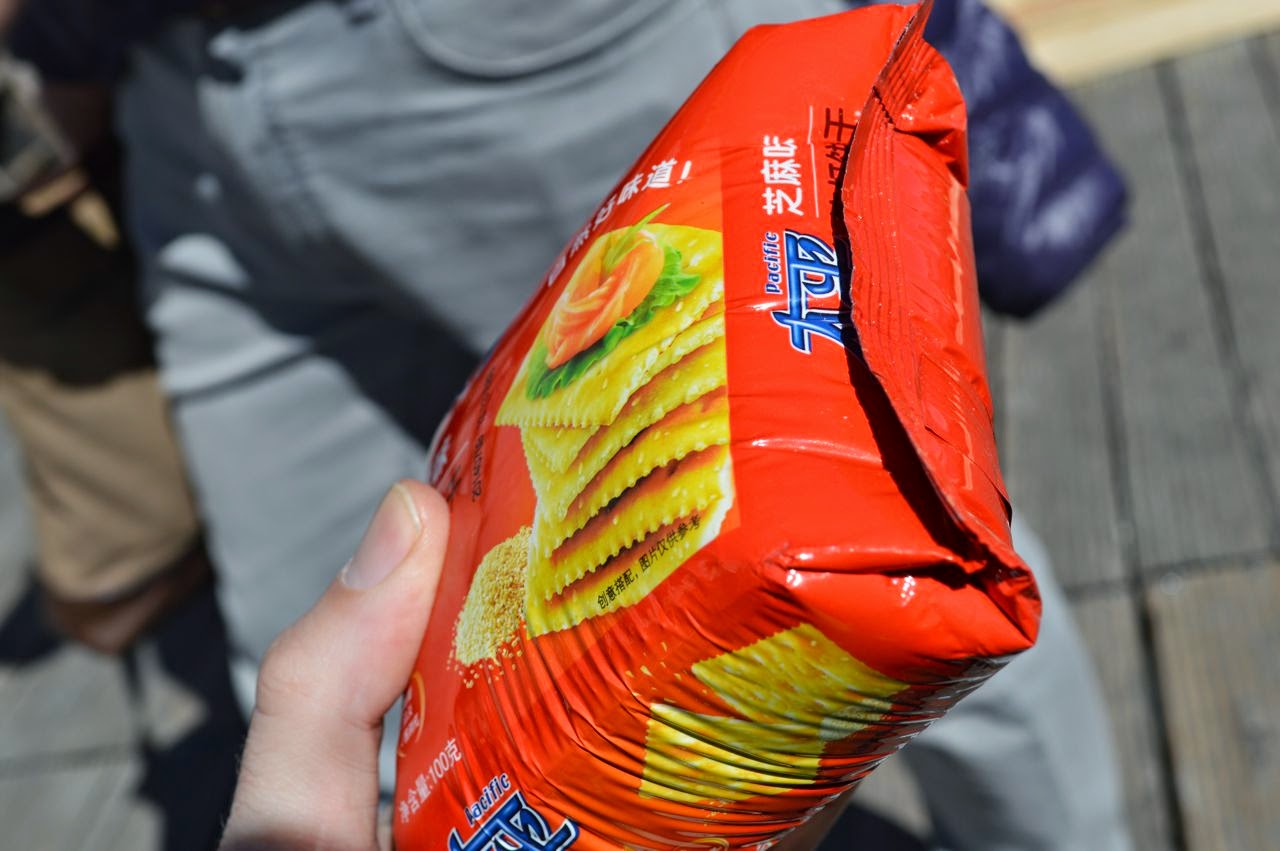
I had never experienced anything like walking in such an atmosphere before. It was necessary to walk slowly and stop regularly to catch breath. Breathing compressed oxygen made this a good deal more bearable. Without it, someone unacclimatised to such thin air as I was, would have been sorely challenged to make it up those staircases. 


An illustration of the change in air pressure was graphically provided by the packet of biscuits which I pulled out of my bag. 


Whilst the tourists edged their way slowly up the stairs, stopping for breath every 20 paces, the local builders had no such problems. This man carried a large bucket of paint up to the hut under construction, put it down, lit a cigarette then started hard manual labour. I'm guessing that over time the body must adapt to the thin air.


And finally this is the top platform at 4680 metres. It offers an excellent view over the glacier, a natural environment I'd never seen up close before, but more than that, it was a curious location that turned out to host three things.


The first of these was a man sitting at a simple open-air table carving tourist's names onto metallic medals. It was a small but popular business with a constant queue.


Next was a small food stall selling wildly overpriced snickers, red bull and sausages, the small red variety that rotate on a heater. He wasn't doing so much business.


And finally there were people, like myself, taking the obligatory selfie or the friends shot like the pair in the background. While I was wearing more than warm enough clothing, what I should have been more prepared for was the sun. It is very powerful and deceptive at this altitude. I got somewhat roasted as the day went on and have the flaking skin now to prove it.


Coming down by the same route there turned out to be more to the trip than expected. We took a wrong bus when alighting from the cable car and were deposited not at the base station but instead at a lake. This was, in many ways, a more beautiful and relaxing place with fewer visitors.


The lake was supplied by the glacier and was of a stunning aquamarine colour. These sunken trees also drew my attention to its artificial construction, accomplished by a series of small dams creating pools where there must have been a faster flowing descent in the past.


With the light hitting that perfect early evening glow the place took on a wonderful energy. There were a few people milling around, even some wedding photography going on, as there is in most tourist spots in China, but the place itself was big enough to absorb all of this. Also, being lower in altitude at a mere 3500 odd meters, it was possible to walk around without having to make constant recourse to the oxygen. Leaving Jade Dragon Snow Mountain behind I thought I had coped with the altitude challenge pretty well but I found that  in the evening a headache came on that refused to leave me till noon the following day. While the bulk of people and the technology goes a long way to opening up a space like this to the casual visitor, it remains a harsh environment. I won't be in a hurry to go further than 4680 metres and, unless I go on a Tibet tour (not impossible), it's unlikely I'll be in a position to do so anyhow. Once, in this case for me, is quite enough.