Showing posts with label Shanghai. Show all posts

Friday, 15 August 2025

Make China Great Again Tour


The US has its MAGA movement, lead by their current president, which might be described as playing to a myth of national revival. I'm not interested here to what extent that is hyperbole, I simply want to start by noting how powerful a force it is. Similarly, the UK has its Golden Age that gets endlessly recycled in costume dramas and which, it could be argued, played a role in Brexit and its aftermath: take back control! China has something similar: a two pronged fork with the revival of traditional culture on one side and the championing of innovative industries on the other.


This performance took the form of a short tour from point A to point B: From Huawei to KFC. Conventional wisdom might imagine the journey should be the other way around; you start by copying lower quality foreign goods and finish by manufacturing your own high quality products. That is of course the model. The reality is a little more complicated. You, and I don't simply mean China here, I'm thinking of revivals more generally, you start with your culture and you construct a self-serving version of it that never really was. The final result is often somewhat kitsch, watch any Chinese costume drama or better still time travel drama for in these we truly get the contemporary eye. 


This tour was given quickly so as to avoid interference with security guards. Not that it was breaking any rules in particular, but experience has taught me that ambiguity is not something that security guards deal in and when there is a foreigner involved, it can get complicated. This was a get in get out sort of tour for a small group, delivered without any sort of framing dialogue. None was needed. 

Monday, 4 August 2025

The Pink Tour of Shanghai


I wanted to take a tour of Shanghai and all the conventional ones seemed a bit boring so I decided to make my own: The Pink Tour of Shanghai.


It is quite a simple exercise, which I sometimes give my students. Choose a colour and then follow it from point to point, wherever it leads you.


I took a picture of each of the pink colored entities that was pulling me towards it.


I discovered something as I was doing this. The colour pink is mostly used in women's clothing and relatively little elsewhere.


This therefore lead me sort of by default onto the middle aged ladies of Shanghai tour. This group were queuing to try and catch a glimpse of a celebrity.


Elsewhere pink lead me to objects used by women.


One thing particular about it then was that most of the pink was mobile. Grey stays put whereas pink is on the move. I had never really thought about how mobile various colors are before.


I followed an energetic older lady but she went into building so I left her. I looked around and found a new pink target.


The delivery bike was too fast for me to catch it but it did take me a distance whereas most other pinks just took me a short way.


Sometimes the distance was quite great but as long as I remained focussed on the pink target I was good.


I finally got taken to a building but it was a building for fashion and it was closed for renovation.


I was starting to wonder if this pattern of following middle-aged ladies was going to ever break and when the right moment to stop would be.


I then got taken to another building, this time an open one.


It was a mall. I stepped inside and saw a lady with a light pink bag and followed her.


It was a bit tricky deciding what is and isn't pink; some pinks are on the edge of pink: they are too pale or are mixed with oranges and reds, not pure pink but still pink enough for me.


These flowers are one such example.


That's when I realized that the mall as a whole was pink by design.


The woman who I had followed had just walked clean through the mall without stopping, for her it was an air conditioned street. For me it was a pink paradise.


Strawberries are not red they are pink!  


And then the LED lighting changed colour and dropped the pink illuminating the space with a colder white light. I was left in a corner of the mall with no pink in view. It was time to stop, I had had my pink tour. This changing of colour was disconcerting and reminded me of another mall I had been in the day before which had put all the signage onto LED screens which also carried ads. If you needed to find the exit or the toilets you had to stare at ads for thirty seconds first. 

Doing this colour themed tour with a different colour would result in a very different sort of experience and lead me through a distinct set of spaces. I remember, for example, once doing this with red in China. The difficulty is really in maintaining concentration and allowing the experience to unfold rather than directing it too deliberately. It's more difficult than it looks.

Tuesday, 9 April 2024

The Tour of All Tours: Shanghai Xintiandi video

Every now and then I find bits of video on old phones or wherever and that's precisely what this is. Some footage of The Tour of All Tours in Shanghai. Seeing as there is rather little video of this show online, I thought it would be good to share it.


The thing that made this performance stand out from the other iterations of The Tour of All Tours was the fact that it was banned by the authorities. To be perfectly honest, I think that says more about Shanghai local council than it does about the show; there was nothing particularly aberrant in this version, it was meta-tourism as usual. 

In terms of video, this does remind me of a plan I have to adapt a tour for the camera. I made one such effort for the Beijing tour and that was part of the exhibition On Tourism (Xiamen 2022). I would like to make a proper effort to do it for the camera, however, rather than piece together bits and pieces. It had struck me that this Shanghai tour might be suitable but the area has changed and is less welcoming. It has turned into a luxury shopping and red tourism site that would make it harder to pull off this sort of thing nowadays. The tour moves on and will happen elsewhere.

Tuesday, 18 June 2019

Shanghai Tour To Return Next Month

Back in 2016 I made a Tour of All Tours in Xintiandi, Shanghai. It was a pretty good show, I believe, and I made it for a festival with the intention that a broad public could get to see it. After 11 of the scheduled 13 shows I was informed the authorities were stopping it because it, "was not positive enough about Shanghai." It was objective, it did not try to sell the city but neither did it lay into the place and rubbish the city. I guess it just feel foul of an over zealous censor. 

I don't believe in rewarding censorship with silence as that will only encourage them to do it more. My solution then was to give the last two tours privately and to make them about the censorship itself. In this way the censor actually breathed some new life into the show, though not that which was probably intended. 

Three years later I have a request to run it again so will be back on the beat looking at how to thread the two shows, the original and the "uncensored" version together and to give it all a contemporary reading. If you happen to be in Shanghai around the middle of the month and are interested in joining the tour get in touch and it can be arranged.

Sunday, 11 November 2018

The Roaming Through 40 Years of Shanghai Tour


Today's tour had all the potential to be something rather special. It was a walking tour of the older part of the city centre with artist interventions. A collaboration between an art festival and a walking tour company. We gathered waiting for it to begin.


The tour was given in Chinese with no translation so I was a bit on the outside of it all. I got bits and pieces of it and actually that was enough to realise the sort of tour it was: an anecdotal historical building tour of the neighborhood. Even though there was enough space to gather everyone on the pavement, we still spilled out into the road, the guide included.


The ostensive theme of the tour was the last forty years of history - that is to say the period of opening up and reform of the Chinese economy - and how that is manifested in the local area. Normally forty years would not be enough to make something historical in the typical frame of the guided tour but given the pace of change in China and Shanghai in particular this could have been interesting, even if it is working to a government agenda. The reality was more loose and we stopped beside older buildings and talked about their histories quickly letting go of the economic reform theme. This turned into a tour of old buildings with stories connected to them, the standard fare of local history tours. 


The public taking this tour was a mix of artists and a general public who were looking for a local history tour. It seemed as if the art interventions were not so welcome, finally. One of the group, July Yang, made a commentary performance while we were walking between stops and I later joined in, repeating the Chinese commentary imperfectly. When we arrived at the next stop we were asked to be quiet.


The guides used a microphone and portable speaker even though the road was not so loud and the group not so large. I felt this was more about establishing authority, though one of the ladies (there was a rotating cast of guides) probably did have a quiet voice. The stories were not particularly interesting and didn't connect to build into anything more than a series of curiosities. 


This got me thinking that, rather than choosing 40 years as a theme (and then breaking it) how about a much shorter time period? What if you were to give a tour of what has changed in a neighborhood over the last week? Immerse yourself in the contemporary and use that as the way to get to the story of what is happening.


There were some things I noticed along the way such as this sign recruiting female staff of between 160-170 cm and 20-35 years of age. This seemed much more interesting to me than these disconnected stories, which, to make matters worse, did not even deal with the appearance and material qualities of the buildings very much. If a tour can make you see something afresh and then understand something from it then it has done something useful. This tour did nothing to alter our perception, the guide simply stood in front of the building and told a story about it.


The weather was, however, very pleasant. It was great just to be outside on a mild autumn afternoon like this.


We entered a building and I was fascinated by this little room, which looks as if it is rouge construction added at a later date. This got me looking for quick-fixes, of which there were plenty, and then exploring the environment of the tour using different themes again. Rather than suffering the mediocre, it seemed much more fun to make something else out of the day. I didn't share this with the wider crowd, just one or two of the artists, as I could see that to do so would disrupt the plan in a way the local history guides were completely unprepared for. A tour with two guides could be good, but the two should agree some basic house rules in advance so that the tension can be a respectful and healthy one rather than an acrimonious one. This was not the occasion, but I should try to find the time to do just this. What would make it all the better would be to propose a route and let different people make their tours of it, then jam them together. That would be fun!

Friday, 17 June 2016

The Banned in Shanghai Tour: a tour of censorship


This performance has been made and remade in nine locations now and I was starting to wonder if it was becoming safe and, within the context of China, over-accommodating of the authorities. It was a surprise to learn after the eleventh of the thirteen scheduled performances that the last two shows were cancelled on the order of the city's cultural censor. The reason I was given was that I presented Shanghai in a negative light. Being cancelled by the authorities did not, however, stop the show, it only made it in into an unofficial, underground performance!


The organs of censorship were slow and acted in two stages. First, on the day before the show opened I gave a try-out show to which this man and an official from the local district government turned up. I had not invited them, they arrived unannounced with the festival team. I was also informed that my plan to use flags would not be possible and that I should change it. The next day I was told to make an adjustment to the show: do not mention the boy urinating on the tour bus. Several days then passed before this charmer turned up again with a phone in hand recording the show start to finish. This was presumably played to his boss with a translator assisting the two of them and the decision then made to pull the show. I can only imagine it took them this long to come to a decision because their English was not so good and they had plenty of other shows to consider cancelling too.


This is the first time I have had a work of mine censored by authorities since the age of nineteen when a picture I had in my Foundation Fine Art end of year show was mysteriously taken down and thrown in the skip. I found it, cleaned it off and put it back up. That, too, was my approach to the tour. I gave the final two shows to invited audiences, bypassing the festival ticketing system, playing it low-key and changing the nature of the show. This new tour was the uncut performance that included not only the peeing boy but also the things I had not included in the first place in order to get the show to initially pass the censor. This site was a case in point. On the normal tour I neither stopped at nor said anything about the most important tourist attraction in Xintiandi: the location of the first congress of the communist part of China. On this uncut tour I stopped and explained why it was impossible to say anything here without it potentially causing problems as the party's narrative is not there for everyone to use and repeat as they see fit. Even though the show was not negative about the party, any reference to it here could well lead to the show being stopped out of fear it might be misinterpreted. Officials don't like to take chances, as their job is on the line, so the higher up the food chain one goes, the more likely it is that caution will prevail.


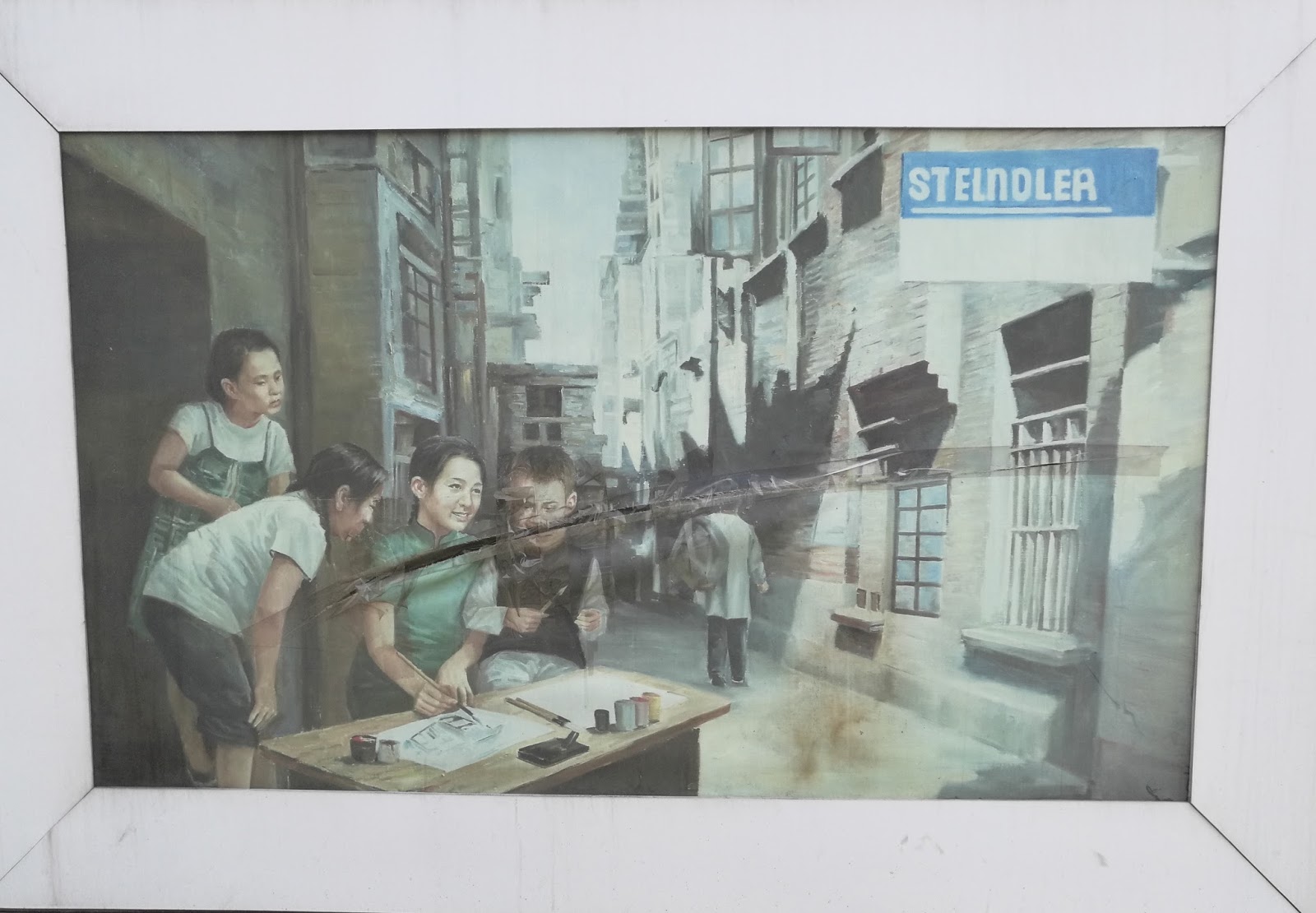
Another example of a thing I was unable to talk about on the normal tour was this ripped picture that I saw in Hangkou. It was part of the Jewish refugee heritage trail put up around the neighbourhood. I did not know the reason why it and several other related pictures, had been slashed. Here it was possible to ask the question and see if my audience knew if this was due to anti-semitic vandalism, if it was related to the redevelopment plans in the area which will see many thousands forcibly moved from their homes or something else entirely. It prompted a real discussion. 


It was shocking that by far the greater degree of censorship I talked about was self-censorship. I'd say that accounted for around 95% of the things that I talked about on the tour. It is not that I would ordinarily (i.e. outside China) include all of this material, but it would all be in circulation and quite possibly find a way into the show in one form or another.


When one of the people on the uncut tour told me that it was very different to the orthodox tour, which she had also seen, it led me to question the wisdom of self-censorship. If I had not been pushed into this situation by unusually conservative city censors, I would not have gone about making this unofficial tour. That said, the standard performance that I made was one that did get people thinking and seeing the area differently. I know this because several told me so. I think it right that art stretches the boundaries of what people think and say in both private and public and that to reach a significant number of people is valuable. I also see that there are some lines it is not possible to cross: if the authorities only want positive tourist marketing, this show will never provide that, it is far too objective. I therefore feel it best to operate on both sides of the line: official and unofficial.


It is ironic that I was able, by performing this piece guerrilla style on the sidelines of the rest of the festival, to actually provide a quite genuine Fringe festival experience here in China. It is also ironic that by censoring the show in order to preserve the neat image of world-class Shanghai, the authorities' efforts were counter-productive. Not only did I do the show anyway and focus on all the negative things I had previously left out, they also revealed themselves to be artistically out of touch conservatives doing their small part in holding the city back from truly becoming China's artistic hub.

Friday, 3 June 2016

The K11 Art Tour: a contemporary art shopping mall in Shanghai


K11 Shanghai is a seriously upmarket property development in the Xintiandi district of the city; an unholy alliance of offices towering above, a mall sandwiched in the middle and a contemporary art space stuffed below, into the basement. If you're idea of sophistication is shopping for luxury brands followed by art and international dining, this might just be your sort of heaven. As an artist, however, I found it a not so very seductive, soft cell version of hell. 


First stop on the tour were the videos. This Warholian homage by a Korean artist was introduced to us by our guide, a youngish lady with an acne problem bubbling away under a thick layer of foundation. Her commentary was brief and she kept to the script. I started to have the sinking feeling that neither the art nor the tour were going to be quite as good as the shopping opportunities.


We wandered past a few China flagship stores then came to these two works: an oversized bronze pillow on the floor and a series of wall mounted ceramic drips by the same artist. She explained how it was the artist's idea that his art could also be practical thus the pillow functioned not only as a sculpture but also as a public seat, not that many people were using it. When I asked why, then, was there a rope in front of the other piece, she was unable to answer. I wasn't particularly trying to be a nuisance, I simply wanted to see if she could come up with an answer that was not part of her script.


We left that one hanging and went up to the centrepiece of their collection, the Hirst. The main thing that she had to say about it was how expensive it was and how, in spite of the price, they insisted on not having it under glass as it is important to be able to really see the work and feel close to it. The last time I saw his work live was a few years ago at the opening of his diamond skull folly at White Cube in London. That occasion struck me as being primarily about the aura of money and the free bar. This statue was a throwaway budget version of the scull, of which many, many thousands now litter private collections and museums around the world, the sub-prime of the art world.


We stopped at a bed of conspicuously planted herbs where Louis Vuitton handbags should rightfully have been on display. I am all in favour of organic farming and re-connecting with nature instead of growing foodstuffs in toxic slurry, as can happen. What is a pity is that this should be a luxury taste one acquires in a high-end mall and not a more general strengthening of food safety across the board. While practices have to start somewhere, when they start so very high, how long will it be before they make their way down to the everyday lives of common people? Touring the art of K11, I felt I was in a bubble far removed from normal life: what happens here stays here. I felt distant, even, from K11's own backstage, which is very carefully concealed. The nearest I got to seeing the backstage workings of the place was in the Family Mart supermarket round the back of the building, where some of the staff eat their lunch while playing on their phones. 


Onwards and upwards we went till we came to an interactive video installation. It showed a young woman out shopping, her hands full of bags bearing brand names. The video invited me to call her and, when I did, the number rang and the woman in the video looked for her phone. I then received a message on my phone, "What is it, darling?" The best thing I can say about this piece is that it was well matched to K11.


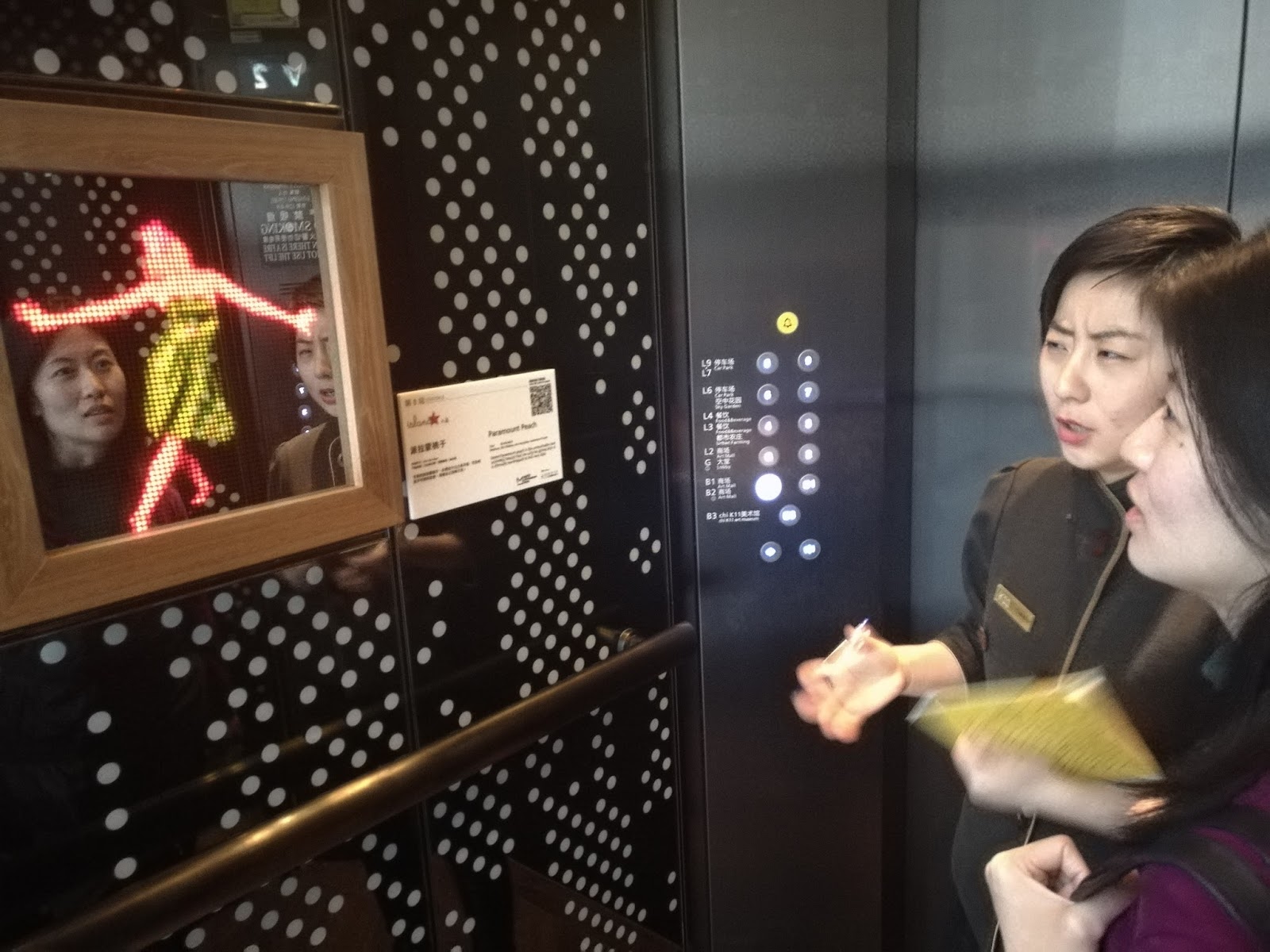
A final decorative video piece waited for us in the lift. This seemed to be how K11 liked its art: a catalyst to consumption and status symbol of a luxury lifestyle. This tour, it slowly dawned on me, was about grooming the next generation of art loving consumers. The guide told me that the tour is frequently given to children, hence, I realised, the simplistic content matter of her explanations. I'm guessing the commercial logic underpinning it is, once the kids become accustomed to the mall they will return with mum and dad (and wallet and purse) in tow. No doubt, there is some genuine love of art behind this collection and public display; if it were purely commercially motivated then every mall would feature art. The infuriating thing is the financial hubris that drips off the artworks and second-rate nature of the collection. That would not matter if K11 were just a rich person's plaything but they are significant players in promoting Chinese contemporary art nationally and internationally. Last year, for example, they were behind Zhang Ding's appearance at the ICA in London for Frieze. 


Stepping out of the lift and saying goodbye to our guide, I looked back at the directory on the wall from which it was not hard to see that this place has some serious money flowing through it. The next day we received a phone call from K11 asking about the tour. Naturally they asked about the quality of the guide, the comfort of the tour and such things and fortunately for them it was my wife who took the call and not me so the answers remained civil. At the end came the most important question, "Did you spend more time shopping around K11 afterwards?" They were smart enough not to directly ask, "How much money did you part with during your visit?" but the meaning was clear. They got the polite but vague answer they deserved but the real answer, which they didn't receive, was this, "Not a single RMB. I couldn't get to the exit too quickly!"

Tuesday, 3 May 2016

The Jewish Refugee Museum of Shanghai Tour


I have noticed that there are Jewish history tours in many cities across Europe and I have been meaning to take one of them for a while to see what they are like. For one reason or another I never got round to it but did instead recently discover that there was one in Shanghai. I never realised that the city had a significant Jewish history so, rather than discovering the Jewish history of Paris, Prague or Porto, it was to China's most populous city Shanghai that I turned.   


I found it amusing that when I stepped inside I was asked to wear an elasticated plastic bag around my shoes. The reason given was to keep the place clean but, since I have not had this request in other museums, I began asking myself whether it was because the building was a former synagogue. Lost in such speculation, I didn't precisely catch what the guide was trying to tell my group. I was on the English language tour and my group mostly consisted of elderly Jewish American who had come on a Smithsonian Journeys package tour of China. Upstairs, another group was on the Chinese tour.


On this metal wall outside were the names of the Shanghai Jews as recorded in the city register. I saw two American men studying it carefully, looking for the names of family members. They were clearly moved when they found one. Our guide, however, had no obvious Jewish ancestry. He did, however, have a keen interest in Jewish history and culture and while he had an odd accent, even by Chinese standards, his English was good and he could tell the story with some precision and charm.


Stepping into the modern museum, we watched a grainy video and were then shown around the exhibits. We touched upon this one about Ho Feng Shan who our guide dubbed 'the Chinese Schindler'. It seems he had a particularly vivid life and there was only time time to hear about his role in issuing a large number of exit visas permitting Jews in Austria to escape to Shanghai. His actions were not officially recognised in his lifetime, indeed he fell out with the ROC government who denied him his pension over a dispute he claimed was politically motivated. Settling in California, it was only after he died that he was publicly thanked and his wartime actions held up first by Israel and then, interestingly, by the PRC. At least, that is how the history is told here. An interesting candidate for a bio-pic, I would say.


The guide stopped to show us this map of the different routes Jews took to come to Shanghai. Because the museum contained so much material, when explanations were given at all, they were often somewhat rushed in order to keep the tour under an hour in length. This meant I did not appreciate until later that different Jewish groups had been settling in the city for some period of time before the war and there existed stratification amongst them. 


This picture of the Israeli Prime Minister put a face on something I had been increasingly feeling through the tour. Namely, that in order to understand this museum it was important to understand the processes by which it came about and to ask whether it served any purposes in addition to that of remembrance. The narrative of the Shanghai Jews, while known to some, was not celebrated until fairly recently. A number of things had to happen to thaw what were not immediately warm relations between the states of Israeli and the PRC, created in 1948 and 1949 respectively, in order for this episode of history to be given the embassy treatment. In China that would be the process of political and economic reform from the 80s onwards. In Shanghai, its relative calm during the political turbulence of 1989 combined with the more recent taking stock of and promotion of the city's heritage, must figure too. As for the Israeli side, I know less, though there are, apparently, early movements afoot in transforming Hongkou into a 'new Xintiandi' with Israeli investment. Whether these financial relations are simply the fruits of improved diplomatic relations and a shared history or are in some way the motor for political engagement and cultural diplomacy, is difficult to say.


This is the short video Xie Xie Shanghai that was made in 2015 and which features Benjamin Netanyahu, amongst others, saying thank you to the city for providing Jewish refugees shelter during the war. The video is curious in that it mixes a political message  with tourist aesthetics. The beach and bar scenes come straight out of a 'Visit Israel' promotional video and is another example of the tourist gaze exceeding itself and finding its way, now, into state level diplomacy. 


The top floor of the museum was where Shanghai's Jewish history was put into the service of political education. Most notable was this educational video (chapter 4) that contrasted Western thought with Chinese thought. Western thought was characterised as conquering nature and as the science of evolution, which slid effortlessly into Nazism, while Chinese thought centred upon living in harmony with nature. Confucian values were attributed to the Jewish American politician Michael Blumenthal, values that rubbed off on him during the time he grew up a refugee in Shanghai. Essentially, anything positive was linked to traditional Chinese culture while anything negative was of Western origin. I had the impression that whoever produced the video was not used to having to defend their opinions in any sort of open debate. If they had, they would have had to have come up with something a bit more refined and robust. In the UK such a video would simply be laughed at then ignored but here it passes for normal.


The museum is today's focal point to the Jewish heritage of Hongkou, but the neighbourhood also has a walking route taking in other historic sites, too. There was not so much to see and a guide would have helped to bring the otherwise blank addresses to life. Disturbingly, a series of public artworks on the side of the street commemorating the area's Jewish heritage, had been slashed. This one shows the youthful American artist Peter Max, being taught to paint. Who did this, or why it happened, I have no idea. There is no significant history of anti-Semitism in Shanghai, as far as I am aware, but there is more to this story than my brief tour could reveal.


Final stop was The White Horse Cafe, a reconstruction of a Jewish cafe that used to do business nearby. The place was unusual not only on account of the man inexplicably crashed out on the lawn outside, but also because it was a European-style cafe run by and for Chinese customers. I should be used to this concept by now as we have had French-themed cafe chains in the UK, such as Cafe Rouge, for a while. I seem to remember that last time I went to a Cafe Rouge (a rare event) they had employed some foreign students as their waiters, but I also recall that the whole place felt like a protracted and ever so slightly embarrassing fancy dress party. White Horse Cafe had the same vibe. Here, this game was augmented by an exhibition upstairs about Polish Catholics saving Jews. The exhibition was sponsored by a southern Polish regional governmental body, an area trying to establish connections in Shanghai on the back of the Jewish Refugee Museum. While the story that the exhibition panels recounted was no doubt true, the whole thing smacked just a little too obviously of political opportunism to be taken entirely at face value.