Showing posts with label Gallery. Show all posts

Sunday, 24 March 2024

The Three Shadows Curator Tour

Three Shadows Photographic Art Centre in Jimei, to give the place its full title, is one of the better art spaces in Xiamen. It is an offshoot of the main gallery in Beijing which is one of China's dedicated photography galleries. They were having an opening and I was invited, somehow, so along I went. Rather than a drinks reception and hobnobbing, as it the London way, an opening here means something far less fun: the curator's tour.


Thirty of so of us shuffled around the space, dutifully stopping in front of the artworks to drink from the fountain of culture. This tour, like practically every other, took place in the afternoon, not evening. These events are timed so that the artists, team and patrons go to dinner afterwards. If there is any fun to be had, it is later at the dinner: you have to earn it by attending the tour in the afternoon.


As we were going around the exhibition I saw one photograph that I recognized as there is a friend of mine Yingmei in it. Not that you'd recognize her in the pile of bodies. This connection brought to mind the fact that artists here are not typically paid for the inclusion of their work in an exhibition, the money goes towards running costs, the space's owners, the exhibition curators and the shipping of artworks. Artists might be invited to the opening, be offered a room for a night or two and can join the opening banquet. For artists selling artifacts this is just about understandable but for performance artists like Yingmei or I, it doesn't work at all. I was, in fact, once invited to give a performance for a British Council sponsored exhibition at Three Shadows but even for a live performance as part of an exhibition with that sort of institutional support, they refused to pay any fee. Needless to say, they didn't get their performance, but I'm sure the curator's tour was wonderful.  


The sound came out of a loudspeaker that was connected to the microphone via bluetooth. Being placed behind the audience the voice was dislocated. This gave the tour a weird touch that everyone tried to pretend was normal. In retrospect, this was the most interesting aspect of the tour and it is something that could be explored further. Just imagine the voice walking off on its own tour, the curator and their voice heading off on opposite tangents.


The basic frame of the curator's tour was educational: it was to help you understand the artworks. It's unidirectional which is to say, there were neither questions nor discussion. When I come to think of it, the tour might have been for the benefit of the curator more than for anyone else. It builds their public profile and shows everyone that they are doing something. 


The final thing to note is that the tour went on far too long. Three Shadows is rather typical in offering these 90 minute tours for openings, but you can see the same thing in art spaces all over China. This tour was an old one from back in 2016 but I went on a curator's tour just the other week in a different art space and it was exactly the same. Sadly the loudspeaker was not behind the audience this time round but it was, otherwise, the same package.

Friday, 7 February 2014

Introductory Essay to The Walking Encyclopaedia

The exhibition The Walking Encylopaedia is opening tonight at Airspace Gallery and here is the introductory text in full I wrote for it, also online on the Airspace website.


The Walking Encyclopaedia is by definition inclusive: it brings together a diverse range of artists and their work within the frame of walking. Like all encyclopaedias it is also partial and reflects the process of its compiling. It is therefore worth making this process of its creation more explicit: it contains art works and events which have been very deliberately curated, such as the Tim Knowles solo show Paths Of Variable Resistance and the events that Phil Smith will be running. In addition to these there are a great many works that have been proposed by artists themselves in response to an open call circulated on the ‘Walking Artists Network’, amongst other places. Some of these submissions were fully realised before this idea of a walking encyclopaedia was ever born, others are works that have been adapted for this context, and then there are some entirely new works made in response to this call. This is therefore an exhibition that surveys some of the most current trends within this emerging field rather than one with a more historical focus seeking to establish a cannon of walking and art. 


As an artist who has always enjoyed walking, I should admit that when I first heard of the notion of a walking artist, it sounded somewhat arbitrary since I also happen to cycle a great deal, drive very occasionally, and take all manner of public transport. What’s more, these other forms of locomotion can find their way into my artistic thinking and projects, so it would be overly partisan of me to classify walking as uniquely creative. What is also true however is that the simple action of walking has attracted increased attention from artists of late, walking not only being a condition of an artwork’s creation and viewing, such as a sculpture placed in a remote location reached only after a long walk, or walking being the subject of an artwork such as a painting depicting a group of walkers in the countryside. Walking has now gone on to become a medium in itself; there are artists whose primary work is the creation and documentation of walks. This shift in the status of walking from the background to the foreground has encouraged us to view what might have previously been seen as separate artistic endeavors and traditions as being related through this central act of walking.

Walking considered as art has a relatively short formal history but an extensive pre-history. The point in time to separate one from the other is a rather complicated question best left for another occasion, it is enough to note that this is both a very young and, at the same time, very old tradition. People have walked for as long as there have been people; a defining aspect of homo sapiens being that they are upright and move on two feet. Stories, songs, pictures and rituals have accumulated around these displacements and some of these go back beyond pre-history reaching us in the forms of cave paintings. In the field of literature there is the 16th Century Chinese classic, Journey to the West, recording a pilgrimage to India, The Old Testament records Moses walking 40 years in the desert (a journey which has itself been turned into a contemporary walk) and the Epic of Gilgamesh dating from 18th Century BC ancient Mesopotamia, describes epic journeys made on foot. A history of walking in the arts is being established albeit one that can be seen through piecing together accounts of journeys, ancient and modern, from disparate sources. 

In addition to an emergent history of walking it seems to me as if almost every week we ‘discover’ a walking tradition from another part of the world and place it within the context of walking art, time and again seeing how it can parallel and inform our art practices. The word discover is of course ironic here as it is contemporary British society that is often the poorer in these comparisons, when it comes to integrating walking into life and art. For example, the songlines of Aboriginal Australians as described in Bruce Chatwin’s book of the same name, fuse creation myth, practical map directions, songs and spiritual journeys together to produce something very unique. Today, these songlines can appear akin to an art project because a frame for an understanding of walking as art activity has been established. This is not the same as saying that the songlines were ever intended to be understood as art, merely that something similar to them happening in British society today would probably take place within the realm of walking art.

I began my love of walking as a boy, taking long scrambles over the shingle beach of Southsea. This I would do alone and in all weathers and with so dynamic a landscape throwing up fresh flotsam and jetsam from the sea with each tide, combined with a view overlooking the ever-busy Solent, there was always a great deal to take in. As time went on and study, work and travels took me further afield, I broadened my experiences of place and learnt to find something of interest in whatever environment I found myself in, whether it be wild mountains, suburban estates or decaying inner cities. My sense of walking is that it is belongs equally to all of these, the only places I have found it problematic to walk being certain American cities designed with the car in mind. Having this broad topographic palette it is with curiosity that I note something of a divide between the different walking traditions that have been developed in relation to the city and those more connected to natural environments. 

The tradition of the urban walker or flaneur, a detached observer of modern life, comes to us from 19th Century France and is traceable in the hugely influential Situationist theories and practices of psycho-geography, such as the dérive or drift. The idea that we can read places using psychological theories and explore them actively and playfully is but one strand of their output but one that has gone on to inspire and inform much subsequent walking art in the city. People have taken these ideas in so many highly original directions that the label psycho-geography has become a bit too convenient a catch-all to fully contain the breadth of work and this is to say nothing of quite independent histories, such as Fluxus tours or the embrace of walking in post-modern dance. Common to many of these urban walking traditions is an understanding of cities as social architecture and art as a tool that can make visible the economic and aesthetic rules that bind us together and produce the urban experience. 

Walking traditions more rooted in the landscape are every bit as diverse and sophisticated. In the UK, for example, we have the poetry of William Wordsworth who, it should be noted, also wrote a guidebook for walkers of the Lake District. His writings greatly popularized the romantic idea of nature and the benefits of walking in it. In the US Henry David Thoreau pioneered the nature essay and artfully folded philosophy, ethics and much more besides into his exemplary reflections upon walking in New England. More recently within the visual field, artists Hamish Fulton and Richard Long have since the late 60s been making artworks that have featured walking as a central element, their walks typically taking place in nature and represented in a variety of media in both the landscape and gallery. 

The situation today is, I feel, not so polarised between city and country traditions; a significant crossover exists with artists drawing equally upon the many traditions and choosing to locate their walks and work in urban, suburban and rural settings, sometimes in all three within the frame of a single piece. This is not unprecedented either, while never constituting a tradition, there has been consistent traffic between the town and country for some time. Daniel Defoe’s tour of 1724-26 around the entire island of Great Britain included The City of London and he deployed some strategies that look conspicuously like walking art projects of today. Then there is Chaucer’s Canterbury Tales dating from the late 14th Century which uses the device of a pilgrimage to frame a series of often ribald stories exchanged whilst walking from London Bridge to Canterbury Cathedral, two urban bookends to an extended procession through the countryside. 

The freedom enjoyed by artists to pick and choose their sources and assemble a history of their own is matched by a leveling process taking place within the landscape itself. In the UK as our cities continue to sprawl (a legacy of the car) leaving vast semi-urban fringes of industrial parks, supermarket distribution depots and park and ride centres punctuating fields and fenced off land awaiting development, the distinction between urban and rural becomes increasingly blurred. Our countryside is managed and technologically connected like never before and almost everywhere we can detect the dual hand of local council and ‘the market’ exercising their powers of organisation and control. Patrick Keiler’s seminal films Robinson in Space and London, while not strictly speaking walking art, elaborate upon these shifts in a contested landscape that forms the backdrop for many of the works featured in this exhibition. 

When out and experiencing an art walk or viewing the documentation of one, the various locations that one encounters can become unusually and unpredictably significant, as they are experienced through the frame of the art and potentially have something to say. The touristic gaze that systematically favours historic and scenic locations is thus often replaced by more idiosyncratic methods of encountering and picturing the landscape. Walking art can therefore often provide us with a more accurate portrait of the land than more conventional approaches to showing it as alternative aesthetics thrive. What’s more, walking in public brings into the work the politics of public space; the rights of access, surveillance and security on one side, the possibility of co-operation and encounter on the other. What happens in the interval between a concept for a walk and its realisation on the ground is often very interesting as it reveals a great many things about both the location and the people involved.

A feature of walking is that it is inherently inter-disciplinary, it crosses and connects both real spaces and, being so essential an action to our lives, it has come under the scrutiny of a staggering range of fields of study. Reflective of this broad range of interests in the act of walking, much of the work in the encyclopedia might usefully be understood not only as art but also as social and political activism, or as urbanism field trip, as sociological mapping, choreography, urban exploration, photography, audio art, literature, local history, video diary, tourism study, mountaineering or simply as pure unadulterated leisure. When out walking the imagination can sometimes flow in powerful torrents and I daresay a good number of the projects surveyed here came about in this way: while the artist was on the move. To those sitting down these propositions may appear to be the actions of idlers with an excess of ideas yet to those who are already on their feet these can be poetic additions to this taken for granted action of walking, artful interventions that grace walking with significance and beauty.

A feature walking art has in common with performance art is that it occupies the dual position of presenting itself as both live, often participatory event and that of presenting the creative documentation of these actions. As the vast majority of walks take place outside of the gallery, sometimes in difficult to reach places, the tendency to encounter this work through its documentation is, if anything, even greater than in performance art. This is particularly the case with walks that take place over long periods of time like Marina Abramovic and Ulay’s 1988 walk begging from opposite ends of The Great Wall of China and meeting one another in the middle. With the rapid growth of video art and digital photography stemming from technical innovations in the late 20th Century, the visual representation of travel and walks has been greatly facilitated. Where the word was once the most portable of mediums and is where much of the history of walking resides, the image is now just as versatile. The growth of walking art has been simultaneous with this rise of digital imaging resulting in a great deal of the documentation of the work, as you will see in the encyclopaedia, being done primarily through the image rather than the word. 

To conclude this brief introduction, I recommend to you The Walking Encyclopedia and encourage you to walk around the exhibition taking in the various works. More contained than a gallery in the countryside like Yorkshire Sculpture Park and more concentrated too than the ritual of the First Thursday tour around East London’s gallery openings, the exhibition nonetheless communicates some of the vitality of walking art and offers inspiration that can stay with us in our walks, whether they be practical walks, artistic walks or in that pleasingly fluid space where the two can overlap and meet.

Monday, 9 December 2013

The First Thursday Tour: Whitechapel Gallery's free bus tour of exhibition openings

The First Thursday Bus is a free bus tour that you can take on, unsurprisingly enough, the first Thursday of the month. It has been running a while now and it is part of the much broader First Thursday initiative by which East London galleries stay open late and often hold not so very private views the same evening. The bus tour departs from Whitechapel Gallery and takes you to a selection of participating galleries.  


I was instructed to arrive at 6.45 in order to pick up my ticket. Upon arrival I found the front desk besieged with hipsters as there was another event taking place in the gallery that evening and people were picking up tickets. The staff were ticking off names, answering the phone, handing out different coloured stickers for the various events and answering the inevitable random questions. There was also a 'meet-up group' trying to form amongst those standing around but nobody seemed to know who was and was not part of that group so it  was slow to happen and more than a little self-conscious. Next to this there were book stalls and some people selling raffle tickets for a youth project. It was proper London art bustle.


The tickets for the tour were not all collected so someone from the gallery went around checking to see who was on the waiting list, handing out yellow stickers accordingly. Because it is free to enter into the ticket lottery to go on the tour (you apply a few days in advance) there must routinely be quite a number of people who do not collect their tickets. If you really want to do this tour then, it is probably quite possible to get on it simply by arriving in advance at around 6.30 and adding your name to the waiting list. Nothing beats actually being there.


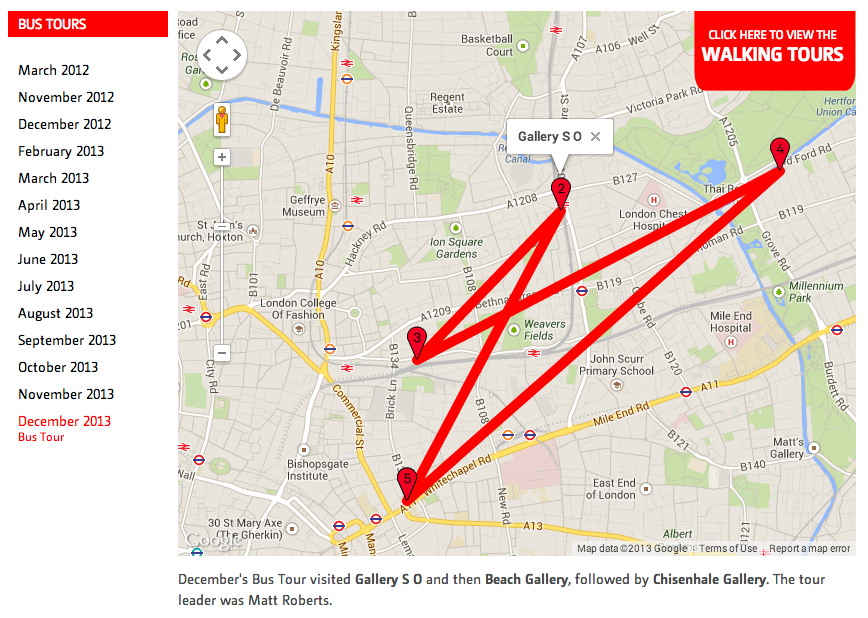
I don't how it happened but the map of the tour on the official website is wrong. As well as having no number 1, Gallery SO is actually located on Brick Lane and not north of Bethnal Green as shown above. The rules dictating the shape of the tour, as far as I understand them, are 1) it starts at 7PM 2) visits 3 galleries in the East End and 3) returns to Aldgate East at around 9PM or shortly after. This time frame is set so that it works with the timing of the private views most of which are winding down by 9. It is interesting to note that there is another First Thursday tour also available from the gallery and that one is a walking tour which obviously covers a shorter distance. Common to both are these bold red lines which connect one gallery to the next like a teleporter zapping you from opening to opening. For those pounding the pavements they must therefore decide for themselves how to make their way from one point to the next as the precise walking route is not specified. Some roads might present themselves as the obvious path but there is an element of active choice here as it is not always obvious. While at first I thought this an oversight I now see potential in deliberate ambiguity and will have to file this thought away in order to retrieve it at a later point when I need to direct people somewhere but not direct them too precisely.  


The bus was waiting for us outside the gallery. It was a nice comfortable Mercedes.


The 20-odd seat bus filled slowly and there were quite a number of empty seats. It was perhaps a little over half full and I had the whole back row to myself. We left Whitechapel 10 minutes behind schedule, probably the result of the ticketing being so complicated and hoping a few latecomers would arrive to bolster numbers.


First stop was SO Gallery which I was excited to enter because it had already featured in the Sound Map Tour I had taken barely a week before. This overlapping of spaces is what happens when working with several tours that cross a more restricted geographical space. It invited me to speculate whether there was a connection between the Jewish heritage referenced in the previous tour and the art of the current one. 


After the gallery's curator said a few words we then got an introduction to the exhibition from Leo Fitzmaurice, the artist whose work filled the space for his solo show Post Match. He talked about his inspiration and process but generally avoided trying to define the meaning of the work too firmly. The exhibition comprised of the tops of cigarette packets that had been unfolded and modified in order to look like footballer's tops. It was a simple idea that was well realised and which allowed for many connections to be made between the worlds of smoking and football. To me at least, it invited a semiotic reading of these two fields that had been unified in the artwork, and the subsequent rubbing of tangential orders of symbols (eg. the Bundesliga vrs cigarette brand design) against one another to produce new meanings. Thinking about this further the CH N KATZ. sign above the window is not so different, or at the very least, has the potential to create a similar crossover of symbols.


When I stepped out of the gallery I saw someone I know, Hydar Dewachi, being dragged into a disagreement with a man on the street. It seemed to be about the right to take photographs and the man on the left appeared to be angry and looking for someone to shout at. I was about to jump in and come to Hydar's defence but the tour bus was waiting for me (I was last person to leave the gallery) and my intervention would probably have only escalated the tension. I later heard that thankfully things resolved themselves OK. It was for me a moment that popped me out of the First Thursday Tour and into a very different situation. I guess most conventional tours function like worlds unto themselves and such events do not happen though I did notice that on the Winterthur Tour people taking it bumped into friends of theirs who happened to be passing in the street, so this is not unprecedented. 

Developing this idea, it amuses me to imagine tours that encourage this fluidity more, either by deliberately going to places connected to the individuals on the tour or going to public meeting spots where such things happen as a matter of course. This First Thursday Tour did already have something of that quality as First Thursdays is, for people connected to the London art world, a significant monthly socialising event. I did in fact bump into another person I knew while waiting at Whitechapel Gallery and met him again later in the evening on the street outside. This happened because I  was in a context I have a place within. As for general public meeting spaces, those are few in number in London as the city is large and anonymous. In smaller cities these function better, such as the pedestrianised cafe zone in the centre of Zagreb. Even there though, it is not a hub for everyone but it does function far more effectively as a random meeting zone to the extent that if you are in a hurry it is a place best avoided. 


Dave Roberts, of Dave Roberts Foundation was our tour guide. He gave a brief introduction at the start of the trip and said a few words about each space, like he is doing here, before we arrived at them and the coach emptied. The coach was in fact very well equipped for guided tours, there was even a microphone just to his right that he could have used in order to look and sound like a proper tour guide. He was never going to go there however.


Beach, the next gallery we stopped at, was smaller and much more crowded. They were showing the work of an artist usually associated with street art who had recently moved into making ceramic 3D works. There was also another event taking place simultaneously in the gallery and a woman was handing out bottle after bottle at the entrance. I was less excited about the work, indeed there was less of it on display, this place was more about meeting people and taking advantage of the drinks. On leaving I took one for the bus ride.


By the time we were back on the bus and moving agin we were running late and our last stop was still a little bit of a drive away and the traffic was inching along Brick Lane. By this time a few people had dropped out of the tour and a new couple had joined us as there was plenty of space. There was in general a more informal atmosphere on the bus with the drinks flowing and people chatting to one another who an hour and a half ago had been strangers. Drawing close to our destination Chisenhale Gallery, we were given another short introduction as to the sort of gallery it is, namely a publicly funded space that typically offers rising artists their first major solo show in London. 


We entered and were immediately asked to take our shoes off before proceeding any further. I have heard of performances at which the audience is required to be fully nude, fortunately this was a more modest request but one which changed our relationship to the space nonetheless.


We entered the gallery proper and sat on the carpeted floor in front of the screen and watched the video. Unlike the other galleries there were no drinks and there was no scene, in fact we were the only people in the gallery. We watched a video work of Jordan Wolfson that was a mix of animation and exterior shots mostly taken around SoHo in the artist's native NYC. The work was OK and reminded me of when I briefly worked for a SoHo gallery in the 90s but I found myself drifting off and asking myself how this piece of work ended up in front of me. I came to the conclusion that this is a two part question the first part of which is how I ended up on the First Thursday Tour: how the tour came into existence and how Chisenhale Gallery ended up on this tour. The other side of the question is how did this video end up being shown in this gallery and that is also a rather complicated issue, particularly as this was not the work's first showing and Chisenhale usually commissions. Both these questions are basically questions about the mechanics of the London (and global) art world where private and public money mix and different interests are served. A woman from the gallery talked a little about the work and why it was here when we were back outside but I felt there was a lot more to this encounter that was left unsaid. To really get inside of a seemingly simple question such as "how did I end up looking at this?" could easily be a PhD study in itself so I will not go any further here as I've probably already said enough.  


The evening ended when the bus dropped us off at Aldgate East a three-minute walk from Whitechapel Gallery. My over-riding impression of it is this is the sort of tour that does not feed you that much information but instead is rather open-ended and you can make of it what you like, depending on what you bring to it in the first place. Someone who hates art and thinks it pretentious will most likely come away thinking it was evening spent amongst tossers while someone interested in contemporary art and the edgy fashion of the London art scene will be right in their element and return bringing their friends next time round.

Monday, 25 November 2013

A Walk Through: an audio art tour of the Old Royal Naval College Greenwich

This is an audio tour that I made back in 2008 and which I've just uncovered, so to speak, having thought it lost. It is one of three audio tours that I made for the exhibition A Walk Througha group show curated by the artists' collective OMSK, which was held at Stephen Lawrence Gallery, University of Greenwich. The exhibition and tour was spread around the gallery and university campus, which is on the site of the Old Royal Naval College. It is a major tourist site so this work anticipates the Tour of All Tours in a number of ways. 


The recording was made with James Dunn who was sound engineer on all three of the audio tours. It was made as a single take improvisation walking through the exhibition's locations and repeating the words visible in the space. The full duration is 25 minutes. A tour can be discerned underneath the formal restrictions of the work; the names of the rooms and signs, the background sound of the indoor and outdoor environments.

Below is the artist statement that accompanied this work:

This audio tour was composed in response to the exhibition A Walk Through and its location, The Steven Lawrence Gallery and related sites around Greenwich University. I have to admit that I almost never listen to audio guides in museums or galleries, and very rarely follow guided tours. A degree of my indifference to the form is probably noticeable in this audio tour; it doesn’t guide the visitor around the exhibition very effectively. In fact, for the most part, it doesn’t guide them at all. It is probably better to think of it as an audio work that proposes movement created in response to the exhibition A Walk Through. What’s more, the audio tour doesn’t offer an overview of the exhibition, pulling the many threads together and making sense of the whole. Rather, it presents a deliberately partial and oblique view. In this I was somewhat inspired by a former housemate and British Museum employee’s descriptions of the guided tours that took place at his work which were given by and for Jehova’s Witnesses. They would pass through the museum making observations such as, “this is an ancient Greek statue of a man; of a homosexual man. God said… “ 

The partiality of the audio tour or better tours, as there are three, is explicit in this multiple choice format. Collage as an aesthetic is common to them all, whether it be the collage of perspectives, of words and language, of space and language, or of time frames. I intend that in the quite open-ended space of this collage, room for interpretation may open up. This stems from a desire to create a tour that does not answer or explain. It should instead be thought of as a work in its own right that adds a further layer to the exhibition, should the visitor wish to engage with it. The type of art that this tour has in its sights is an unfinished art, an art of the event or encounter, an art that requires the active participation of the visitor. In this sense it is the prompt to a firsthand experience rather than the document or explanation of an experience that has already happened to another, elsewhere.