With thanks to Martha King (camera) and Cheryl Pierce (interviewer). Recorded outside the Roman Baths in Bath City Centre, October 2014.
Thursday, 20 November 2014

Saturday, 15 November 2014
The Jade Dragon Snow Mountain Tour: altitude tourism in South West China
Jade Dragon Snow Mountain (玉龙雪山) is located near Lijiang in Yunnan, South West China. Lijiang's old towns, once beautiful places, have today become one of the country's top 5 tourist destinations and are swamped with tourism to the near exclusion of anything else. I am here for COART festival, an arts festival which has given me the opportunity to see something of this part of China. I'll write more about Lijiang subsequently but for now I will concentrate on the mountain.

There are different ways to go about ascending; in the old town there are many travel agents who offer package tours that include an ascent as part of a one, two or four day trip around Lijiang. Having already had the Chinese coach tour experience of The Great Wall I wanted to see how the site might reveal itself differently when travelling outside of the structure of a large organised group or, to put it another way, I had had it with the guide turning salesman at every opportunity routine and everything devolving into kitsch. This more independent tour of the mountain began, then, with some advice from the appropriately named K2 hostel, who gave the number of a driver. With the arrangements made for the next day, it was a simple matter of hanging about till she showed up. Yunnan is not a hurried place and it turned out she was waiting at a different gate to the village but, after a while, the van arrived and we got inside.

She advised us to buy oxygen and pulled up in front of a shop on the edge of the village that sold portable oxygen canisters and nothing else. I've seen some specialist stores before and this place was up there with the best of them. The driver said it would be wise to take some and the man in the store was, predictably enough, more certain still that we absolutely needed to buy some and what's more, we'd need the large canisters. Not knowing what to expect, having never been to so high an altitude before, I suspected he was exaggerating in order to boost sales. Still, we bought two large canister anyway and got back in the van.

We drove for about 40 minutes and during this time the driver expanded upon some of the other tours that could be had in the area. It did not seem as if we were climbing that much, except at the end of the journey, but we must have steadily gained altitude. Lijiang is already 2400 metres above sea level and the base station where we were heading was well over 3000 metres. The air was thinning.

This is a view of the mountains in the background from the car park of the base station. Forget any ideas of Everest Base Station and rudimentary camps used for trekkers and climbers This was a huge car park with shops, a leisure centre and restaurants. They even have a Starbucks.

After buying the ticket for the cable car there was a half-hour queue for the shuttle bus. As is often the case here, we had to queue and a minority tried every trick in the book to jump it. The most common one, which was successfully deployed here, was to have one person in the queue up ahead then other people who vaguely know that person join them. It doesn't matter how vague the relationship is, as long as they could stand beside the person and say hello. And once in, everyone else in their group then joins too. Whole tour groups can sometimes work this technique of one person establishing a bridge and the other 20 then following. This queue was reasonably polite, later in the day when people were in a hurry to get back for dinner, such niceties were dropped and more brazen tactics employed.

The queue took us not to the cable cars but to a bus that drove a further 20 minutes to the cable car station. Here we got out, queued some more and finally got into one of the 8-person enclosed gondolas. It pulled us high up into the sky and our rapid ascent began. Each time we crossed over one of the supporting pillars the gondola rocked forward and backwards prompting nervous laughter and some white knuckles amongst the 8 of us thrown together in the metal and glass box, dangling giddily from a line leading upto the summit.

As we continued to climb the trees gave way to rocks and snow. I am not so keen on heights, I get mild vertigo, so I looked forward as much as I could at the mountain coming towards us. When I looked behind me at the void stretching out below, I could imagine us falling down into it so easily that I quickly turned forward again. It is an odd thing that altitude does not bother me but heights do.

Arriving at the end of the line we spilled out into a loveless commercial hall that had the surprising addition of a green-screen photo studio. It wasn't in use so I couldn't see what photoshopped location you could be placed into, but the very idea of coming all this way to use a green-screen studio struck me as bizarre. I can only suspect that its purpose is to give you the edge over the other tourists in the altitude stakes by placing you at the very top of the mountain, rather than stopping at the final visitor platform some distance from the summit, as regular visitors must do.

As you can see, the altitude here is an impressive 4508 metres above sea level. You can travel to this height without having to barely walk a step. That makes this a location that attracts tourists who might not otherwise make it to such an altitude, who, it could be said, shouldn't even really be there.

From this landing the final ascent on foot is up a wooden staircase weaving around the side of the mountain and its glacier.

I had never experienced anything like walking in such an atmosphere before. It was necessary to walk slowly and stop regularly to catch breath. Breathing compressed oxygen made this a good deal more bearable. Without it, someone unacclimatised to such thin air as I was, would have been sorely challenged to make it up those staircases.
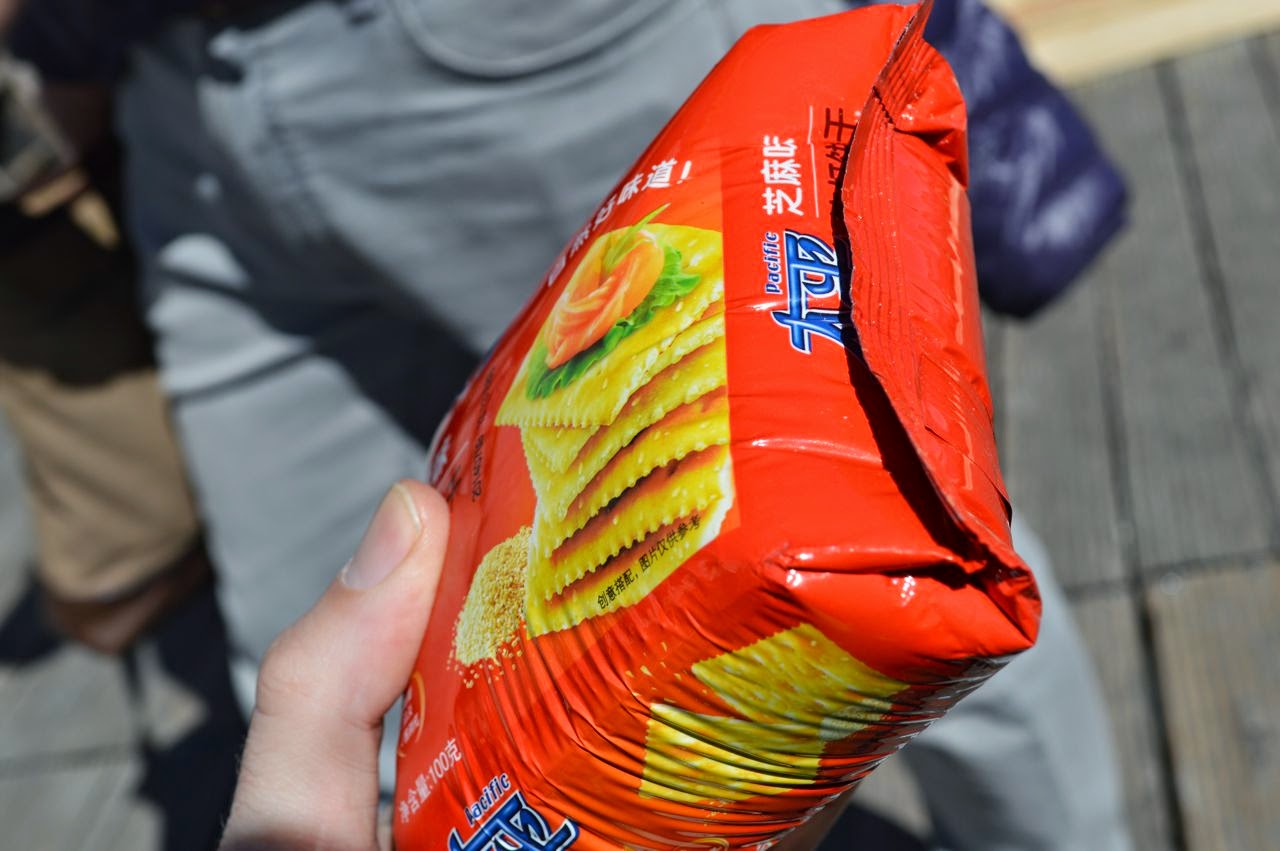
An illustration of the change in air pressure was graphically provided by the packet of biscuits which I pulled out of my bag.

Whilst the tourists edged their way slowly up the stairs, stopping for breath every 20 paces, the local builders had no such problems. This man carried a large bucket of paint up to the hut under construction, put it down, lit a cigarette then started hard manual labour. I'm guessing that over time the body must adapt to the thin air.

And finally this is the top platform at 4680 metres. It offers an excellent view over the glacier, a natural environment I'd never seen up close before, but more than that, it was a curious location that turned out to host three things.

The first of these was a man sitting at a simple open-air table carving tourist's names onto metallic medals. It was a small but popular business with a constant queue.

Next was a small food stall selling wildly overpriced snickers, red bull and sausages, the small red variety that rotate on a heater. He wasn't doing so much business.

And finally there were people, like myself, taking the obligatory selfie or the friends shot like the pair in the background. While I was wearing more than warm enough clothing, what I should have been more prepared for was the sun. It is very powerful and deceptive at this altitude. I got somewhat roasted as the day went on and have the flaking skin now to prove it.

Coming down by the same route there turned out to be more to the trip than expected. We took a wrong bus when alighting from the cable car and were deposited not at the base station but instead at a lake. This was, in many ways, a more beautiful and relaxing place with fewer visitors.

The lake was supplied by the glacier and was of a stunning aquamarine colour. These sunken trees also drew my attention to its artificial construction, accomplished by a series of small dams creating pools where there must have been a faster flowing descent in the past.

With the light hitting that perfect early evening glow the place took on a wonderful energy. There were a few people milling around, even some wedding photography going on, as there is in most tourist spots in China, but the place itself was big enough to absorb all of this. Also, being lower in altitude at a mere 3500 odd meters, it was possible to walk around without having to make constant recourse to the oxygen. Leaving Jade Dragon Snow Mountain behind I thought I had coped with the altitude challenge pretty well but I found that in the evening a headache came on that refused to leave me till noon the following day. While the bulk of people and the technology goes a long way to opening up a space like this to the casual visitor, it remains a harsh environment. I won't be in a hurry to go further than 4680 metres and, unless I go on a Tibet tour (not impossible), it's unlikely I'll be in a position to do so anyhow. Once, in this case for me, is quite enough.
Friday, 7 November 2014
The Bath Tour of All Tours
After a hard Summer of intensive tourism in and around Bath, it was finally time to offer up my tour of the Bath tours in response.

This is not a critical review of the tour, like the majority of the posts on the blog are, it is something simpler: some pictures of the tour and descriptions of what they are or what they remind me of. So, to begin, this is us in front of the Abbey where a moment later an official emerged and shooed us away with the choice words, "This is not a theatre, it's an abbey!"

Here I am describing the horse drawn carriage tour of Bath. The carriage wasn't doing the rounds during the morning tour but in the afternoon we did cross it more than once. As you can see the group is very mixed with younger and older people, residents, students, strays and visitors all tagging along.

The City Sightseeing Bus is parked in the background and one afternoon an actual guide who gives tours for the company joined us. I make a point of only saying things I would be fully prepared to say to the people who give the tours I am talking about, but I must say that of all the stops this is perhaps the one where I give the most critical comments so I was unsure how they would be taken. I need not have been so concerned; the guide turned out to be openminded, amusing and not at all like the colleague of his I talk about on my tour. There were in fact a number of interjections from different people I talked about at different junctures of this tour.

The tour is not all ironic jokes, as might be expected from the description of it. Whilst there is an obvious humour to the proposition of making a guided tour of tours, the tour would quickly exhaust itself if it only used the idea as a platform for gags and nothing else. Rather, the format offered a readymade way to talk about the city and its users, tourists and locals alike. I felt this tour was rather conventional, formally speaking, and it was the subject matter that marked it out as different. I suspect I'll want to stretch the formal boundaries of what constitutes a guided tour a bit further with subsequent tours, but making this one within a stricter frame was a good challenge and seemed to work well for the location.

I was particularly happy with the last minute addition of the sign on a stick. It is so simple a form of advertising that it is easy to overlook and immediately focus at online platforms and suchlike. The sign on a stick, however, did bring some people to us and, just as importantly, it provided a nice presence throughout the tour reminding us of what we were doing and announcing it to passers by too.

Speaking of simple technology, the other item which proved incredibly useful was the portable speaker I wore around my waist and was connected to by a hands free microphone. It allowed me to be heard easily above the passing traffic in places like this stop opposite Nelson's former residence. When I took the People Behind the Plaques tour, which stopped to talk about the same building, they had to withdraw round the corner where Nelson's old digs could barely be seen, just in order to be heard. I do turn the speaker down when it is not required, it can be off-putting to be barked at unnecessarily, but more often than not, it was useful to raise the voice above the traffic and crowds that flood the city centre at weekends.

Opposite Thermae Bath Spa I shared my experience of the Spa Audio Tour and this was interesting for the fact that people did indeed have their own opinions about the spa, its history and the process of privatisation that I introduced. What's more, they have quite different opinions with some regarding it far more favourably than others, who consider it plain robbery. One lady was so animated by the subject that she took the opportunity to go not only into the history, at some length, but also into the current campaign to heat the swimming pool with the thermal water which, she finally told us, she was one of the moving forces behind.

We cut a tourist picture walking through the streets looking for all the world like just another group on the UESCO merry go round. This forward progression came through in what I said too. Unlike some previous tours which were more episodic, this one really tried to build a narrative as it went along, drawing upon previous spots and constructing a history and frame of reference of its own. This history was not anything like a chronological one giving a history of the city or of a person, it was restricted to a history of our tour. It self-consciously built up a story of sorts from the tours, a story in which the city itself is the chief protagonist with additional voices provided by tour guides and tourists alike.

Here we are looking at the City Trail which, I was surprised to discover, one or two people were aware of. Inviting the group to follow the trail and placing myself no longer at the front was a way to let the group play a more active role in the tour, something I liked because it got people talking to one another. This gentle encouragement to interact was effective but was always delicately balanced with a desire to avoid contriving embarrassing situations. Street entertainers tend, too often for my liking, towards the latter so I was careful to create space for those who wanted to watch in silence while setting the general tone as one that encouraged interaction between me and the public and within the tour goers too.

Here we are dowsing. I was intrigued to notice how this works for some people and not others. From observation, about two thirds of people got a response from the dowsing rods. There were one or two who were keen to make it not work as they were skeptical about the whole procedure and it seems mind might have been able to suppress the movements of the rods. What this all means I cannot say, it will have to rest as an observation.

A proper Bath weekend moment came towards the end of the tour when we were asked to bulk out a group photo for a hen party.

Finishing up at the Royal Crescent seemed to work fine and it offered us a gentle stroll back into the city centre where we repaired for food and refreshment. Over the three days I had a number of interesting conversations with people who were on the tour, each had their own take on it and on the city itself. I am fortunate to have had such generous people come along and even more so to have had one, Richard White, write about the tour on his blog, which is worth looking at more generally being based around landscape, arts and walks. He concludes, "A wonderful and surreal experience" which is in no small part due to the interventions of all the various people we encountered along the way who somehow became a part of the tour. I should conclude however, by thanking not just the inadvertent participants but also the very steady and significant practical support and advice from ICIA who commissioned the tour and visitBath who supported the project too. Thank you and see you on the next tour!
Saturday, 18 October 2014
The Time To Get Lost Audio Tour: drifting round Wangfujing
The Time to Get Lost audio tour is an artist's project by Jennie Savage. It is described as "an invitation to people all over the world to get lost simultaneously" and the designated moment for this to happen was 6.30PM on the 3rd October 2014. A list of suggested starting locations was published so people could chose to start their walk in a common location in their city, if they wished, and possibly get lost in company. The other twist is that there were not one but three, presumably different, recordings that could be followed, one titled 'wanderers' and the other two, 'idlers' and 'drifters'. I tried downloading one of these onto my phone but was thrown off by some technical issues which meant I did not manage to get this done on time. Trying again a few days later it worked fine so, even if a little late for the collective event, I headed off to the suggested meeting point: outside the Beijing Dept Store 北京百货大楼 located on Wangfujing.

I figured that even if I had been here at the appointed hour, the chances of meeting someone else doing this audio walk in Beijing were slim to non-existent and, added to that, I was not sure if the proposed start time was 6.30PM local time or 6.30BST, which would have required me to have started at 1.30AM on October 4th, not a likely prospect, even with the best of will. So a week late, but round about on time, I went to Wangfujing. There was still a relentless flow of people and standing still for a moment I was approached by a not unattractive Chinese woman in a leather jacket who spoke to me in English and came on a bit over-friendly. Having witnessed this routine before, one which typically finishes in a tea scam as China Uncensored amusingly describe, I made an exit, pressed play and pretty much immediately heard a softly spoken woman telling me to turn left.

This quickly brought me into the night market. I've been here once before so knew what to expect: bright and shiny tourist tat China style. The voice on the recording was at times hard to make out as the crowds around me were loud, the C-pop and electronic toys louder still and the vendors the true volume kings. What's more, the recording itself also had background sounds that seemed to shift in and out of focus. At one moment I found myself in a silk store and the next jammed by the crowd beside a stinky tofu stall, and yes the name is well deserved. The woman described some things she could see: workmen eating their lunch and looking around I could see some half parallels in the tourists eating the weird and wonderful snacks from the market, which not only include stinky tofu but go as far as the infamous scorpions on a stick. Passing a small but aggressively amplified Beijing opera stage, I finally squeezed out of the market and could hear the voice clearly.

I was led back onto Wangfujing and where previously I had been noticing the correspondences between the place she was describing and where I was, I now started noticing differences. For example, I cannot imagine seeing large portraits of politicians proudly displayed in the window of a photography shop in, say, Bristol. A picture of Thatcher of Blair in the window there would almost certainly dampen sales and quite probably attract unwanted late-night fast food or even a brick.

Following the instructions proved to be more an art than a science; there was plenty of scope for interpretation. For example, the way the roads and paths were laid out around me did not permit such rapid twists of direction as those being taken in the recording. Faced with impossible instructions or old ones that were superseded by fresh suggestions, choices had to be made. Without ignoring the tour's suggestions I interpreted them in a way that allowed me to be spat out of the shopping area and onto roads behind the shops as a change of atmosphere felt due. Here, removed from the neon and bustle of commerce, other layers of the city presented themselves. Was this a map of the city and its six current ring roads or was somebody making I Ching doodles while on the phone?

The basic premise of the walk is that you follow the directions given by the woman on the recording as she is walking elsewhere and describing her environment. This elsewhere turns out to be a composite location for whilst I was delving further into one location, the recording seemed to be continually expanding its scope. This basic premise of taking a walk parallel with someone else in another location is familiar. Last year I wrote about A Walk With Amy by Amy Sharrocks which I took in Stuttgart whilst she was on the other end of a phone walking, presumably, in London. In both that work and this the two walkers are paired and the differences and similarities of their observations make up a considerable part of the work's appeal. Where they differ is that Sharroks spoke live, one to one, from a single location whereas Savage's walk is pre-recorded, for multiple users and is not contained within any one real space.

The audio tour often seemed to be referring to market type places and global business being what it is, it was almost inevitable I would encounter a shopping parallel. This came in the form of H & M. If not them then it would have been an Apple Store, Gap or Starbucks or some other global brand. Ten or twenty years ago that would not have been the case here in Beijing but the city is slowly becoming predictably normal in the sense of having designated shopping areas with global brands. I wonder if the potential walker in Baghdad, one of the other locations proposed, would be more able to escape the reach of McDonalds and KFC?

I came across a man taking a picture of the city map and for a moment liked to imagine he was on a similar mission to mine, but his lack of headphones precluded him from being on the Time To Get Lost tour. Taking a picture of a map might indeed look like the opposite of trying to get lost but this map, one showing the city's ring roads and sprawling suburbs is all but useless for finding your way locally, such is the scale needed to contain the entire city on a single panel. Added to that, there is no 'you are here', so it really is more an emblem of the city demonstrating its size and showing all the recently conquered lands that make up the new far-lying neighbourhoods.

There were a section of the recording that featured many cars and this had the effect of inducing some nervousness that they might in fact be in my space. That is a real danger in Beijing as the lines between pavement and road can at times be very fluid with pedestrians often having to walk on the roads and cars driving and parking on the pavements. On at least one occasion I had to check behind me in case a car was rushing upon me. This blurring of the sonic spaces was quite pleasing, particularly as it was done by introducing something new into the area rather than doubling up the existing sounds, which is more commonly done on audio tours that appropriate the existing sonic space for the recording.

The recording then seemed to shift to a developing country and talk about shacks and stalls that had solidified into buildings. The closest equivalent I could see were these soft drink stalls doing bubble tea and what not. This shift in the recording from a British environment to a very different one made some sense given the global ambition of the project.

Although Wangfujing is one of the most developed shopping streets in Central Beijing, I almost never come here so it is relatively unfamiliar to me. It was, then, a surprise to stumble in front of the Foreign Languages Bookstore which I remember looking around the first time I came to Beijing in 1997. Back then I came out of it with absurdly cheap propaganda posters of Mao, Marx and Stalin as well as some translated Chinese literature. Not having seen the place in 17 years it seemed at first glance peculiarly similar, a Communist era time capsule surrounded by malls and tourist markets. This interruption of the tour with a strong personal memory span me off on another tangent while I was being urged to turn left by the insistent voice.

I was brought finally into one of the malls and went up an escalator. In my own Waylosing in Beijing Tour, which I took earlier this year, I found myself similarly putting aside my visceral dislike of malls and trying to get lost in one. The problem with using them for this purpose is that they are usually designed with these central atriums that help you find your bearings and the best that can generally be hoped for is to exit the mall into an unfamiliar space.

I consciously avoided making any selfie pictures on this audio tour but when I arrived at a mirror it was clearly the moment to place myself in the frame. Looking at this picture of myself now, I am prompted to ask, 'what was I really doing there? What was I looking for?' Without getting too introspective about it, I think I was looking for a disorienting experience which might lead me to some unexpected locations and possibly new realisations. As such, I was bringing my own ideas about the value of getting lost and I rather think this audio tour was doing something else. With it only being 30 minutes in length and taking a circuitous path, it did not cover much ground and was never going to seriously disorient me. When leading a Waylosing tour in Birmingham this year, it took us four and a half hours of dedicated action to reach a location entirely unfamiliar to us all and to sense we were more or less lost. The Time to Get Lost Tour was instead for me an experiment in parallel indeterminate spaces that might result in a little disorientation. Taken that way the experiment worked.

The places I was moving through seemed in general a good deal richer and busier than the locations of the recording. This did not entirely surprise me given the neighbourhood.

The recording did not have a strong narrative line to it, it simply seemed to be about movement through different spaces which, at a certain point and without any climax, came to an end. My final location was this street. I don't know how the other two audio tours would have been different, maybe they would have brought me into more contact with people or to other places, I will never know. Knowing there was potential for the experience to have followed other lines is pleasing in a way, but I have to think back to Auto-theatre an experimental audio tour I made with a three way multiple choice of routes back in 2008. Knowing that this work already contained a healthy does of inherent indeterminacy in terms of which way the listener should walk, I now ask myself whether compounding that with two alternative tours was really necessary. With regards this Time To Get Lost Tour, I will of course never know the scope of the full work. If you are interested to know more about the walk there is an interview with Jenny Savage on Talking Walking in which she goes into the process of creating the walk and some of its intentions. It makes for interesting listening, whether sitting or walking. It is definitely a worthwhile experiment and fun to take, even if the name is a little misleading. I should not be surprised to find myself getting lost again with Savage in the future.
Subscribe to:
Posts (Atom)