Tuesday, 7 February 2017

The Tour of Geyuan Garden: a heritage nightmare


Geyuan Garden is, apparently, one of the four most prestigious gardens in the whole of China. I would never have guessed. Numbed from a 24-course Spring Festival feast the night before in which the baijiu toasting went on long and hard, I dragged my way around the residence and formal gardens. It was piercingly cold and despite the many layers I was bound up in, I was still freezing. I was here thanks to a family outing which I got hoovered up into and before even setting off I was saying to myself, this was an absurd moment to come sightseeing. It truly was, and yet so many did.


Rather than following any one single guide, the way this place seemed to work was that the place was flooded with so many guides you could hop on and off their tours and surf your own course around Geyuan. The guides all seemed to be women, mostly under thirty, wearing costumes that featured dashes of shocking pink. The look was of history tarted up according to the tastes of someone lacking in any deep sophistication.


The guides congregated around the built up areas explaining thing like, who this was the former home of, or what that assemblages of stones meant. They looked like they were following a tight script and there were no questions except the obvious ones like, where are the toilets? And the most inevitable one of the lot, where is lunch?  


The crowds were nothing short of crazy. I am used to China, I've been here a while now and learnt how to switch off and find privacy in public, but this was something else. This was the third day of Spring Festival. There didn't seem to be any limit on the number of visitors, this was the moment for Geyuan to fill the coffers. The crowd was very accepting, however, sardine tourism probably came as no great surprise and most people simply made the best of it. The guides cranked up their microphones, great big bottlenecks swelled around gateways and some  boys got bored and ran wild: it was the usual low-level tourist chaos.


There is a certain level of ennui I have come to associate with Chinese heritage sites: once you've seen one you've more or less seen them all. There may be exceptions but Geyuan isn't one of them: we trudged from one unconvincing restoration job to the next. When you look around the backsides of the buildings you see hastily slapped together concrete, wires poking through rough holes in the walls and air conditioning units. I was reminded of what Paul Theoux wrote about sightseeing in China, "It has all the boredom and ritual of a pilgrimage and none of the spiritual benefits."


Guyuan has a bamboo garden and this was probably my favourite part of the experience on account of it being ever so slightly less packed solid. That said, I was not crazy for it either as it was all a bit too intentional in its aesthetic for my tastes. 


The garden worked well enough as a backdrop for selfies and group pics, which seems its primary purpose these days. I watched a constant stream of people with phones in hand carefully framing up shots, finding the right expression and then waiting for the moment that the crowd thinned enough so the background no longer resembled the Shanghai Metro rush hour. I think the attraction of the place is that it lets visitors imagine they are in one of the immensely popular costume dramas, but it was doomed to fail on a day like this. There is a paradoxically repressed yet rampant and distinctly Chinese strand of postmodernity at play here. Geyuan is not precisely a pastiche or simulation but a thorough restoration that approximates these in form and function and which offers temporal continuity to the Han who voraciously consume it in a very contemporary and disconnected way. Some sort of narrative continues, whether it has any veracity or not is irrelevant, the point is it must go on, like Burroughs word virus, to reproduce itself and continue being told.


Some distance away from the garden is the Yangzhou Slender West Lake which is truly the cherry on the cake. Actually, I shouldn't get started on Chinese copies of Western cakes, that is a whole sorry topic in itself. This scenic spot, clustered around the water, is in a similar vein to Geyuan but more expansive and thus less crowded. In places it is beautiful, but it is also deeply frustrating. As I looked around a Buddhist monastery I asked myself, what went on here during the cultural revolution? What about other ups and downs? When, how, why and by whom was it restored? The site could be very interesting if there was a way to unpick the different layers, or even more so if there was a desire to make them visible, but there was none of this. The site had been designed to smoother questions and promote historical feel-good. This is not a uniquely Chinese phenomenon, British stately homes often give me the creeps too with their Downton Abbeyesque faux historical projection. The lingering impression I was left with here was that heritage used this way can never be true to itself. It is a fiction that refuses to recognise itself as one even when the cracks in the visage are glaring and there for all who want to see. 

Thursday, 2 February 2017

The Wood Green Revisited Tour


Today's tour was of the stalwart North London neighbourhood Wood Green in the affable company of Hugh Chapman. I say stalwart because Wood Green is one of those areas that has the character of always being there but never being too obtrusive, like the waiters in the excellent Kervan Sofrasi Turkish Restaurant on the High Road. This is in complete contrast to attention seeking Dalston, for example. This can mean that the place gets taken for granted, which is a pity because changes, such as the imminent demolition of the gas holder, can just happen like weather: it lurches from grey to grey.


Our tour of Wood Green was not a rehearsed walk with a set script, but Hugh did have several locations in mind to take me to. That is what brought us to the Chocolate Factory, a former industrial building now housing creative businesses. It still bore traces of its history of sweetening the tooth of the British Empire but today it housed such things as overspill from Mountview Theatre Academy. As we were walking around this oversized shoebox and later waking beside some of the other refashioned industrial units in the area, I had a sense of familiarity that I now realise came from the old Middlesex University Fine Art School being based here on Western Road back in the 90s. I first visited it as an undergraduate student and then later as a judgemental life model; a cash-strapped 22-year-old performance artist who looked down on life drawing but had to keep his opinions to himself and humbly take the money. The school has long since moved elsewhere, the building changed its appearance and my attitudes to drawing softened.


Back out into the cool grey we ascended the multi-story car park in search of a view and this is the best we got. Whilst Wood Green's centre has some density, it is surrounded by rows of two-storey houses with cars parked out the front and little back gardens filled with patches of grass, bikes and children's plastic toys.


For an area whose name evokes a Robin Hood-like image of a clearing deep in the forest, the reality is resolutely urban with no wood to see and scarce little green either. The slither of greenery that we did come to was the New Riverreached by walking under the train tracks, which neatly slice the urban fabric in two. To the south we arrived at Turnpike Lane Station where the slender Ducketts Common stretched before us but which marked the limit of our walk: we turned around and headed back up High Road. That park is another old haunt of mine: many moons ago I directed A Goat to Grind a performance for six cyclists that briefly interrupted the assembled Special Brew drinkers. Whilst I have been away too long, they looked as if they were still there, still putting the world to rights and peeing in the bushes. It is reassuring that some things don't change.


One of the purposes of the tour was to test out an idea of mine to explore an urban environment via the reproductions of art that can be found in it. This picture on the left, sitting in a charity shop, is an example. I wanted to first identify its origin and with this see if there was a way to connect this Rembrandt (right) to its contemporary environment. The first thing that I noticed doing this was how unevenly art is distributed: there are vast swathes of the city that art barely touches. What you do see everywhere, however, are the byproducts of art, namely design. Looking for both art and the traces of it through the etymology of images, proved to be a quite fascinating exercise that offered an original method of viewing the city. How the art reflects back upon the city remains to be seen but it can be so rich in content - Balthazar's Feast, Rembrandt's life and the painting's history - that these will, without the shadow of a doubt, include stories that could be reactivated in Wood Green.


Hugh is working for the social enterprise Green Rooms, a hotel catering for the arts sector which has its own arts programme. Naturally, they have an affinity with independent local businesses such as the Big Green Bookshop, a sympathetic place tucked away off the main street. Here we met the people running the place who were happy to chat and willing to be involved in some sort of artistic tour too. This is quite a contrast to another one of our stops, the frozen food store Iceland, where a security guard asked us to stop taking photographs, afraid we might be stealing their stellar design concepts. This division between local stores and national chains was predictable but is worth bearing in mind when making a tour. The temptation is to make tours on a personable and local level, bypassing the brightly lit mall, but that would give a very false impression of the neighbourhood. Somehow, it seems to me the resistance or impersonality that you can encounter in the larger places is interesting in itself and a tone not to be avoided altogether. 


All the time that we were looking around the neighbourhood as a form of artistic research, there was also a secondary very practical task of looking for a suitcase going on. This took us up and down High Road in and out of large and small stores alike. I did finally find a decent case in a sale in one of the smaller places and it was put to use immediately as I checked out of Green Rooms. I expect to see more of the area and, in the words of Arnold Schwarzenegger, I will be back. Touch wood (Green). 

Friday, 20 January 2017

The 42 km Tour aka The Xiamen Marathon


The 2nd of January was a big day for me. Some months earlier I had signed up for the Xiamen Marathon. I followed the instructions, arrived at 7.15 AM, only to be told I could not participate because I had not collected my race number. A trying-to-be-helpful but actually hopeless young lady in a reflective yellow jacket told me race numbers had to be collected the day before. This crucial detail was not included in the communications I received from the race organisers but was instead buried in their website's information on a not so very obvious page. My wife and I tried to get the race assistants to find a manager who could issue a number but the girl in yellow just gave us phone numbers which didn't respond except for one which someone picked up and then immediately slammed back down again.


There was nothing for it but to go home and watch the race on TV. From this point of view, the marathon is basically a two-and-a half-hour tourism promotion. Once the pros had crossed the line and the Ethiopians collected their prize money, the TV coverage wrapped up. 


As I noted when reviewing The Tour of England, sporting events have become another way in which cities are made visible through a sort of tour. With that one, a small number of cyclists followed the route, a few more people lined their way and a considerably larger number of people watched them circle around the city on TV. I think it is very interesting how cameras construct a very selective live video portrait of the city, but what I miss in these TV tours is being inside of frame myself and having firsthand experience of the location. Reality is almost always much more diverse and ambiguous. That’s why the idea of running a marathon, rather than watching one, was so appealing. Well, that and I also wanted to get in shape.


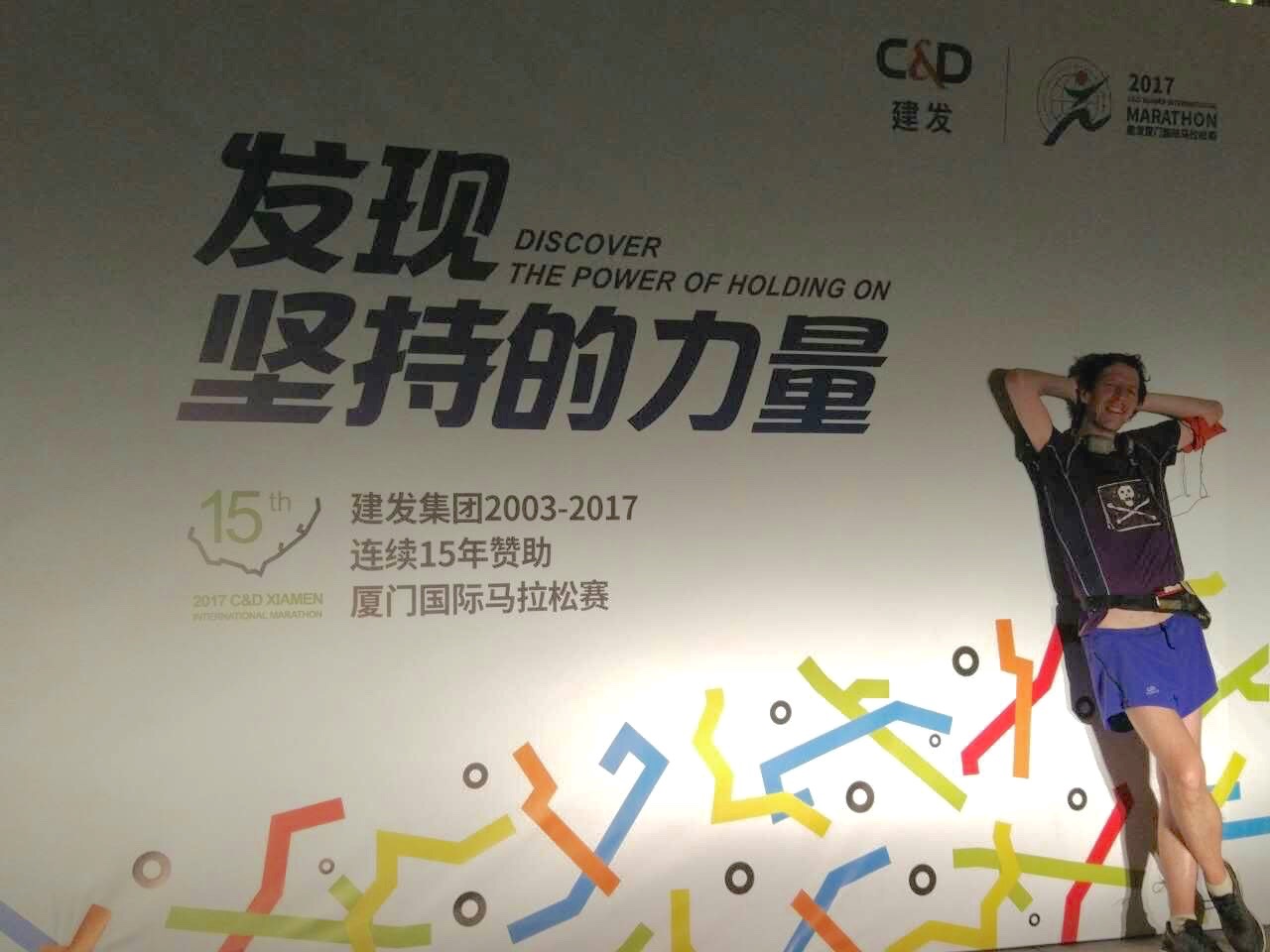
In place of the race number that had been denied me, I donned a pirate flag. I was not going to be running for the corporate sponsors like China Construction Bank and KFC, I was doing this for myself. I know that if I had not been denied a number I would have run the race anyhow, but I started to sense that being excluded was in fact not a bad thing; it alerted me to the true nature of the beast I was dealing with. Call it a stroke of luck or simply the power of self-justification, this race was taking an interesting new tack. I waited six and half hours till the last of the stragglers from the official race had groaned over the line then approached the exhibition centre where the action was. Coming towards me was a tired looking Monkey King. Very few Chinese runners have the gumption to dress up like this and I should admit I was impressed, particularly given the heat. I had been toying with dressing up too, but not being sure if I would complete all 42 km, I was reluctant to fail spectacularly in fancy dress.


The starting point was now freely accessible so I took my mark and at 2.30 in the afternoon set off on this endurance tour. It was an extremely pleasant 24ยบ C; pleasant if you were sitting in the shade sipping tea and eating watermelon, that is. For me it was anything but relaxing, it was sticky, humid and precisely the time of day I would normally avoid running in Xiamen. Never having gotten further than 22 km before, I knew I'd need to pace myself so I set off speed walking. 


Since the roads were no longer blocked off for runners I pounded along the pavements and cycleways on the side of the ring road and must have been quite a sight: a lanky westerner wearing a pirate flag wiggling his bum furiously from side to side. Some people did take pictures and a bemused older man on a mountain bike followed me for a while. Mine was, however, a very solitary marathon, not the crowd experience of the morning. Perhaps because of this, I listened to music on headphones. At first I set my music library on shuffle which served up a hopelessly random selection of audio oddities many of which were slow melodic thinking stew or even worse, Chinese lessons and audio books. I was, however, prepared for what was to come and had downloaded the three CD album The Workout Mix (2011). In any other context this would have been downright painful to the ears but slogging round the sweaty Xiamen ring-road, this relentlessly upbeat electro-kitsch was exactly what I needed. 


Even when I reached the insipid Emall, a long way short of the mid-point, my feet were already complaining. I had read that there are many things that can go wrong when doing marathons. I knew that for me the feet that were quite definitely my weakest link but there was no plan B, I simply had to endure the dull repetitive pain that grew with each kilometre. I dared not take off my shoes to see what the pain consisted of. One good look at that gore would have been the end of my race.


Making this very particular tour up and down the city's tourist coastline was a good opportunity to reflect upon the current transformation of Xiamen. When I first visited the city in 2010 it seemed much more beautiful than today. There was abundant nature bursting out at evert corner, threatening to reclaim this relaxed tea slurping city. But there has been a shift, maybe for older residents they'd say that already in 2010 that shift had already taken place. What was unmistakable was that the city was now being remade according to a much more intentional aesthetic. It looked like it was trying to style itself as a new Hong Kong or Singapore: high rise, malls and manicured nature. The irony here was that in doing so it was destroying the very thing that made it beautiful in the first place and turning itself into just another Chinese city, albeit one with better weather.


I like the comparison here between the battle hardened face at mid-point and the shell shock of the finishing line. My final time was far from heroic: just over five hours. Still, my sole ambition was to complete the 42 km and this now leaves me with something to improve upon. Crossing the deserted finishing line, littered with the detritus of corporate sponsorship, my immediate feeling was of defiance. The pirate held true! The message: don't let companies who don't care for you deny you of your dreams. 


And here I am making my best efforts at an 'it was easy' smile. With distance, I can see that there are some aspects to marathons which, as a format, have made them become almost inherently corporate. Maybe other cities do a better line in them, I don't know. Not having run one before, I did not know what I was letting myself in for. I later learnt from several other people (Chinese and foreigners alike) that they had the same problem obtaining a number from Xiamen Marathon. The organisers just seem to be very poor at communicating and don't bother to improve as the race is heavily oversubscribed. You really are just a small cog in the wheel and the juggernaut keeps on rolling regardless of your experience. I did in fact ask their press office for comment but they, like all the other phone lines and emails, have also not replied.


When I got home I gingerly peeled off my shoes. My long suffering feet were in a sorry shape. On the sides of the heels were white oversized blisters that looked like miniature pitta breads. My big toe was wrecked too, the next day the nail would go an unusual shade of blue. I cannot say for sure but my guess is that this is a result of fake shoes. I first tried on the shoes in a store and then, like the cheapskate I am, ordered the same pair from a Taobao seller. Either Asics are not all they are cracked up to be or I got a poor imitation, something that does happen in China. I have in any case learnt a lesson here about online shopping, and also another one about the nature of marathons, too. There is quite definitely a whole lot more to them than just an unreasonably long tour. They offer a window into the dynamics of the city and to your own, deteriorating state, over the course of 42 km.

Tuesday, 10 January 2017

The Genhe Tour: a journey to the coldest place in China

Out of the blue I received an invitation to participate in the Burnt By Snow festival, which was taking place over the soon approaching Christmas weekend. It was not entirely clear to me where this was happening but, since I didn't have any other Christmas plans, I said yes and then did my research. It was then that I realised it was to be held in Genhe, a small city in the far north of Inner Mongolia, close to the Russian border. 


Getting there turned out to be quite an expedition in itself. From Xiamen in Southern China it would have been easier to get to Europe than to Genhe. The flight north was long and included stops and changes at each of which new people got on looking more and more seriously dressed for extreme weather. Never having flown along this central axis up through the heart of the country, I was keen to see the landscape from above but it was only when we got as far north as Shanxi that the clouds parted and the mountains below came into view.


I have gazed down over Northern China many times from planes flying from Europe to Beijing and it has never failed to startle me how, in spite of the inhospitable landscape, people tenaciously cling on and make a life here. This is particularly true of Inner Mongolia where winter temperatures plummet to fantastically cold numbers that seem purely abstract. Stepping out of Hailaer airport and meeting the other artists who had come for the festival, the cold was no mere idea anymore, it was a slap-you-in-the-face concrete reality. It immediately woke me from the hours of transport lethargy and introduced a sense of urgency about wrapping any exposed flesh and moving on and out to Genhe. My now reddened cheeks tingled and went ever so slightly numb as if the dentist had missed the mouth and injected them by mistake. This was just the start; it was to get a good deal colder as we headed northwards up to the higher land around Genhe.


Bodies and bags were squeezed into the mini-bus, rearranged and then squeezed again to stuff every last cubic centimetre of space. The precision with which the driver staggered our entry into the vehicle, so that the baggage could be layered around and upon us, was impressive. As he was marshalling us I thought, I bet he was an expert at Rubik's Cube as a teenager. Packed like proverbial sardines then, we set out on the three-hour drive through the darkness to Genhe.


The main road between Hailaer and Genhe was little short of a disaster. The cold and ice had wrecked havoc upon the driving surface to the point that, in places, it was little more than a scree slope. On top of this, blocks of ice were strewn and once in a while almighty pot holes tossed the minibus one way and another. The windows were coated with a tough layer of ice on the inside of the vehicle and the long-suffering suspension sounded as if it might give up the ghost at any moment and abandon us to our fate. What should have been a three hour journey ended up taking four and half and, arriving in Genhe, I stepped out giddy as if I had been five rounds on a roller coaster blindfolded.


We had a day to settle into this iceberg of a city then, on Christmas morning amidst light snow that me feel like I was inside an ever so slightly dystopian snow globe souvenir, we drove out through the suburbs and on to China's Cold Pole. It turned out to be about an hour outside the city, on a hill surrounded by a birch forest where a team of police cars was waiting for us. It was a God-forsaken place in the middle of nowhere. I felt momentarily sorry for the policemen who had to sit and freeze in their cars and watch performance art but then, considering how the police have historically been so hostile to performance art in China, I thought there was a rough justice in this posting after all. Actually, this festival enjoyed an unusually positive relationship with the authorities; the local government even supported it, a very rare thing for performance art in China. 


The Cold Pole may well have been stunning but I really couldn't tell as it was so cold I hopped around in the snow for five minutes trying to take it in then darted inside the gift shop. The shop sold local specialities and souvenirs that nobody seemed interested in but it was well heated so the place filled up. Soon enough the cigarettes came out and the room stank to high heaven of smoke, as indeed most of the restaurants we ate in during our stay in Inner Mongolia did, too.


After some delays, the media crew and local government officials rolled up the hill and spilled out. The festival's curator, Yang Dezhong, gave the inaugural performance, followed by two Thai artists Aor Nopawan and Mongkil Plienbangchang, who must have been suffering having just flown in from a sultry 37ยบ Bangkok. There was talk beforehand of people stripping off, nudity being a bit of a thing here apparently, but in the final event wisdom prevailed and the clothes stayed on. We were told to limit the duration of performances to ten minutes for safety reasons and that was pretty sound advice. The cold was such that every physical action they made in their performances was modified and approximated, lending the performances a rough urgency. Afterwards, their were interviews  and I was asked by CCTV to explain what performance art is. I fumbled an answer but I honestly think it is better not to ask what it is but rather to put that concern aside and instead ask, what did I just see, and how does it make me feel? It was too cold for such subtleties. 


We then drove a short distance to an excellent local restaurant housed inside a log cabin. Through a combination of underfloor heating, big plates of food and blueberry alcohol served in teapots, we warmed up, relaxed and sang songs. This was so comfortable, in fact, that it was difficult to pull ourselves out of there and face the Siberian chill once again. Still, as the light was receding, we did just that and headed to a nearby riverbed for the next round of performances.  


It was my turn now and I decided against leading a way-losing tour, or anything as rash as that, and instead traced out a short phrase in Chinese through walking slowly through the snow. This was inspired by the views of Inner Mongolia seen from a plane and from Chinese landscape paintings upon which there is usually an inscription. Mine, then, read like the title of a landscape ink and wash paining, "A Poet Walking in the Mountains". I concluded by walking into the distance, back towards the Cold Pole. The title of the work, Some Lines Written Above Genhe, is in reference to Wordsworth's Tintern Abbey and the tweed suit is my attempt to embody what poetry had become for me in the UK. Having been asked recently to record English poems for a Chinese newspaper I was surprised to find that I actually quite like Wordsworth, so this was not for me a wholly ironic gesture, it was more a suitably incongruous one.


I later heard that a Mongolian woman who had been watching the performance asked, "is he connecting with the heavens?" She asked because this is something she said she could do. I gazed up at the sky for a length of time at both the beginning and end of the performance to put my actions into a relationship with my other self, who is more typically flying above the Genhe's of this world at 10,000 metres. While this might not have been connecting with the Gods in the way she practiced it, I had to ask myself whether maybe, through performance, I too was attempting in another way, to connect with the Gods.