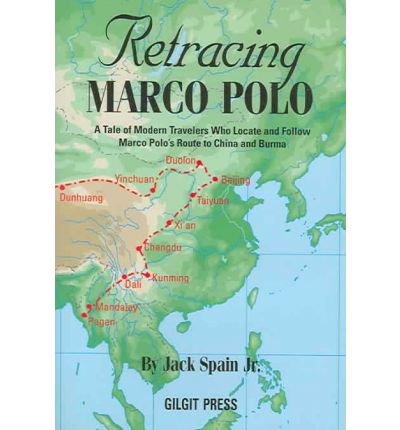
I've been reading the Travels of Marco Polo, some of the writing that followed in its wake and a few films inspired by this journey too. It took Polo several years to reach China from Venice and so too could it take me several years to get through all of the accounts, commentaries, recreations, documentaries and so on, of this journey. That amount of time I don't have so this summary is necessarily incomplete. The book itself is both more and less interesting than expected. It was written long before the sort of travel writing that self-consciously places the writer inside the text, that can weave together reflections on culture and place with anecdotes and multiple narratives, that places itself amongst other traveller's accounts and deliberately strays into areas more the preserve of fiction. No, it belongs to an older tradition of writing on travel; the book reads as a merchant's account of a journey that might provide useful information to those who might wish to follow the same route. As such, a lot of the things that I look for in modern writing on travel, and take somewhat for granted, are absent.

The book is, however, multilayered and for quite other reasons. Firstly, it was not written by Polo himself but instead by Rustichello a writer from Pisa who was, for a while, his cell mate when they were held prisoner by the Genoese. As travelling to China was unheard of back then, Polo and his trip were greeted with scepticism and his account was apparently deemed fictional by many. In the 1982 Italian film adaptation of The Travels, David Warner, a favourite actor of mine, plays the part of Ructichello, portraying him as a long suffering author who'd much prefer his own stories were taken seriously and that he be released from jail. This film is an true epic, complete with cameos from John Gielgud and Burt Lancaster, a major part for Leonard Nimoy who just about shakes off Spock, and a soundtrack by Ennio Morricone. Rustichello is very present in this version and so, necessarily, is the active role he played in compiling and editing the travels.

From the start, then, there was an editor at work on the text. In the intervening centuries from it's first publication to me downloading it for free onto my travel-friendly kindle, it has accumulated many more layers of commentaries. The first third of the book was devoted to prologues and the biographies of the translators and commentators and as such reflected an orientalism particular to the British empire. I read about English public schools, railway construction projects in India and parliamentary committees. At first this padding surrounding the text seemed absurd and mostly pointless but, once the journey East finally began, the story seemed disappointedly bare and I started dipping back into the commentaries and the commentaries on the commentaries. Slowly, I grew to appreciate them, even those that seemed like pure diversions. One pervading feature of them is that they attempt to verify Polo's account by putting modern names to places in the original text and to check whether his travel instructions are accurate or not. For the most part it seems to add up. Another aspect of them is picking holes in the previous commentaries, or praising them when warranted.

As much as it is necessary to study the original text, a much more enjoyable read is In Xanadu, William Dalrymple's account of following, for the most part, Polo's route. Published in 1989, it reads as a student adventure that gets out of control. He looks for traces of Polo and the Mongol Empire and offers some useful background history, but this does not deflect attention away from the tribulations and absurdities of the trail. Faithful to the journey to the point of madness is the documentary In the Footsteps of Marco Polo which tells the story of two friends from New York who, in the early 90's, decide to recreate the journey. With little support or experience they chance their luck, end up being held up in war-zone Afghanistan, fake visas to get over borders, travel undercover with Uighurs, get bogged down in Iranian administration and generally have a thoroughly challenging and life-changing experience. Many other accounts exist, Colin Thubron's looks excellent for example, and I feel it should be necessary to read about the journey from the other point of view: travellers from the Far East journeying West or, Ibn Battua's 14th Century travel's from Morocco through Asia. All in good time.

Reading and watching these various accounts of this intercontinental trip does not exactly make me want to rush off and retrace the route myself: a journey through Afghanistan looks plain crazy right now. What it does do however is draw my attention to a long line of places in Central Asia that sit between Europe and the Far East. I am no stranger to making the journey in a plane, looking down over the mountains below and wondering how people live there before taking another bite into my airline meal or flicking through Toy Story 23 or whatever else is on the film programme. Convenient as flying may be, it sometimes feels as if it is either too slow or too quick. Too slow for the obvious reason that being squeezed into a seat for over 10 hours is no pleasure; you exhaust all the time-killing diversions available such as, magazines, videos, alcohol, your neighbour, food, music, work and staring at clouds, and there's still 4 hours more to go. That is a small problem however, compared to the journey being too quick. Too many times I have been spat out into an airport, blurry but excited with the promise of a new beginning with my body and mind completely out of synch. It has sometimes taken me several weeks for the mind and spirit to catch up with one another. What's more, Central Asia is incredibly diverse and to simply treat a vast swathe of the planet as an obstacle to be flown over as swiftly as possible strikes me as profoundly incurious. For all the talk of a 'global village' it is clear to me that this is a way to talk of a network of highly connected global hubs like Shanghai, London and New York. While those living far away from these hubs may know much about the global centres and the brands and celebrities that seem to spring from them, those in the hubs know relatively little of the life beyond the media bubble. Last year, for example, I got to know a group of Tajik students and they were all avid followers of Britain's Got Talent. I am not saying that watching a talent show is the same thing as really understanding a place but I had to confess I knew next to nothing of their country and would even have had to rely on a bit of guesswork to locate it on a map.

There is a revived interest in the Silk Road right through the Chinese governmental initiative "The New Silk Road". This is designed to stimulate economic and cultural links and it incorporates both the overland and maritime silk road routes of old. Additionally, there is also a new railway freight connection to Europe and plans for a high-speed passenger service in the pipeline too. While these ambitious large-scale projects might feel like a separate concern; the silk road of camels, deserts and traveller's tales is a far cry from today's freight containers packed full of fridges, model contests and state sponsored dance troops enacting friendship in national costumes, it does still reflect a need to connect to the actual terrain. Whether it is revived as a metaphor or enacted on a more literal level, Marco Polo's travels through the Mongol Empire, which have come in the West to stand for the the first European contact with China, have a renewed significance. For my part I will be looking into ways to slow my travel down and transform it into an activity in itself rather than a means to an end. Badakhshan here I come!
Reading and watching these various accounts of this intercontinental trip does not exactly make me want to rush off and retrace the route myself: a journey through Afghanistan looks plain crazy right now. What it does do however is draw my attention to a long line of places in Central Asia that sit between Europe and the Far East. I am no stranger to making the journey in a plane, looking down over the mountains below and wondering how people live there before taking another bite into my airline meal or flicking through Toy Story 23 or whatever else is on the film programme. Convenient as flying may be, it sometimes feels as if it is either too slow or too quick. Too slow for the obvious reason that being squeezed into a seat for over 10 hours is no pleasure; you exhaust all the time-killing diversions available such as, magazines, videos, alcohol, your neighbour, food, music, work and staring at clouds, and there's still 4 hours more to go. That is a small problem however, compared to the journey being too quick. Too many times I have been spat out into an airport, blurry but excited with the promise of a new beginning with my body and mind completely out of synch. It has sometimes taken me several weeks for the mind and spirit to catch up with one another. What's more, Central Asia is incredibly diverse and to simply treat a vast swathe of the planet as an obstacle to be flown over as swiftly as possible strikes me as profoundly incurious. For all the talk of a 'global village' it is clear to me that this is a way to talk of a network of highly connected global hubs like Shanghai, London and New York. While those living far away from these hubs may know much about the global centres and the brands and celebrities that seem to spring from them, those in the hubs know relatively little of the life beyond the media bubble. Last year, for example, I got to know a group of Tajik students and they were all avid followers of Britain's Got Talent. I am not saying that watching a talent show is the same thing as really understanding a place but I had to confess I knew next to nothing of their country and would even have had to rely on a bit of guesswork to locate it on a map.
There is a revived interest in the Silk Road right through the Chinese governmental initiative "The New Silk Road". This is designed to stimulate economic and cultural links and it incorporates both the overland and maritime silk road routes of old. Additionally, there is also a new railway freight connection to Europe and plans for a high-speed passenger service in the pipeline too. While these ambitious large-scale projects might feel like a separate concern; the silk road of camels, deserts and traveller's tales is a far cry from today's freight containers packed full of fridges, model contests and state sponsored dance troops enacting friendship in national costumes, it does still reflect a need to connect to the actual terrain. Whether it is revived as a metaphor or enacted on a more literal level, Marco Polo's travels through the Mongol Empire, which have come in the West to stand for the the first European contact with China, have a renewed significance. For my part I will be looking into ways to slow my travel down and transform it into an activity in itself rather than a means to an end. Badakhshan here I come!