Showing posts with label line. Show all posts

Friday, 16 September 2016

The Rewildings Tour: Walking out of London on a line at 200°


Rewildings is a year-long series of walks that I heard about through the Walking Artists Network. I did not know quite what to expect, the instructions were starkly simple: "Meeting @ statue Charles I, Charing Cross Roundabout" ... "come prepared to sleep wherever we get". Oh and over the day we would walk in a line at 200° and should avoid electronic communication and purchases. I arrived a little before the start time of 9AM and sat solitary at the base of the former monarch, notable for being executed for treason and soiled by London traffic fumes. More or less on the stroke of nine, the other five of the group descended upon the traffic island, we exchanged pleasantries and were off.


For the most part we stuck to the roads and public paths and only once did we find ourselves in a true impasse needing to retrace our steps. A little later, in a park, we had to climb out, a task made more sporting by the backpacks laden with camping gear and provisions. 


The river interrupted our flow south south west and sent us upstream in search of a bridge. We were dressed as hikers not urban walkers so, encountering perhaps the single most important landscape feature of the city, we were, in a sense, meeting a kindred spirit.


This was a common dilemma: which direction to follow at a junction? We tended to decide through a form of collective navigation. If you had a compass, you had a say, and we went with majority opinions. There was some room for manoeuvre and persuasion and I heard things like, "it could be argued that it is this way." Walking at 200° was an art not a science and the principles by which we proceeded were never formalised. We instead decided through action such questions as, "how far do you insist on holding to the straight line? Do you go through buildings? Do you allow yourself to act upon foreknowledge of the route? If you are diverted, do you then try to correct for it and find again your original line or do you simply proceed from where your diversion has taken you? 


We passed many curious sites that could be written into a narrative of their own but, in my mind, they simply remain nodes of a suburban esoteric map that slipped by either side of us. This walk was much more about the journey, for me, than about sensitivity to the sites we passed through. The purposeful line and target of reaching the limits of the city saw to that. What remains in my memory is the transformation of the city over the course of the day and the company of the group. These were the two constants.


The southern suburbs also included an industrial estate with an ironically pastoral name. This brought me back to a walk I undertook some years ago, a walk which also started in Trafalgar Square, though at dawn, and which had me walk for one day in the direction of the sun. That walk revealed South London in a different way: grittier estates and industrial decline sat alongside banal burbs and all of them cut across by many more train lines that required continual picking around. Was this difference in texture purely due to the luck of the route? Or, perhaps unconsciously, was I attracted to squalor, or this group to respectability?


We came to the River Wandle. This river has come into vogue of late with a resurgence of interest in the lost rivers of London. That interest is not so far away from the spirit of this walk which reframes the city as the interplay between the natural environment and the very human historical and contemporary construct. I asked the initiator of these walks, a tall energetic research scientist named Morgan who once walked from Mexico to Canada, what the inspiration or purpose of Rewildings was. The walks, he said, were something he wanted to do to gain a perspective upon and connection to London, a city he had moved to after spending several years in California. Taking pictures, scribbling notes and dropping into conversations throughout, I can see how this could, over a year, offer a very rich and rewarding experience of the city.    


As the afternoon wore on, the city started to thin out. We were in the land of the dog walkers. After this came the hills of the North Downs and secretive mansions hidden away behind high wooden fences. We had entered Operation Yewtree arrest zone.


The early evening took us as far as Banstead in deepest South London. While there had been talk earlier of breaking out of London's girdle, the M25, we were consulting no maps and this barrier was still out of sight. We had been walking over unpaved paths for some time and while the presence of the city was never entirely lost, we were in the rolling North Downs and avoiding golf courses more than shopping centres. The line we held, it tuns out, was not at 200° but closer to 190°. Maybe there was some over-correcting for the Thames dragging us westwards, maybe we were not as faithful as we could have been or maybe the roads really do lead in that direction.  


We gazed over the patch of green that chance had brought us to and drank wine as the dusk gathered. When the last of the late summer sun fell behind the trees, we retreated to our woodland clearing campsite. While the communal dinner of smoked tofu and vegetable stew was heated up I picked out stones from below me and set up my tent. What a difference a hot meal makes! Early to bed with warmth inside, I crawled into the tent and quickly relaxed into a deep, restorative sleep.


Restorative, that was, until I awoke with flints poking into my back in the depth of the night. I should have been a little more vigilant with clearing the ground earlier with the price being nocturnal twisting like a kebab turning in slow motion. The following morning we rose early, phones came out in force, located us and plotted a route to the nearest station. The cold light of day revealed us to be depressingly close to London and well within the Oyster card zone. Climbing aboard one of the beleaguered Southern Railways trains, we headed back into the city annulling a day's walking in less than half an hour. The Rewindings walks continue till the end of the tear with a highlight being the 320° New Year's Eve walk.

Wednesday, 17 September 2014

The Stone Seeker Tour of Avebury

The Stone Seeker Tour is a tour given by author and guide Peter Knight, who is based close to Avebury. He offers a range of activities and tailors his tours to the group or individual. I did not come to this tour with an especial interest in pagan religions and ancient sites, though I should also add, I am not against them either. I would count myself as one of the curious who has visited a few stone circles, mostly in Scotland, and once by chance ended up at a Beltane festival in Wales where I found myself in a sweat lodge with the great unwashed whilst shamanic drummers deep in psychedelic revelries circled the flimsy structure connecting with the ancient ones. At least, that is what they said they were doing afterwards, while sitting around a fire, smoking up a storm. Today's tour was to be a good deal more proper; I was, basically, getting an Earth Mysteries 101 tour of Avebury and the West Kennet Long Barrow. 


The tour started inauspiciously enough at Chippenham train station. It was a short, 12-minute ride out of Bath but it felt like a significant step in terms of atmosphere. Whereas Bath is very cosmopolitan and urban, albeit according to an 18th Century design, Chippenham felt like it belonged far more to the countryside.  


My guide, Peter, picked me up in his car and we drove to Avebury. The stones are accessible free of charge to visitors and not fenced off at all, unlike Stonehenge. This meant we could walk amongst them, touch them, sing at them, perform magic with them, check their auras, ley lines and everything else that was on this afternoon's esoteric agenda. He told me that while he was not such as fan of the restrictions at Stonehenge, they were probably necessary to deal with the sheer volume of visitors. For the type of interactive tour that we had lined up, Avebury was clearly the better location.


We began by looking at the stones with Peter explaining his theory of the stones being gendered with alternate masculine and feminine stones. He knew from which angles to best observe them from, having taken many pictures of them himself.


We noticed these impressively large mushrooms and this provided the cue to discuss the role mushrooms might have played in the rituals that took place here. He said there were no less than 12 varieties of psychoactive mushrooms growing in the area, back in the day. While it is tempting to say that such speculation and ritualistic use of drugs is more a product of the present, such as the Beltane I witnessed, some things in people, like the desire to get out of your head now and then, are, I suspect, fairly constant. What's more, we were not talking about a Friday night down the pub sort of scenario, we were talking about  the use of hallucinogens within sacred rituals.


The next thing we did was to look for faces in the stones, such as this stern face looking out to the side. It is a human capacity to find faces in abstract shapes and the idea here was that the people who constructed the stone circle chose the stones and positioned them such that there would be faces everywhere. I had the feeling the way he had developed his theories had been to read the literature, as it existed, and then spend a lot of time around the stones coming up with ideas of his own and connecting his observations to alternative beliefs from related fields. As such, it all hangs together because it comes from a consistent position but it would be difficult to say with absolute certainty that much of it is definitely true. That is one of the beauties of the stones, that their past usage has been lost in the depths of prehistory and then rediscovered through a mixture of scientific study and contemporary sacred practice. 


I then had a go at dowsing. Avebury, he told me, was on the Michael and Mary ley line which crosses Southern England. He said that it was possible to detect this line using dowsing. I had a go myself and something certainly happened, namely, at a certain point the metal rods pointed together and then, taking a few steps further, returned to a parallel position. This they did without me directing them at all. When he was telling me about the ley line from Cornwall to Norfolk I immediately thought to myself, "that would make a great tour!" I have since noticed that The Avebury Experience already offer an 8-day tour of the line line. Alternative tourism is a definite niche business. Peter did say that he sometimes shows dowsing groups around Avebury and they can spend a full hour on just one small part of it, so much is this a central point on their map. 


This brought us to the so called 'Devil's Seat.' Spending some time with Peter I had the impression that he was quite well suited to being a guide. He knew his stuff, which is a first pre-requisite, and then he also quite liked answering questions. I was a bit afraid I'd say something very dumb but he was easy going and made a few jokes here and there which made things relaxed. 


At this point a group of Americans on some sort of pagan package tour appeared out of the ether. They were mostly women of a certain age with one or two men in robes tagging along. They were clearly here on a mission: three of the women were carrying metal swords. They seemed to be circling the stones but then took a wrong turn and were backtracking looking for a way to cross the road that annoyingly bisects the circle. Peter put them on the right path and then told me that he gets significant interest in his work from the USA and from time to time flies over to give talks or workshops. California, it seems, is where the greatest amount of interest in this sort of stuff is to be found. It was interesting to note how the US has ancient religious sites of its own but that these belong to the people the settlers have largely displaced. Peter, to his credit, said he recognised this and tried to incorporate these into his talks and work when over there as he viewed these cultures as being essentially alike. I am usually rather sceptical of essentialist beliefs, in the sense of we are all one, as they usually conceive of this oneness in very particular terms. Still, I understand the impulse in this case and I wouldn't be surprised if there is something to it. 


At this point we had a go at testing the acoustics of the stones. Many of them had cavities and Peter would speak and make sounds into them. Of all the parts of the tour this is the one which, to the outsider, must have looked the most puzzling.  


There were quite a few other groups visiting the stones for different reasons. There was a school group having their lunch there and I spotted another 'alternative' looking group pounding the ley line. Peter told me that at mid-summer it can get very lively indeed and look a bit like a fancy dress party. I want to go!


Stepping away from the stones we went to the National Trust cafe for lunch. It was strangely normal. We did see some of their guides who were showing the sort of people sitting at the tables here around Avebury. I suspect their tour was very different to mine.


We then drove a short distance outside of the circle to look at a double row of standing stones that branch out from it. Again they all had faces and I was put on the spot by being asked, what do you think this one is? I was quietly happy when I guessed correctly that it was known as the shark stone.


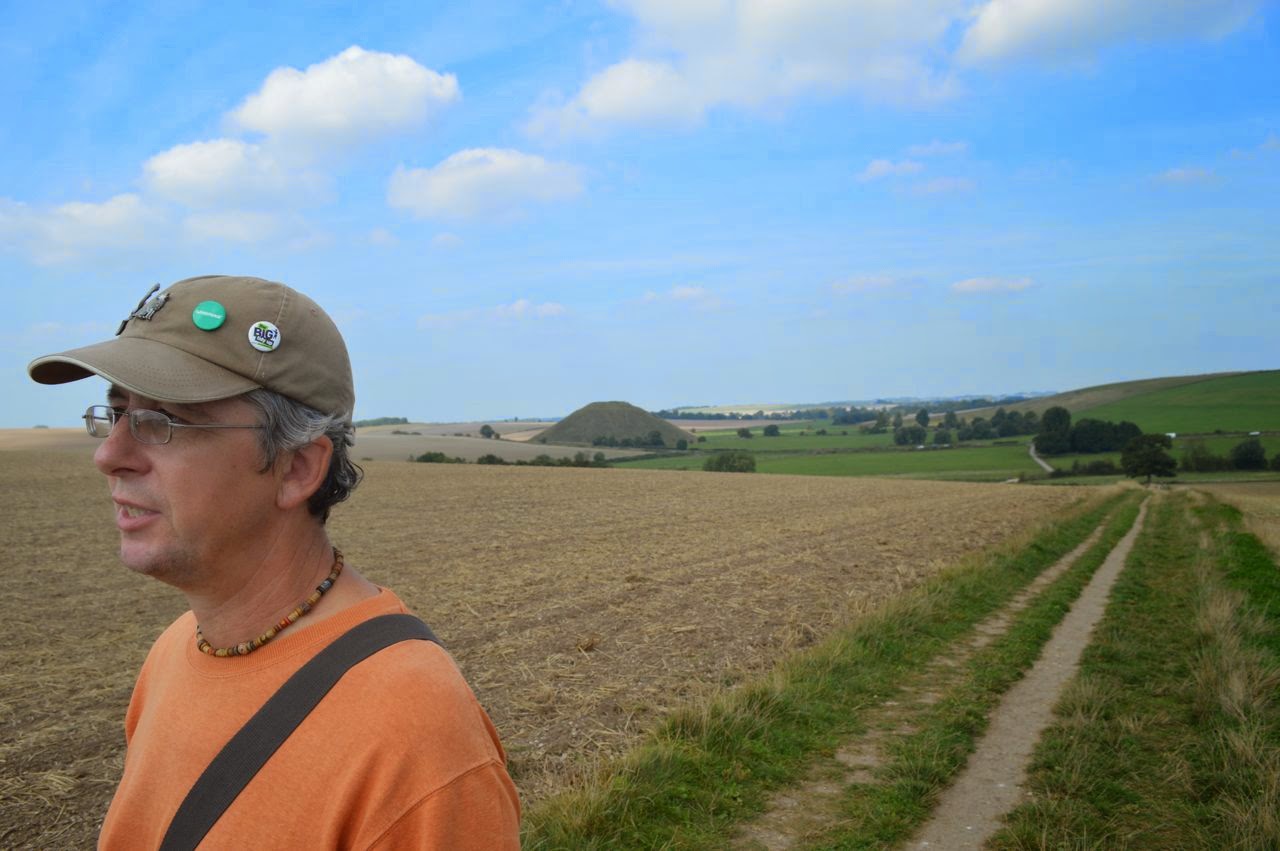
We then drove a little further and stopped close to Silbury Hill. This, I was informed, was a man-made structure and another one of the sacred sites in the area. A huge truncated cone, it is, apparently, a special place for dreaming. Sadly, I didn't have the time for an overnight stay to put that to the test.  


We walked up a gradual hill to the top where the West Kennet Barrow is located. A barrow is a burial chamber and I had seen many small round ones but this one was something else as it was long and narrow one which, happily, is open to the public. 


Again checking the acoustics of the stones, Peter built up a rhythm with his drum and then invited me to stand in front of the stone. He played the drum in front of and around me, I could feel the vibrations moving through my body. This built up over a few minutes and where I was at first rather self-conscious I relaxed into it. This is a tour which itself blends into action, I was no longer just the observer but also the observed and it was all the better for it.   


An elderly couple then entered and asked us to be quiet. Peter told me that this was the first time in the fifteen years that he had been coming here that he had been asked to stop drumming. It's a pity I didn't get a decent picture of how the couple looked, they had the countenance of those who like order. In fact I think they probably prefer order to the barrow: they sniffed around for a couple of minutes and then left. When we were leaving a little later we did some informal cleaning; there were a good few tea lights and the remains of rituals past. Seeing how popular Stonehenge is and also how flat the experience can be, I'm surprised that more people don't try this sort of tour. I daresay there is some marketing and communication issues which conspire to make things how they are, but with just a little effort there is a great deal more you can experience at these ancient sacred sites and the Stone Seeker Tour is a great way to do this which does not demand you be an initiate or anything, you simply have to turn up with an open mind, ready to see faces in stones.

Sunday, 7 September 2014

The Bath City Trail

I realised today that I have been walking over a tourist route these last few days that I hadn't even noticed. I'm probably in company with pretty most of the people in the city centre as The City Trail is anything but noticeable.


Upon emerging from the Tourist Information with some leaflets on further tours, such as The Tour of Britain coming to Bath very soon, I looked down and by chance spotted this plaque below.


Each of these brass plaques, sunk into the pavement, has a quote about Bath from a British writer or notable figure of the past. What they have to say is rarely interesting or important, all that matters is that Dr Samuel Johnson said something about Bath.


Unexpectedly then, I was off once more on a tour, excited to see where it would lead me. I somehow managed to miss plaque 2 and passed directly to 3. The arrow seemed to be pointing in the right direction. When I thought about it further, the work involved in laying out this trail is not simple at all and there is scope for error both in the design of the plaques and in their installation too.


The arrow gives you the direction of the next plaque but not the location. It could be 10 metres away it could be 10 kilometres, there is no way of telling. This made the game more interesting as it introduced an element of uncertainty that kept the eye busy. In practice the distances were never that great but they were certainly not uniform either.


The route was also designed to make it easy, as far as possible, by avoiding obstacles in the path from one point to another. It would have been possible to have made two points on either side of a building, so that you would either have to walk through the building or else walk around it, thus going off the line of the arrow in order to return to it. I would have rather liked it more if they would have done this as that would have brought the intervening structures and spaces more fully into the frame of the trail. 


Thinking about that further, such a trail cutting straight lines through space is somewhat reminiscent of the colonial divisions of newly acquired territories. When conquering powers had a duty of administering land over which they had little familiarity, the line was the abstract and arbitrary method of delineating one area from another. It is precisely this possibility of making a line that passes through someone's house and then turning that line into a meaningful border that displays both power and insensitivity. The line can be a potent thing. These lines, however, were not.


As I fell into a rhythm moving from plaque to plaque, I started to think of the work of the Boyle Family too. Some of their works present pavements as wall mounted artworks and I remember how these had the wonderful effect of reawakening the senses to the complex compositions under the feet. The least loved of the directions of looking, down is where these abstract social sculptures abound.  


As I was fully expecting, there were locations where the trail met unforeseen obstacles. The arrow pointed in the direction of this construction site and at the far end of it no plaque was to be found. With the pavement claimed and closed off, I had to assume the plaque was there but I could not be sure, which made it far more interesting.   


I found my way back on the trail again easily enough as it passed through the tourist attractions. I only had to pause and think, what is the most obvious place to walk to next, go there, search for the plaque and there it was.


The trail made me think of the trail of plaques put up by The Museum of London along the length of London Wall. I really should write that up as a tour sometime since I have taken it and it was a really worthwhile stroll. It was enjoyable partly because of its limitations and neglect: the Roman wall has been largely destroyed and exists only in fragments. The contemporary plaques have also fallen into neglect making it a trail of double neglect. Following such a tenuous route became a challenge.


This plaque struck me as a sad one. The designer must have run out of quotes to add so it remained blank with just a number and an arrow in its centre.


After a while the distances between the plaques enlarged and it became increasingly difficult to find them. What also happened is that my eye became more attuned to looking for them. I spotted, for instance, the plaque on the far side of this crossing.


I here realised that there was another quoteless plaque and that the previous ones had attempted to make the quotes relevant for the locations they were sited in. That must mean that there was nothing much to say about Queen Square, which was sad in itself too. Surely, even staying within the frame of the work, it would have been possible to find enough specific quotes for the locations that had them and keep enough generic Bath quotes to spread around the rest. But no, the trail became a simple game of directing the walker from point to point. To be honest I didn't miss the quotes that much as they added little and were written in a circle that makes you have to stand above them, twist your head, turn around and even stoop down to read more closely when there is an interior line of text with a smaller font size.   


Thank God for number 14, then. and a return of words! My impressively practical though less than beautiful shoes, by the way, are for a skyline walk tomorrow which I was instructed to come suitably attired for.


I found this plaque a curious one as it was quite different to the others. It was on the right direction, more or less, but it seemed to not belong to the series. It had no number in the middle and was embedded in a newer concrete slab which was itself framed by tarmac. I suspect that this may have been a later addition but I could not say for sure. If it were a newer addition it makes me ask, is the trail still maintained or was there a year when it ceased to be?


The trail seemed to fall apart all together at this point so I took a picture of a water cover instead, as it was in the area the plaque should have been. That's when it struck me just how invisible these plaques are. With a little bit of weathering they fade into invisibility and become a variant of the utilities cover.


By the time I got to 18 my will to pursue this City Trail was failing. I started to wonder if anyone had really bothered to come this far before, except for the people specifically invited when the trail was first set in place. I suspect there may be a handful, but this really is one of those public art projects that must have seemed like a good idea at the time but which is now near forgotten.


At the circus I felt sorry for the designer of this trail as he or she had an obvious problem to contend with: how to point with a straight line around a circular space? Their solution, pointing towards where this woman is coming from, was not a good one but then again this was always going to be a challenge. Following the arrow on its word would have led me into the building behind her so I instead interpreted it to mean, follow the circular path of the pavement.


This I did and I failed to find another trail plaque so settled for this gas cover. With that I concluded the City Trail.


Stepping back to Tourist Central I noticed this woman posing for the camera. Following up on an observation I made on the Pingyao Tour about there being a very interesting range of culturally specific poses that tourists pull when getting their picture taken, this was a new one for me. I cannot locate this body gesture at all. It looks very deliberate, like it might be part of a traditional dance or a pose common to statues, yet there is always the possibility that it's a more personal mannerism.  


The tables were soon turned and she was in the camera crew taking pictures of the monks. There's something funny about monks doing typical tourist things, you somehow imagine they would be above that. 


On a similar note, I saw this picture of Obama in Stonehenge this morning, he visited it after the NATO summit in Newport, which itself is also slightly mismatched. This opens up the question of appropriate and inappropriate costume for tourists which narrows down to casual and smart casual in the UK. Going round the Roman Baths dressed as a soldier, a nurse, a cleaner or a homeless person would not look at all right. A businessmen in a suit mixing work with leisure is somewhat acceptable but even that looks like it belongs more to the 1970s than to today. Practical solution: remove the tie and jacket.