Friday, 22 March 2024

The Completely Lost Tour: a three day walk to the heart of nowhere

The Completely Lost Tour was an elaborate form of a Way-Losing Tour that took place a few years ago but which I'm only getting round to writing up now. Rather than just spending an afternoon drifting from place to place, getting progressively more and more lost, the concept here was to spend three full days traveling blind. 


It began more or less like any other way-losing tour, the only real difference being it started not in a city centre but at Bicester, a semi-rural train station in Oxfordshire. From there we heading off on foot... somewhere. We walked down country lanes and around housing estates, over fields and alongside a canal. At some point we walked into Bicester Village a shopping mall trying to pretend to be a village. It seemed popular with Chinese visitors who have an appetite for a perfect past that never actually existed.


The canal turned out to be interesting as we somehow got talking to a boat owner who invited us onboard. We slowly chugged along and heard some wild conspiracy theories, nodding eagerly all the way. You meet some curious people when you open yourself up for it on events like this.


The real challenge came when it started to get dark. The village we had stumbled into didn't have a B&B and we had a rule of not using our phone to check maps or call for services. We did find a pub that was open and started talking to people. Through one of them introducing us to another, we got ourselves invited to spend a night in someone's home. They sometimes rented rooms out to people and we ended up paying a reasonable price for a large comfortable room in a period building. 


It strikes me now that when traveling in this way it becomes more important to talk to people as that is how you find food and shelter. This in turn, makes the landscape a far more populated one, rich with stories, opinions and ideas. That is how travel was conducted more, in the past, whereas we now use technology and money to make our way. It was a worthwhile experiment but if I were to repeat it I would probably try and do it somewhere warmer and dryer, perhaps in a country I know less well. I also wonder what would have been the outcome if I were very different to the people we met. I put on my best accent and presented myself as the nice gentleman and it worked. In other circumstances I would have to play it differently and I suspect some people would have a harder time working this crowd, but that's just speculation. The real proof only comes from trying it for yourself. So maybe I should set out to get completely lost in Vietnam or Bulgaria and see what happens.

The Taiwan's Indigenous People Tour


The Taiwanese Indigenous People's Tour is a guided tour that takes place in a part of the National Taiwan Museum, a grand neo-classical structure built by the Japanese when they were the colonial power in 1908.


There were in fact three guides all offering the same tour to a large group of visiting foreigners. I tried to figure out which would be the most interesting guide by looking at them closely. I finally picked the lady on the left.


The tour was focussed on the pre-history and anthropology of Taiwan. There were the usual types of artifacts you would expect to find on such a tour augmented with photographs of excavations and maps. The exhibits themselves were relatively sleepy, the bread and butter stuff of a middle of the road museum.


Where the tour started to get interesting was in the fault lines: the guide was ethnically Han Chinese and spoke English and Mandarin. Language is a complicated, not to say divisive issue in this context as there are indigenous oral languages and then the mix of Mandarin and Taiwanese, also known as Minnanhua. The relative status of these languages, that is to say who knows them, when, how and why they are used, starts to open up a number of points within the exhibition and society more widely.


It became clear through questioning her that there has been a politicisation of Taiwanese pre-history from the 1990s onwards. This is an ongoing process of cultural de-sinification that has prompted a deeper examination of Taiwan's indigenous culture. What is meant by the term indigenous people is those who lived in Taiwan long before the arrival of the Han Chinese. This is significant as it becomes a way to mark a cultural difference between Taiwan and mainland China. This process has, to an extent, politically divided the country with a difference of emphasis between the two political parties, the more China friendly KMT and more pro-independence DPP. 


Having seen, through the tour, how indigenous culture has been accorded a freshly important status, the next day I noticed stores selling what looked like Taiwanese ethnic craft objects. These designs have been re-purposed and shaped for modern living and now adorn notebooks, handbags, sports shoes and so on. Indigenous design therefore seems to play a role in identity politics and fashion in contemporary Taiwan.


There was one quite remarkable map which showed the full geographic reach of the indigenous culture that the exhibition depicted. The map shows connection with the indigenous cultures across the whole of Austronesian even going so far in the other direction as Madagascar. There is one place, however, that was strenuously avoided on the map: mainland China. The omission is significant and so too the blurring of the map at the top. There most probably is sound evidence to support this redrawing of the map but, ironically, the manner in which it is done also struck me as something that I am familiar with: to the outsider it all looks like a very Chinese form of presentation.

Kitsch is like gold dust: The Golden Tour of Shenzhen

The Golden Tour has got interesting and found its feet at long last. The first performances have been given in Shenzhen and it is loud and lurid to say the least.

As so often happens in China, what happens around the show is just as incredible, maybe even more crazy, than the show itself. This one was a real battle to pull off. The festival as a whole had a lukewarm welcome from the authorities, shopkeepers and security guards, in spite of the fact it was publicly funded. The child-friendly events happening in designated squares were fine but the dazzling, enigmatic golden tour was barely tolerated.  


The audio side of the show broadened out into a celebration of kitsch. More specifically, songs which were already kitsch and were then given a DJ remix which made them only more kitsch still. What's more, there were examples from different countries, including China like the song below. While the music is terrible, it is not so much worse than what you might hear at many tourist attractions here. It was therefore safe to play, even though the intent was satirical. In the context of this gentrified neighborhood, however, the sound of vulgar Chinese music was particularly grating as it reminds people too much of the grannies who dance to it in public squares up and down the country.  


The text is where this one pushed the limits. Delivered with a broad smile, it consisted of introductions and commentary to various parts of this newly-built ancient town. The area is contradictory: it is presented as an historic walled town in the ultra modern city of Shenzhen. What's more, it was until recently a run down neighborhood for migrant workers where what little history that was left, was neglected and tumbledown. Since property developers moved in, it has been restored, augmented and turned into a model community. The neighborhood has a political significance too. It is claimed as the oldest settlement in the area and therefore the root of all culture not only in Shenzhen but the root of Hong Kong and Macau too. There are a lot of texts online that push this politicized archeological line. These were one part of the mix I auto-translated, turned into a speech file, then repeated the audio of from a set of headphones.  


So too were there out of date descriptions from official newspapers that flatly contradicted some of the contemporary narrative as well as plain marketing speak from the property developer which moved it into corporate branding, art speak and nationalism. Throw this all together and give it a kitsch veneer and you have The Golden Tour. I'm lucky I got away with it, to be honest! I delivered it in broken Chinese the first day and that was a harsh show but when done in English, with a child friendly smile, using official information only, it was just about OK.


I ended up being shadowed by security guards itching to stop it, having to do it with minimal amplification, off the main locations and constantly moving. Part of the problem with the neighborhood is that it has been accorded this political and commercial significance and that makes it far less amenable to public art events. The shop owners want the public that an art event brings in, but they don't want the actual art. The type of art that is suitable for this type of place becomes more and more narrow and official in style too. I saw the same thing happen in Shanghai's Xintiandi which has become a rather arid site of red tourism and shoppingNext, I will have to make The Golden Tour somewhere a bit easier to work in. It may be time to bring the formula to Europe, for example. After all, the soundtrack had plenty of Eurokitsch like this:


Friday, 3 November 2023

The Golden Tour - an odd sort of alchemy

T


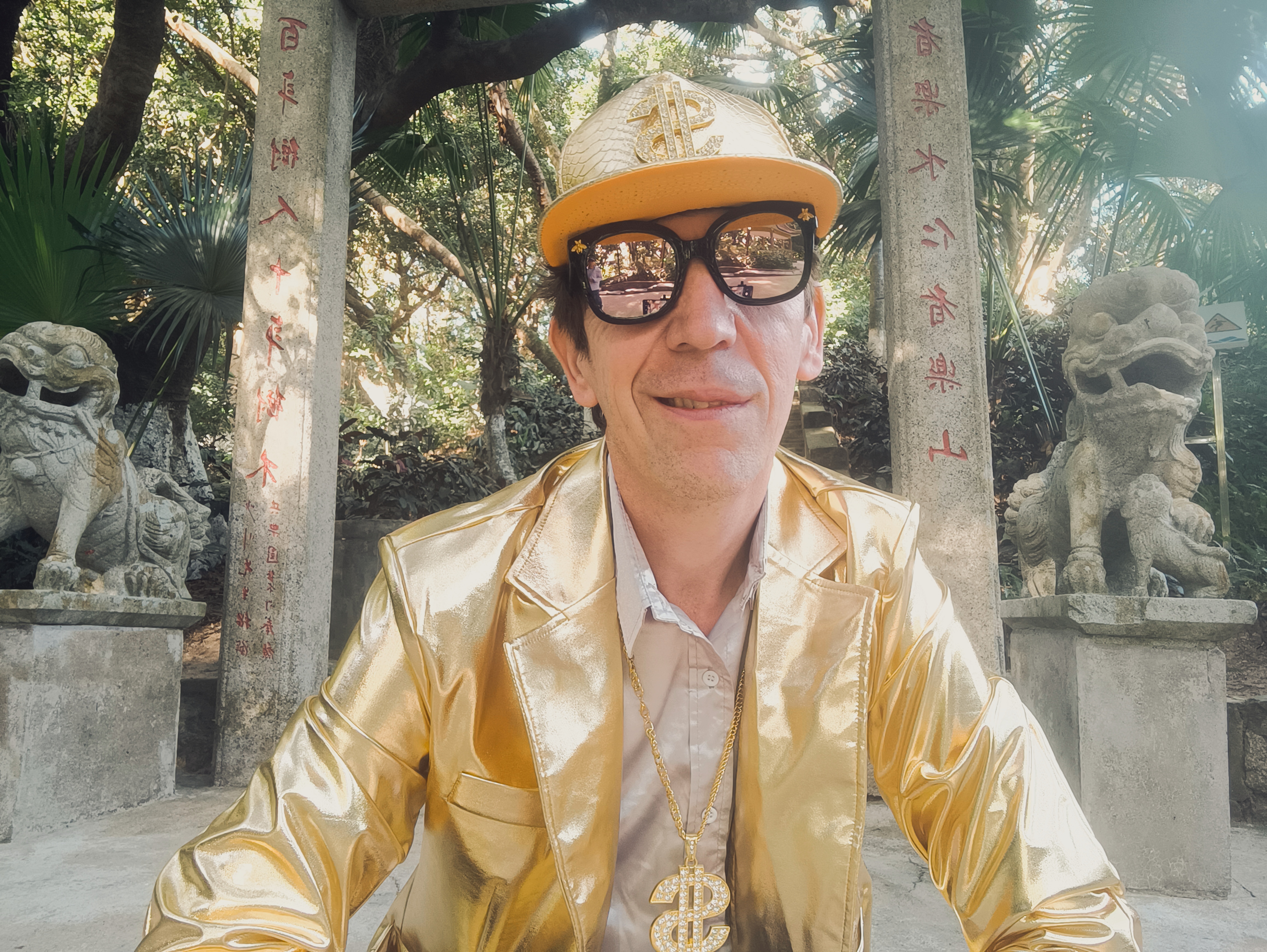
The clothes have arrived so I'm playing around with costume and sound. This is usually more of an afterthought but with this tour I want to embrace style above content so this comes first. It's clearly a dumb look. This offers me some cover and is entertaining too. Next is sound and the dumbest obvious sound I found so far is this:


Along the way a quite decent image also popped up by accident. I might just have to use this sun reflection in the mirrored shades effect somehow. It's rather good.


In all of this madness I did also manage to make a site visit and work out the locations where I will stop. It will be of a hit and run guerrilla style tour. Loud and tasteless and gone before anyone has time to stop it. In many ways it's a collection of many of the things I hate, but when you string them together in a deliberate way it becomes something else. You could almost call that a form of alchemy - the ancient art of turning base materials into gold. Let's see if there's still magic to be found in Nantou Ancient Town.